
Seoul
Seoul (서울) is the capital of South Korea. With a population of over 9 million (with over 20 million in the wider metropolitan area), Seoul is by far South Korea's largest city and one of East Asia's financial and cultural centers. A fascinating blend of ancient traditions and cutting-edge digital technology, home to endless street food vendors and vast nightlife districts, an extraordinarily high-pressure educational system and serene Buddhist temples, a dynamic trend-setting youth culture and often crushing conformism, extraordinary architecture and endless monotonous rows of grey apartment buildings, Seoul is a city filled with stark contrasts, contradictions, and paradoxes. People in Seoul can enjoy various artistic activities such as plays, musicals, and concerts.
Most read about in August, least in February. That is when people look it up, which tends to run a month or two ahead of when they go.
Before you book
The Foreign, Commonwealth & Development Office publishes the UK’s official travel advice for South Korea. It changes without notice and travelling against it usually invalidates your insurance, so read it at the source rather than anywhere else — including here.
FCDO travel adviceUnderstand

With over 10 million people, a figure that doubles if you include neighboring cities and suburbs, Seoul is the largest city in South Korea and unquestionably the economic, political and cultural hub of the nation. By some measures it is the second largest urban agglomeration on the planet, after Greater Tokyo. Seoul is a favourite with tourists from China, Japan, Southeast Asia, and, increasingly, the West, encouraged by the success of Korean pop culture. Aside from the native Korean, travelers will frequently overhear Japanese, Cantonese or Mandarin as well; many restaurants and stores, especially in the more touristy areas like Myeongdong, will have signs in Japanese and Chinese, as well as Korean and English. The traveler who visits Seoul will not be disappointed. This sprawling metropolis is truly vast – though the casual traveler can see most of the main sites in a few days, a dedicated traveler could spend months exploring all the alleyways and far-off neighborhoods. As the capital of a country that has gone through massive development in the past sixty years, Seoul is constantly changing at an incredible pace, matched only by the mainland Chinese cities. This frantic pace of life is reflected everywhere – in Seoul's cutting-edge digital technology, in the millions of commuters rushing to work everyday in the world's third largest subway system, in one of the most vibrant nightlife scenes in the world, and in the thousands of high rises and apartment buildings still under construction.
History
Considering all of this, one may be forgiven for forgetting that Seoul has a long history stretching far back into Korea's dynastic past. There is evidence for settlement in this area as far back as 18 BCE, but Seoul as the capital city of South Korea has a history dating back to the 14th century. Originally named Hanseong (한성; 漢城), the city was the capital of the Joseon Dynasty from 1392 to 1910. The Joseon Dynasty built most of Seoul's most recognisable landmarks, including the Five Grand Palaces and Namdaemun. After the Japanese surrender in 1945, the city was renamed to its current name, Seoul. Since the establishment of the Republic of Korea in 1948, Seoul has been the capital of South Korea. Occupied twice during the Korean War by Communist forces from the North, the city was extensively rebuilt and today is one of Asia's primary metropolises. Much of Seoul's infrastructure and facilities, such as the buildings, stadiums and transport systems, are exceptionally modern and clean.
Orientation
Seoul is a relatively well organized city covering over 600 square kilometres (230 sq mi) with a population of around 10.5 million. It is a new modern city built on an ancient and shining history. The city is in the north-western portion of South Korea approximately 40 km (25 mi) east of the Yellow Sea (황해 "Hwanghae") and 60 kilometers south of the Korean Demilitarized Zone (DMZ). The city is roughly bisected by the Han River (한강 Hangang), which runs east to west across the city. Seoul blurs seamlessly into its surrounding satellite cities and towns, most of which are also served by the Seoul metro. The largest of these is Incheon (to the west), the home of the metropolitan area's main airport and seaport. Other satellite cities include such as Ilsan (to the north), Bucheon (to the west) and Anyang (to the south).
What's inside
Administratively, Seoul is divided into 25 districts (구 gu), each with an area and population comparable to a small city. The districts are then further subdivided into 522 sub-districts (동 dong). The Han river splits the city into two halves: Gangbuk (강북), the northern, more historical half, and Gangnam (강남), the southern, wealthier and more modern half. The sheer size of the city means that travelers to Seoul will find it difficult to locate a true "center" of Seoul; instead, Seoul is almost more like a collection of cities that happen to be bunched together, each with their own central business and commercial districts. The two largest core areas are Jongno/Jung in the north, and Gangnam in the south. For travelers with more time, there are many more, smaller centers and districts to be explored, such as the island of Yeoui-do and the college district of Hongdae/Sinchon. For the typical traveler, it would be useful to divide the city into the following areas:
Getting there
By plane
Seoul (SEL IATA for all airports) is served by two airports; Incheon International Airport serves most international flights, while Gimpo Airport mostly serves as Seoul's domestic airport, plus a smattering of international routes to China, Japan and Taiwan.
Incheon Airport
Most visitors arrive via 1 Incheon International Airport (ICN IATA) on Yeongjong Island in the neighboring city of Incheon. The A'REX train connects the airport to Seoul Station (for further connections to KTX high-speed services) and Gimpo Airport (most domestic flights), operating from 05:20 until 00:00. Two versions exist: express services to the city (every 40 minutes) take 43 minutes and cost ₩9,000 (with WiFi available on board); while all-stops services (every 6 minutes) take 53 minutes and cost ₩4,750. The express train and the regular train leave from different platforms and have different ticket booths. The express train requires reservations, accepts credit cards and can be purchased in advance, while the all-stops service is a regular unreserved train and payments are cash/T-money only. If you have a lot of luggage or are heading to southern parts of Seoul (e.g. Gangnam), the airport buses remain your best option. A taxi direct to Seoul will cost around ₩50,000/70,000 regular/deluxe.
Gimpo Airport
2 Gimpo Airport (김포국제공항, GMP IATA). Closer but older. Caters only to the shuttle services to Taipei-Songshan, Tokyo-Haneda Airport, Osaka-Kansai, Beijing Capital International Airport and Shanghai-Hongqiao, as well as domestic flights within South Korea, mostly to Jeju. Gimpo Airport is easily reached on the A'REX link from Seoul Station or Incheon Airport, as well as subway lines 5 and 9. All lines intersect Line 2 which runs in a large circle through Seoul. Line 9 (Gold Line), the first privately run subway line in Seoul, has express trains as well. Travelers coming into Seoul should first have detailed directions to their destination from the nearest station then consult the subway map before deciding on which line and route to take. All three lines cost ₩1,000-2,100 (depending on distance), while a taxi to central Seoul will run around ₩30,000. Discounts for subway fare are available with T-Money cards.
Getting around

Traffic jams are common in Seoul, but buses usually have their own lanes so they don't get stuck in traffic. The subway is a good choice too. Street and subway signage is usually written in English as well as Korean. Until 2011, Seoul (and South Korea as a whole) used an address system that was similar to that of Japan, where the streets did not have names and houses were numbered according to the position in the lot. This very confusing address system made it harder for tourists to navigate Seoul, and the government has introduced a Road Name Address System, which uses street names and the method of "odd house numbers on one side, even house numbers on the other side". The confusing old address system was discontinued in 2013, and nowadays, Seoul is easy to get around without extra help. The 'Climate Card' (Gihoo Donghaeng Card) offers unlimited rides on subways and buses within Seoul for a fixed monthly fee.
By subway
In Seoul, you can visit most places by using the vast subway network. There are nine numbered lines plus a smattering of named suburban lines, all distinguished by different colors. All signs in the subway system are in Korean (both hangeul and if applicable, hanja) and English, as well as Japanese and Mandarin in some stations. The signs leading to the platform for a particular direction of travel on a given subway line typically list the names of a number of stations in that direction. Stations each have a 3 digit number, but locals rarely make use of these numbers, and they're not on most subway maps, so don't rely on them. An English subway map can be found here. Subway fares are based on the distance traveled, but the shortest ride costs ₩1,250 (base charge) plus a deposit of ₩500 for single-ride cards (refundable if you return the card at designated machines at each station). The base charge roughly covers up to 10 km (6.2 mi) of the journey and ₩100 is added for every 5 km (3.1 mi) beyond that. Cards can be purchased from vending machines only. All vending machines accept coins and bills, up to ₩10,000 notes (and some ₩50,000 notes, but cash exchange machines are at each station). Hang onto your card until the end of your trip, as you'll need it to get out. Most of Seoul's automated card machines are equipped with touchscreen and full English support (along with Chinese and Japanese). Note that the subway does not operate late at night but there are night bus services on major trunk routes.
T-money card
If planning on using the Metro extensively or staying for more than a couple of days, you should consider purchasing a T-money stored value contactless smart card. You can buy this card from staffed desks at most subway stations, very few vending machines (cash only), many newspaper kiosks near subway entrances, and convenience stores with the T-money logo. The most basic card costs ₩5,000 as of 2025, and cash can be added to the card as often as you like (which has to be done separately after purchasing one, it does not come with stored value). Top-ups are only possible using cash, most conveniently at machines at every station entrance, which do have English as a language option. When entering and leaving a subway turnstile, place the card on the reader (leaving it inside your purse or wallet is fine), and it will deduct the appropriate fare from the card. Using this card will allow you to save ₩100 on all transfers (these are common with Seoul's extensive subway system), and you can get all but ₩500 back if you have unused credit. Any value on the T-money card never expires. Credit refund up to ₩20,000 can be received in most convenience stores. Above ₩20,000 you can still get a refund, but the procedure is more complicated, so it's wise to keep your credit below that figure. Typically for most travellers staying less than a week in Seoul, purchasing this card may not be cheaper, but other factors should be considered: it can also be used for taxi fares, buses, storage lockers, pay phones, etc. The T-money card is far more convenient than buying per trip ticket. Using a transportation card is highly recommended if you wish to use it on both subways and buses, simply for its ability to transfer for free since you will not have to pay for the base fare twice for a single journey when using two modes of transport. Be aware that any issues (e.g. insufficient balance) are not displayed in English at the turnstiles. Only the error code is shown in Latin letters. The different error codes are listed at the metro website. Here are some things to know when riding the subway.
See

Individual listings can be found in Seoul's district articles
Seoul is a vast, vibrant cityscape, set against an airy backdrop of mountains. It includes a standout collection of attractions with a blend of old and new. While Seoul today is mostly known as a super-modern mega-city that is home to skyscrapers, malls, and millions of electronic-mad Koreans, the city contains over 2,000 years of history. The city contains 4 UNESCO sites marking important monuments from its 505 years as the capital of the Joseon Dynasty. Originally a walled city with 20 ft (6.1 m) stone walls and narrow lanes inside. Though many buildings were destroyed or damaged during the violent events of the first half of the 20th century, much of its historic core remains. So, anyone staying in Seoul should visit the many historical treasures the city has to offer, including the many palaces and city gates within the Jongno district.
Palaces, shrines, and walls of Joseon Dynasty and other traditional sites
Seoul has been a capital of Korea since the Joseon Dynasty. Starting from the Gyeongbokgung, many palaces were built for kings and royal family. The most important of them are called Five Grand Palaces (5대궁). Gyeongbokgung Palace is the grandest and most important palace, and is also the site of the Joseon Palace Museum and Korean Folk Museum. The main gate of the palace, Gwanghwamun, and its plaza are the center of Seoul. Changdeokgung, a UNESCO World Heritage Site, was the most favored residential palace of the Joseon Royal Family. It also has the beautiful garden named Secret Garden (Also was called 'Forbidden Garden'). Changgyeonggung and Gyeonghuigung are less famous due to extensive damage sustained after the fall of the Joseon Dynasty; Changgyeonggung was once a zoo, and Gyeonghuigung was once a high school. Finally, Deoksugung was used during the last years of the monarchy. It has a harmony of both traditional and western building design. All of these palaces have a thicker, more informative pamphlet for ₩500, which is worth the cost.
Do
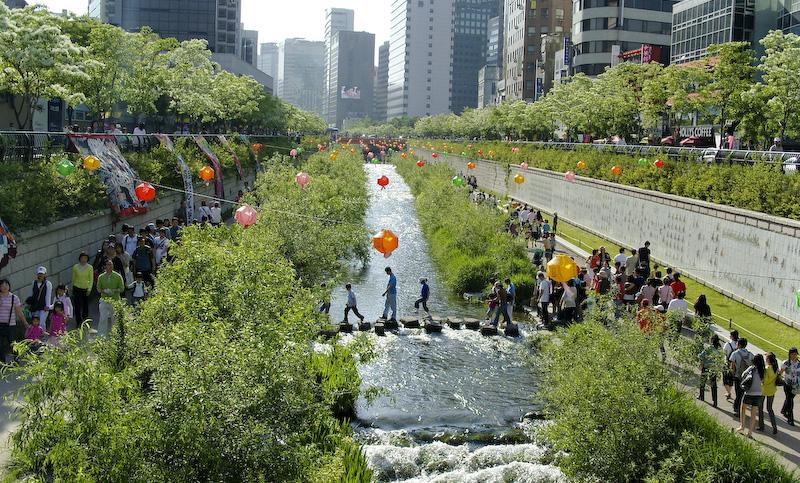
Individual listings can be found in Seoul's district articles Enjoy hiking in the mountains around the city. Up to 800m (3,000 ft) is accessible by public transport, with courses ranging from easy to difficult. There are Bukhansan Mountain, Gwanaksan Mountain, Samseongsan Mountain, Inwangsan Mountain, etc. (Mostly [Seoul/North]). If you don't like mountains, walk along Cheonggyecheon Stream. Watch baseball, a national sport, at Gocheok Sky Dome in Guro-gu, the home of the Kiwoom Heroes, or Jamsil Baseball Stadium in Songpa-gu, the home of the LG Twins and Doosan Bears. Watch local soccer teams (FC Seoul based at Mapo-gu World Cup Stadium and Seoul E-Land FC based at Songpa-gu Olympic Main Stadium). In South Korea, indoor sports are practiced until dawn. Golf and baseball on indoor screens, beer and bowling under upbeat music and lights. Order jjajangmyeon and tangsuyuk for delivery and play pool.
Nerd activities in Seoul
Shopping

Individual listings can be found in Seoul's district articles
Malls
Seoul features some of the largest malls in Asia, including COEX Mall and Lotte World Mall, both east of Gangnam. They all offer a wide range of Korean and international brands with a focus on a more upscale selection. During weekends, they tend to get very crowded. Additionally, there are several very large department stores scattered throughout the city which provide a comparatively large selection on up to 12 floors.
Fashion
Fashion shopping in Seoul isn't a mere industry, it's an art form. Trends often begin in University areas like Hongdae. Hongik University boasts Korea's most famous art school, thus fashion in this area is often influenced by the students' artistic sensibilities. The shops in this area feature funky, punky, boho, and vintage style. Ewha Women's University also has a big shopping area in front of its main gate, as do many of the Women's colleges. Many trends also originate here. There are even seamstresses who can help you make your own designs come to life. Seongsu also is rapidly becoming the center of fashion in Seoul. It was once an industrial complex, but now it's home to new fashions such as hip-hop, reggae, vintage, and gukdu, as the abandoned factories have been redecorated by young people. Nearby is Ttukseom Hangang Park, where you can enjoy Korea's famous fried chicken and beer.
Eat
Individual listings can be found in Seoul's district articles
Much of Korean social life revolves around food and the city is packed with restaurants, so you would have to be determined to starve to death in Seoul. This fate may still befall you if you insist on English menus and meals consisting only of easily identifiable, familiar ingredients, so see South Korea#Eat for a quick Korean menu reader. An alternative is to just point and eat, your hosts generally will accommodate. If you look in the right places, a good meal (lunch or dinner) including side dishes can cost ₩5,000 or less (try basements of large department stores).
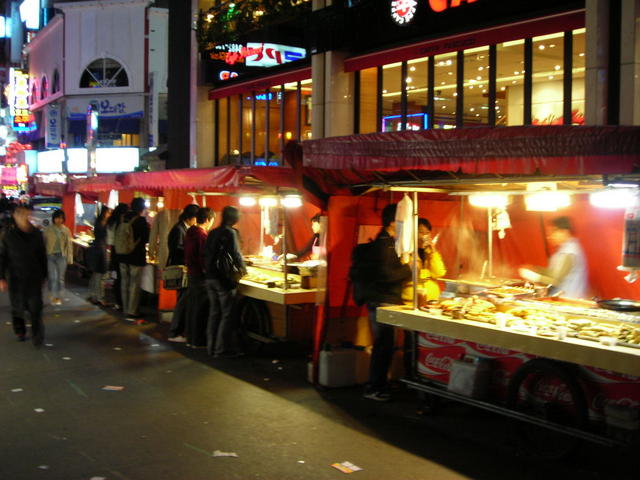
In addition to Korean food, Japanese restaurants in Seoul tend to be excellent, featuring excellent sushi and sashimi. Chinese restaurants exist, but are typically adapted to suit local preferences. There are a few Italian restaurants; these are generally excellent, with chefs trained in Italy, although flavors tend to be more or less Koreanized, with sugar in the garlic bread and meatballs. Bakeries are found throughout, including some of the common big chains. Seoul has plenty of budget places to eat. Everything from convenience store junk food and noodles to street stall food and lots of 24 hr Korean fast food restaurants. The 24-hour restaurants are great because they've usually got a wide variety of foods, including: mandu, odeng, ddeokbokki, naengmyeon, udong and ramyeon. Prices do vary from about ₩2,000-9,000 at these restaurants. Also open late into the night are Korean BBQ restaurants, which are everywhere in Seoul. These can be very cheap and are usually of good quality. Barbecue options usually are limited to pork and beef, and they often come with a smattering of side dishes. Korean BBQ is, in itself, an experience that makes you feel like a Seoulite. The larger department stores in the city have basement food courts that offer excellent food (not recommended if you care about atmosphere). Don't be surprised if you find yourself with 5 plates even though you only ordered one, most main dishes are served banchan, side dishes such as kimchi, fermented vegetables with spices, and soup to rinse your palate before and/or after eating. While this is great, this could also be the reason why some restaurants doesn't accept solo dining, especially in Korean BBQ, since the portions might be too much for a single person; always make sure to ask if it's ok to eat alone by telling them “han myung” – a table for one person. Public trash bins around Seoul are rare. If you're eating street food, you can hand back leftover trash, like skewers, to the food vendors or throw it away in their trash bags. Some leave a box for trash in front of their stand. Other places to find trash bins are restrooms and convenience stores.
Drink
Individual listings can be found in Seoul's district articles Seoul features a mind-bogglingly large array of nightspots catering to every taste and budget. Hongdae and Sinchon in Seodaemun-Mapo are Seoul's most active nightlife districts. Itaewon in Yongsan is Seoul's international district, with a wide variety of Western-styled venues to eat and drink. Since many foreigners congregate there, Itaewon remains somewhat of a niche nightlife area for Koreans interested in a more international scene. Itaewon is also home to the highest concentration of gay bars in Seoul, in an alleyway known as "Homo Hill". Much nightlife in Seoul revolves around soju. Soju is a traditional Korean spirit that comes in many varieties, including original and many kinds of fruit-flavored soju.
Sleep
Individual listings can be found in Seoul's district articles Seoul has two unofficial backpacker districts, Jongno (Anguk/Sinseol-dong) to the northeast of the city and Hongdae-Sinchon out to the west. Within walking distance to Dongdaemun Market, Jongno is better located for sightseeing and can be reached directly from Incheon Airport on limousine buses or city bus 6002 to Sinseol-dong stop (₩9,000, 90 min). There are many budget accommodation places across Seoul. Hongdae, Itaewon, Myeongdong and Jongno (Hanok area) are traditional hot spots for Foreign Individual Travelers (FIT). Furthermore, Gangnam is emerging thanks to the huge success of the eponymous song. Hongdae, Sinchon area is in university area. Yonsei Univ., Ehwa woman's Univ., Hongik Univ. and Sogang Univ. are around this area. so there are many restaurants, bar, club and shopping center and easy to be reached from Incheon Airport by limousine bus and Arex (Airport express train) in 1 hour. Gangnam has a wide range of luxury with the Imperial Palace Hotel, the Park Hyatt Seoul and the Ritz-Carlton Seoul. Most points of interest are along subway lines 1, 2, 3, and 4. So it's best to reside somewhere near a station on one or two of those lines.
Stay safe

Seoul is a remarkably safe city despite its size, comparable in safety to Hong Kong or Tokyo. Pickpocketing is not very common and violent crime is very rare. There are very few places where CCTV cameras are absent. Smoking is allowed only in designated areas. Walking while smoking can incur a fine. If you happen to be a non-Korean man walking hand-in-hand with a Korean woman, drunk older Korean men might give you a tongue lashing or occasionally worse. This is far less of a problem than it used to be. If you do end up in a fight and the attacker gets hurt, the fact that you didn't start the fight may not give you legal protection. Do not try to use drones to take pictures in Seoul, because most of the city (especially north of Han river) is a restricted flight area. Unfortunately, crimes by American soldiers against Koreans do happen, and when they do they often receive a huge amount of national attention. If you are a Westerner then you should exercise some extra care when such a case hits the media, although it is still highly unlikely you would be in any danger.
Protesting: Large-scale demonstrations against the government happen from time to time. Often they can result in violence where there are pitched battles between protesters and combat police. People do get seriously hurt, so try to avoid getting too close to the action. Fake monks have been known to operate in Seoul, notably around the Jogyesa temple. They are dressed as Buddhist monks requesting donations from people on the street in return for blessings, although they do not actually belong to any Buddhist order and just keep the cash for themselves. Actual monks would never seek donations at all. If you want to donate money, put it into the donation box in temples. Scams: Be wary of Korean people randomly coming to teach you about Korean culture and inviting you to try a Korean tradition in their studio. They tend to be very friendly to foreigners, offer to try a traditional Korean outfit and see a real-life Korean ceremony and then ask for money during or after it is done.
Go next
The Korean Demilitarized Zone — the 'last frontier of the cold war', and is very close to Seoul. This includes the famous peace village of Panmunjeom where negotiations have taken place for the past 50 years. Many tour companies offer DMZ tours which is a day trip from Seoul, the highlight of which is a village lying in the Demilitarized Zone between North and South Korea. You cannot visit without booking with a tour company, and that some nationalities are not allowed to visit for security reasons while others (including South Koreans and Chinese) require additional procedures. Many of these attractions are closed as of 2024, due to rising tensions. Check with tour providers which sites can still be visited. Gwacheon — connected by short metro ride, it is home to many attractions such as Seoul Grand Park, Seoul Zoo, MMCA Gwacheon, and Gwacheon National Science Museum. Yeongjong Island — Beaches, hot springs and fresh sea breezes. Yongin — south of Seoul, home to Everland, Korea's most popular theme park as well as the Korean Folk Village, where traditional Korean arts are regularly performed in a living museum of the Joseon Dynasty, as well as Yongin Daejanggeum Park, an outdoor set built by Korean television broadcaster MBC for the filming of period dramas. Incheon — The place where U.S. Gen. Douglas MacArthur landed in the Korean War; it also has the biggest and oldest Chinatown in Korea. Gapyeong — a popular weekend getaway, east of Seoul. A small town in the mountains of Gyeonggi-do, on the border of Gangwon-do. Chuncheon — Filmed in many Korean dramas and movies and now accessible by subway from Seoul Suwon — 30 km south of Seoul, the home of Hwaseong Fortress (화성), a UNESCO world heritage site. Subway line 1 can take you there in about one hour. Good for a half-day trip from Seoul. Busan — take a KTX or SRT high speed train down to Busan to enjoy the beach in summer. Makes a nice change of pace from Seoul.
More pictures of Seoul


From this destination's category on Wikimedia Commons. Each photograph is credited to its own author under its own licence.
The guide text on this page is from the Wikivoyage article Seoul, written by Wikivoyage contributors and published under CC BY-SA 4.0. The authors are listed in the article’s edit history. It has been shortened and re-laid-out for this page; that adapted text is available under the same licence. Nothing else on this page is.
Wikivoyage is written by travellers, not by us. Opening hours, prices and whether a place still exists are exactly the details that go out of date, so check anything you are relying on.
“2,632 readers a month” and the ranking are ours, counted from Wikimedia’s published pageviews (CC0) — the median of twelve complete months. They count people reading about a place, which is not the same as people going there.