
Shanghai
Shanghai (上海; Zånhae in Shanghainese, Shànghǎi in Mandarin) is the most developed city in China, the country's main center for finance and fashion, and one of the world's most populous and important cities. Shanghai is a fascinating mix of East and West. It has historic shikumen (石库门) houses that blend the styles of Chinese houses with European design flair, and it has one of the richest collections of Art Deco buildings in the world. There were concessions (designated districts) controlled by Western powers in the late 19th and early 20th century, so many neighbourhoods have buildings in various Western styles.
Shanghai is split in two by the Huangpu River (黄浦江 Huángpǔ Jiāng), which divides the city into Puxi (浦西 Pǔxī), west of the river, and Pudong (浦东 Pǔdōng), east of the river. Both terms can be used in a general sense for everything on their side of the river, including various suburbs. However, they are more often used in a much narrower sense where Puxi is the older (since the 19th century) city center (#Downtown below) and Pudong the mass of new (since 1990) high-rise development right across the river from there (#Pudong below). This is an overview article for the entire municipality. For the central districts which have most of the tourist attractions, hotels, restaurants and nightspots, see #Downtown and #Pudong below.
Most read about in June, least in May. That is when people look it up, which tends to run a month or two ahead of when they go.
Before you book
The Foreign, Commonwealth & Development Office publishes the UK’s official travel advice for People's Republic of China. It changes without notice and travelling against it usually invalidates your insurance, so read it at the source rather than anywhere else — including here.
FCDO travel adviceUnderstand

Shanghai is one of four cities in China that are administered as municipalities (市), meaning that it is not part of any province, and its government instead reports directly to the central government in Beijing. There are several ways to rate the size of cities; based on UN numbers, Shanghai is the fifth-largest city in the world after Jakarta, Dhaka, Tokyo and Delhi. By any measure, it is in the top ten for the world and either the largest in China or second to Chongqing. The municipality covers quite a large area — 6341 km2 or 2,448 square miles — and has a population over 25 million, about the same as Australia. Its GDP is larger than that of many countries, and it has the world's busiest container port. Shanghai is the main hub of the East China region, all of which is densely populated, heavily industrialized, prosperous, well supplied with migrant workers from poorer parts of China, and still growing. History has shaped Shanghai's cityscape significantly. British-style buildings can still be seen on the Bund, while French-style buildings are still to be found in the former French Concession. What was once a horse racing track on the edge the British area is now People's Park, with a major metro interchange underneath. Other metro stops include the railway station at the edge of what was once the American area, and Lao Xi Men and Xiao Nan Men, Old West Gate and Small South Gate respectively, named for two of the gates of the old Chinese walled city. Shanghai is a cosmopolitan city by Chinese standards, although it is less diverse than many western cities. The population was 23 million as of the 2010 census; 9 million (almost 40%) of those were migrants, people from elsewhere in China who have come to find work or to attend one of Shanghai's many educational institutions. There is also a substantial international contingent: 208,300 foreigners lived in Shanghai as of 2010, slightly over a third of the national total of 594,000. There are services catering to these migrants — restaurants with food from anywhere in China for the migrants (in particular, much good cheap Sichuan food and West-of-China noodles) and a variety of grocery stores, restaurants and bars that cater to the foreigners. Groups of refugees from other parts of the world have sometimes arrived in Shanghai. One group were White Russians fleeing the 1917 revolution; in the 1920s the French Concession had more Russians than French (and of course more Chinese than both of those together). Another group were Jews leaving Germany in the 1930s; they mainly settled in Hongkou, a district that already had many Jews. After Japan took over Korea in 1910 and Manchuria in 1931, Shanghai received refugees from both regions. There is an Encyclopedia of Shanghai, in English, that is available both as a book in local bookstores and online at the municipal government site. Much of it is rather boring — statistics, photos of the officials in charge of each development project, and project descriptions that give much financial and engineering detail — but there is also some quite useful material. For example, it has detailed descriptions of every museum and park in the city. Suzhou Creek (Wusong River, 苏州溪) is more a small river than a creek, a tributary which flows into the Huangpu at the north end of the Bund. It starts near Suzhou and is the outlet for Lake Tai. Within Shanghai parts of it form the boundary between Huangpu and Jing'an districts to the south and Hongkou and Zhabei to the north. Beisuzhou Road and Nansuzhou Road run along the riverbanks downtown; bei and nan are Chinese for north and south respectively.
Economy
Shanghai is strategically positioned: near the geographic center of China, at the mouth of the great Yangtze River and surrounded by fertile delta land. It has been a trading city for a thousand years and one of China's main centers of trade since the 1840s; today it is a major transport hub. It has the world's busiest container port and additional port facilities are under development. Shanghai's Pudong Airport is a global air hub and ranks third on a list of China's busiest airports, behind Beijing and Guangzhou. Shanghai's other airport, Hongqiao, ranks fourth. The city is also very well connected by both road and rail. Shanghai is also one of the main industrial centers of China, and the municipal government has set up a number of industrial zones to encourage additional development. GDP was $670 billion in 2023, less than the US or China, about the same as Japan, Germany or California, and more than any other country. According to a saying, "Shanghai is heaven for the rich, hell for the poor." People from all over China flock to Shanghai — everyone from farmers seeking jobs in manual labour to university graduates seeking to start a career or wanting to live in a cool up-tempo city. About 40% of the population, 9 million out of 23, are migrants from other parts of China. Real estate prices, especially in central areas, have skyrocketed in the past few years; rents are among the highest in the world and even well-off people complain that buying a home is becoming impossible. The surrounding East China region is populous, prosperous, highly developed, and still growing. Shanghai plays an important role as the center of that region.
History
While the area has been inhabited since prehistoric times and there has been a town at least since the Song Dynasty, a thousand years or so ago, Shanghai only rose to prominence after China lost the First Opium War in 1842. Shanghai was one of the five cities which China was forced to open to Western trade as treaty ports. Shanghai grew amazingly after that; until then nearby cities like Hangzhou, Suzhou and Nanjing had been far more important, but since the late 19th century Shanghai has been the center of the region. By the early 20th century, Shanghai was the largest and most prosperous city in the Far East, and one of the wildest. With the opening up of China since the late 1970s, Shanghai has regained much of its former glory and has surpassed it in many ways; the pace of development being absolutely furious. Today, Shanghai is again one of the largest and most prosperous cities in Asia, though not nearly as wild as it once was. It is now a very attractive city for travellers from all over the world, and a major destination for both tourism and business.
What's inside
Shanghai Municipality has 16 administrative districts, each with at least a few hundred thousand people, and Wikivoyage has separate articles for most of them. Here we try to split them up in a way that will make sense for travellers.
Downtown
The historic core of Shanghai, it includes both the old Chinese city and the area of the International Settlement which began in the 1840s and lasted until the 1930s. It can be called Puxi (浦西), downtown Shanghai (上海市区) or the city center (市中心). Today this area is still the core of the city. Most of the tourist attractions and many hotels are here, and many metro lines run through it. The four downtown districts are:
Of course "downtown" is not precisely defined; the four districts we have above are clearly the most central, but some definitions would include others which we list under inner suburbs below, and some would include parts of the Pudong New Area, perhaps everything within the outer ring road.
Getting there

Shanghai is one of China's main travel hubs and arriving from pretty much anywhere is easy.
Visa-free transit
Visitors from 54 countries who are transiting through Shanghai are permitted to visit without a visa for up to 240 hours. People visiting under this scheme can travel freely between Shanghai, Jiangsu and Zhejiang, but may not travel beyond the three provincial-level units. At immigration, you will need to present an onward ticket to a country other than the one you arrived from. Hong Kong, Macau and Taiwan count as separate countries with regard to this scheme. The following countries are included in the transit program:
24 Schengen Agreement Countries: Austria, Belgium, Czech Republic, Denmark, Estonia, Finland, France, Germany, Greece, Hungary, Iceland, Italy, Latvia, Lithuania, Luxembourg, Malta, Netherlands, Poland, Portugal, Slovakia, Slovenia, Spain, Sweden, Switzerland 15 Other European Countries: Russia, the United Kingdom, Ireland, Cyprus, Bulgaria, Romania, Ukraine, Serbia, Croatia, Bosnia-Herzegovina, Montenegro, North Macedonia, Albania, Belarus, Monaco 6 American Countries: the United States, Canada, Brazil, Mexico, Argentina, Chile 2 Oceania Countries: Australia, New Zealand 6 Asian Countries: Korea, Japan, Singapore, Brunei, United Arab Emirates, Qatar
Getting around

Shanghai has an excellent public transport network with the one of the world's most extensive metro (subway and elevated train) systems as its backbone and buses that go more-or-less everywhere else. Taxis are plentiful, and cheap by international standards, and getting around on foot is often practical. Metro, taxi and walking will be the main means of transport for most travellers. The city is huge (24 million), though, and all transport methods sometimes have problems with congestion.
Metro cards
International credit cards (Visa, Mastercard, AmEx, JCB) including mobile payment apps can now be used to "tap to pay" on all Shanghai metro lines. They are not accepted by buses or most taxis.
Shanghai Jiaotong Card
If you intend to stay in Shanghai for more than a few days, a metro card — also called a Shanghai Jiaotong Card (上海公共交通卡) or Shanghai Public Transportation Card — is a must. You can get these cards at any metro station, as well as some convenience stores like Alldays and KeDi Marts. You can load the card with money and use it in buses, the metro and even taxis, saving the hassle of buying tickets (sometimes with long queues) and keeping change for buses and taxis. Also, the card allows you to change lines at some stations where without the card you would need to get another ticket, and gives a ¥1 discount for each bus↔bus or metro↔bus transfer. These cards do not require contact with the card reader to work. It is quite common to see someone just pass a purse, wallet or shoulder bag over the reader without taking the card out, and this almost always works. The card can be used once after it runs out of money; up to a ¥8 "overdraft" is allowed. Cards come in several sizes — regular (credit card size), mini, and "strap" (for hanging on mobile phones) — and special editions with interesting pictures are available for each. New machines that can load money to any size of card are replacing older machines, but they do not take cash, generally only accepting Alipay or UnionPay/Discover cards. Service counters in most metro stations will recharge any type of card in multiples of ¥10, but a few stations are no longer staffing their service counters, while others are experimenting with requiring recharges to be done at the self-service machines, so it is advised to make sure sufficient funds are available for your return trip if you are going to a less-populated part of town. There is a ¥20 deposit for the card; regular-sized cards can be returned for a deposit refund, but mini or strap sizes cannot. For any card type, the balance on the card can be immediately returned if it is less than ¥10. If the balance is between ¥10 and ¥2,000, an invoice should be taken to ask for the return of money; however, a 5% handling fee will be charged. Some metro stations have special offices for returning the cards. These stations include:
See

Individual listings can be found in Shanghai's district articles Where to go in Shanghai depends largely on available time and your interests. For the areas with most of the main tourist attractions, see the Downtown and Pudong sections above and the district articles they link to. If you read Chinese well, the Meituan app, Amap, or Baidu search engine may also be helpful. Many of Shanghai's main tourist sights are in Huangpu District:
The Old City (老城厢; Lao Chengxiang, also known as 南市, Nanshi) is the original Chinese city going back about 1000 years, now a major tourist area. The center of that area is Yuyuan Gardens. The International Settlement and the Bund People's Square (人民公园, Renmin Gongyuan). What was once the horse-racing track on the edge of the British district is now a large and busy downtown park. The old track's clubhouse now houses a museum and a fine restaurant. Under the square at the edge of the park is a metro station that is one of the hubs of the Shanghai system and one of the busiest subway stations on Earth; lines 1 , 2 and 8 meet there. Nearby are several large high-end malls and department stores.
Nanjing Road was the main street of the old British Concession; today it is a major upmarket shopping street. Line 2 runs under it for some distance and has four stations along it; listed east-west they are Nanjing Road East, People's Square, Nanjing Road West and Jing'an Temple. The road extends across two districts.
Do
Individual listings can be found in Shanghai's district articles The municipal government runs the Shanghai Cultural Information website which has good listings of current events (special exhibits at museums and galleries; shows such as acrobatics at the circus, touring musicians, and plays; sporting events).
Shopping
If you like shopping or window shopping, a walk along either of Shanghai's major commercial streets takes an hour or two (or up to several days if you visit many stores and explore side streets) and can be quite interesting:
Nanjing Road, starting from the Bund (Nanjing Road East metro station, line 2 or 10 ) and heading west toward People's Park, Jing'an Temple and perhaps beyond Huaihai Road in the French Concession, starting at South Huangpi Road metro station on Line 1 and heading west. At the cross street just past the Changshu Road station, turn left (past the Starbucks) to reach a whole district of bars and restaurants along Hengshan Road to end your journey in comfort. See #Buy below for more on these streets and nearby areas.
Shopping
Individual listings can be found in Shanghai's district articles Much of the shopping in Shanghai is either downtown or (mostly for big malls) across the river in Pudong. Many clothing shops are downtown, but others are scattered citywide; see #Clothing for details. There are also many shopping opportunities in the big malls of Pudong, and all the suburban areas have malls as well. Two of the largest malls on the Puxi side of the river are:
Cloud Nine shopping center in Changning district has nine floors above ground (hence the name) and two below. Wanda Plaza in Yangpu is the favorite entertainment spot for university students and locals on the north side. With those exceptions, most of the shopping is downtown
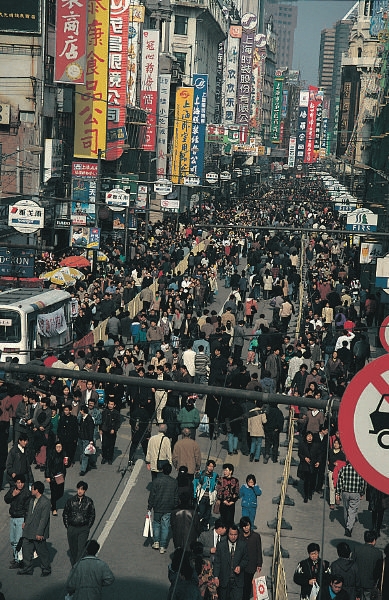
Nanjing Road in Huangpu is Shanghai's best-known shopping street, and probably China's. Nanjing Road starts on the riverside at The Bund and goes about 6 km (3.7 mi) west from there to Jing'an Temple. It continues beyond the temple, gradually changing from intensively commercial to more office and residential use. The park divides Nanjing Road into two parts: Nanjing Road East (Nanjing dong lu) in Huangpu District, mostly pedestrians-only and a major shopping area since the mid-19th century. It is a 1-km long pedestrian boulevard running inland from the Bund, lined with busy shops. The wide boulevard is often packed with people on weekends and holidays. The shops are often targeted to domestic tourists, so the prices are surprisingly reasonable. The Nanjing Road East station (lines 2 and 10 ) is near the center of that pedestrian area. The People's Park station (lines 1 , 2 and 8 ) is at the inland end, furthest from the Bund. Beyond that station the road is no longer pedestrian-only; it runs along the north side of People's Park (人民广场), which is often considered the center of Shanghai. For high-end international brands, go to Nanjing Road West (南京西路 Nanjing xi lu) near Jing'an Temple station (line 2 or 7 ). Several large shopping malls (Plaza 66 aka Henglong Plaza, Citic Plaza, Meilongzhen Plaza, and others being built) house boutiques bearing the most famous names in fashion. The French Concession is another major shopping area. Huaihai Road is a busy boulevard with upscale stores; well-off locals tend to shop there in preference to the more touristy Nanjing Road. For boutique shopping, head to the smaller streets just off it — Xinle Lu (新乐路), Changle Lu (长乐路) and Anfu Lu (安福路) — starting from east of Shaanxi Lu (陕西路); the nearest Metro station is South Shanxi Rd on Line 1 . This area of low-rise buildings and tree-lined streets bustles with small boutiques of clothing and accessories, where young Shanghainese seek the latest fashion shops. A renovated but still picturesque older area called Tian Zi Fang also has boutique clothing, plus much arts and crafts. The Bund is mainly office buildings but does have some hotels, restaurants, and a few multi-storey high-end shopping centers. No. 3 on the Bund has, among other things, Giorgio Armani's flagship store in China. No. 18 has many stores including an art gallery. Yuyuan Bazaar in the old town is well provided with Chinese crafts and jewellery. See Shanghai#Clothing for other tourist shopping areas.
Eat

Individual listings can be found in Shanghai's district articles Many food options in Shanghai are much as anywhere else in China. A lot of the street food is cheap and interesting; roasted sweet potatoes are a common and low-risk item. Hole-in-the-wall restaurants, especially West-of-China Muslim noodle places or spicy Sichuan places, often have good cheap food as well. The local bakeries are generally reasonably priced and the coffee houses have Western-style baked goods for not much more. For excellent Sichuan food in classier surroundings, Spicy Joint on Huaihai Road is extremely popular; do not go at a peak time unless you are willing to wait for a table. While there are some good Indian and Thai places, there are also many Japanese curry places in Shanghai. A popular chain is Coco Ichibanya with about a dozen locations from Pudong to Suzhou, mostly downtown. One is in the mall attached to Jing'an Temple metro station, another in Metro City mall at Xujiahui, and another on Huaihai Road. The Wagas chain has restaurants offering coffee and a mostly western menu—mainly light choices like sandwiches, soups and salads—at mid-range prices and "Baker & Spice" places which combine a café and bakery. They offer free WiFi and are a popular spot for locals and digital nomads working on laptops as they sip coffee. Downtown Shanghai has at least one Wagas location in each of the eight #Districts covered in this article, including at least two in Jing'an. The ground-level strip of restaurants behind Grand Gateway Mall at Xjiahui has a Wagas with a Baker & Spice shop next door. There are plenty of places with various sorts of international cuisine, mostly at higher prices than those mentioned above. The largest group are in the French Concession, mostly along Hengshan Road or streets running off it, but there are also many in Jing'an, Huangpu and Pudong, and some elsewhere. As anywhere in China, Brazilian all-you-can-eat barbeque restaurants are common; one is on Hengshan Road. There is also an all-you-can-eat Indian buffet above the Dutch department store on Huaihai Road. Huanghe Rd (黄河路), off Nanjing Road has upmarket Chinese-style seafood. Much western fast food is available: McDonald's, Starbucks and KFC are ubiquitous, while Dairy Queen, Pizza Hut, Dunkin Donuts and Burger King are fairly common. Shanghai has a few you might not find (yet?) in smaller cities, such as a Papa John's Pizza on Hengshan Road and a Carl's Jr. burger place at Xujiahui.
Shanghai cuisine
Shanghai's cuisine, like its people and culture, is primarily a fusion of the forms of the surrounding Jiangnan region, with influences sprinkled in from the farther reaches of China and elsewhere. Characterized by some as sweet and oily, the method of preparation used in Shanghai emphasizes freshness and balance, with particular attention to the richness that sweet and sour characteristics can often bring to dishes that are otherwise generally savoury.
The name "Shanghai" means "above the sea", but paradoxically, the local preference for fish often tends toward the freshwater variety due to the city's location at the mouth of China's longest river. Seafood, nonetheless, retains great popularity and is often braised (fish), steamed (fish and shellfish), or stir-fried (shellfish). Watch out for any seafood that is fried, as these dishes rely far less on freshness and are often the remains of weeks-old purchases. Shanghai's preference for meat is unquestionably pork. Pork is ubiquitous in Chinese cooking, and in general if a mention refers to something as "meat" (肉) without any modifiers, the safe assumption is that it is pork. Minced pork is used for dumpling and bun fillings, whereas strips and slices of pork are promulgated in a variety of soups and stir-fries. Here are some of Shanghai's representative pork-based specialties:
Drink
Individual listings can be found in Shanghai's district articles Most of the places mentioned under #Eat above also serve booze, and the rest have coffee and tea. The traditional alcoholic drink of choice for the Shanghainese is Shaoxing rice wine, and this can still be found in most restaurants. Prices of drinks in cafés and bars vary like they would in any major metropolis. They can be cheap or budget-busters, with a basic coffee or beer costing ¥10-40. In a high-end hotel bar, one basic beer may cost as much as ¥80. Western-style cafés and bars have also become commonplace. There are internationally-known chains, like Starbucks and Coffee Bean & Tea Leaf, as well as popular domestic and local java joints to satisfy those looking to relax. Hong Kong-style tea cafés are also common, as are Asian "pearl milk tea" or "bubble tea" bars. Some traditional tea houses can still be found, especially in the Old City. Tsingtao, Snow and Pearl River beer are widely available. Major foreign brands are produced domestically and smaller brands are typically imported. There is also a local brew known as REEB (beer spelled backwards). A large bottle (640 ml) of any of these costs anywhere from ¥2-6. Shanghai is filled with amazing nightlife, complete with both affordable bars and nightclubs that pulsate with urban energy. There are plenty of bars in all areas, with the biggest concentration in the French Concession. Xintiandi in particular has many upmarket bars and nightclubs, many with live music. Gay bars are concentrated in the French Concession and the Xinhua Road Residential District in neighboring Changning district. There are many magazines for expats available at hotels and expat eateries, listing and reviewing events, bars, clubs and restaurants in Shanghai. The most popular are That's Shanghai, City Weekend, and Time Out. Shanghai also has an English newspaper, Shanghai Daily, and an English-medium TV channel, International Channel Shanghai or ICS; most expats find these better than the corresponding national media outlets, People's Daily and CCTV channel 9.
Shanghai Pub Crawl, ☏ +86 181-0214-1515, shanghai_pubcrawl@qq.com. In addition to a plethora of watering holes ranging from bars, lounges, dives and world-class clubs, there is a pub crawl that arranges transportation to various popular venues. For non-Mandarin speakers or those in town for just a few days, this service takes the guesswork out of finding the hippest, most interesting spots that bustle with expatriates and locals. ¥150.
Sleep
Individual listings can be found in Shanghai's district articles Accommodation in Shanghai can be rivaled by few cities in China, in terms of both variety and services. There are establishments for all types of travelers, from backpacker options for the weary to top-of-the-line hotels and serviced apartments for those wishing to be spoiled. Puxi has both new and old hotels with classy architectural styles and charm, some of them described in stories when Shanghai may have been the only place in China known to much of the rest of the world, while modern amenities commonly found in Pudong rival many hotels in Asia and beyond. For clean, safe, budget accommodation, three reliable options are the Jin Jiang Star (website in Chinese), Motel 168 (website in Chinese) and Motel 268 chains, all of which have locations in most districts of Shanghai. For long-term accommodation, be prepared to splurge as Shanghai's real estate prices are among the highest in the world, rivaling even those of major Western cities. If your budget allows it, all the downtown districts except the Old City have high-end hotels, and Pudong across the river has many others. Prices are near international levels, anywhere from around ¥700 a night to several times that. Most of the big international chains have at least one location in Shanghai, and many have hotels in both Pudong and central Puxi; Hilton has those plus a third one at Hongqiao Airport. Many of these hotels are in very convenient locations; Les Suites and Hyatt are on the Bund, Le Meridien is just off Nanjing Road, and Radisson is on People's Square; see Huangpu for listings. In Jing'an, the Shangrila is right next to the temple and metro station, and in the French Concession, the Langham Xintiandi is close to Xintiandi and the old town. Shanghai also has some grand old hotels built in the art deco style during the city's glory days (1840s-1930s). The Peace Hotel and Astor House are on the Bund and the Park Hotel is across from People's Park on Nanjing Road; all are listed in the Huangpu article. These are often somewhat cheaper than the newer luxury hotels. Quite a few low-priced and mid-range places are in the area north of Jing'an Temple, in Jing'an, Zhabei and Putuo districts. For a more central location the Captain's Hostel is a backpacker place just off the Bund. Backpacker dorms are under ¥100 in most places, while many hostels and most of the plainer hotels can provide private rooms with private shower in the ¥250-600 range.
Stay safe
Shanghai, despite its size, is a very safe city, and violent crime is incredibly rare; it is generally not a problem for women to roam the streets alone at night. Petty crimes like pick-pocketing and bike theft can sometimes occur, though they are not as common as they used to be with the ubiquity of CCTVs these days. Sexual harassment occasionally occurs on crowded public transport. Pay extra caution before the Chinese New Year (in Jan or Feb depending on lunar calendar), as thieves may be more active in looking for new-year money. Although pickpocketing is not as rampant as in major European cities, it pays to be prudent, especially in crowded public transport and the main shopping streets. Pickpockets often work in groups, sometimes including women carrying babies. Beware of this taxi scam: first you agree on price (e.g., ¥300 for a taxi shared with someone else from Hongqiao Airport to Suzhou) then after a short taxi ride they ask to get out and a group of people say that you need to pay agreed money right now. Then you are transferred to a shared bus where other people cheated like yourself wait until the bus departs, then the bus finally gets to its destination. Most taxis belong to a taxi company, with the company telephone number printed in the taxi that you can call in English. There is also a common Shanghai help-line number that can help you, call 962288, with English service. The notorious tea house scam, long practiced in Beijing, is unfortunately spreading to Shanghai as well. Be cautious of overly friendly strangers, probably well-dressed, speaking good English, and look innocent like a student. They will invite you to an art gallery, tea shop or karaoke bar, and after accepting they will leave you to foot a large bill. In this case, you should call 110 (emergency hotline). The con artists may tell you that calling the police does not work and claim to have connections with police, but the police in China tend to be helpful in these cases, especially when innocent foreigners are involved. These scams can be found around People's Square near the entrances/exits of the museums and art galleries. Actual physical harm to yourself is unlikely. Just walk away. A temple scam in various big cities and also Tibet is when your guides may ask you to make a wish and burn a stick of incense which ends up costing a hundred to more than a thousand. Another trick is to ask you how much you want to "donate". After you said ¥10, they will tell you that ¥10 is for a one-day blessing but the monk has already turned an incense to bless you for 1 year, so you have to pay 365 x ¥10. This scam has caused significant backlash because of blasphemy since no legitimate temples in China ever charge followers in this way. Male travelers may attract attention from female sex workers at nightspots. Remember that prostitution is illegal in China, so you could face potential legal consequences should you partake. Around the Old Town and the Science Museum in Pudong, hawkers are sometimes also eager to sell. Saying wǒ búyào ("I don't want it") may help. Also be cautious of people who approach and offer to polish your shoes. Make sure both of you agree on the price before anything is put on your shoes. The same rule also applies to the commercial photographers at the Bund area. They will offer to take your picture with the scenic background (and sometimes with costumes) for ¥50, but once you have contracted their services, several cohorts will arrive to "assist" the photographer. They may force you to buy all the snapshots and try to gather crowds to increase pressure. Don't rush into or out of Shanghai metro trains at the last moment. Despite the safety barriers on the platform, the train doors sometimes close before all passengers have boarded; people squeezed between closing doors is a common sight. Apparently, the fail-safe that is supposed to block trains from running with open doors isn't foolproof: In 2010 a woman died after being smashed against the safety barriers as she was hanging half out of the closed doors of a train leaving Zhongshan Park Station. By Chinese law, foreigners are required to show their passports when requested, although this is rarely enforced. Most hotels will help you keep the passport in the safe, and then you can carry a photocopy along with your hotel's name card. See the Chinese Money Counterfeiting article for details about fake notes that you may encounter.
See the Chinese Stay Healthy article for general health and food advice. See the Chinese Smog article for information about issues relating to air pollution Do not drink Shanghai's tap water unless it is boiled or goes through a reverse-osmosis filter. Drinking the water is relatively safe when it has been boiled; however, tap water is also said to contain high amounts of heavy metals which are not removed by boiling. When buying bottled water you will come across a whole range of foreign and domestic mineral water brands, with the cheaper domestic brands costing ¥1–2.50 available in all convenience stores and from street vendors. Most hotels provide domestic mineral water for free in your room. Individuals with asthma or respiratory issues should be prepared when visiting due to the air pollution. Public hospitals in Shanghai are generally not up to the standard that foreigners from Western countries would be used to, and most of the doctors and nurses working there are unable to communicate in English. Ambulance services are unreliable, and in the event of an emergency, the quickest way to get to a hospital would usually be to take a taxi. Many private hospitals and medical clinics around the city mainly cater to foreigners and expatriates. The doctors and nurses working at these places will be able to speak English, and the standard of care is usually on par with what you may be used to at home, though their services are usually very expensive. Many of these medical services will take travel insurance if your insurance company is partnered with the hospital. Generally speaking you will likely have to pay ahead of time, however these facilities tend to be far superior in equipment and cleanliness to the ones that Chinese locals are forced to deal with. A popular chain of western medical clinics is Parkway Health. There is a 24-hr hotline in English (6445 5999) to arrange an appointment in the clinic nearest you. This service is expensive: basic medical consultations start at ¥1,200. Check with your insurance beforehand to see if you are fully or partly covered. Note that because these services are pay services, they are paid more when they conduct more tests. Furthermore, Chinese doctors, even Western-trained ones, tend to be overly thorough compared to Western doctors. However since you are a customer, they are not usually too insistent on unnecessary tests. Use your common sense to determine if you need the ordered tests (e.g. blood tests, x-rays etc.).
International Medical Care Center of Shanghai First People's Hospital, 585 Jiu Long Road, near Haining Lu, Hangkou (九龙路585号,近海宁路) (in Building 1), ☏ +86 6324 3852. M-F 08:00-17:00. Provides "VIP Service" for ¥300, then you pay for any services beyond the basic examination.
Go next
Several other major cities are near Shanghai and conveniently reachable on the new CRH high-speed (over 300 km/h) trains. These are comfortable and reasonably priced and, except at holidays, are not too crowded since other trains are cheaper. Look for the separate ticket windows with "CRH" on the signs.
Hangzhou — 45 minutes away by high-speed train, is one of China's top domestic tourist destinations, featuring the famous West Lake, a fine silk market, and Buddhist caves. The popular times of year to go are spring and fall. An information booth at the train platform exit provides a useful booklet with maps. Suzhou — a historic town half an hour away from Shanghai by high-speed train, is also a major destination for Chinese tourists. Traditionally a city of scholars and poets with many fine classical Chinese gardens and enough canals that it has been called the "Venice of the East". It has also become a major center of hi-tech manufacturing. There is a Chinese saying along the lines The sky has heaven; the Earth has Suzhou and Hangzhou.
Nanjing — about 1.5 hours away by high-speed train, is a great place to get a Chinese history lesson. Nanjing was the capital of China under several dynasties, and of the Nationalist government in the early 20th century. From the city walls to the Presidential Palace, it's a walkable, friendly place with a variety of hotels for all budgets. Well worth the effort. It is also home to the tombs of three prominent figures in Chinese history. Wuxi — roughly halfway between Suzhou and Nanjing, known for the Grand Canal, Lake Tai, the giant Buddha at Lingshan, and delicious local cuisine. Ningbo — is two and a half to three hours away from Shanghai, across the 36 km-long Hangzhou Bay Bridge. The train, via Hangzhou, is faster. There are places that serve as the somewhat rural escapes for Shanghai residents. These are near cities mentioned above, and probably neither would seem at all rural to someone from a less densely populated country.
More pictures of Shanghai


From this destination's category on Wikimedia Commons. Each photograph is credited to its own author under its own licence.
The guide text on this page is from the Wikivoyage article Shanghai, written by Wikivoyage contributors and published under CC BY-SA 4.0. The authors are listed in the article’s edit history. It has been shortened and re-laid-out for this page; that adapted text is available under the same licence. Nothing else on this page is.
Wikivoyage is written by travellers, not by us. Opening hours, prices and whether a place still exists are exactly the details that go out of date, so check anything you are relying on.
“3,296 readers a month” and the ranking are ours, counted from Wikimedia’s published pageviews (CC0) — the median of twelve complete months. They count people reading about a place, which is not the same as people going there.