
Hiroshima
Hiroshima (広島) is an industrial city of wide boulevards and criss-crossing rivers along the coast of the Seto Inland Sea. Although many only know it for the horrific split-second on August 6, 1945 when it became the site of the world's first atomic bomb attack, it is now a modern cosmopolitan city with excellent cuisine and a bustling nightlife.
Most read about in August, least in May. That is when people look it up, which tends to run a month or two ahead of when they go.
Before you book
The Foreign, Commonwealth & Development Office publishes the UK’s official travel advice for Japan. It changes without notice and travelling against it usually invalidates your insurance, so read it at the source rather than anywhere else — including here.
FCDO travel adviceUnderstand
Those expecting to step off the Shinkansen into a pile of smoldering rubble will be in for a surprise, as Hiroshima has all the ferroconcrete and blinking neon of any other modern Japanese city. Teenagers stream in and out of the station, where McDonald's and the latest keitai (mobile phones) await; hapless salarymen rush down Aioi-dori to their next meeting, casting a bloodshot eye toward the seedy bars of Nagarekawa as they pass. At first glance, it can be hard to imagine that anything out of the ordinary ever happened here. Hiroshima was founded in 1589 on the delta formed by the Ota River, flowing out to the Seto Inland Sea. The warlord Mori Terumoto built a castle there, only to lose it eleven years later to Tokugawa Ieyasu after the Battle of Sekigahara, which marked the beginning of the Tokugawa shogunate. Control of the area was given to the Asano clan of samurai, who ruled without much incident for the next two and a half centuries. Their descendants embraced the rapid modernization of the Meiji period, and Hiroshima became the seat of government for the region, a major industrial center, and a busy port. By World War II, Hiroshima was one of the larger cities in Japan, and a natural communications and supply center for the military. Forced laborers from Korea and China were shipped in by the tens of thousands, and local schoolchildren also spent part of their days working in munitions factories. Residents of the city must have felt curiously blessed for the first few years of the war, as Hiroshima had been left largely untouched by American bombing campaigns; that was, however, intended to ensure a more accurate measurement of the atomic bomb's effect on the candidate cities, which had been narrowed down to Hiroshima, Kokura, Kyoto, Nagasaki, and Niigata.
On 6 August 1945 at 08:15 the American B-29 bomber Enola Gay dropped an atomic bomb dubbed "Little Boy" on Hiroshima. It is estimated that at least 70,000 people were killed in the explosion and its immediate aftermath. Most of the city was built of wood, and fires raged out of control across nearly 5 sq mi (13 km2), leaving behind a charred plain with a few scattered concrete structures. Corpses lay piled in rivers; medical treatment was virtually non-existent, as most of the city's medical facilities had been located near the hypocenter, and the few doctors left standing had no idea what hit them. That evening, radioactive materials in the atmosphere caused a poisonous "black rain" to fall.
In the days ahead, many survivors began to come down with strange illnesses, such as skin lesions, hair loss, and fatigue. Between 70,000 and 140,000 people would eventually die from radiation-related diseases. Known as hibakusha, the survivors were also subject to severe discrimination from other Japanese, but have since been at the forefront of Japan's post-war pacifism and its campaign against the use of nuclear weapons. Recovery was slow, given the scale of the devastation, and black markets thrived in the first few years after the war. However, the reconstruction of Hiroshima became a symbol of Japan's post-war pacifism. Today, Hiroshima has a population of more than 1.1 million. Automobiles are a major local industry, with Mazda's corporate headquarters nearby. There are three excellent art museums in the city center, some of Japan's most fanatical sports fans, and a wide range of culinary delights — most notably the city's towering contribution to bar cuisine, Hiroshima-style okonomiyaki. Although many visitors, especially Americans, may feel apprehensive about visiting Hiroshima, it is a friendly, welcoming city, with as much interest in Western, especially American culture as anywhere else in Japan. Tourists are welcomed, and exhibits related to the atomic bomb are not concerned with blame or accusations. Bear in mind, though, that many hibakusha still live in the city, and even most of the young people in Hiroshima have family members who lived through the blast. As such, the average Hiroshima resident isn't likely to relish talking about it, although you needn't shy away from the topic if one of the chatty fellows around the Peace Park brings it up.
Getting there

By plane
1 Hiroshima Airport (HIJ IATA). Connects from domestic destinations in Japan. ANA and JAL offer flights from Tokyo Haneda and Sapporo Chitose airports. ANA also offers flights from Narita, Sendai and Okinawa. There are direct international flights from Dalian, Guam, Shanghai, Seoul, Hong Kong and Taipei. Buses connect the airport to JR Hiroshima Station (45-50 min, ¥1370) and the Hiroshima Bus Center (55 minutes, ¥1370). There are also buses from the airport to Okayama, Onomichi, Iwakuni, Tottori, and other spots in the Chugoku region. The departing frequency varies from 30 minutes to an hour.
By train
2 Hiroshima Station (広島駅 Hiroshima-eki) is a major station on the JR West Sanyo Shinkansen line. On the fastest Nozomi and Mizuho trains, it is 35 minutes from Okayama (¥6350) and 80–85 minutes from Shin-Osaka (¥10630). Tokyo is around 3 hr 45 min away via Nozomi (¥19440). These prices are for reserved seats; unreserved seats, and seats on slower services such as the Sakura and Kodama, cost slightly less. If you have a Japan Rail Pass, you cannot use Nozomi and Mizuho trains, unless you pay a surcharge of approx ¥6500 (adult) so if you are traveling from Tokyo or Nagoya you will have to take one of the two hourly Hikari trains and switch at Shin-Osaka (alternatively at Shin-Kobe or Himeji) to the Sakura or another Hikari train on the Sanyo Shinkansen line. With these trains you can travel from Tokyo to Hiroshima in approximately 4 hours 30 minutes. There are a few one-way Hikari departures from Nagoya in the morning that run directly to Hiroshima with no change of trains necessary. There is also a direct one-way morning Hikari service that departs from Shin-Yokohama at 06:00 and reaches Hiroshima in less than four hours. Traveling overnight by train from Tokyo, you can take the 22:00 Sunrise Izumo/Sunrise Seto train to Okayama, then take a Mizuho train to Hiroshima, arriving just before 07:30. If you have a Japan Rail Pass, you can book a carpeted floor space on the overnight service at no charge. Otherwise you can travel in a compartment or room by paying the applicable room fee and surcharges. Upon arriving at Okayama, Japan Rail Pass holders can transfer to a Hikari or Sakura at Okayama, arriving in Hiroshima just before 08:00. Regular train services run through Hiroshima on the Sanyo Main Line (between Kobe and Kitakyushu), along with several local lines.
By bus
Long-distance buses arrive and depart from the north exit of JR Hiroshima Station, where there is a JR Bus counter, and the Hiroshima Bus Center in the city center. There is service to and from cities in Kanto, Kansai, Kyushu, Shikoku, and much of the rest of Japan.
Getting around

There is a Visit Hiroshima Tourist Pass that covers either 1-3 days of unlimited journeys inside the city or the prefecture. It can be obtained from the Information Center on the first floor of the airport, the JR station, the Hiroshima Bus Center, and other tourist locations. Digital passes are also available online and are suitable for travelers seeking to use public transportation frequently during their trip in the city.
By tram
Hiroshima has an extensive tram (streetcar) network, which is operated by Hiroden (広電). It's a slow but reliable way of getting around. The trams themselves are a mix of old rattle-traps and sleek, new "Green Movers" — although they all run on the same lines for the same fares. There's no difference other than the smoothness of the ride. Because the trams were bought from other cities, you're getting a tour of Japanese transit history — some have been in service for more than fifty years, and that might be an old Kyoto tram taking you through Hiroshima. Trams 651 and 652, both of which survived the atomic bomb blast, are still sometimes used in regular service. Most lines originate from JR Hiroshima Station, and run frequently during daytime and evening hours, approximately one tram every 10 minutes per line. Boarding and payment procedures vary by tram; however, the entrance and exit are clearly marked in English. (If in doubt, just follow the locals.) Pay as you exit. Change machines are usually available on board if you don't have exact change — check near the front or back of the car. A of Nov 2025, trips are a flat ¥240 (¥120 for children ages 6-11; up to 3 children ages 1-5 may ride with a paying adult/older child). One-day passes are available from the tourist office for ¥700 (¥350 children). A day pass which also includes travel on the Matsudai Kisen ferry to Miyajima costs ¥1000 (¥550 children). Digital passes are also available online and include 8/24 hour passes for ¥600/700 (¥300/350 children) and weekday (10:00-16:00) and weekend (8 hours) passes for ¥440 (¥220 children).
By bus
Bus lines run through Hiroshima and out to the suburbs. Generally speaking, these serve areas more likely to be used by locals than visitors. Signs include English, and buses depart next to the tram depot in front of JR Hiroshima Station. Japan Rail Pass holders can use a free sightseeing bus, which goes in a loop from and to Hiroshima station via all important sights in the city. There are three meipuru-pu ("Maple + Loop") bus lines operated under Chugoku JR Bus Company that circulates around the city's main tourist spots.
See

Peace Memorial Park
Most of the memorials related to the atomic bomb are in and around the Peace Memorial Park (平和公園 Heiwa-kōen), reachable by tram line 2 or 6 to Genbaku Dome-mae. Coming from JR Hiroshima Station, you'll see the Peace Park on your left just before crossing the T-shaped Aioi Bridge, which is thought to have been the target of the bomb. Once part of the busy Nakajima merchant district, this area was destroyed almost in its entirety by the bomb. Today, there are more than fifty memorials, statues, and other structures in the Park. Some will be obscure in their meaning; others are immediate and devastating. There is no entry fee, save for the Peace Memorial Museum, and access to the grounds is not restricted at night.
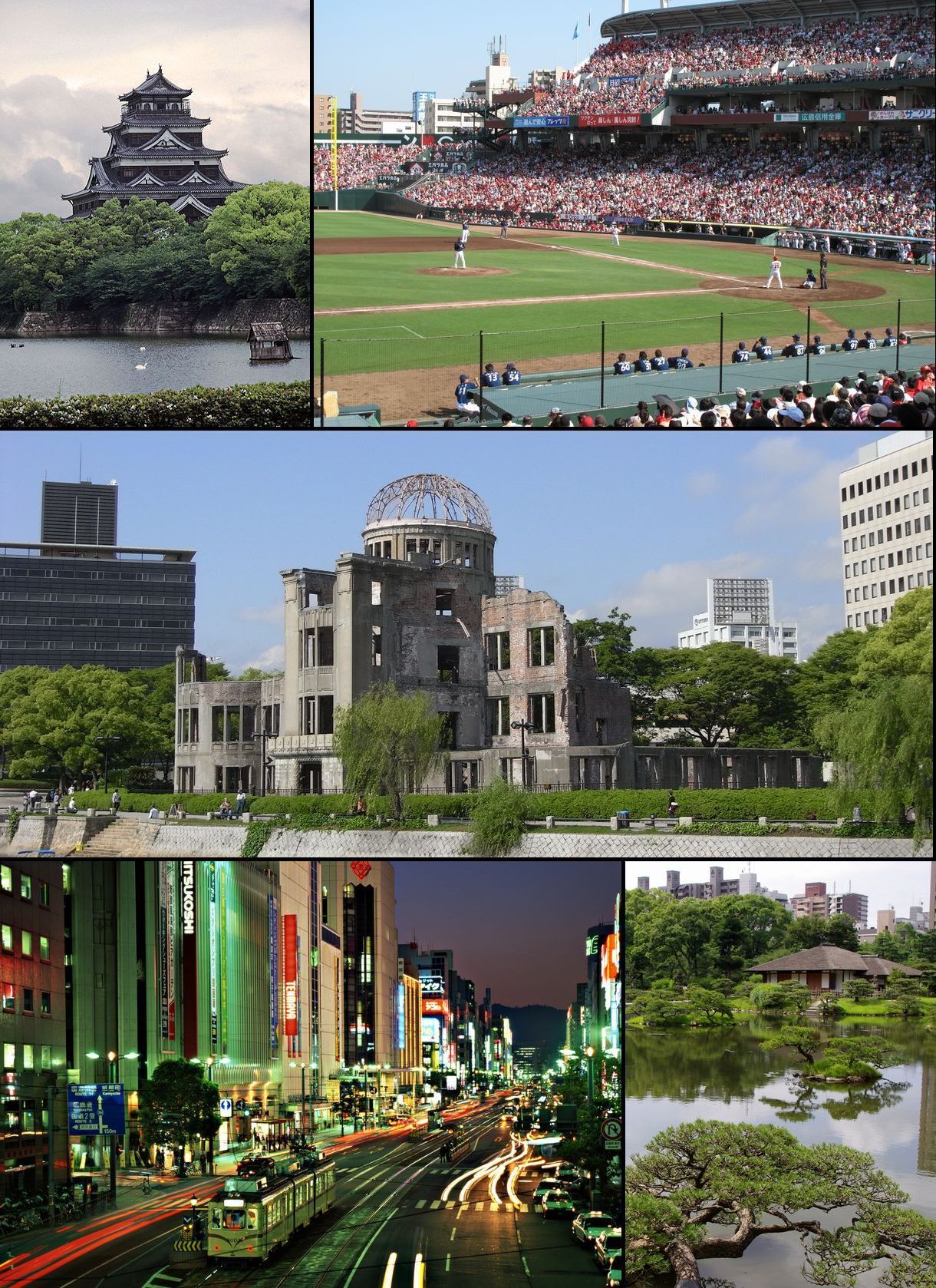
1 A-Bomb Dome (原爆ドーム Genbaku Dōmu). The skeletal remains of the dome are the most recognizable symbol of the atomic bombing in Hiroshima. In another lifetime, the building was one of the city's best-known sights for an entirely different reason; designed by Czech architect Jan Letzel in 1915, the Hiroshima Prefectural Commercial Exhibition Hall (and its fanciful green dome) had a bold European style in a grimy, crowded city with few modern flourishes. Because the explosion took place almost directly above the building, the walls remained largely intact, even as the dome shattered and the people inside were killed by the heat of the blast. Initially, as the city rebuilt, it was left alone simply because it was more difficult to demolish than other remains in the area; gradually, the A-Bomb Dome became the symbol it is today. The "Hiroshima Peace Memorial" was declared a UNESCO World Heritage site in 1996 amid some controversy — the United States and China both voted against the nomination for reasons related to the war. Today, the benches around the Dome are a favorite spot for Hiroshima natives to read, eat lunch, or simply relax. (updated Apr 2017) 2 Hypocenter. One block east of the A-Bomb Dome (outside Shima Clinic) is a plaque which marks the exact point above which the bomb exploded. (updated Apr 2017)
3 Children's Peace Monument ((原爆の子の像 Genbaku no ko no zō). Perennially draped in thousands of origami paper cranes folded by schoolchildren across Japan in the memory of the young bomb victim Sadako Sasaki (see Literature). You can bring your own origami cranes and donate them to the memorial. (updated Mar 2023) 4 Memorial Tower to the Mobilized Students. Commemorates the 6,300 students who were conscripted to work in munitions factories and killed by the atomic bomb. There are statues of doves scattered throughout its five levels; at the base is a beautiful Kannon statue, always draped with origami cranes. Tens of thousands of forced laborers from Korea were working in Hiroshima at the time of the attack. But the 5 Monument in Memory of the Korean Victims of the A-Bomb was erected outside the Peace Park in 1970, and only moved within its boundaries in 1999. Today, the turtle at the base of the monument — symbolically carrying the dead to the afterlife — tends to be draped in his fair share of colorful origami cranes and flowers. The 6 Peace Bell is engraved with a world map, drawn without borders to symbolize unity. The public are welcomed to ring the bell — not coincidentally, the log is aimed to strike an atomic symbol. (Ring the bell gently, so as not to damage it.) The 7 Atomic Bomb Memorial Mound holds the ashes of 70,000 bomb victims who were unidentified or had no living relatives to claim them. Services are held in their memory on the 6th of every month. The 8 Rest House was known as the Taishoya Kimono Shop at the time of the explosion. Only one employee, who was in the basement at the time, survived. However, the reinforced concrete building stayed mostly intact. (The interior has been entirely refurbished, but it is possible to visit the preserved basement with advance request.) Today, it holds a gift shop, some vending machines, a helpful tourist information office, and — as the name would suggest — a place to rest.
Do
Festivals
Flower Festival (フラワーフェスティバル). First weekend of May. This is Hiroshima's biggest festival, begun in 1975 to celebrate the Carp's first baseball championship. There are food vendors and things for sale, but live performances now dominate the program, with comedians and J-pop bands on stages along Heiwa-o-dori. It's the smaller performances that make the Flower Festival worthwhile, though, particularly in the stalls near Jizo-dori, where you might stumble across a phenomenal Okinawan band or a local jazz combo. Free. Peace Memorial Ceremony (広島平和記念式典 Heiwa Kinen Shikiten), Peace Memorial Park, ☏ +81 82-504-2103. 6 August. Held each year on the anniversary of the atomic bombing, with many hibakusha in attendance. Ceremonies are held in the morning (8:15AM, the time the bomb was dropped). The air raid sirens sound, followed by a minute of silence, and then appeals for peace by the mayor of Hiroshima. There's also a ceremony in the evening (20:00), when a thousand colorful lanterns are floated down the river. Free. Sake Festival (酒まつり Sake Matsuri). Early October. The suburb of Saijo is famous for its sake breweries and this annual boozy blow-out. For the price of entry, attendees can drink their fill of sake from local breweries. In short order, the festival area turns into a wild (yet reasonably well-behaved) display of public drunkenness involving people of all ages. Outside the festival area, tours of sake breweries are also available, with wood sake cups are available as souvenirs for your visit. JR Saijo Station is just a couple of stops from Hiroshima — you'll be swept up in the crowds as soon as you arrive. Tickets ¥1000 in advance, ¥1500 at the festival. Food Festival. Last weekend in October. This one's pretty simple — food, glorious food of all kinds, from international delicacies to local favorites, from roasted slabs of meat and seafood to delicious vegetarian-friendly dishes and desserts, served in stalls lining the moat of Hiroshima Castle and parts of Chuo Park. There's a flea market as well, and usually some cultural performances at the castle in the evening. Free — pay for what you eat.
Recreation
1 Hiroshima Toyo Carp Baseball, Mazda Zoom Zoom Stadium, 2-3-1 Minami-Kaniya, Minami-ku (10 minute walk east from JR Hiroshima Station, or a shorter walk from the Enkobashi-cho tram stop), ☏ +81 82-223-2141. The much-beloved and much-bemoaned Carp are Hiroshima's entry in the Central League of Nippon Professional Baseball. After more than fifty years in a stadium across the street from the Peace Park, the Carp moved to the new Mazda Zoom Zoom Stadium in 2009. While the team doesn't win much, the enthusiasm of the fans can hardly be faulted, and Hiroshima is as good a place as any to witness the fervor of Japanese baseball fandom. Tickets range from ¥1800 to ¥3500. Ask for the Carp Performance (カープ パフォーマンス) tickets — that's where the drums, chants, and excitement are. Tickets are sold at the stadium starting at 10:00, the "Green Window" at JR Hiroshima Station, and a number of convenience stores. 2 Hiroshima Sanfrecce Soccer, Big Arch Stadium, 5-1-1 Ozukanishi, Numata-cho, Asa-Minami-ku (Astram to Koiki Koen-mae), ☏ +81 82-233-3233. Sanfrecce (Japanese/Italian for "three arrows", from a Japanese folk tale) are Hiroshima's entry in the J-League, although they date back to 1938 as a semi-pro team. Though coming off consecutive J-League championships, Sanfrecce struggle for attention in Carp-town, but the fans are great. Tickets are available at most convenience stores. Reserved seats ¥3000-4500 in advance, ¥500 more at the stadium; unreserved ¥2300 in advance, ¥300 more at the stadium. And if you're on a quest to complete the whole set of Hiroshima professional sports, visit the Hiroshima (JT) Thunders of the V-League (volleyball), who hold court at the 3 Nekoda Kinen Gymnasium, and the Hiroshima Maple Reds of the Japanese Handball League, Women's Division, who play at the Hirogin no mori Gymnasium. Family Pool, 4-41 Moto-machi, Naka-ku (Genbaku dome-mae tram stop), ☏ +81 82-228-0811. Daily 09:00-18:00. Open from 1 July-31 August, right when it's needed most, this huge, open-air pool/water park is a popular place for kids and families to beat the heat. And it's easy to find — in Chuo Park, right in the center of town. ¥670 adults, ¥340 kids. Big Wave (Astram to Ushita), ☏ +81 82-222-1860. Daily 09:00-21:00, except 08:30-21:30 July-early September. On the other hand, if you're a serious swimmer, Big Wave offers longer hours and Olympic-size 50-meter swim lanes from July to early September. Then, from November to April, it turns into an ice-skating rink. (Rental skates are available, although people with big feet may not manage.). Swimming ¥260 kids, ¥530 adults; ice-skating ¥910 kids, ¥1520 adults. 4 Hanbe Gardens (半べえ) (Bus #4 from Hiroshima Station to Niho, get off at Yuenchi Iriguchi and follow the signs about 50 metres), ☏ +81 82-282-7121. If you want to take an onsen in Hiroshima, this hotel, restaurant, garden and onsen isn't bad. They have a good range of baths including a variety with jets, a "lap walking" bath, and a small outdoor area and a sauna. Not too remarkable as onsen go, but nice enough. Onsen ¥800 adults, ¥500 kids. 5 Round One, 3-11 Tatemachi, Naka Ward, 730-0032 (A block away from mid-Hondori), ☏ +81 82-545-8910. 09:00-06:00. Bowling alley and entertainment center, popular with locals of all ages in Hiroshima (it is also present elsewhere in Japan). The first three floors consist of an expansive arcade, with racing games, classical arcade games, horror games, claw machines, and gambling/slot machines. The following four floors have bowling alleys, and the final floor has food, billiards, ping pong, and darts. Prices depend on what you're doing, and for how long. (updated Feb 2018) 6 縮景園 (Shukkeien), 2-11 Kaminoboricho, Naka Ward, Hiroshima, 730-0014 일본, ☏ +81 822213620. 09:00-17:00. There are carp ponds, tea houses, and flowering trees in the tranquil urban gardens that were created in the 16th century. 200~300¥. (updated Sep 2024)
Shopping
Shopping in Hiroshima is dominated by a few huge department stores. Hon-dori (本通り), a covered shopping arcade in the city center, is the place to wander with a wallet you'd like to empty. In terms of souvenirs, Hiroshima Carp memorabilia is the most widely found, although there's some spillover from the super-powered knick-knack engine that is Miyajima.
1 EDiON (formerly DeoDeo), 2-1-18 Kamiya-cho, Naka-ku (Kamiya-cho nishi tram stop), ☏ +81 82-247-5111. Daily 10:00-20:00. This is the headquarters of the Hiroshima-based electronics giant, with an appropriately huge selection of computer and camera equipment, music and DVDs, and — somewhat incongruously — imported designer watches. 2 Fukuya (Ekimae) (福屋広島駅前店), 9-1 Matsubara-cho, Minami-ku (across the street from the south exit of JR Hiroshima Station, or via underground walkway), ☏ +81 82-568-3111. Daily 10:00-20:00. Upscale boutiques like Chanel, Armani, and Dior. 3 Hiroshima PARCO (広島パルコ), 10-1 Hon-dori, Naka-ku (Hatchobori tram stop), ☏ +81 82-542-2111. Daily 10:00-20:30; food court to 22:30. For the latest in Japanese teen fashion, this is the place to look, with eight floors of clothes boutiques, and beauty supplies in the basement. There are also several music shops for a J-pop fix, and a good shop for soccer fans on the ninth floor. The concrete shape-jumble square behind the store is a popular hang-out space. 4 SOGO, 6-27 Moto-machi, Naka-ku (Genbaku dome-mae tram stop), ☏ +81 82-225-2111. Daily 10:00-20:00; food court to 22:00. This concrete behemoth is on the other side of the street from the Peace Park, and the Hiroshima Bus Center is on its third floor. There are groceries and coin lockers in the basement, and a food court on the 10th floor. If you make it past all of the toys on the 6th floor, you'll find a Kinokuniya bookstore, with foreign titles (not just English) and a good selection of Japanese language study books. 5 SunMall, 2-2-18 Kamiya-cho, Naka-ku (Hondori tram stop), ☏ +81 82-245-6000. Daily 10:00-20:00. Another teen fashion favorite, with five floors of boutiques and a great secondhand shop on the top floor. Of note for travelers will be the Uniqlo on the 2nd floor, which has good, cheap clothing at foreigner-friendly sizes. 6 Hands, 16-10 Hatchobori, Naka-ku (Hatchobori tram stop), ☏ +81 82-228-3011. Daily 10:00-20:00. Mostly Japanese home goods and appliances, but the first floor is full of travel and camping supplies, and the second floor has some fun party supplies (along with a great selection of Halloween gear, when in season). If you scout around on the upper floors, you'll find some reasonably-priced traditional souvenirs like miniature sake barrels and tea sets. 7 Costco, 2-3-4 Minami-Kaniya Minami-ku. Daily 10:00-20:00. Next to Mazda Stadium, about 20 minute walk from JR Hiroshima station or 8 min bus (extremely accessible for a typical Costco even in Japan). Food court is available (hot dog; cheese/pepperoni/combo pizza; green tea/hokkaido ice cream; clam chowder; bulgogi bake instead of chicken bake, though chicken bake is better). Requires any Costco membership card (Japan or international members, international members must stop by counter to fill out a form). (updated May 2018) 8 WEGO 広島店, Naka Ward, Hondori, 9−4 広島ソシオテラス 1F~3F, ☏ +81 825453345. 10:00-21:00. (updated Sep 2024) 9 2nd Street, Naka Ward, Hondori, 1−14 2nd Street, ☏ +81 825455052. 10:00-21:00. (updated Sep 2024) 10 LUSH, 1-11 Hondori, Naka Ward. 10:00-20:00. (updated Sep 2024) 11 Daiso, Naka Ward, Hondori, 1−11 1階, ☏ +81 824200100. 09:00-21:00. It is a general merchandise chain in Japan that sells household items, toys, stationery, decorative props, lunch box supplies, and souvenirs. (updated Sep 2024)
Eat

Hiroshima is famous for its style of okonomiyaki (お好み焼き), which literally means "cook it as you like it". Often (and somewhat misleadingly) called "Japanese pizza", it is better described as a type of savory pancake made with egg, cabbage, soba noodles, and meat, seafood or cheese. It is grilled in layers on a hot plate in front of you and slathered liberally with okonomiyaki sauce, with optional extras such as mayonnaise, pickled ginger, and seaweed. It sounds and looks like a mess, but is very tasty and filling. To give you a sense of the civic pride involved here, the Hiroshima tourist information office offers a map with a whopping 97 shops serving okonomiyaki within city limits, and reports have several hundred more in the area. Micchan (みっちゃん) is the most famous of the Hiroshima- style okonomiyaki restaurants with long histories. It has a few branches in and around the center of Hiroshima. Hiroshima style and Osaka style are the two competing types of okonomiyaki, and if you raise the subject of okonomiyaki with a local, be ready to state your preference between the two! Basically, in Hiroshima the ingredients are layered and pressed together while cooking, while in Osaka the batter is mixed together first, and the ingredients do not include noodles. According to local legend, both dishes originate from a cheap snack called issen yōshoku (一銭洋食) or "one-cent Western meal", which consisted of a wheat and water pancake served with scallions and sauce. Representing the other side of the pancake divide, Tokunaga (徳永) is the best-known Kansai-style okonomiyaki restaurant in Hiroshima. There are Japanese and American chain restaurants clustered near the station, including Starbucks, McDonald's, sushi shops and okonomiyaki shops among many others. Most will serve until 22:00, though McDonalds stays open later. Hiroshima is also famous for its oysters (available between October and March) and a maple-leaf-shaped pastry called momiji manjū (もみじ饅頭). (Momiji is the leaf of a Japanese maple tree.) Momiji manjū are available with a variety of fillings, including the more traditional anko (あんこ), red bean and matcha (抹茶), or green tea; it's also available in cream cheese, custard, apple and chocolate flavors. Boxes of momiji manjū are considered the quintessential Hiroshima souvenir, but Miyajima is the best place to buy it fresh.
Budget
1 Okonomi-mura (お好み村), 3-3 Nakamachi, Naka-ku (Hatchobori tram stop), ☏ +81 82-241-2210. The shops keep their own hours, but most will be open around 11:00, and a few stay open until 02:00-03:00. Three floors packed with no less than 27 okonomiyaki shops. This, indeed, is Hiroshima culinary nirvana. They all serve beer and okonomiyaki with some variations (kimchi, oysters, etc.), and they'll all start clamoring for your business as soon as you walk through the door. It's right behind PARCO, with a distinctive 'Okonomi-mura' arch out front. Figure on ¥700-1500 for a meal. 2 Organ-za (ヲルガン座), 1-4-32 Tokaichi-machi, Naka-ku (Morimoto Building, 2F) (Tokaichi-machi tram stop), ☏ +81 82-295-1553. M-F 17:30-02:00, Sa 11:30-02:00, Su 11:30-00:00. If you and your companion have completely different tastes in mind, Organ-za offers dishes from India, Japan, Thailand, Vietnam, and others direct from the imagination of a capable and creative chef. English menus are available. There's also a full bar (tended sometimes by Chie from the late, lamented Alcoholiday) and frequent live music. Most entrees ¥850, with dessert sets and drinks ¥500. 3 Otis!, 1-20 Kako-machi, Naka-ku, ☏ +81 82-249-3885. M-Sa 12:00-23:00, Su 17:00-23:00. Serving Tex-Mex in Hiroshima for more than twenty years, Otis! is the most vegetarian/vegan/organic-friendly restaurant in town, with items clearly marked on their English menu. In addition to tacos, burritos, enchiladas, and nachos, they have a varied of made-from-scratch bakery items including muffins, brownies, and rye bread, as well as a handful of other items not easy to find in Japan such as jambalaya and lentil curry with brown rice. The atmosphere is more that of a small live house or indie cafe than a restaurant, with the walls covered in graffiti messages from passing musicians, and the corners stacked with audio equipment and unusual stringed instruments-- they also have a fairly busy schedule of live music, both Japanese and international. Most meals ¥700-1200, shows ¥2300-4500 including a drink. 4 Sankanou (三冠王), 11-2 Ōsuga-cho, Higashi-ku. M W-Sa 17:30-23:30, Su to 22:30. A tiny okonomi shop in a little back alley near the railroad tracks and beside Hiroshima Station. The shopkeep speaks English and is a friendly, enthusiastic young manga fan. He's decorated his shop with Gundam models, moe-moe figurines, manga posters and baseball and wrestling action figures. This shop serves okonomiyaki in the traditional method, directly on the hot griddle built into the table in front of you. Highly recommended for a visiting anime/manga nerd in search of true Hiroshima okonomiyaki (the same way Ukyo serves it in Ranma ½!) Food and a cold draught beer for about ¥900. 5 Micchan (お好み焼 みっちゃん総本店), 8-4 Komachi, Naka-ku (Chuden-mae tram stop), ☏ +81 82-248-3022. W-M 11:30-14:30, 17:30-21:30 (Sa Su 17:00-21:30). Reasonably priced okonomiyaki restaurant. There are branches in Hatchobori, Hiroshima Station, Sogo Department Store, Fukuya Department Store and Tokyo. Okonomiyaki \869. (updated Jan 2023) 6 Tachikoma (たちこま), 1-3-9 Dambara, Minami-ku (Dambara 1-chome tram stop), ☏ +81 82-262-7635. F-W 17:00-23:30. A tiny okonomoyaki shop where locals go, with very friendly owners. The okonomiyaki is quite good and filling, and there's beer to enjoy with it. Figure on ¥1000 for a meal. 7 Cocoruku (ココクル), 7-11 Hashimotocho, Naka Ward, ☏ +81 82-221-0087. Nice tiny okonomoyaki shop, where you get classic okonomiyaki with soba noodles, fried egg and plenty of delicious carp sauce. Drinks are primarily beer, shougu or sake. The owner is friendly and talkative (but speaks only a little English). ¥1000. (updated Oct 2023) 8 生クリーム専門店 MILK, 1-2 Tatemachi, Naka Ward. 500~2000JPY. (updated Sep 2024) 9 壽ゑ廣餃子 立町店, ☏ +81 822428270. 17:00-21:00. Izakaya sells gyoza dumplings (updated Sep 2024) 10 Tonkatsu 16, Nagarekawacho, 5−19 とんかつ16 カサブランカビル 1F奥, ☏ +81 5037002252. 11:30-20:00. It is a restaurant specializing in pork cutlet that is 100% operated by reservation. Since it is operated by reservation, you can taste food by selecting options that suit your preference. (updated Nov 2024) 11 Hiroshima specialty oyster first, Shintenchi, 5−13 新天地PLAZA 1F, ☏ +81 5054859650. 11:00-22:30. Here, you can taste a variety of dishes using oysters. At lunch, you can sell a set menu and have a hearty lunch made with oysters. (updated Nov 2024) 12 Sumiyaki Wagaya, 1-14 Nakamachi, ☏ +81 822475671. It is a restaurant where you can taste Japanese skewer dishes. Here, you can also taste various fried foods such as yakitori and karaage. (updated Nov 2024) 13 Kushiyaki Teki Kamiyacho Branch, 1 Chome-5-5 Kamiyacho, ☏ +81 5054848331. 17:00-11:00. It is a restaurant where you can taste Japanese skewers. It is a restaurant where you can enjoy various kinds of skewers and alcohol comfortably together. (updated Nov 2024) 14 uutora, Fukuromachi, 5−4 安部ビル 1階, ☏ +81 822442377. 17:00-11:30. Seafood dishes. Inside, it is a restaurant where you can stand comfortably or sit down and eat. Fish balls are the main menu. (updated Nov 2024) 15 Okonomimura, 5-13 Shintenchi, ☏ +81 822412210. It is a restaurant specializing in okonomiyaki. You can eat Hiroshima's specialty food in the middle of the city. (updated Nov 2024)
Mid-range
16 Cusco Cafe, 5-23 Hatchobori, Naka-ku (Jogakuin-mae tram stop), ☏ +81 82-502-7366. Su-Th 11:00-00:00, F Sa 11:00-13:00. Spanish and Peruvian cuisine including paella and ceviche, plus a smattering of other dishes such as pizza and pasta. There's a pleasant, eclectic ambiance to the decor and the menu, and a full bar if you're not in a hurry. Lunch sets ¥790, Multi-course set dinners from ¥1500-3500; burgers, chicken, and other dishes from ¥590-950; tapas from ¥390 each. 17 Caffe Ponte, Motoyasu-bashi, Ote-machi (5 minutes walk downriver from the A-bomb dome), ☏ +81 82-2477471. M-F 10:00-22:00, Sa Su 08:00-22:00. Italian restaurant and cafe just next to Peace Memorial Park. Indoor seating for up to 30, but when the weather is not too hot or too cold there's a nice view of the Park and Motoyasu river outside on the terrace. Pasta and Drink set for ¥1280 is the most popular choice, but also offers 5-course dinners and wide selection of Italian food into the late evening. Menus in English, and there's usually some English speaking staff on hand. 18 Roopali (ルーパリ), 14-32 Wakakusa-cho, Higashi-ku, ☏ +81 82-264-1333. M-Sa 11:30-14:30, 17:00-21:30; Su 11:30-21:30. Good food on the quieter Shinkansen side of JR Hiroshima station. A wide range of curries are on offer, and there is plenty to eat for vegetarians. The thali sets are good and filling. Comprehensive English menus are available, and it's kid-friendly to boot. If you're just arriving in Hiroshima on an empty stomach, you can't do much better than this. Sets from ¥2000. 19 Graffity Mexican Diner, 4F Exa Bldg 6-4 Fukuromachi, Naka-ku, ☏ +81 82 243-3669. 11:30-14:00, 18:00-01:00. Yes - good Mexican food does exist in Japan. The owner and chef worked in San Diego for many years, and the food is tasty, traditional mixed with experimental, and they even have hot sauces. Open for lunch and dinner, English spoken. Large groups welcome, call ahead. ¥200-2500. 20 Ikinari Steak, 2-1 Mikawacho. 11:00-01:00. Range of quality Japanese and international steaks served on hotplates with corn. Some standing room, some tables, can get very busy. From ¥2000. (updated Aug 2017) 21 Standing Sushi Restaurant, 2 Mikawacho (next door to Ikinari Steak). 17:00-03:00. Standing room only at this good-value sushi bar. Start with a few here, then move next door for a steak! From ¥500. (updated Aug 2017) 22 Kiku honten (喜久本店), 2-6, Kyobashi-cho, Minami-ku (Hiroshima station), ☏ +81 82-568-1888. 11:30-14:00, 17:00-22:00. Restaurant serving seafood and other products from the Seto Inland Sea. You can taste sea bream rice, sea eel sashimi, oysters, etc. Sea bream rice (large size) \3080. (updated Jan 2023) 23 Akushu Cafe ORGANIC (握手カフェ), 1F Orizuru Tower 1-2-1 Otemachi Naka Ward (at the bottom of Orizuru tower, across the road from the atomic bomb dome). 10:00-17:30. Reopened March 2024. (updated Feb 2018)
Drink
Nagarekawa has the highest concentration of bars in Hiroshima — the good, the bad, and the hostess — but there are a number of good, quiet wine bars on Hakushima-dori, and plenty of foreigner-friendly pubs clustered around the giant PARCO building. Yagenbori-dori is full of bars and clubs that are spread across floors of the various high-rise buildings as well as a number of "soapland" brothels. Sake enthusiasts should not miss the chance to visit the breweries of Saijo, particularly during the annual festival in October — see above.
1 Barcos, 7-9 Yagenbori-dori, Naka-ku (Sanwa Building, 2nd floor) (Hatchobori tram stop), ☏ +81 82-246-5800. Daily 08:00-17:00. All races and creeds are in attendance on an average night at Barcos — from the locals to the international community (and not just English teachers), from fashionistas and lunkheads to lost souls and chatterboxes. If you come on a weekend or a holiday, be prepared for a massive crowd. The DJs play a wide range of music, including soul, techno, R&B, and Latin, but they're happy to take requests. Mambos Latin Bar, on the third floor of the same building and with the same owner, focuses on the Latin music, with dance classes in various styles in the early evening before things get rolling. 2 Club Quattro, 10-1 Hon-dori, Naka-ku (PARCO Building, 10F) (Hatchobori tram stop), ☏ +81 82-542-2280. Doors open for most shows at 18:00 on weekdays, earlier on weekends. The biggest rock venue in town, Club Quattro hosts most of the major touring bands that deign to visit Hiroshima. Tickets vary; anywhere between ¥2-8000 depending on the band. 3 Fukuya Beer Garden, 9-1 Matsubara-cho (11F), ☏ +81 82-568-3111. Daily 18:00-22:00, varies by season. Many of the department stores have beer gardens on their roofs, and this is a nice one, directly across from JR Hiroshima Station — just you and a few hundred of your closest friends under the stars, sharing a terrific city view. Regardless of the crowds, though, there's plenty of room and the lines are well-managed. Admission varies from ¥1000 to ¥2500 by day of the week and season, which includes all you can drink, some desserts, and a ton of Western and Japanese fried food. 4 Kemby's, 2-9-13 Ote-machi, Naka-ku (Fukuro-machi tram stop), ☏ +81 82-249-6201. Su-Th 18:00-01:00, F Sa 18:00-02:00. A big, friendly bar that's a favorite with locals for watching major sporting events. There's plenty of seating, and pool & darts as well. The English menu offers enough food (mostly Italian and Mexican) to make this a valid dinner spot. 5 Mac Bar, 6-18 Nagarekawa-cho, Naka-ku (Hatchobori tram stop), ☏ +81 82-243-0343. M-Sa open 18:00, close varies — as late as 06:00. A friendly, venerable hole-in-the-wall owned by a chatty fellow with a massive collection of rock CDs. He's happy to take requests or just talk about music. 6 Molly Malone's, 1-20 Shintenchi, Naka-ku (Teigeki Building, 4F) (Hatchobori tram stop), ☏ +81 82-244-2554. Open 11:30 daily, close late. Happy Hour M-Sa 17:00-19:00. Another popular foreigner hang-out. It's a reliable source for rugby and soccer games, but arrive early if you want a good viewing spot. The Irish food is great (¥850-1800), and the desserts (¥700) are quite good with a beer. 7 Mugen 5610, 1-3 Yagenbori-dori, Naka-ku (Atsuma Building, 2&3F) (Hatchobori tram stop), ☏ +81 82-240-7788. Daily 10:00-04:00. Local and traveling DJs spin quality dubstep, reggae, and drum 'n bass with the aid of a great sound system. The two floors are split between a big dance space and a more laid-back bar area. Cover is usually around ¥1200, which may include a drink or two.
8 Centre Point, 5F 3-12 Yagenbori, Naka-ku (Walk down Nagarekawa-douri and turn left just after you see Amipara game center on your left and Poplar convenience store on your right, head down to the end of the street and Centre Point Hiroshima is on the 5th Floor of the building on the left corner of the block facing you.), dgclimited@gmail.com. Small and modern bar on the top floor of an office building. Owned by a DJ, he performs there and brings in visiting acts from across the country. Cocktails are a speciality, and beer on tap costs about ¥600 a glass.
Sleep
Budget
For a short night before an early train, the cheapest digs in town will be to nap in the easy chairs at the two Internet cafes outside the south exit of JR Hiroshima Station (see Connect), or possibly a Nagarekawa karaoke box. You won't be the only one doing it, particularly on weekends.
1 JMS Aster Plaza (JMSアステールプラザ), 4-17 Kako-machi, Naka-ku (Wel City/Kosei Nenkin Kaikan bus stop), ☏ +81 82-247-8700. aka Hiroshima International Youth House (広島市国際青年会館). City convention center with guest rooms on top two floors. Cable Internet access in rooms, coin-fed access available in lounges, coin laundry facilities on 7th floor. Front door locked at midnight. ¥5760 adults, ¥3620 minors (or event-related discount). 2 K's House, 1-8-9 Matoba-cho, Minami-ku (Matoba-cho tram stop), ☏ +81 82-568-7244. Part of the popular hostel chain. No curfew or lockout, free wifi, computers with Internet access available in the lobby for a small fee, and laundry facilities. Take the south exit from JR Hiroshima Station, then follow the tram tracks across the river. When they split, follow the tracks that go along the river, and look down the streets to your right. You should see a large K's House sign. ¥2500 for a 6 person dorm, ¥10,800 for room for 3 people with private bathroom. 3 J-Hoppers Trad Guesthouse, 5-16 Dobashi-cho, Naka-ku (Dobashi-cho tram stop), ☏ +81 82-233-1360. A lively hostel with English speaking staff. Every private room is Japanese style. They also offer free wifi with your laptop (¥100 per 30 min for hostel computers) and rental bikes (¥500 per day), with no curfew or lockout and held-luggage services. 8 bed dorm ¥2500, private rooms ¥3000 per person. 4 Hiroshima Town Hotel 24 (広島タウンホテル24), 6-20 Nishi Hiratsuka, Naka-ku (Hatchbori tram stop), ☏ +81 82-546-0705. Check-in: all-time, check-out: all-time. Sort of a hybrid of a business hotel and a love hotel, featuring a bewildering array of cheap rates from the 70 minute "shower" (¥2300) up to 20 hours (¥5900). It is clean, convenient, and comfortable. 5 Minshuku Ikedaya, 6-36 Dobashi-cho, Naka-ku (Dobashi-cho tram stop), ☏ +81 82-231-3329. The rooms at this minshuku are clean, bright, and pleasant. The staff speak enough English to get you checked in, although you may not see a trace of them afterward. Single rooms with/without bath from ¥4200 to ¥5775; double rooms from ¥7350 to ¥9450.
Mid-range
6 Mitsui Garden Hotel Hiroshima (三井ガーデンホテル広島), 9-12 Nakamachi, Naka-ku, ☏ +81-82-240-1131. Although the hotel is three-star, it provides many services such as free Wi-Fi, buffet breakfasts and three restaurant choices. Some guests have the chance to overlook the Hiroshima Peace Park right at the windows of their room, and there is a close to 360° view surrounding the Sky Restaurant where people enjoy their breakfast. Expect around ¥10000 for single and ¥15000 for double. (updated Apr 2018) 7 Chisun Hotel Hiroshima (チサンホテル広島), 14-7 Nobori-cho, Naka-ku (Kanayama-cho tram stop), ☏ +81 82-511-1333. Bright, new, small rooms. Buffet breakfast is available for ¥1200. Economy to deluxe single rooms for one person range from ¥7500-9500, including. 8 Hotel S-Plus Hiroshima Peace Park (ホテルエスプル広島平和公園), 3-17 Komachi, Naka-ku (Chuden-mae tram stop), ☏ +81 82-541-5555. 9 Dormy Inn Hiroshima (ドーミーイン広島), 3-18 Komachi, Naka-ku (Chuden-mae tram stop), ☏ +81 82-240-1177. Centrally located along Heiwa-o-dori, this is a comfortable and friendly full-service hotel with Western-style rooms, free laundry facilities, bike rentals, and a great sento bath. There's a complimentary taxi service from JR Hiroshima Station with advance reservation. Rooms from ¥7500 single, ¥9750 double. 10 Hiroshima Grand Intelligent Hotel, 1-4 Kyobashi-cho, Minami-ku (Inari-machi tram stop), ☏ +81 82-263-5111. A tall, pleasant Western-style hotel with a suitably grand lobby and comparatively modest guest rooms. Breakfast is served for ¥1350 buffet, ¥600 toast set. LAN Internet access is available in every room. Rooms from ¥6300 single, ¥10,000 double. 11 Hiroshima Intelligent Hotel Annex, 3-27 Inari-machi, Minami-ku (Inari-machi tram stop), ☏ +81 82-263-7878. Just down the street from the Grand, with comparable facilities. Rooms from ¥6300 single, ¥10,000 double. 12 Hotel Active!, 15-3 Nobori-machi, Naka-ku (Kanayama-cho tram stop), ☏ +81 82-212-0001. Cheaper than most business hotels, featuring small but modern, fashionable rooms with LAN Internet access, and helpful, cool staff. Rooms from ¥5980 single, including large Japanese-style breakfast. 13 Oriental Hotel Hiroshima, 6-10 Tanaka-machi, Naka-ku, ☏ +81 82-240-7111. Very stylish 4-star hotel (though the outside doesn't look like it). Features a lot of modern Japanese and European art. Make sure to check out the bar on the 23rd floor which is quite pricey but makes up for it with its 360° view of Hiroshima and an interesting ceiling. Rooms from ¥6000 double. 14 Comfort Hotel Hiroshima Otemachi, 3 Chome-7-9 Otemachi, Naka Ward, Hiroshima, 730-0051 일본, ☏ +81 825457811. Check-in: 15:00, check-out: 11:00. As a three-star hotel, it provides a comfortable stay. There are also various services and convenience facilities inside. 5000¥~. (updated Nov 2024)
Stay safe
Hiroshima has a rough reputation among Japanese people from other cities, thanks largely to the yakuza movies that were filmed in town. In reality it is much safer than any large Western city. As with most places in Japan, petty theft is virtually non-existent. Nagarekawa, the nightlife district, has the usual range of adult entertainment venues found in most large Japanese cities, including some hostess bars that may overcharge — so the standard caution applies. There have been a few surprise police raids on bars that offer dancing after 01:00, in accordance with a semi-obscure local law about public immorality that Hiroshima occasionally feels compelled to enforce — probably in order to catch people who are in the country illegally. Japanese citizens are generally allowed to leave right away, but foreigners have been made to stand in line to have their paperwork checked. If you find yourself in one of these situations, just stay calm, show the police your passport, and you'll eventually be allowed to leave without any trouble.
Go next
Miyajima and its iconic floating torii are an easy day-trip from Hiroshima — about an hour away by tram or local train to the port of Miyajima-guchi and then a short ferry ride. If WWII history brought you to Hiroshima, nearby Kure has more to see with the Yamato Museum Higashihiroshima is home to Saijō, one of the nation's top three sake districts. Trips from Hiroshima's Ujina Port can be made to other islands in the Seto Inland Sea, such as Ninoshima and its old style Japanese village of Aki no Kofuji. A longer ferry ride from Ujina could take you to Matsuyama for a day at the famed Dogo Onsen hot springs. The ferry company operating this service offers a foreigner discount of ~45% off the normal price. One way ticket price after discount from Hiroshima to Matsuyama is ¥2000 for the slow ferry and ¥3600 for fast one. Iwakuni, about 45 minutes away by train, features the Kintai-kyo samurai bridge and a scenic castle reconstruction. Onomichi, a hillside town of temples and Japanese novelists, is 75 minutes away by train. Okayama is the other major transit hub for the region, about 45 minutes by Shinkansen. Aside from its own attractions, Okayama offers access to the museums and canals of Kurashiki.
More pictures of Hiroshima


From this destination's category on Wikimedia Commons. Each photograph is credited to its own author under its own licence.
The guide text on this page is from the Wikivoyage article Hiroshima, written by Wikivoyage contributors and published under CC BY-SA 4.0. The authors are listed in the article’s edit history. It has been shortened and re-laid-out for this page; that adapted text is available under the same licence. Nothing else on this page is.
Wikivoyage is written by travellers, not by us. Opening hours, prices and whether a place still exists are exactly the details that go out of date, so check anything you are relying on.
“1,472 readers a month” and the ranking are ours, counted from Wikimedia’s published pageviews (CC0) — the median of twelve complete months. They count people reading about a place, which is not the same as people going there.