
Osaka
Ōsaka (大阪) is the beating heart of Japan's Kansai region and the largest of the Osaka-Kobe-Kyoto trio of cities, with a population of over 17 million people in the greater metropolitan area. With fantastic food and nightlife, great connectivity and accommodation options in every price bracket, it makes a great base for exploring the entire region.
Most read about in August, least in December. That is when people look it up, which tends to run a month or two ahead of when they go.
Before you book
The Foreign, Commonwealth & Development Office publishes the UK’s official travel advice for Japan. It changes without notice and travelling against it usually invalidates your insurance, so read it at the source rather than anywhere else — including here.
FCDO travel adviceUnderstand

If Tokyo is Japan's capital, one might call Osaka its anti-capital. Ask a local, and they'll proudly tell you that while Tokyoites are reserved, polite and boring, Osakans are warm, friendly and colorful, in speech, clothing and spirit. The Osakan rallying cry is kuidaore (食い倒れ), bringing yourself to ruin through extravagance in food, drink and more – a far cry from the austere Zen discipline often associated with Japan. Osaka dates back to the Asuka and Nara period. Under the name Naniwa (難波), it was the capital of Japan from 683 to 745, long before the upstarts at Kyoto took over. Even after the capital was moved elsewhere, Osaka continued to play an important role as a hub for land, sea and river-canal transportation. (See "808 Bridges" infobox.) Hirano, located southeast of present-day Osaka city center, was a "free city" during the Sengoku period, with numerous shrines, temples, and roads converging there. It formed an alliance with Sakai, another free city, to resist the power of the daimyo. During the Edo period, merchants from Hirano played a major role in the construction of Osaka. Afterwards, it prospered as a "cotton city," and like Osaka, its townspeople built a lavish culture. During the Tokugawa era, while Edo (now Tokyo) served as the austere seat of military power and Kyoto was the home of the Imperial court and its effete courtiers, Osaka served as "the Nation's Kitchen" (天下の台所 tenka-no-daidokoro), the collection and distribution point for rice, the most important measure of wealth. Hence it was also the city where merchants made and lost fortunes and cheerfully ignored repeated warnings from the shogunate to reduce their conspicuous consumption. During Meiji era, Osaka's fearless entrepreneurs took the lead in industrial development, making it the equivalent of Manchester in the U.K. A thorough drubbing in World War II left little evidence of this glorious past – even the castle is a ferroconcrete reconstruction – but to this day, while unappealing and gruff on the surface, Osaka remains Japan's best place to eat, drink and party, and in legend (if not in practice) Osakans still greet each other with mōkarimakka?, "are you making money?"
Orientation
Think of Osaka as a magnet, with businessy, posh, uptown Umeda (梅田) as the north pole (Kita) and the proletarian shop-eat-drink downtown of Namba (なんば) at the south end (Minami). The tree-lined Midōsuji (御堂筋) boulevard, fancifully called Osaka's Champs-Elysees, connects the two and so does the subway line of the same name. Draw a circle around the two—the JR Osaka Loop Line—and that's Osaka in a nutshell.
Tourist information
Osaka Info is the official multilingual guide site, jointly run by the city and the prefecture.
What's inside
"Osaka" can mean either the larger Osaka prefecture (大阪府 Ōsaka-fu), covered in a separate guide, or central Osaka city (大阪市 Ōsaka-shi), the topic of this article. The city is administratively divided into 24 wards (区 ku), but in common usage the following divisions are more useful.
Getting there

By plane
Kansai International Airport (KIX IATA) is the main international gateway to Osaka (Metropolitan area airport codes: OSA IATA). Also, Kobe Airport (UKB IATA) is nearby and easily reachable by boat from Kansai Airport.
Itami Airport
1 Osaka International Airport (also known as Itami Airport, ITM IATA). This was Osaka's main airport before the opening of Kansai, where most domestic flights arrive. Despite its name, it no longer serves international flights. The name is surely confusing; Itami is a city in adjacent Hyogo Prefecture. Only the airport's South Terminal is in Osaka. Getting there and away:
By monorail – The Osaka Monorail serves the airport, but it doesn't connect to the city center at all, instead tracing an arc around the northern suburbs. To get to Umeda, the fastest option is to take the monorail a single stop to Hotarugaike, then transfer to the Hankyu Takarazuka Line (¥420 total). For destinations on the Midosuji subway line, including Shin-Osaka for Shinkansen services, transfer at Senri-Chuo. By bus – A more convenient option for most are the Airport Limousine Buses, which run frequently from Itami to various locations within Osaka and elsewhere in the region (including Kansai Airport), with fares starting around ¥500-600. By taxi – A taxi from Itami airport to Osaka castle area costs ¥4,000 plus ¥700 for toll road.
Getting around
If you are planning to travel beyond city limits you might consider using the tickets from Surutto Kansai. For use in Osaka and other cities in the west of Japan, there are some other useful tickets.
ICOCA smart card. These rechargeable smart cards are available at vending machines at all transport hubs, and can be used on virtually all rail, subway and bus networks in Kansai area. If you're coming from Tokyo and already have a Suica or Pasmo card, they can be used in and around Osaka as is, so there's no need to buy an ICOCA. Similarly, an ICOCA card can be used interchangeably with Suica and Pasmo cards in Tokyo. ¥2000, including a refundable ¥500 deposit and ¥1500 travel credit. Unlimited Kintetsu Rail Pass (Purchase at the Kansai Airport Agency Travel Desk in Kansai International Airport.). This pass is good for unlimited travel within the Kansai region for up to 5 consecutive days. The Kansai region covers Kyoto, Nara, Nagoya, Mie, and more. ¥1800/3000/4700 for 1/2/5 days. Subway and bus one-day Passes. The "Enjoy Eco Card" (adults ¥820) offers unlimited one-day travel on all subways and buses, and includes about 30 discounts around town. "Osaka Rakuyu Pass" (大阪楽遊パス, ¥2400/\3000 for 1/2 days) allows entrance to more than 25 tourist spots.
By metro
The Osaka Metro is Japan's second-most extensive metro network after Tokyo, which makes the underground the natural way to get around. The Midosuji Line (colored red on the map) is Osaka's main artery, linking up the massive train stations and shopping complexes of Shin-Osaka, Umeda, Shinsaibashi, Namba and Tennoji. The signage, ticketing and operation of the Osaka Metro are identical to its larger counterpart in Tokyo, and Tokyo's Pasmo/Suica smartcards are accepted as well. You can use the metro with a contactless payment card (credit, debit, prepaid) or a smartphone linked to an eligible card. Fares ¥200-350, depending on distance. Station arrivals are displayed and announced in Japanese and English. Keep your ticket when you enter the train — it is required when you exit. When using escalators, stand to the right to allow people in a hurry to pass you on the left.
See

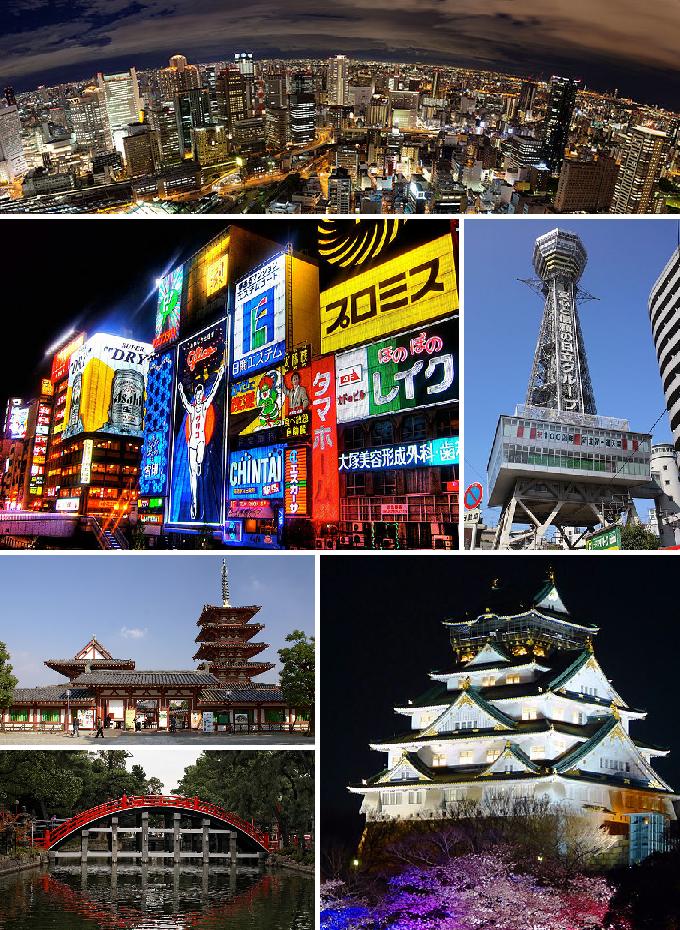
Osaka's best known sight is the Osaka Castle. While it is a reconstruction, it is pretty and has a nice castle park. The reconstruction is basically only skin deep. The interior is a generic late 20th century building, with some display cases containing artifacts related to the original structure. To learn more about the history of Osaka, you can head to the nearby Osaka Museum of History. Hirano Old CIty (平野旧市街) in Hirano is a well-saved historical city which was originally independent from Osaka. There are many temples and shrines in the city. Osaka Science Museum (大阪市立科学館) on Nakanoshima is an interactive activity center with planetarium and cinema. The Umeda Sky Building is a weirdly shaped building with an observation deck and an escalator suspended between two buildings mid-air. It is near the Osaka station. The Sumiyoshi Shrine is south of the city center. It is one of Japan's oldest Shinto shrines and has a very unusual architecture. It is also famous for a bridge arching over a pond. Japan Mint is in Osaka and is especially famous for the nearby cherry blossom tunnel road, a prime spot to see the annual cherry blossom.
The Tsūtenkaku landmark tower in the Shinsekai area with an observation platform at 91 meters. The Shitennōji temple is near the Tennōji station. It is regarded as maybe the first Buddhist temple in Japan dating back to the 6th century. The building of today's temple however, are a reconstruction. In Ryokuchi Park is the Open Air Museum of Old Farmhouses, a collection of Edo period farmhouses. This gives a good insight in the lives of the common people during this period. It is north of the city center. The Kamigata Ukiyoe Museum in Namba is dedicated to ukiyoe, Japanese woodblock prints. Tobita Shinchi in the South is Japan's largest red-light district that can easily compete with Amsterdam's one. It is well worth a visit, even though not everyone's taste.
Do
Osaka Aquarium Kaiyukan is one of the world's largest aquariums, with 11,000 tons of water and plenty of sharks (including a whale shark), dolphins, otters, seals, and other sea creatures. Nearby are the Tenpozan Ferris Wheel, the Suntory Museum, a mall, and the ferry to Universal Studios across the water. Sumo Spring Grand Tournament of Japan's national sport, sumo wrestling, is usually held mid-March at Osaka Prefectural Gymnasium.
Universal Studios Japan in the Osaka/Bay Area is Japan's second-largest theme park. Spa World in Tennoji offers gender-separated European and Asian-themed spas and saunas, and a pool for the family with slides and fun. Outdoor onsen, bar, gym, massages and body scrubs. National Bunraku Theater, near the Osaka Castle, is one of the last places in the world where bunraku, a form of intricate puppet theater from the Edo period, can be seen live. The large puppets, which require three operators each, are accompanied by traditional music and narration, and act out great Japanese plays of the 1600s and 1700s. Osaka Shiki Musical Theater in Kita, is the home of the Shiki Theatre Company, proposing plays and musicals. Kita ward is also the place to head to see jazz at Billboard Live Osaka or pop shows at Zepp Namda. The festival hall in Nakanoshima, near Umeda, and the symphony hall in Umeda host modern and classical recitals, while Umeda Koma in Umeda, and Shin-Kabukiza in Uehommachi host Enka performances. For more independent or underground music, try Banana Hall in Umeda or Big Cat in Amerika-mura. ROR Comedy is an English-language stand-up comedy playhouse in Minami. Touring the Ecomuseum of Hirano, called Hirano Machigurumi Museum (平野町ぐるみ博物館) is a good way to feel city history and ninjo (人情) of Hirano Old City.
Shopping

Osaka's most famous shopping district is Shinsaibashi (心斎橋), which offers a mix of huge department stores, high-end Western designer stores, and independent boutiques ranging from very cheap to very expensive. Within Shinsaibashi, the Amerika-mura (アメリカ村, often shortened to "Amemura") or "American Village" area is particularly popular among young people, and is often said to be the source of most youth fashion trends in Japan. Just west of Amerika-mura, Horie (堀江) is a shopping area with fashionable Japanese boutiques, centered around Tachibana-dori (which is often translated as Orange Street). The many shops in Umeda are also popular among trendy locals, particularly in the Hep Five and Hep Navio buildings adjacent to Hankyu Umeda Station, although these shops tend to be too expensive to captivate most tourists' interest. For example, the “E-ma” buildings next to Hanshin department store, and “Nu-Chayamachi” (Nu 茶屋町) near Hankyu Umeda station. For electronics, the Nipponbashi (日本橋) area southeast of Namba, and particularly the "Den-Den Town" shopping street, was once regarded as the Akihabara of western Japan; nowadays, more people would rather shop at the new, enormous Yodobashi Camera (ヨドバシカメラ) in Umeda or BicCamera (ビックカメラ) and LABI1 in Namba, although Nippombashi still offers good deals on many gadgets, PC components and used/new industrial electronics. For Japanese and foreign books, try Kinokuniya in Hankyu Umeda Station, or Junkudo south of Osaka Station. The Official Hanshin Tigers (baseball team) Shop is on the 8th floor of Hanshin Department Store at Umeda. Tenjinbashi-suji Shopping Street (天神橋筋商店街 Tenjinbashi-suji Shōtengai) is said to be the longest straight and covered shopping arcade in Japan at approx. 2.6 km length. The arcade is running north–south along Tenjinbashi-suji street, and is accessible from multiple subway and/or JR stations, e.g. Tenma, Minami-Morimachi, and Tenjinbashi-suji 6-chome. Nothing meant for sightseeing, the arcade is a live exhibition of Osaka's daily life, open since Edo period.
Eat
Individual listings can be found in Osaka's district articles
The widest selection of restaurants is in Osaka's main entertainment districts, with the highest concentration of all in the Umeda and Dotombori areas. Even in a nation of obsessive gourmands Osaka is known as an excellent place to eat, exemplified by the Osakan maxim kuidaore, "eat yourself into ruin". The best place for trying out kuidaore is probably Dōtonbori (道頓堀) and neighboring Hōzenji-yokochō (法善寺横町) or Soemon-cho (宗右衛門町), the whole area containing nearly nothing but one restaurant after another. Some typically Osakan foods worth trying include:
Battera (バッテラ), is a block type sushi, with mackerel put on rice and squeezed very hard in a wooden box, cut into pieces when served. Battera sushi is a variant and direct descendant of primitive sushi, this one from Osaka is unique for its squarelike shape. Available not only in sushi restaurants but also as take-away in department stores and train stations. Okonomiyaki (お好み焼き), fried cabbage cakes that resemble a cross between a pancake, pizza, and omelette. Takoyaki (たこ焼き), bits of octopus inside fried eggy dumplings. The quintessential Osakan street food snack. Kushikatsu (串かつ), battered and deep-fried skewers of various sorts of food (meat, vegetables, cheese, etc), dipped in a runny black sauce and washed down with beer. Osaka's working class answer to fancy tempura. Doteyaki (どて焼き), bits of beef tendon stewed in miso broth until they fall apart. Fatty, gelatinous and a common accompaniment to kushikatsu.
Drink
Individual listings can be found in Osaka's district articles There are many nightlife districts in Osaka. Nightlife in Osaka is very popular.
Kitashinchi (北新地) This area, south of JR Osaka station, is the most famous nightclub and entertainment district of contemporary Osaka. It's just like Tokyo's Ginza, filled with many hundreds of high-class bars, clubs and small restaurants where Japanese businessmen entertain their clients.
Dotonbori (道頓堀) This area is the centre of nightlife.
Sleep
Individual listings can be found in Osaka's district articles Osaka has a vast range of accommodation, including some of the best hotels in the world. Most of the city's moderate and expensive hotels can be found in Umeda, Namba, Shin-Osaka and Kyobashi, though they also have their share of budget options. Backpackers have begun to use budget hotels around the JR Shin-Imamiya (新今宮) and subway Midosuji Line Dōbutsuen-mae (動物園前) stations, in Tennoji area. Room quality varies widely and prices vary from ¥800-3000, but there are many options. The area is rather poor and there are many homeless that wander about during the day, but generally they are harmless and safety is not an issue. One benefit of the district being so poor is that prices at the supermarkets and such are generally very low. However, as always use common sense when traveling in unfamiliar areas.
Stay safe
Crime
Osaka has a reputation among the Japanese for being crime-ridden, but it is still remarkably safe compared to any Western city of similar size. However, some areas in the southern suburbs, particularly Shinsekai and Tobita Shinchi, may be a little dodgy at night and the Airin/Kamagasaki area — Japan's largest slum, home to a lot of jobless and/or homeless people — south of Shin-Imamiya is best avoided after dark. Incidentally, despite the movie stereotype of gangsters speaking in Osakan dialect, the actual base of Japan's biggest yakuza families is neighboring Kobe — and the most gang violence occurs in Tokyo. Unless you're dealing drugs or engaging in prostitution, you're unlikely to get involved with the local mafia.
Bicycles
Osaka is a city where people use bicycles heavily, so much and chaotic that even traffic police regular does "raids" along bicycle ways to check whether cyclist adhere to the rules. As a pedestrian it can become quite nerve-wrecking to have cyclist speeding on the sidewalk while you are trying to enjoy your travels. It's better to pay a little more attention in Osaka when changing route or sidewalks. And always try to walk at one side of the sidewalk and not in the middle, so cyclists don't run you over.
Go next
Its location makes Osaka a perfect base for doing one-day trips to nearby cities like Kyoto (30 minutes), Kobe (20 minutes), Nara (40 minutes) or Himeji (1 hour). (Typical times shown on JR Trains available without extra express charges starting from Osaka Station.) The Expo Park in Suita, the huge commemorial park of the Japan World Expo '70, with its interesting Japanese Garden and Museum of National Ethnology. It's a very large park, and a good place for a picnic. Hirakata - Home to the child-friendly Hirakata Park and Kansai Gaidai University. Church of Light (茨木春日丘教会 Ibaraki Kasuga-oka Kyoukai) (Ibaraki), one of the masterpiece architecture by Tadao Ando. Minō, a popular maple watching spot in autumn and nature escape all year round. From Hankyu Umeda station take the train to Minō station. It is a pleasant walk to the waterfall (~30 minutes one way) through shady forest, with wild monkeys and deer . Try the local Minoh beer or maple leaves in sweet tempura batter. The temples and lush greenery of Mount Koya, 90 minutes away by train, are an entirely different world and the perfect getaway when all the concrete starts to get to you. Akashi Kaikyo Bridge, the world's longest single-span suspension bridge is near Kobe, about 40 minutes away by train. Tokimeki Beach is a good get away if you want to spend the day at the seaside. Take the Nankai line from Namba station to Tannowa Station. The trip costs around ¥720 and takes about 45 minutes. The bag and shower service closes at 5PM.
More pictures of Osaka


From this destination's category on Wikimedia Commons. Each photograph is credited to its own author under its own licence.
The guide text on this page is from the Wikivoyage article Osaka, written by Wikivoyage contributors and published under CC BY-SA 4.0. The authors are listed in the article’s edit history. It has been shortened and re-laid-out for this page; that adapted text is available under the same licence. Nothing else on this page is.
Wikivoyage is written by travellers, not by us. Opening hours, prices and whether a place still exists are exactly the details that go out of date, so check anything you are relying on.
“2,014 readers a month” and the ranking are ours, counted from Wikimedia’s published pageviews (CC0) — the median of twelve complete months. They count people reading about a place, which is not the same as people going there.