
Yellowstone National Park
Yellowstone National Park is a national park and a UNESCO World Heritage Site. It was the world's first national park, set aside in 1872 to preserve the vast number of geysers, hot springs, and other thermal areas, as well as to protect the incredible wildlife and rugged beauty of the area. The park contains 3,472 sq mi (8,990 km2), mostly within the northwest corner of Wyoming, but with portions extending into the states of Idaho and Montana.
Most read about in June, least in October. That is when people look it up, which tends to run a month or two ahead of when they go.
Before you book
The Foreign, Commonwealth & Development Office publishes the UK’s official travel advice for United States. It changes without notice and travelling against it usually invalidates your insurance, so read it at the source rather than anywhere else — including here.
FCDO travel adviceUnderstand

History
On March 1, 1872, Yellowstone became the first national park reserve declared anywhere in the world, by President Ulysses S. Grant. In 1978 it was designated a World Heritage Site. Although it is commonly assumed that the park was named for the yellow rocks seen in the Grand Canyon of the Yellowstone, the park's name comes from the Yellowstone River that flows through it, which is in turn named after sandstone bluffs found farther down its course in eastern Montana. Long before any recorded human history in Yellowstone, a massive volcanic eruption spewed an immense volume of ash that covered all of the western U.S., much of the Midwest, parts of the US east coast, northern Mexico, and some areas in Canada. The eruption left a caldera approximately 34 by 45 miles (55 by 72 km). See volcanoes for background; Yellowstone is classed as a supervolcano and its last eruption is thought to have been a VEI-8 event with over 1000 km3 of ejecta, a thousand times more powerful than the 1980 eruption of Mt. St. Helens. The Yellowstone super volcano is believed to erupt every 600,000 to 900,000 years with the last event occurring 640,000 years ago. Its eruptions are among the largest known to have ever occurred on Earth, producing drastic climate change in their aftermath.
Landscape
They key feature of Yellowstone is the caldera of a supervolcano. Its last eruption was a stupendous (VEI-8) blast about 640,000 years ago. With half of the earth's geothermal features, Yellowstone holds the planet's most diverse and intact collection of geysers, hot springs, mudpots, and fumaroles. Its more than 300 geysers make up two thirds of all those found on earth. Combine this with more than 10,000 thermal features comprised of brilliantly colored hot springs, bubbling mudpots, and steaming fumaroles, and you have a place like no other. Yellowstone's hydrothermal features would not exist without the underlying magma body that releases tremendous heat. They also depend on sources of water, such as from the mountains surrounding the Yellowstone Plateau. There, snow and rain slowly percolate through layers of permeable rock riddled with cracks. Some of this cold water meets hot brine directly heated by the shallow magma body. The water's temperature rises well above the boiling point but the water remains in a liquid state due to the great pressure and weight of the overlying water. The result is superheated water with temperatures exceeding 400 °F (200 °C). The superheated water is less dense than the colder, heavier water sinking around it. This creates convection currents that allow the lighter, more buoyant, superheated water to begin its journey back to the surface following the cracks and weak areas through rhyolitic lava flows. This upward path is the natural "plumbing" system of the park's hydrothermal features. Once it reaches the surface, the various colors of the pools are due to different types of bacteria growing in different temperatures.
Flora and fauna
The park is the core of the Greater Yellowstone Ecosystem, one of the largest intact temperate zone ecosystems remaining on the planet, and as a result is an exceptional area for wildlife viewing. Yellowstone is home to the largest concentration of mammals in the lower 48 states. Sixty-seven different mammals live here, including grizzly bears and black bears. Gray wolves were hunted to extinction by 1926, but reintroduced from Canada in 1995, and more than 100 live in the park now, making it one of the best places to see them in the wild. In addition, the park is also home to thriving populations of coyotes and red foxes. Wolverine and lynx, which require large expanses of undisturbed habitat, are also found in the Yellowstone ecosystem. Seven native ungulate species - elk, mule deer, bison, moose, bighorn sheep, pronghorn, and white-tailed deer live here. Non-native mountain goats have colonized northern portions of the park and numerous small mammals, including beavers, are found throughout the park. Records of bird sightings have been kept in Yellowstone since its establishment in 1872; these records document 330 species of birds to date, of which approximately 148 species are known to nest in the park. The variation in elevation and broad array of habitat types found within the park contributes to the region's relatively high diversity. Glacial activity and current cool and dry conditions are likely responsible for the relatively small number of reptiles and amphibians found in the park. Yellowstone is home to more than 1,350 species of vascular plants, of which 218 are non-native.
Getting there
By plane
The principal airport serving Yellowstone is Jackson Hole Airport (JAC IATA), in Grand Teton National Park, near Jackson, and the largest airport in Wyoming. United and Delta serve Jackson Hole year-round, from Denver and Salt Lake City respectively. These airlines plus American and Frontier provide seasonal flights from those cities and eight others across the US. Other airports with commercial services are at:
Bozeman (Montana) (BZN IATA). From eight cities year round and more seasonally. During the winter only, Xanterra runs a once-a-day hotel bus from Bozeman; expect to pay $100 per person. Cody (Wyoming) (COD IATA), Yellowstone Regional Airport. From Salt Lake City and Denver. Idaho Falls (Idaho) (IDA IATA). From six cities. West Yellowstone (Montana) (WYS IATA). From Salt Lake City, Jun–Sep only.
By bus
Several bus companies provide service to the areas surrounding Yellowstone National Park, though direct bus routes into the park are limited. Here are some of the primary bus companies that operate in the region:
Getting around
A useful way to orient yourself is to visualize the roads inside Yellowstone as making a "figure-8" shape. The lower loop, West Thumb - Old Faithful - Madison - Norris - Canyon - Lake Village - West Thumb, is about 90 miles (140 kilometres) around. The upper loop, Norris - Mammoth - Tower-Roosevelt - Canyon - Norris, is about 70 miles (110 kilometres) around. The park is large.
By car
Most visitors use private vehicles to get around inside Yellowstone National Park. Roads can become very crowded whenever people stop to view wildlife; use pullouts, and be respectful of other motorists to help avoid bear-jams. When snow falls roads may be closed, and during winter months many park roads close permanently.
By bus
There is no public transportation available within the park. Xanterra Resorts provides bus tours within the park during the summer season. The Lower Loop Tour departs from locations in the southern part of the Park only. The Upper Loop Tour departs from Lake Hotel, Fishing Bridge RV Park, and Canyon Lodge to tour the northern section of the park only. The Grand Loop Tour departs from Gardiner and Mammoth Hot Springs Hotel to tour the entire park in one day. During the winter season snowcoach tours are provided from various locations. Call +1 307 344-7311 for information or reservations. In addition, during the summer season, commercial businesses offer tours originating from many area towns and cities. During the winter season, some businesses provide snowcoach tours for most park roads or bus transportation on the Mammoth Hot Springs to Cooke City road.
See

Yellowstone is world-famous for its natural heritage and beauty - and for the fact that it holds half the world's geothermal features, with more than 10,000 examples. Travelers to Yellowstone can view more than 300 geysers (such as "Old Faithful"), pools of boiling mud, and an amazing assemblage of wildlife, such as grizzly bears, wolves, bison and elk, all while standing on the surface of the Earth's largest known "super-volcano". The park can be sub-divided into approximately eight major areas, which are organized below as they would be encountered by someone traveling the park in a clockwise direction, starting from the east.
Bridge Bay, Fishing Bridge & Lake
These three regions are situated on the north side of Yellowstone Lake. Recreation options include boating, fishing, and a handful of thermal features. Thermal features and natural attractions in this area include:
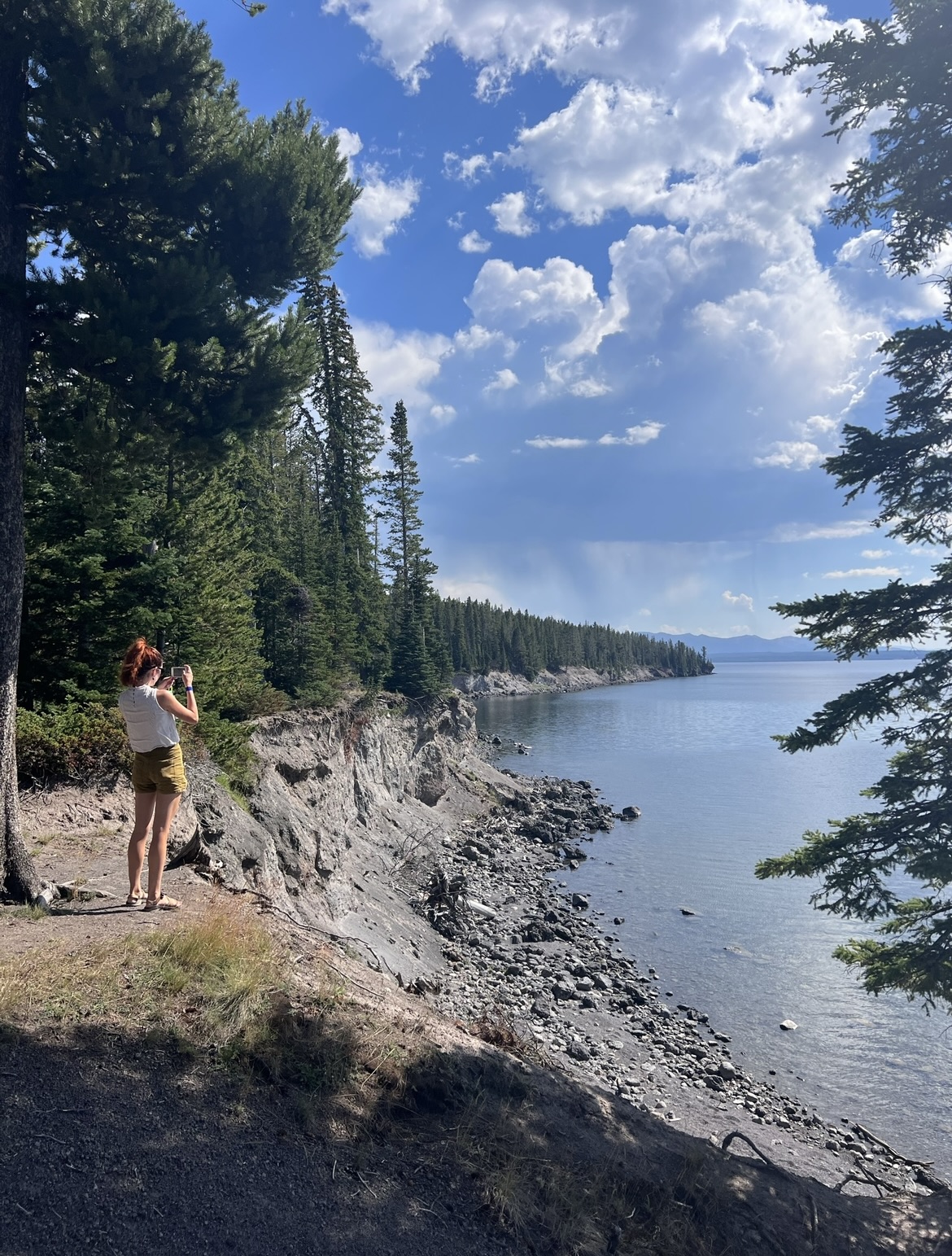
1 Yellowstone Lake. With a surface area of 132 square miles (340 square kilometres), Yellowstone Lake is the largest lake at high elevation (more than 7,000 ft) in North America. It is a natural lake, situated at 7,733 ft (2,357 m) above sea level. It is roughly 20 miles (32 km) long and 15 miles (24 km) wide with 141 miles (227 km) of shoreline. It is frozen nearly half the year. It freezes in late December or early January and thaws in late May or early June. Hayden and Pelican Valleys. The Hayden Valley is 6 miles (9.7 km) north of Fishing Bridge Junction. The Pelican Valley is 3 miles (4.8 km) east of Fishing Bridge. These two vast valleys comprise some of the best habitat in the lower 48 states for grizzly bears, bison, elk, and other wildlife species. 2 Natural Bridge (just south of Bridge Bay Campground). This rock formation is accessible via an easy one-mile (1.6 km) walk, and there is also a bicycle trail leading to the bridge. The Natural Bridge was formed by erosion of a rhyolite outcrop by Bridge Creek. The top of the bridge is approximately 51 ft (16 m) above the creek. A short switchback trail leads to the top, though travel across the bridge is now prohibited to protect this feature. 3 LeHardy Rapids (3 mi (4.8 km) north of Fishing Bridge). The LeHardy Rapids are a cascade on the Yellowstone River. Geomorphologically, it is thought that this is the actual spot where the lake ends and the river continues its northward flow. In the spring, many cut-throat trout may be seen here, resting in the shallow pools before expending bursts of energy to leap up the rapids on their way to spawn under Fishing Bridge. A boardwalk, built in 1984, provides access to the area, although it is closed during the spring nesting season to protect this sensitive bird habitat. 4 Mud Volcano. This was once a hilltop thermal feature that would hurl mud into the nearby trees during eruptions, but a particularly large eruption blew apart the Mud Volcano, leaving a hot, bubbling mud pool at the base of the hill. Access to the area is via a short loop from the parking lot past the Dragon's Mouth and the Mud Volcano that is handicapped accessible, and a half-mile (800 m) upper loop trail via Sour Lake and the Black Dragon's Caldron that is relatively steep. The rhythmic belching of steam and the flashing tongue of water give the Dragon's Mouth Spring its name, though its activity has decreased notably since December 1994. The Black Dragon's Caldron exploded onto the landscape in 1948, blowing trees out by their roots and covering the surrounding forest with mud. In January 1995, a new feature on the south bank of Mud Geyser became extremely active, covering an area of 20 by 8 feet (6.1 m × 2.4 m) and comprised of fumaroles, small pools, and frying-pan type features. The most dramatic features of the Mud Volcano area, including the huge seething mud pot known as the "Gumper", are open to the public only via off-boardwalk ranger-guided walks. 5 Sulphur Caldron. The Sulphur Caldron area can be viewed from a staging area just north of Mud Volcano. The yellow, turbulent splashing waters of the Sulphur Caldron are among the most acidic in the park with a pH of 1.3. Other features which can be viewed from this overlook are Turbulent Pool (which is no longer "turbulent") and the crater of a large, active mud pot. Historical and educational attractions in this area include:
Do

Many visitors believe they can visit all 2.2 million acres or 8.9 thousand km2 of Yellowstone in 1-2 days - all the while staying within sight of their car or tour bus. To truly appreciate this vast park, get off the park roads and paved tourist paths.
Park programs
Car Free Week. Yellowstone opens its roads to bicyclists and hikers one week before car traffic resumes each spring (usually in April). This week is a rare opportunity to see Yellowstone's sights and wildlife without the crowds and traffic. Several West Yellowstone businesses rent bikes. Ranger-led programs. Ranger-led programs are offered year-round and provide an opportunity to visit a portion of the park in a small-group setting with a ranger who will provide information about the sights along the way. Most ranger programs involve a short hike. Junior Ranger Program. The Junior Ranger Program provides an opportunity for children 5 - 12 to earn a Junior Ranger patch. Ages 5-7 can earn the Wolf patch, and Ages 8-12 can earn the Bear patch. In order to get a patch, a 12-page activity booklet needs to be answered correctly and checked by a ranger. An activity booklet costs $3. Young Scientist. Students ages 5 and up can learn about Yellowstone's geothermal features. Students are given a scientist toolkit, including an infrared thermometer, stop watch, magnifying glass and other gear. Once you've finished it, you have a choice of a patch or key chain.
Activities
Wildlife viewing. There is a great variety of wildlife to view within the park limits. Birds (osprey, bald eagles, and many, many other species,) bison, big cats, deer, wolves, coyotes, foxes, bears, big-horn sheep, elk, and other animals can all be seen within the park in a short time. The more time that you spend in the park, the more wildlife you will see. Some animals, such as wolves, bears, and big-horn sheep, are generally not viewable from the park roads. Habitat preferences and seasonal cycles of movement determine, in a general sense, where a particular animal may be at a particular time. Early morning and evening hours are when animals tend to be feeding and thus are more easily seen. Wild animals, especially females with young, are unpredictable and dangerous. Keep a safe distance from all wildlife. Each year a number of park visitors are injured by wildlife when approaching too closely. Approaching on foot within 100 yards (91 m) of bears or wolves or within 25 yards (23 m) of other wildlife is extremely dangerous and strictly prohibited. Please use roadside pullouts when viewing wildlife. The spaces within the park are grand, so make sure to bring binoculars and/or a spotting scope to view animals safely and to avoid disturbing them. By being sensitive to its needs, you will see more of an animal's natural behavior and activity. If you cause an animal to move, you are too close! It is illegal to willfully remain near or approach wildlife, including birds, within ANY distance that disturbs or displaces the animal. Horseback riding. Xanterra Parks & Resorts offers horse rides of one and two hours in length which are available at Mammoth, Tower-Roosevelt, and Canyon. Advance reservations are recommended. They also offer horseback or wagon rides which take visitors to a cookout site for a steak dinner. Advance reservations are required; call +1 307 344-7311 or +1-866-439-7375. TDD service (Telecommunications Device for the Deaf) is available at 307-344-5395. Online reservations are not available at this time. Guided stock trips into the backcountry (horse or llama) may be arranged with one of the stock outfitters licensed to operate in Yellowstone. Private stock can be brought into the park. Overnight stock use is not permitted prior to July 1, due to range readiness and/or wet trail conditions. Horses are not allowed in frontcountry campgrounds, but are permitted in certain backcountry campsites. Wilderness backpacking. Yellowstone has a designated backcountry campsite system, and a Backcountry Use Permit is required for all overnight stays. Each designated campsite has a maximum limit for the number of people and stock allowed per night. The maximum stay per campsite varies from 1 to 3 nights per trip. Campfires are permitted only in established fire pits. Wood fires are not allowed in some backcountry campsites. A food storage pole is provided at most designated campsites so that food and attractants may be secured from bears. See the Backcountry section below for additional details. Photography. Yellowstone holds unprecedented photo opportunities with natural environments, beautiful hydrothermal features, and animals to be found throughout the park. The colors of the hot springs range from bland white (for the very, very hot) to yellows and blues, greens and oranges. Some of the features are very large, and the challenge can be finding a way to get them in the frame. Be creative! There have been a lot of pictures taken in Yellowstone, and there are a lot more still waiting to be taken. Fishing. Permits are required for fishing, and not all areas are open to fishing; check with rangers. Native species include arctic grayling, Westslope cutthroat trout and Yellowstone cutthroat trout. Non-native species include brook trout, brown trout, lake trout and rainbow trout. Check the park's fishing guidelines for the latest rules and regulations. Swimming. Swimming is allowed (but not encouraged) at the Firehole Cascades swimming area, a section of the Firehole River that is warmed by hot springs. This area, accessible via the Firehole Canyon Drive, has a toilet but no lifeguard and not much parking. Swimming is also possible in the Boiling River near Mammoth. Swimming in Yellowstone Lake is permitted but not recommended due to temperatures which seldom exceed 66 °F (19 °C). Boating. A permit is required for all vessels (motorized and non-motorized including float tubes) and must be obtained in person at any of the following locations: South Entrance, Lewis Lake Campground, Grant Village Backcountry Office, and Bridge Bay Ranger Station. Non-motorized boating permits are available at West Entrance, Northeast Entrance, Mammoth Backcountry Office, Old Faithful Backcountry Office, Canyon Backcountry Office, Bechler Ranger Station, West Contact Station, West Yellowstone Chamber of Commerce and locations where motorized permits are sold. The fee is $20 (annual) or $10 (7 day) for motorized vessels and $10 (annual) or $5 (7 day) for non-motorized vessels. A Coast Guard approved wearable personal flotation device is required for each person boating. Boat permits issued in Grand Teton National Park are honored in Yellowstone, but owners must register their vessel in Yellowstone and obtain a no-charge Yellowstone validation sticker from a permit issuing station. Jet skis, personal watercraft, airboats, submersibles, and similar vessels are prohibited in Yellowstone National Park. All vessels are prohibited on park rivers and streams except the channel between Lewis and Shoshone Lakes, where only hand-propelled vessels are permitted. Outboards and rowboats may be rented (first come, first served) from Xanterra Parks & Resorts at Bridge Bay Marina on Yellowstone Lake. Xanterra also provides guided fishing boats which may be reserved in advance by calling +1 307 344-7311 or +1-866-GEYSERLAND (439-7375). Mountain biking. most trails in the park are closed to mountain bikes, however several gravel roads are open to BOTH bicycle and automotive traffic. The Old Gardiner Road and Blacktail Plateau Drive allow two-way bike traffic and one-way auto traffic. These roads are best suited for mountain bikes and usually closed to autos and offer another way to experience the park.
Shopping
Every major village within the park offers food, camping supplies, and souvenirs for sale, although these stores all close during the winter months. Gasoline and automotive services are available in the following locations:
Canyon. Open late April to early November. Gasoline, diesel and auto repair. Fishing Bridge. Open mid May to late September. Gasoline, diesel, propane and auto repair. Grant Village. Open mid April to mid October. Gasoline, diesel, propane, and auto repair. Mammoth. Open early May to mid October. Gasoline and diesel. Old Faithful (Lower). Open mid April to early November. Gasoline and diesel. Old Faithful (Upper). Open late May to late September. Gasoline and auto repair. Tower Junction. Open early June to early September. Gasoline. There is also a post office at Old Faithful Village:
1 Old Faithful Village Post Office, 1000 Old Faithful, Yellowstone National Park, WY 82190, ☏ +1 307 545-7252. Seasonal (Apr 24-Oct 20), daily 8:30am-5pm. Post office/general delivery
Eat
Most of the villages sell food supplies and may offer snack bars. The following restaurants and cafeterias are also available:
1 Canyon Lodge Dining Room. Open June-September. Breakfast 7AM - 10AM, lunch 11:30AM - 2:30PM, dinner 5PM - 10PM. Offers a breakfast buffet, à la carte lunch, and an upscale sit-down dinner. Dress is casual and reservations are not accepted. Dinner entrees include prime rib, stuffed trout, and a decent wine list. $15-$25 per person for dinner. 2 Canyon Lodge Cafeteria. June - September. Breakfast 6:30AM - 11AM, Lunch/Dinner 11:30AM - 9:30PM. A good option for budget dining, with a decent variety of breakfast fare, sandwiches, wraps, and soups. Breakfast from $5, sandwiches and wraps from $7. 3 Canyon Lodge Deli. Open June-September from 7:30AM - 9:30PM (through September), 7:30AM - 7PM (in late September). Snacks, beverages, deli sandwiches and ice cream. Sandwiches from $5. 4 Grant Village Dining Room, toll-free: +1-866-439-7375. Open late May through September. Breakfast 6:30AM - 10AM, Lunch 11:30AM - 2:30PM, Dinner 5PM - 10PM. Upscale dining in Grant Village, with options such as bison top sirloin and wild Alaska salmon. Also offers a breakfast buffet for $12 and lunch options such as burgers and wraps for around $10. Dinner reservations are required, dress code is casual. $20-$30 per person for dinner. 5 Grant Village Lakehouse Restaurant. Open late May through September for breakfast and dinner only.. With an excellent lake view, offering casual fare such as burgers, sandwiches and salads. There is also a selection of wines and beers available. $10-15 per person. 6 Lake Lodge Cafeteria. Open June-September for breakfast, lunch and dinner. Cafeteria dining including standard breakfast options, sandwiches, salads, and soups. $6-$12 per person. 7 Lake Yellowstone Hotel Dining Room, toll-free: +1-866-439-7375. Open early May through late September. Breakfast 6:30AM - 10:30AM, Lunch 11:30AM - 2:30PM, Dinner 5PM - 10PM. Upscale dining in the Lake area. Continental breakfast and breakfast buffet available daily, lunch options include specialty sandwiches and burgers. Dinner options include lobster ravioli and rack of lamb. Approximately seventy wines are available on the wine list. Dinner reservations recommended, dress code is casual. Lake Deli. Open late May to late September. Breakfast 6:30AM - 10:30AM, Sandwiches 10:30AM - 8:30PM. Deli sandwiches, soups, non-alcoholic beverages and cookies. $6-$10 per person. 8 Mammoth Hotel Dining Room, toll-free: +1-866-439-7375. Open early may through early October and late December through early March. Breakfast 6:30AM - 10AM, Lunch 11:30AM - 2:30PM, Dinner 5PM - 10PM. Upscale dining including options such as bison top sirloin and stuffed chicken breast. A decent wine list is also available. Reservations suggested during the winter season. $15-$25 per person. 9 Mammoth Terrace Grill. Open late April through mid-October. The breakfast menu includes sandwiches, cereals, juice and coffee. The deli menu includes burgers, chicken sandwiches, salads, value meals and hand-dipped ice cream. 10 Old Faithful Inn Bear Paw Deli. Open mid-May through mid-October from 6AM to 8PM. Deli sandwiches, continental breakfast, non-alcoholic beverages, beers and wine. $7-$10 per person. 11 Old Faithful Inn Dining Room, toll-free: +1-866-439-7375. Open mid-May through mid-October. Breakfast: 6:30AM - 10AM, Lunch 11:30AM - 2:30PM, Dinner 5PM - 10PM. Breakfast buffet $12 per person, lunchtime "western" buffet is $14 per person and dinner buffet is $26 per person. Alternately, a standard menu is available for any meal featuring upscale options. A decent wine list is available. Dinner reservations are recommended, dress code is casual. $20-$30 per person. 12 Old Faithful Lodge Cafeteria and Bake Shop. Open early May through early October. Offers lunch and dinner from various serving stations including sandwiches, meatloaf, turkey, salads, etc. Outside of the cafeteria is the snack shop, offering fresh-baked muffins, bagels, sandwiches and soft-serve ice cream. $7-$12 per person. 13 Old Faithful Snow Lodge Obsidian Dining Room. Open during the summer from early May through late October (breakfast and dinner) and in the winter from mid-December through early March (breakfast, lunch and dinner). Upscale dining including bison short ribs and wild Alaska salmon. Seating is first-come, first served for all meals. Breakfast is à la carte. Dinner reservations required in winter. $20-$30 per person. 14 Old Faithful Snow Lodge Geyser Grill. Open during the summer from late April through early November and in the winter from mid-December through mid-March. A take-out restaurant offering breakfast, lunch and dinner and specializing in burgers, chicken sandwiches, value meals, deli sandwiches, salads and more. The ceiling of the restaurant features whimsical character carvings. A small selection of beer and wine is also served. $6-$9. 15 Roosevelt Lodge Dining Room. Early June through early September. Breakfast 7AM - 10AM, Lunch 11:30AM - 4:30PM, Dinner 4:30PM - 9:30PM. Old West "cowboy" style dining including such fare as "Teddy's top sirloin" and mesquite smoked chicken. "After dinner libations" include an extensive selection of beers, wines and cocktails. $20-$25 per person. Old West Dinner Cookout. Early June through early September. After a ride via horse or wagon to the cookout site guests are given a steak and all-you-can-eat sides. Entertainment is provided at the cookout, usually a cowboy singer. $80 by wagon, $110 for a one hour horse ride, $135 for a two-hour horse ride.
Drink
Cocktails can be purchased in the lodge restaurants, and lighter beverages can be obtained at the snack bars.
1 Seven Stool Saloon (Grant Village Dining Room). As the name suggests, don't expect an expansive seating area. 2 Bear Pit Lounge (Old Faithful Inn). Featuring etched glass panels inspired by the original wooden Bear Pit Murals and offering a variety of wines, beers and cocktails.
Sleep

While there are an abundance of hotels and campgrounds within the park, they fill quickly in the summer so visitors may also want to consider lodging options in the gateway towns of West Yellowstone and Gardiner.
Lodging
Lodging in the park fills quickly and should be booked in advance. Cancellations are common, so if a particular lodging option is unavailable it is a good idea to re-check frequently to see if it becomes available. Reservations for all lodges and cabins in the park can be made through Xanterra Parks & Resorts or by calling (307) 344-7311. All park accommodations are non-smoking and, reflecting the natural surroundings of Yellowstone, televisions, radios, air conditioning, and Internet hook-ups are not available. During the winter the only lodging within the park is the Old Faithful Snow Lodge and the Mammoth Hotel. Getting to the Old Faithful Snow Lodge requires traveling over snow-covered roads, which usually means reserving a seat on the snowcoach at a cost of about $150 per person.
1 Canyon Lodge and Cabins, 41 Clover Ln, toll-free: +1-866-439-7375. Lodge rooms are in the Cascade and Dunraven Lodges, both built in the 1990s while the cabins were all constructed in the 1950s and 1960s. All lodging includes private bath. Open from early June through late September. Lodge Room $178, Western Cabins $183, Frontier Cabin $98 (2012 rates). 2 Grant Village, toll-free: +1-866-439-7375. The Grant Village lodging options consist of two six story buildings containing fifty rooms each. This hotel complex provides the basic amenities without some of the flair of the Old Faithful Inn but at prices that are a bit lower, and Grant Village may have greater availability due to the number of rooms available there. There is a post office nearby, as well as a cafeteria, a soda-jerk diner, and a sandwich shop in the complex, as well as a reservations-only restaurant serving local fare. Even if you decide not to eat at the restaurant, do go in to check out the large array of beautiful photographs taken by one of the long-time Yellowstone Maintenance heads, who is also one of the park photographers. Open late May through late September. $155 (2012 rates). 3 Lake Lodge Cabins, toll-free: +1-866-439-7375. All units include private bath including shower. The Western cabins are the most modern, the frontier cabins were built in the 1920s but have bern refurbished, and the pioneer cabins were built in the 1920s and have not been refurbished. Open mid-June through late September. Western Cabin $183, Frontier Cabins $109, Pioneer Cabins $75 (2012 rates). 4 Lake Yellowstone Hotel & Cabins, toll-free: +1-866-439-7375. This hotel is listed on the register of historic places and is on Lake Yellowstone (there's a boat pier and a restaurant right on the edge of the lake). The Lake Yellowstone Hotel and Cabins provide a rustic experience that probably won't excite a luxury traveller, but the staff provides the basics - decent rooms, reasonably good food, and breathtaking views of the lake and its surroundings. Watch out for mosquitos especially as you walk near the lake in mornings and afternoons in the summer, they come out in swarms, but DEET or similar mosquito repellant will keep them away. Open mid-May through late September. Suite $549, Lakeside Hotel Room $223, Hotel Room $207, Standard Room $149, Frontier Cabin $135 (2012 rates). 5 Mammoth Hot Springs Hotel & Cabins, toll-free: +1-866-439-7375. The only in-park lodging that is open year-round. The hotel offers rooms both with a private bath or with a shared bath. Another option is to stay in the many cabins next to the hotel (summer only), also with private or shared bath; hot tub cabins are also available for a premium price. For hikers just looking to clean up, showers are available for $3.25 (inquire and pay fee in advance at front desk). Suite $449, Hotel Room $120, Hotel Room with Shared Bath $87 (2012 rates). 6 Old Faithful Inn, toll-free: +1-866-439-7375. A national historic site, this rustic hotel was constructed entirely of logs during the winter of 1903. The original 120 rooms were expanded with the addition of the east wing in 1913, and the west wing was added in 1927. Major renovations were done from 2004 - 2008 to improve infrastructure and shore up the building's supports while also reverting some past modifications to bring the inn closer to its original design. Today it is the largest log hotel in the world, and the vast lobby incorporates large tree trunks as pillars and a stone fireplace. Accommodations range from rooms with shared bathrooms and showers nearby to suites with private bathrooms and refrigerators. Open from mid-May through mid-October. Suite $499, Semi-suite $399, East Wing Geyserside $237, East Wing Standard $210, West Wing Frontside $221, West Wing Standard $157, Old House Room $132, Old House Room with Shared Bath $98, Old House 2-Room Unit With Shared Bath $183, Old House 2-Room Unit $224 (2012 rates). 7 Old Faithful Lodge Cabins, toll-free: +1-866-439-7375. Frontier cabins offer private bath (including shower) while the budget cabins offer communal showers in the lodge with toilet and sink facilities near the cabins. Large windows in the lobby face Old Faithful Geyser. Gift shop, restaurants, bakery. Open from mid-May through late September. Frontier Cabins $113, Budget Cabins $69 (2012 rates). 8 Old Faithful Snow Lodge, toll-free: +1-866-439-7375. This lodge is one of only two winter lodging options within the park. All lodging options have private bath including shower. The western cabins were built in 1989 while the frontier cabins are simpler. Open December through March and May through October. Lodge Room with 2 Queens $219, Lodge Room with 1 King $229, Western Cabin $152, Frontier Cabin $96 (2012 rates). 9 Roosevelt Lodge Cabins, toll-free: +1-866-439-7375. Frontier cabins offer two double beds and private bathroom with shower. The Roughrider Cabins are sparsely furnished and heated with wood burning stoves (two "presto" logs are provided) and offer communal showers and shared bathrooms. Open mid-June through early September. Frontier Cabin $114, Roughrider Cabin $69 (2012 rates).
Stay safe

Yellowstone has some hazards related to volcanic activity. There are also hazards from dangerous animals.
Wildlife
Though many of the animals in the park are used to seeing humans, the wildlife is nonetheless wild and should not be fed or disturbed. According to park authorities, stay at least 100 yards/meters away from bears and wolves and 25 yards/meters from all other wild animals! No matter how docile they may look, bison, elk, moose, bears, and nearly all large animals can attack. Each year, dozens of visitors are injured because they didn't keep a proper distance. These animals are large, wild, and potentially dangerous, so give them their space. In addition, be aware that odors attract bears and other wildlife, so avoid carrying or cooking odorous foods and keep a clean camp; do not cook or store food in your tent. All food, garbage, or other odorous items used for preparing or cooking food must be secured from bears. Treat all odorous products such as soap, deodorant, or other toiletries in the same manner as food. Do not leave packs containing food unattended, even for a few minutes. Animals that obtain human food often become aggressive and dependent on human foods, and many can suffer ill health or death from eating a non-native diet. A short film about food safety is now mandatory before a back country permit will be issued.
Thermal areas
It is illegal to swim or bathe in thermal pools. There is a designated swimming area along the Firehole River near Madison Junction. Always stay on boardwalks in thermal areas. Scalding water lies under thin, breakable crusts; pools are near or above boiling temperatures. Every year visitors traveling off trail are seriously burned, and people have died from the scalding water. Park rangers can also issue $130 fines for being out of bounds, or much more if there is any geological damage. Serious violations can result in the visitor being banned from the park, or even facing criminal charges. It's common to get sprayed with fine mist from the geysers, though. You don't need to worry about being burned, as the water has traveled a sufficient distance to cool down, provided you're within the designated areas. (Mist can't retain heat for more than half a second.) Beware, glass lenses (such as eyeglasses and camera lenses) may be permanently damaged by the high mineral content of the water in the mist. For cameras, clear glass filters can provide inexpensive protection for high-priced lenses (be sure to have some replacements). If water from a thermal feature gets on a vulnerable lens, it must be washed off immediately. If no clean water is available, you can try – no, this is not a joke – licking the lens. If you try to wipe off the geyser water with a cleaning cloth (without rinsing the lens first), you risk grinding the suspended minerals into the glass of the lens, and scratching it. For eyeglasses, use safety goggles over glasses. These are quite cheap, and available at hardware stores.
Go next
Grand Teton National Park (WY). Yellowstone's southern neighbor is famous for its dramatic mountain vistas and its alpine lakes. The road connecting the two parks is closed during winter (early November to mid-May). West Yellowstone (MT). This town is most notable as a gateway to the park, with all the motels, services, and kitsch that park visitors require. West Yellowstone is the most convenient non-park lodging option for those planning to visit the Old Faithful area. Gardiner (MT). Just north of the park, Gardiner is another border town that provides lodging and service options. It is the most convenient non-park option for those wanting to be near the Mammoth area of Yellowstone. Cody (WY). About 50 mi (80 km) from the park's east entrance, this town offers a Wild West atmosphere in addition to lodging and service options. The Cody rodeo runs during the summer and the Buffalo Bill museum provides an excellent collection of old West artifacts and western art. Virginia City (MT). Historical gold mining town of the old west. About 90 min from West Yellowstone, and halfway to either Butte or Bozeman, Montana. In the town of Ennis, be sure to turn right at Main St. onto Montana Hwy 287, and stop following the US highway of the same number. Idaho. There are no roads in the small Idaho portion of the park, and very few visitors ever venture in. However, if you want to visit southern Idaho next, exit through West Yellowstone, and follow US Hwy 20. The first major city is Idaho Falls (just over 100 miles (160 km)).
More pictures of Yellowstone National Park



From this destination's category on Wikimedia Commons. Each photograph is credited to its own author under its own licence.
The guide text on this page is from the Wikivoyage article Yellowstone National Park, written by Wikivoyage contributors and published under CC BY-SA 4.0. The authors are listed in the article’s edit history. It has been shortened and re-laid-out for this page; that adapted text is available under the same licence. Nothing else on this page is.
Wikivoyage is written by travellers, not by us. Opening hours, prices and whether a place still exists are exactly the details that go out of date, so check anything you are relying on.
“760 readers a month” and the ranking are ours, counted from Wikimedia’s published pageviews (CC0) — the median of twelve complete months. They count people reading about a place, which is not the same as people going there.