
San Diego
From balmy beaches with a laid-back attitude to a gleaming modern image, San Diego offers much for the tourist to enjoy. Situated on the Southern California seacoast, San Diego is the second largest city in the state, with 1.4 million residents (2020), and has long attracted travelers for its ideal climate, miles of beaches, and location on the Mexican border right across from Tijuana. But there's much more here than surfer culture and a quick hop across the border. A rich maritime and military heritage lives on in San Diego, which is home to the Pacific Fleet of the United States Navy. The city has also become known for its part in the wildlife conservation movement, owing to the presence of the world-renowned San Diego Zoo and Safari Park and the Scripps Institution of Oceanography. Natural scenery abounds from rocky tidepools and seaside cliffs to desert hills and canyons inland. San Diego is a proud city that never seems to cease growing, and though the city has a strong identity many of its residents are newcomers, joining in the flood of immigrants to this city. With this has come the problems associated with Southern California cities, such as traffic jams and air pollution. And yet, though large itself, San Diego is also a place where many come to escape the hustle and bustle of Los Angeles, some 100 miles (160 km) to the northwest.
Most read about in August, least in May. That is when people look it up, which tends to run a month or two ahead of when they go.
Before you book
The Foreign, Commonwealth & Development Office publishes the UK’s official travel advice for United States. It changes without notice and travelling against it usually invalidates your insurance, so read it at the source rather than anywhere else — including here.
FCDO travel adviceUnderstand

Like much of California and the Southwestern United States, English is the predominant language with Spanish the second most widely spoken. Store signs are written in English or both languages, and many businesses have bilingual employees who speak English and Spanish.
History
The area was long inhabited by the native Kumeyaay people (also known as the Diegueño by the later Spanish settlers), who lived off the land and created a proud culture. The first time a European visited the region was in 1542, when Portuguese explorer Juan Rodriguez Cabrillo, sailing under the Spanish flag, claimed the bay for the Spanish Empire and named the site San Miguel. In November 1602, Sebastián Vizcaíno was sent to map the California coast. Arriving with his flagship "San Diego", Vizcaíno surveyed the harbor and what is now Mission Bay and Point Loma, renaming the area for the Spanish Catholic saint, St. Didacus (more commonly known as San Diego). San Diego was established in 1769 as the first European settlement and Spanish mission in California, at the present site of Old Town. However, due to the poor nature of soils in the Old Town area, the mission was eventually relocated about 5 miles up river in Mission Valley. The mission had a troubled history, seeing bloodshed between the Spanish missionaries and natives resisting conversion, and the settlement didn't grow far beyond a few hundred people owing to the fact that it was too far from navigable water. In the 19th century, San Diego passed from Spanish to Mexican to American hands. In 1850, a few years after the United States gained control of California, San Diego was officially designated a city. But with much of the westward expansion to California centered on the gold rush around San Francisco, American influences were slow to come to San Diego. Eventually they did, however, and in the 1860s Downtown was established on the shores of the bay, soon exploding in growth when the railroad arrived in the 1880s and developing into a major port. The city celebrated the opening of the Panama Canal in 1914 with a huge exposition touting San Diego's prominence and history; the fairgrounds, buildings, and exhibits of that expo formed the basis for today's Balboa Park and San Diego Zoo. The U.S. Navy discovered San Diego in the early 20th century, and constructed a coaling station on Point Loma in 1907. Ten years later, the Naval Air Station on Coronado island was established, and in later years the military would take on an increasingly important role in the city's economy, peaking with World War II, when the city's ship building yards and naval base made San Diego one of the busiest ports on the west coast. San Diego is still home to the Navy's Pacific Fleet and is a favorite leave location for many sailors. Growth in San Diego has exploded and the economy has shifted away from its maritime and military roots. The defense industry still plays a big role here, but it is now rivaled by tourism, trade, biomedical laboratories and research, with many corporations moving their headquarters here amid the huge influx of residents. San Diego is a favorite destination for retirees and tourists, drawn by the balmy weather and the many attractions the city has to offer.
Climate
With coastal temperatures around 75 °F (24 °C) most of the time, the city's weather is close to ideal. The climate of Southern California is rather complex, however, and temperatures change rapidly as one travels from the coast eastward. In the summer during the day, the temperature might increase as much as one degree Fahrenheit for each mile going east. In the winter, especially at night, eastern areas are usually relatively cooler. Some valleys and other areas have significantly different weather due to terrain and other factors. These are often referred to as "micro-climates". Daylight hours vary between 6:45AM- 4:45PM in the winter months; the summer months see sunrises around 5:45AM and the sun down before 8PM. If you're coming to San Diego for sunny weather, avoid May or June, when the city is covered in clouds most days, a phenomenon the locals call "May Gray" or "June Gloom". Along the beach during the warmer half of the year, it can get surprisingly cool after dark, even when it's not too cold a short distance inland. The months of March and April typically see the strongest winds. Along the coast, fog is most common in September through April; it is not uncommon to see three to seven foggy days per month. September is usually the hottest month of the year in the daytime. Daily averages typically peak with a high of 77 °F (25 °C) and a low of 68 °F (20 °C). There are some exceptionally hot days from time to time that can see temperatures upwards to 83 °F (28 °C) with lows of 72 °F (22 °C), but in more uncommon instances hotter temperatures can result. During the late summer and fall, hot, dry air blows from the desert to the coast: the Santa Ana winds. Milder Santa Anas can result in excellent dry air conditions, but powerful ones can last days on end, raising temperatures, making the outdoors unpleasant, and increasing the risk of fires. Mid-September through October is the riskiest time for wildfires, because of the long absence of substantial rainfall.
What's inside
A city defined by its many neighborhoods, San Diego really doesn't have any clearly defined districts. This list, by no means an official division, is a reflection on how a visitor might see the city based on its attractions and amenities.
Getting there

By plane
See also: San Diego International Airport 1 San Diego International Airport (SAN IATA) (less than 10 minutes from downtown San Diego). The descent into the airport from the east comes remarkably close to downtown buildings, which can be a bit alarming for first-time visitors. Alaska Airlines and Southwest are the dominant airlines at San Diego. The airport has international flights, mostly from Mexico and Canada but also Munich, London–Heathrow, Tokyo–Narita, and Zurich. Visitors to California from other countries will most likely travel through Los Angeles (LAX IATA) or San Francisco (SFO IATA). However, San Diego has non-stops from Hawaii (via Alaska Airlines, Hawaiian Airlines, and Southwest Airlines), most major American hubs including Atlanta, Chicago–O'Hare, Dallas, Houston, New York–JFK, and some smaller non-hubs. If traveling from Mexico, it may be advantageous to fly into Tijuana on a domestic flight and then take the CBX Pedestrian Bridge directly from the airport into San Diego. This allows you to skip the border crossings in San Ysidro with its lengthy delays. (updated Apr 2020) Terminal 1 – Has two concourses, East and West, plus the annex for gates 1 and 2. If you are connecting on Southwest, keep in mind there are three separate secure gate areas. Should you have to transfer aircraft, you might have to go through security again. Terminal 1 West – Low-cost carriers including Allegiant Air, Frontier Airlines, JetBlue, Southwest Airlines, and Sun Country Airlines Terminal 1 East – Southwest Terminal 2 – Terminal 2 has two concourses, East and West. Terminal 2 East – Served by American Airlines and Alaska Airlines Terminal 2 West – Delta Air Lines, Hawaiian Airlines, United Airlines, all international carriers, and international arrivals on U.S. airlines (even if you departed from Terminal 1) Airport shuttle companies handle transportation to and from the San Diego airport. They generally cost around $15 per person. MTS bus #992 The Flyer ($2.25 per boarding or $6 for a day ticket to transfer to another bus or trolley) takes 10 minutes to travel from both terminals to Santa Fe Depot in downtown San Diego, where you can connect to other MTS bus routes, the Coaster commuter train, the Trolley, and Amtrak. There is also a direct free shuttle from both terminals to the Old Town Transit Center & trolley stop where passengers can connect to Greyhound, additional MTS buses/trains, or walk over to visit the famous Old Town. The 2 Airport Consolidated Car Rental Center is on the opposite side of the airport from the terminals, at 3355 Admiral Boland Way directly off of Pacific Highway north of downtown; from I-5 take the Sassafras Street exit and head towards the airport. The terminals are located along Harbor Drive between downtown and Point Loma. Free shuttles run regularly between the airport terminals and the rental car center. There is a separate 3 USO Neil Ash Airport Center, at opposite side of the road from the international arrivals doors, for military personnel and their families transiting into or out of the area and for travelers reporting for duty to the USMC Boot Camp (Recruit Depot). The USO is accessed via the Eastern Skybridge from Terminal 2. For international travelers, flying into Los Angeles (LAX) and then taking ground transportation may be cheaper. Take the LAX Flyaway bus to Union Station, then Amtrak or Greyhound to San Diego. 4 General Abelardo L. Rodríguez Airport or Tijuana International Airport (TIJ IATA) in Mexico is not far from San Diego, and may be an option especially if traveling to/from Mexico as the fares would be less expensive as a domestic flight than if flying between Los Angeles or San Diego and Mexico. It offers numerous domestic flights from many destinations in Mexico. This allows many tourists from the Pacific Rim to bypass the Los Angeles or San Francisco airports when connecting to Latin America or arriving closer to San Diego. Tokyo flights now go direct to Mexico City. As this airport is not in the United States, travelers will need to make sure that they have the proper documentation such as passports or visas for their respective nationality to travel through Mexico into the United States. However, you may access the Tijuana Airport from the U.S. side of the border at the 5 Cross Border Express Terminal (CBX). A 120 m (390 ft) airport border-crossing pedestrian only bridge connects the CBX terminal into the main terminal in the Mexican side of the border. Passengers pay a US$19.95 to $26.95 toll each way (or $37.95 to $49.95 return), depending on season and direction, to walk across the bridge from the CBX terminal to the main terminal for departures and to enter the US for arrivals. The bridge is privately owned, and part of the fee pays for the U.S. Customs and Immigration inspectors. This is much faster than going through the vehicle inspection lanes, which often have hours-long delays. There's a shuttle that connects passengers from the downtown Santa Fe Station and from the Las Americas Premium Outlet Mall in San Ysiro to the CBX terminal (the last bus from the CBX to San Diego leaves at 20:30; bus stop is to the right as you exit the CBX). On return they offer drop off at the San Diego Airport on request. A cheaper but longer way going south is the 'UC San Diego Blue Line' trolley down to San Ysidro, cross the border on foot into Mexico and a taxi over to the airport in the Mexican side. The White & Orange 'Libre' Taxi is cheaper than the solid yellow taxis. Taxis of other color combinations are shared ride taxis operating on a fixed route like a bus. If coming to the United States it would be quicker to walk across the bridge into the second CBX terminal and take the CBX shuttle to downtown San Diego or San Ysidro bus station. This avoids the wait times for pedestrians and vehicles going into the United States as the wait times are longer going into the U.S. than to Mexico. Private pilots will prefer the nearby general aviation airports, 6 Montgomery-Gibbs Executive Airport (MYF IATA) in Clairemont Mesa, 7 Gillespie Field (SEE IATA) in El Cajon, or 8 Brown Field Municipal Airport (SDM IATA) east of San Ysidro. There are several more in North County, including 9 McClellan-Palomar Airport (CLD IATA) in Carlsbad which is also served by SurfAir as the only small commercial carrier. If you are flying to the San Diego area from the east, watch out for the 5,722-foot (1,744-m) Volcan Mountain near Julian. Private aircraft have flown straight into the mountain at night, often with deadly results. Some air taxi and air charter firms offer specials to the San Diego area from local airports, including from many smaller Los Angeles airports and from the San Luis Obispo area.
By train
Amtrak, toll-free: +1-800-872-7245. Amtrak operates from the historic 10 Santa Fe Depot, downtown at 1050 Kettner Blvd. The station is the southern terminus of Amtrak's frequent Pacific Surfliner route, which runs north to Los Angeles and San Luis Obispo. The depot is within walking distance of downtown hotels and near San Diego Bay. There are also secondary rail stations in Old Town and Sorrento Valley, used mainly by the Coaster (Commuter) Train. The trolley stops at Old Town and the downtown Santa Fe Station while the Amtrak Pacific Surfliner stops at Old Town, Solana Beach and Oceanside. Check if your train stops at the Old Town stop (OLT), if you plan to get off there. If you are coming from or going to areas of San Diego north of downtown, such as La Jolla or Mission Valley, the Old Town station is much easier to access than the Downtown (SAN) train station. Coaster, ☏ +1-800-262-7837. A commuter train that runs north from downtown along the coast into northern San Diego County all the way to Oceanside where it connects to the Metrolink commuter rail service from Los Angeles and the Sprinter light rail service from Escondido. Fares are based on how far you ride; a one-way fare will be in the range of $4-5.50 ($2-2.75 seniors, July 2018). Tickets must be purchased from the ticket vending machines located at each station.
By car
San Diego is easily accessible by car via the 5, 8, and 15 interstate freeways:
Getting around
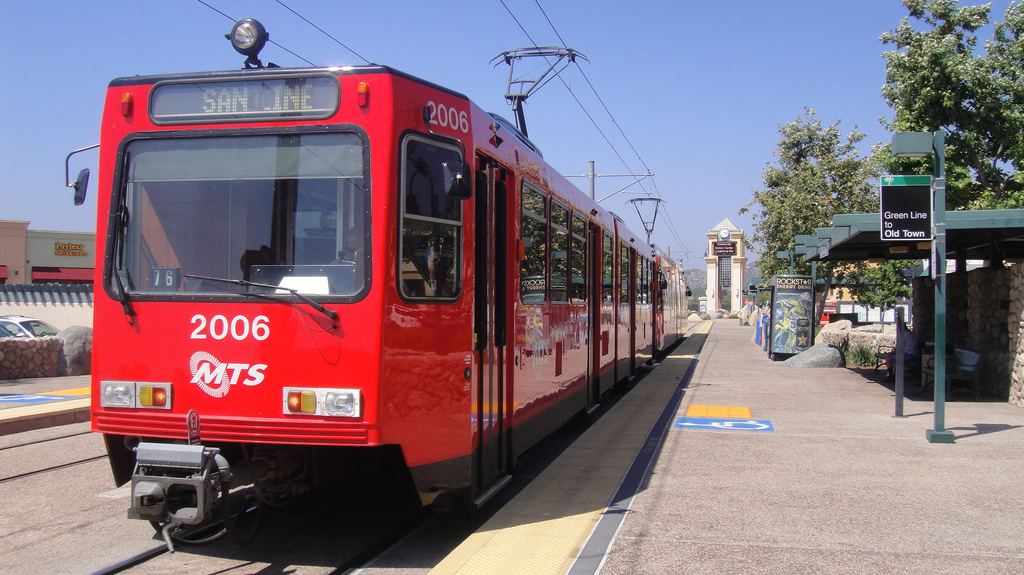
The San Diego metropolitan area is large and sprawling. Car travel is the most efficient way of navigating the city and county. If you want to "see it all", rent a car. For less ambitious itineraries, public transportation may be used with enough planning and time allotted for travel. Most San Diego addresses do not include the cardinal directions of north, south, east, and west. This is because the address grid north of Mission Valley is totally separate from that to the south, and nearly everything is east of the ocean. The exception is in the downtown area, where streets west of 1st Avenue are designated "west." For example, 234 Broadway in downtown is assumed to be East Broadway, while 234 West Broadway would never drop the word "west." Unlike the greater Los Angeles area, the freeways go by their route numbers and not their names. Although most of the San Diego freeways do in fact have names, in practice, they're almost never used.
By car
Throughout the Downtown and beach communities, on-street parking is metered. Parking meters accept coins, pre-paid Parking Meter Cards, and some newer meters accept credit cards. For more information on parking meters and enforcement, or to purchase a pre-paid meter card, visit the City of San Diego Parking Administration website. Gas/petrol prices tend to be higher than elsewhere in the U.S., but gas is cheapest in the outlying communities of El Cajon, Santee, Lemon Grove, Poway, and Chula Vista. Many intersections with a traffic signal allow U-turns. If making a right turn on red, look both ways beforehand. All the major rental car companies operate at the San Diego Airport, though most require you to take a 2½-mile shuttle which goes behind the terminal and runway. To get to the I-5 freeway, turn right at Sassafras Street, then cross the railroad tracks. Do not mistake the railroad crossing for Kettner Blvd./I-5 south as a few visitors have done (mostly after dark) over the years. These tracks are heavily used by Amtrak and other rail services, and there's a good chance of being hit by a train if you make a wrong turn. Likewise, the car rental returns are near the railroad tracks, so don't blindly follow your GPS before making a turn. Parking in the city center can be expensive and difficult to find, so using ride-sharing apps like Uber or Lyft is often more convenient.
Bus
The Metropolitan Transit System (MTS) operates bus service to large portions of the county, although service in many areas is sparse and infrequent. The weakest points in the transit system are suburb-to-suburb travel and poor links between some of the individual coastal communities, both of which often require long trips to one of the transit hubs, then back out. If you will be mainly in the areas around downtown, the bus may be suitable, but service generally gets weaker the farther you are from the central area. A few newer and wealthier communities have no public transportation at all, such as Carmel Valley (east of Del Mar). There is a bus service every 15 minutes or so (at least on weekdays) between Downtown San Diego and a number of destinations useful to tourists. These include the Airport, the Zoo, and neighborhoods such as Hillcrest, North Park, and La Jolla (about an hour ride). There is frequent service to Sea World and Pacific Beach from the Old Town Transit Center, where the trolley stops. Service from Downtown to Coronado and Ocean Beach is about once every 30 minutes. All downtown buses intersect with Broadway at some point. During the day all kinds of people will be taking the bus; at night some people might feel a little less comfortable, but generally not unsafe in the main parts of downtown. MTS buses and the Trolley (see below) use an electronic fare system called PRONTO. Money can be loaded onto a physical card (which costs $2 to purchase) or a virtual card via a smartphone app for iOS or Android (no additional charge). The card is tapped or a QR-like code on the app is scanned on boarding. The fare for standard and Rapid buses is $2.50 and includes free transfers (including to the Trolley) for 2 hours after first use (Rapid Express buses cost $5.00 but are mainly catered to commuters). Taking $6.00 worth of trips on a single day automatically "earns" a day pass, making additional rides that day free.
See

Individual listings can be found in San Diego's district articles See San Diego with children for travelers with children. A couple of combination passes are available which offer discounted admission to multiple attractions:
Go San Diego Card. Covers admission and express entry to over 40 attractions, including Sea World San Diego, Legoland California, San Diego Zoo, San Diego Zoo Safari Park, USS Midway Museum, Birch Aquarium, and all Balboa Park museums. Southern California CityPass. Gives you one day each at SeaWorld San Diego, Legoland California, and a 3-day park hopper ticket for Disneyland, as well as one-day admission to either the San Diego Zoo or the San Diego Zoo Safari Park for an additional fee if purchased online.
Zoological
One of San Diego's main claims to fame is its array of renowned zoological attractions which are at the forefront in the wildlife conservation movement. Of them, the most respected is the San Diego Zoo, a massive zoo that encompasses over 100 acres of Balboa Park and is possibly the premier zoo in North America. One of the earliest adopters of naturalistic animal exhibits, this is also one of the most gorgeous zoos in the world. Animal shows run constantly, and there are creatures here that aren't visible in any other zoo on the planet. It's definitely worth a visit, but you need a full day to really do it justice. The sister park to the San Diego Zoo and another stellar attraction in its own right, the San Diego Zoo Safari Park covers 1800 acres of the San Pasqual Valley, about 30 miles (50 km) north of Downtown San Diego near Escondido. Here the wide open expanse of the desert valley has enabled the creation of stunningly huge exhibits that resemble African savanna, where herds of animals roam and drink from watering holes. Like the Zoo, the Safari Park is also well worth a trip, but also requires a full day to take it in. Considerably smaller but also important in its own right is the Birch Aquarium in La Jolla, the public face of the renowned Scripps Institute of Oceanography. The Birch holds fantastic exhibits which cover physical oceanography and plenty of beautiful aquarium fish, with highlights including a touchpool and a massive kelp tank that is a simulation of ocean life just off the San Diego coast. Less scientifically renowned but popular in its own right is Sea World on Mission Bay, the California branch of the marine theme park chain with its numerous animal shows and enclosures showcasing sharks, penguins, polar bears, dolphins, and killer whales among other marine animals. Also in the area and something of a hidden gem is the Living Coast Discovery Center, a nature center in the marshes of San Diego Bay in Chula Vista with a lot of interactive exhibits on the native wildlife.
Do

Individual listings can be found in San Diego's district articles
Beaches
Along San Diego's coast you can find miles of beaches providing excellent opportunities for swimming, surfing, and general beach-going. Each beach is unique, ranging from popular white sand beaches to harsh surf spots to the clothing-optional Black's Beach in La Jolla. Surf conditions vary by beach, and there are numerous surf schools throughout the San Diego area. Among San Diego's beaches, Mission Beach and Pacific Beach are the most popular, with a connected boardwalk popular with bicyclists and roller bladers and plenty of shops, restaurants and bars catering to the huge crowds that show up, as well as a pier in Pacific Beach and a seaside amusement park on Mission Beach. This area tends to be the center of the Spring Break scene and has some of the calmest ocean swimming and surfing in San Diego, albeit also the most crowded. To the south, Ocean Beach draws a more local crowd, with a large sandy beach, a fishing pier, and designated surfing and swimming zones, as well as a dog beach at the northern end, making it a good place to come if you want to get a taste of the local beach culture away from the crowds of Mission and Pacific Beaches. Further to the south, Coronado's main beach is noteworthy for its gleaming white sands and mostly family crowd, while the Silver Strand extending between Coronado and Imperial Beach has some excellent swimming and surfing spots. To the north, La Jolla has some of the most scenic beaches around, including the popular La Jolla Cove, frequented by swimmers, snorkelers and scuba divers. Surfing is not allowed in the Cove, but the nearby Windansea Beach and Marine Street Beach are proven places to test your mettle against some rough surf. La Jolla Shores has some of the gentlest waves anywhere in San Diego, while Torrey Pines State Beach is arguably the most scenic, set against steep cliffs and a splendid place to get away from the crowds. Even further north, the coast of Northern San Diego County offers multiple scenic and popular beaches.
Water recreation
San Diego Bay offers amble opportunities for sailors to enjoy boating, with plenty of anchorages and marinas catering to all boaters. Launch ramps and marinas are located in Point Loma, Downtown, Coronado, National City and Chula Vista (see separate pages for specific places). Some anchorages require a permit, while others do not. If a permit is required, it can be obtained at the Shelter Island Harbor Police Facility in Point Loma (1401 Shelter Island Drive, ☏ +1 619-686-6272). There are also several moorings throughout the harbor for vessels ranging from two to 65 feet in length; see the SD Mooring Company Office on Harbor Island (near the airport; 2040 N. Harbor Island Drive, ☏ +1 619-291-0916) for a mooring application. San Diego Bay and the calmer man-made inlet of Mission Bay are also excellent places for sailing, windsurfing, and jet skiing, with rentals and lessons offered on Mission Bay. The calm waters of Mission Bay also make it an excellent place for kayaking, with numerous rental places. Kayaking is also superb at La Jolla Shores, where you can see leopard sharks, dolphins, sea turtles, sea lions and pelicans, and explore ocean caves. San Diego also features some great scuba diving, including the "Wreck Alley" where you can see kelp beds and explore the shipwrecks of the Yukon and the Ruby E. In addition, several dive boat operators offer regular runs to the Coronados Islands off the Mexican coast where you can dive with sea lions. Diving here is usually considered cold water diving and visibility is not always the greatest. If you're looking for a more casual way to get on the water, there are also whale watching cruises. California gray whales migrate south along the coast each February, and there are some great places along the coast to view the migration, such as the overlook in Cabrillo National Monument (in Point Loma). Several private companies offer sailing tours during the migration season that bring you much closer to the whales. The City of San Diego also operates public pools at affordable prices. Unlike many public pools in the US, San Diego's pools have an emphasis on lap swimming. However, all pools offer recreational swimming as well. Some offer play structures for children depending on location.
Shopping
Individual listings can be found in San Diego's district articles San Diego is dotted with major shopping centers and upscale boutiques catering to nearly every style of dress and expression. The most well-known shopping centers in the area are Fashion Valley and Westfield Mission Valley in Mission Valley and Westfield UTC near La Jolla. In addition to these, one can find numerous other malls and outlet centers across the city. If you're more interested in smaller shops and more local businesses than you'd ordinarily find in your average mall, Downtown, Hillcrest, and the beach neighborhoods (Ocean Beach, Pacific Beach, La Jolla, etc.) offer a slightly more unique shopping scene. San Diego County has some unique antique markets, with a treasure trove of high end stores, as well as a host of second hand shops, bric a brac, and vintage stores.
Groceries and other basics
The major supermarket chains in San Diego are Ralph's (which is owned by Kroger), Vons (which is owned by Albertsons), Smart & Final, and Grocery Outlet. In addition many specialty and organic supermarkets such as Whole Foods Market, Jimbos, Sprouts Farmers Market, and Trader Joe's can also be found throughout the area along with ethnic supermarkets catering to San Diego's sizable immigrant populations including Mexican, Chinese, Vietnamese, Filipino, Italian, and many others.
Eat

Individual listings can be found in San Diego's district articles Like any large metropolitan area, San Diego offers a wide variety of national and international cuisine. Food representing almost every world cuisine can be found somewhere in the city, and major restaurant chains are found in almost every district. Some of the best districts for fine dining are Downtown, Hillcrest, and La Jolla, which all offer extensive options that cater to both a local and tourist crowd. Pacific Beach also has a bustling — albeit more laid-back — dining scene, while the neighborhoods of Mid-City (particularly Kensington and North Park) have plenty of great restaurants that cater to a more local crowd. Other food scenes of note in San Diego are the concentration of Italian restaurants and delis in Little Italy in Downtown and the numerous Southeast Asian restaurants and markets that serve the large Asian-American population in Kearny Mesa. Given the proximity to the border, it should come as no surprise that Mexican food is abundant in San Diego. Be sure to look beyond the touristy (and generally overpriced) concentration of Mexican restaurants in Old Town; this city offers endless options for Mexican food, from hole-in-the-wall taco joints to fine dining. Ask a local for their opinion; every San Diegan has their favorite place. A local specialty is rolled tacos, which consist of beef or chicken tightly rolled into a corn tortilla and fried until crispy, then served with guacamole and shredded cheese piled on top. You can find them all over Southern California, but the best ones are to be found in San Diego, where they're ubiquitous. Other quintessential San Diego menu items not to be missed are fish tacos and the carne asada burrito; unlike other regional burrito varieties that tend to use rice and beans as filler, the San Diego variety is typically jam-packed with chunks of carne asada steak with some guacamole and pico de gallo mixed in, making for an immensely satisfying meal. A variant of the carne asada burrito is the California burrito, which contains carne asada, French fries, cheese, and some combination of cilantro, pico de gallo, sour cream, onion, or guacamole.
Drink
Individual listings can be found in San Diego's district articles Bars and clubs can stay open past 2AM but are not permitted to sell alcohol after this time. Expect beer bars to be open until midnight and bars and clubs to call last call around 1:30-1:50AM. A medium-sized beer generally costs $4-5 in a restaurant. The best bar scenes in San Diego are in the Gaslamp Quarter area of Downtown and in Pacific Beach. San Diego is well-known for its craft-brewing scene, with an emphasis on highly-hopped beers. Local brewers of distinction include AleSmith Brewing Company, Stone Brewing Company, Karl Strauss Brewing Company, Green Flash Brewing Company, Coronado Brewing Company, Ballast Point Brewing Company, and Port Brewing Company. Craft beer can generally be found at nearly every bar in San Diego. In addition, many specialty craft beer bars are scattered throughout San Diego, boasting some of the best and most unique selections of beer in the country. Happy hour specials are very popular in San Diego, offering some of the best and cheapest deals on food and drink in the city. The Pacific Beach and Downtown areas are particularly known for their numerous bars and restaurants offering deals during happy hour.
Sleep
Individual listings can be found in San Diego's district articles San Diego offers a wide range of accommodation and a wide range of price levels. If you don't mind splurging, there are luxury highrise hotels in Downtown and many beachside (and bayside) hotels and lavish resorts along the coast in Coronado, Ocean Beach, Point Loma (along the bayside), Mission Beach/Bay, Pacific Beach, and La Jolla. There are also many vacation rentals and beach cottages available for the traveler, most of which can be found along the shores of Mission Beach and Pacific Beach. For travelers with a smaller budget, San Diego also has a few downtown hostels and many chain motels scattered across the city. A high concentration of the chain motels are along Hotel Circle in Mission Valley. Comic-Con is a massive celebration of geek culture. Lodging, even well outside of downtown, becomes expensive and scarce during this time, so if this isn't your scene, you probably want to check the website for when it's going on and avoid San Diego.
Public County Campgrounds
The County of San Diego Parks & Recreation offers nine public campgrounds in the San Diego county, not all of which are within the districts highlighted above. Reservations are recommended, especially on weekends. The full list of these campgrounds as of 2022 is:
Agua Caliente County Park - offers tent camping and cabins Dos Picos County Park - offers tent camping and ADA-accessible cabins Guajome Regional Park - tent camping, RV camping, and one cabin Lake Morena County Park - good for angler fishing, BYO drinking water, near Pacific Crest Trail - tent camping and some cabins Oakoasis County Park - youth groups only Potrero County Park - near Tecate border crossing - offers hiker/biker campsites, regular tent camping, two cabins Sweetwater Summit County Park - popular with people who ride horses, most common campsite pests are ants and squirrels - offers tent campsites, RV campsites, and camping sites with horse corrals Tijuana River Valley Regional Park - popular with people who ride horses, near San Ysidro border crossing - tent campsites, yurts Vallecito County Park - offers tent campsites and campsites with horse corrals William Heise County Park - at 4000+ feet - offers tent campsites and cabins All county campgrounds use shower tokens, you should get them when you check in, the person checking you in may not remember to remind you and then you'll need them when you go to shower in the morning and the booth is closed.
Stay safe

San Diego is considered to be one of the safest cities in California. Though crime is present, violent crime is on an overall decrease, but property crime still exists. Avoid walking in Southeast San Diego or Barrio Logan (near or under the Coronado bridge) at night. If you do or must, avoid walking down dark alleyways or approaching unknown people. Most people do not encounter any problems if they avoid buying illegal drugs or patronizing sex workers. In addition, gangs are not as present as they are in Los Angeles, but they still exist. In an emergency (immediate danger to loss of life or limb), call 911 to reach the Police Department, Fire Department, and/or to call for an ambulance. If you call from a cell phone, 911 calls are directed to the California Highway Patrol, which can result in delays in contacting city police. (911 calls made from land-line telephones are directed to the appropriate local agency.) 911 calls are free from all phones including pay phones. In many cases, when within the city limits, it may be more appropriate to directly dial the San Diego non-emergency number, ☏ +1 619-531-2000. For example, to report a crime in progress when you are not in direct danger, it is probably best to call the San Diego Police (or other local municipality) directly.
Police
San Diego is served by a professional police force as well as a county sheriff department. Additional protection is offered on the major highways by the California Highway Patrol (CHP). To report a non-emergency within city limits, call ☏ +1 619-531-2000.
Fire Department
The city of San Diego fire department offers fire protection, emergency medical care, hazardous waste cleanup, and search and rescue functions. If you dial 911 for an emergency the first responders will be the San Diego Fire Department. Urban brush fires are always a risk during the summer and fall, but rarely affect tourists.
Go next
San Diego is probably the best city in America for making a quick trip to Mexico. Tijuana, which sits directly across the US - Mexico border, can be reached by public transit. The San Diego Trolley's Blue Line provides service from downtown San Diego to the border. The trip on the trolley takes about 45 minutes from downtown. Once you reach the end of the line (San Ysidro), follow the people and signs to the border crossing. It takes less than five minutes from the trolley stop to the border. Once across, it is either a 20-minute walk or a 5-minute cab ride to reach Av. Revolucion, the main tourist shopping street in Tijuana. If you take a car, avoid driving hassles and long waits when returning by parking in pay lots near the border and walking across. This also saves you the added expense of purchasing Mexican insurance on the US side before you drive into Mexico. Be warned: it is illegal to drive your car or a rental car into Mexico without this type of insurance. Otherwise, taxis, buses, and private car hires are all available. If traveling to Tijuana Airport, the Mexican airline Volaris operates a bus service between that airport and San Diego's Santa Fe Train Depot. For a delightful, low-key alternative, drive 60 minutes on the American side to the small border crossing of Tecate (home of the Tecate brewery). It's a short walk to the town square. Coming back, the line is usually shorter here at the pedestrian crossing. You can easily combine a trip to the train museum in nearby Campo with a quick trip across the border for lunch! The greater San Diego County has a lot of smaller, more private beaches to the north (e.g., Del Mar and Encinitas). Del Mar has the largest county fair in the nation (June-early July), and horse racing mid summer to fall, plus November. There are also some great small towns to stay in and explore. Carlsbad, about 30 miles (50 km) north on I-5, is home to the popular Legoland California theme park. Further east, the Imperial Valley and the California Desert give a change of scenery. Julian is the largest and most popular mountain community in San Diego County. Also, nearby is Cuyamaca Rancho State Park and Palomar Mountain which has a large observatory. Beware, on hot summer days, the mountains are actually warmer than the city (as they're next to the desert). Temecula Wine Country is located about 60 minutes northeast of San Diego on I-15 and makes a good day trip. There are about 30 wineries (with tasting rooms) fairly close to each other. One hour further is the mountain resort of Idyllwild which features shopping and outdoor activities in an alpine forest. It's also relatively easy to get up to Los Angeles and other points in Southern California. Interstate 5 extends through the San Joaquin Valley of California, Oregon and Washington to the Canadian border. Although slower, California Route 1 (Highway 1 or Pacific Coast Highway in most of Southern California) and the US Route 101, through the Central Coast, Monterey Bay, and the San Francisco Bay Area, makes for more of a pleasant and fruitful trip. There is no gas/petrol or other services on I-5 between Oceanside and San Clemente for a distance of about 20 miles (32 km). Hourly Greyhound and Amtrak service available to Los Angeles, with service extending further at less frequency. There are no boats to Catalina Island (Avalon) within San Diego County. You'll have to go north into neighboring Orange County to the pier at Dana Point. By car, take I-5 to exit #79 Pacific Coast Hwy 1 (make reservations). A car-free option includes taking Amtrak to San Clemente and a bus or Uber to the boat dock.
More pictures of San Diego


From this destination's category on Wikimedia Commons. Each photograph is credited to its own author under its own licence.
The guide text on this page is from the Wikivoyage article San Diego, written by Wikivoyage contributors and published under CC BY-SA 4.0. The authors are listed in the article’s edit history. It has been shortened and re-laid-out for this page; that adapted text is available under the same licence. Nothing else on this page is.
Wikivoyage is written by travellers, not by us. Opening hours, prices and whether a place still exists are exactly the details that go out of date, so check anything you are relying on.
“1,590 readers a month” and the ranking are ours, counted from Wikimedia’s published pageviews (CC0) — the median of twelve complete months. They count people reading about a place, which is not the same as people going there.