
Manchester
Manchester is a vibrant, post-industrial gem at the heart of North West England. The city that used to be nicknamed 'Cottonopolis' (a reference to its most famous export) has hung up its clogs and, thanks to successive regeneration projects, is now a major centre for culture and commerce; seen by many as the capital of the north of England, and sometimes regarded as England's second city. The site of the world's oldest surviving passenger railway station and one of the birthplaces of socialism and the Industrial Revolution, Manchester remains at the vanguard of British culture and technology with a verve and a vibe of its own. This vivacious spirit is augmented by the city's two world-famous football clubs and large student population; whilst the mills have been swapped for Michelin stars and the warehouses for world-class shopping and museums, this is still a city that is very proud of its industrial past and of its influences on music and sport. Smaller than London, Manchester offers the 'buzz' of a large city without the overwhelming scale of the capital. Outside of the city 'proper' lies Greater Manchester, home to 2.8 million inhabitants, unique shopping destinations, urban havens and beautiful countryside. The region also hosts Manchester Airport, one of the UK's best-run international airports and the busiest British airport outside of South East England. Throughout time, writers have sought to describe the magic of Manchester: George Orwell called it "the belly and guts of the Nation"; Edward Abbott Parry "a synonym for energy and freedom", but Ian Brown, lead singer of The Stone Roses, perhaps summed up the Mancunian spirit best when he said "Manchester's got everything except a beach". The sand is almost certainly on order already.
Most read about in August, least in May. That is when people look it up, which tends to run a month or two ahead of when they go.
Before you book
The Foreign, Commonwealth & Development Office publishes the UK’s official travel advice for United Kingdom. It changes without notice and travelling against it usually invalidates your insurance, so read it at the source rather than anywhere else — including here.
FCDO travel adviceUnderstand

The city is in the North West of England, between Liverpool and Leeds. It is seen by many as a young, vibrant and cutting edge city, where there is always something happening. The "Manchester brand" is seen to extend well beyond the city's boundaries (covering all of neighbouring Salford and Trafford, as well as districts of other boroughs) and even beyond those of Greater Manchester. This serves to reflect the influence it has on the wider region as a whole. Manchester is a friendly city as well. Northerners do talk to each other and to strangers. Just compare asking for directions in London and Manchester and the difference is often clear. Locals seem more proud than ever of Manchester and all it offers. Some outsiders may find this fierce pride in their city somewhat "un-British". Positive comments and praise go down a treat with the locals, and with all that has happened, such is often due. The adjective associated with Manchester is Mancunian or simply Manc. The distinctive linguistic accent of the city's indigenous inhabitants is much more closely related to that of Liverpool with its strong north-Waleian (Welsh) roots than it is to the Lancastrian or Cestrian of the neighbouring cotton towns. However, most locals still consider Manchester to be part of Lancashire, and the rivalry with Yorkshire persists. Although it has gained the stereotype of being very wet, it is actually less than the UK average.
Tourist information
1 Manchester Visitor Information Centre, Manchester Central Library, St Peters Square, M2 5PD, ☏ +44 871 222 8223, fax: +44 161 236-9900, touristinformation@visitmanchester.com. M-Sa 9AM-5PM. Has up-to-date lists of places to eat and sleep. The visitor centre has moved close to the town hall. (calls incur a 12p per minute service charge, plus your phone provider's per-minute access charge). (updated Oct 2022)
History
Manchester was the site of the Roman fort Mamucium (breast-shaped), founded in AD 79, but a town was not built until the 13th century. The old Roman road that ran to the nearby fort of Coccium (Wigan) is mirrored today by the route through Atherton & Tyldesley. A priests' college and church (now Chetham's School and Library and the Cathedral) were established in Manchester in 1421. Early evidence of its tendency towards political radicalism was its support for Parliament during the Civil War and in 1745 for the Jacobite forces of the Young Pretender.
What's inside

Other towns within Greater Manchester but not covered by this page are (clockwise) Stockport, Marple, Altrincham, Sale, Wigan, Bolton, Bury, Oldham, Rochdale, and Ashton-under-Lyne,
Getting there
By plane
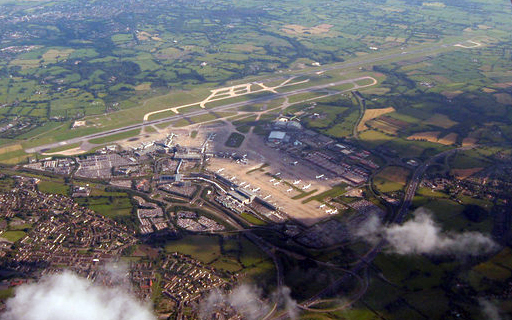
Main article: Manchester Airport Manchester Airport (MAN IATA) south of the city is Britain's largest airport outside London, with flights to over 200 destinations, including North America, the Gulf and Far East. Most flights use Terminal 1, holiday charters are usually from T2, and T3 has smaller aircraft on domestic and near-European hops. Train is the quickest way downtown: they run frequently to Manchester Piccadilly and Oxford Road stations, taking 20 min, for a fare of £6.20. Many trains continue direct to other cities: via Warrington to Liverpool, via Preston and Carlisle to Edinburgh and Glasgow, via Huddersfield, Leeds and York to Middlesbrough, Durham and Newcastle, and via Sheffield, Doncaster and Scunthorpe to Cleethorpes. Trains are sparse after midnight but you can use Bus 43 which runs all night, taking 50 min to Piccadilly via the university corridor/Oxford Road. The bus is just £2 for a single fare of any distance. There's also a tram, most useful for the southern suburbs.
Liverpool John Lennon Airport(LPL IATA) has mostly budget flights across Europe by Easyjet and Ryanair. There's a coach to the airport from Manchester's central coach station, taking 45 min. There are also several trains hourly between Liverpool South Parkway (the station near John Lennon Airport) and Manchester Oxford Road in city centre.
By train
Wikivoyage has a guide to Rail travel in Great Britain Manchester city centre is served by two major railway stations, 1 Piccadilly in the south and 2 Victoria in the north. Piccadilly is the main destination for trains from around the UK, e.g. London, Birmingham, Leeds etc. Victoria has trains from Bradford and local services from elsewhere in North West England. Trains from Liverpool, Leeds, York, Sheffield and Nottingham often also stop at 3 Manchester Oxford Road which is convenient for the University. Other stations in the city centre are 4 Deansgate and 5 Salford Central, but generally only local services stop at these stations. Avanti West Coast operates service between Manchester Piccadilly and London Euston. This journey, on the West Coast Mainline, takes just over 2 hours in Pendolino trains that do not need to slow down when going around bends. Prices start from just over £26 each way if booked on-line in advance.
Getting around

Transport in Greater Manchester is overseen and co-ordinated by Transport for Greater Manchester (TfGM) who use the branding "Bee Network" (Information: 0161 244 1000). Bee Network operates a multimodal journey planner which is a great help in planning getting around the Greater Manchester area. Bee Network sell a number of tickets which are valid for multiple operators, such as the1-day Bee Bus tickets are £2.50 for children and £5 for adults. If you are planning to do a lot of travelling in one day, these might be your cheapest option. If using Metrolink There are tickets for single people and family tickets. The cheapest off-peak fares are after 9:30AM. For Smartphone users there is a "Bee Network" app available for Android & iPhones which has journey planning tools and the availability to purchase some ticket types.
Maps
Dotted around the city centre on main streets including Deansgate, Oxford Road, and Market Street, are the pedestrian-level street maps. They are usually placed in normal advertising hoardings, which can make them difficult to spot from a distance. The maps have been updated with different colours for each district area of the city centre. Your position is marked by a dark circle. They cover the whole centre down to the university district and also central Salford up to Salford University. You can obtain a similar map from the tourist information centre or download one from here. Most smartphone owners use Google or Apple Maps but if you are more "Old School" A-Z maps are still available. These street maps, in book form, are available from newsagents or bookshops and, depending on size, cover everything from the city centre to the whole Greater Manchester conurbation.
On foot in the city centre
Manchester city centre's many attractions are easily reached on foot, and walking provides the perfect opportunity to take in the architecture of the city. There are various pedestrianised streets across the city centre such as Thomas Street, Market Street.
See

Cosmopolitan Manchester
Manchester's Chinatown around George Street and Faulkner Street has been a feature of Manchester since the late 1970s. It is home to the bulk of Manchester's east-Asian restaurants and many traders in Chinese food and goods. As night falls upon Chinatown, the neon lights come on, adding to the ambient feel of the area. There are many eateries to try too. They range from Chinese to Japanese; reaching out to a wide spectrum of tastes. There are also Chinese shops for the locals to buy items imported directly from China, such as newspapers, magazines, DVDs and medications. The Village, also known as the Gay Village, has built up around Canal Street out of the many cotton warehouses in the area. It is home to one of the oldest and most-established gay communities in Europe and is known for its tolerance toward all kinds of people. Many of Manchester's most famous bars and clubs are to be found here, most of which are as popular with straight party-animals as they are with the gay crowd. The Village hosts a major Pride festival every year (August Bank Holiday; the last weekend of the month). Manchester's Northern Quarter has developed massively over the last few years and is brimming with restaurants, bars, live music venues and independent shops. Check out the Curry Mile, an 800-metre-long stretch of curry restaurants, sari shops, and jewellery stores in Rusholme. If you have time and want to mix with trendy, monied residents try an evening out in the very upmarket southern suburb of Didsbury. This is a popular nighttime destination for many from across the conurbation. "The village" (not to be confused with the Gay Village in the city centre) as it is known is too far from East Didsbury station for comfort, but a taxi is possible from the city centre or there is a good bus service.
Historical Manchester
Castlefield is the site of the original Roman settlement Mamucium and has been known as Castlefield since Medieval times. The walls that still stand over two metres high are from as late as the 16th century. It is the centre of Manchester's canal network and a transport nexus of unique historical importance. The Castlefield Basin joins the Rochdale and Bridgewater canals, the latter being the first cut canal in Britain. The nearby Museum of Science and Industry contains Liverpool Road station, the first passenger railway station in the world. Very important in industrial times, it became run down in post-war times until it was completely regenerated in the 1990s and designated Britain's first Urban Heritage site. These days the area is like a small country oasis in the heart of the city, with regular events and a handful of great pubs around the canals and the neighbouring streets. It is also the only place to see wildlife in Manchester's centre.
The University of Manchester, on Oxford Road, where amongst other things, the atom was first probed by Rutherford, the first computer was built, and where radio astronomy was pioneered. It was here too that the element Vanadium was first isolated. The architectural style of the new curved visitor's centre contrasts with the old buildings on the opposite side of Oxford Road, within which Manchester Museum is to be found. Manchester Cathedral, in the Millennium Quarter. The widest cathedral in England with important carved choir stalls (school of Lincoln) and pulpitum. A visitors' centre provides an intimate experience for newcomers to the cathedral. This is near to Harvey Nichols, Urbis and Victoria Station. Manchester Town Hall, on Albert Square. This imposing and beautiful neo-Gothic masterpiece by Alfred Waterhouse is a symbol of the wealth and power of Manchester during the Industrial Revolution. The building is closed to the public until 2026 because of renovation work. The Town Hall is on the wide cobbled area of Albert Square, which is all accessible from St Peter's Square Metrolink station. John Rylands Library, on Deansgate. The bequest to the people of Manchester by who was once the world's richest widow, Henriquetta Rylands, in memory of her husband John, but now administered by the University of Manchester. It contains the 'Manchester Fragment' the earliest known fragment of the New Testament, part of St. John's gospel found near Alexandria and dating from the first part of the second century, shortly after the gospel was first written. Tours can be booked around lunchtime. The library was designed by Basil Champneys and is the last building built in the perpendicular gothic style. There is a good cafe on the ground floor. St Ann's Church is on one side of St Ann's Square and offers a quiet refuge from the noise of the city. There is always a warm welcome inside. It is very popular for weddings on Saturdays.
Shopping

Manchester's shopping district is one of the most diverse shopping districts in the UK and the majority of city centre shops are within reasonable walking distance of each other (15 minutes at most) and most are served by a metroshuttle service. Even in the most upmarket stores you are treated in a friendly manner. The Arndale Centre is a large 1970s city-centre shopping precinct with 280 stores. Although renovated, the place retains some of its 1970s concrete charms and still some of the infamous yellow tiles that are a testament to the urban planning of that era. It is connected via link bridge to the Marks and Spencer and Selfridges department stores adjacent in Exchange Square. There are large shops aimed at bargain hunters, including the largest Primark in the country, which is great for a bargain and much loved by visiting cabin crews, and an Aldi food hall on Market Street (just off Piccadilly Gardens). The Millennium Quarter (at the back of the Arndale Centre) is now quite smart and good for shopping. There's The Corn Exchange, an upmarket shopping centre based in the beautiful old Corn Exchange, worth a visit for the building alone and Selfridges, spread across 5 floors with its large Louis Vuitton concession and fantastic food hall in the basement. You will find everything from sushi to fine chocolates, kosher foods, to a juice bar, etc. Harvey Nichols, opposite the Triangle, offers luxury fashions and produce to Manchester's rich and famous. The centre of Manchester's shopping area has traditionally been St. Ann's Square, and there are many shops nearby. King Street and Spring Gardens to the immediate north of the city centre offer a Vivienne Westwood store (a local girl, from the nearby Peak District), Joseph, DKNY, Emporio Armani and Collezione; these catering for, amongst others, the city's Premiership footballers, soap stars (Coronation Street has been produced in the city since the early 1960s), and the many media types who can also be found in the area. Deansgate has a fair number upmarket stores, as do some of the roads off it. The House of Fraser store, considered by many to be the top people's shop, (still known as "Kendals" to most Manchester people and "Kendal Milne's" to an even older generation) is on Deansgate and has been on roughly the same site since the mid-19th century. It is somewhat old school and the eating places are worth a visit. There is a champagne bar, on the third floor. One of central Manchester's few quiet green squares is just behind the store. This is Parsonage Gardens. Deansgate is also home to Ed Hardy, the General Store, Edwards as well as some high-end restaurants. Just off Deansgate is The Avenue a luxury designer shopping destination in the Spinningfields district of the city centre. It is the home to stores such as Flannels, Mulberry, Emporio Armani and Armani Collezioni, Brooks Brothers, Ermenegildo Zegna, Oliver Sweeney and Joseph. Combined with cafés and restaurants this is a top retail and leisure venue in the city centre. There is also an outlet mall at The Lowry, in Salford Quays, near the Media City: UK development which houses the BBC's northern presence and Salford University's school of Media and Performance. The Trafford Centre is a huge out-of-town shopping centre and accessible by car, taxi, bus or tram. It was linked to the Metrolink tram system in March 2020. Dubbed by many a Temple to Consumerism, it is one of the largest, and possibly the grandest of such centres in Europe. It has its own branches of Selfridges, Debenhams and the best of Greater Manchester's two John Lewis stores. The other is in suburban Cheadle. The centre is spectacular, luxurious, and 'posh' inside and out. Look out for the biggest chandelier in Europe, near the Great Hall! The cinema is also one of the best in the area and has even hosted some UK premières in the past. The centre is now also linked to an annexe offering homewares and furniture, built in an Italianate style around a very large outdoor fountain. With supermarkets and DIY outlets nearby, Mancunians can buy everything in this area without venturing into the city or any other town centre.
Of particular interest
Merchandise from the football clubs Manchester United and Manchester City is available from many locations including dedicated superstores in Old Trafford and Sportcity, respectively. Afflecks Palace in the Northern Quarter is "an emporium of eclecticism, a totem of indie commerce," and a shopping arcade in a five-storey Victorian building, featuring a range of more than 50 independent stalls catering to a young alternative crowd. It's a lot of fun: strange costumes, lots of goths, punks, and teenagers. Saved from closing in 2008, it is now known as "Afflecks". The Northern Quarter is Manchester's answer to Soho, and there is a mishmash of stores which sell music, art, and clothing. More and more bars and cafes are opening too. At night look out for the illuminated, public art attraction on top of the Church Street car park. It is lit from 9PM to 1AM. Every Christmas time, continental style Christmas markets take place in Albert Square, in St. Ann's Square, and along both New Cathedral Street and Brazennose Street. You can buy all the usual Continental and British Christmas curios as well as various foodstuffs. Good fun and very atmospheric at night when it's all lit up. Also at Christmas, into the new year, there are open air skating rinks in Spinningfields as well as a snow slide and other attractions at Piccadilly Gardens. There is also a winterbar at the Spinningfields location. The small but perfectly-stocked food section of Harvey Nichols has a particularly fine wine department. Wines range from relatively inexpensive to the highest levels, e.g. Château Latour, vertical ranges of Petrus, Vega Sicilia, etc. They are still remarkably good value in context, e.g. 1990 Krug Clos de Mesnil 1990, one of the greatest Champagnes ever made and incomparably finer than the footballers' wildly overrated Crystal is about £150 cheaper than usually quoted elsewhere. There is a flower market at the Market Street corner of Piccadilly Gardens Thursday through Saturday from 10AM-6PM. Some food stalls and craft stalls can be found there too. Also hunt out the Craft and Design Centre, in the old Smithfield Market Building, in The Northern Quarter. The complex is full of artist studio space and boutiques, as well as a cafe. There are regular events in Albert Square, St Ann's Square and on New Cathedral Street, all year around, where you can buy art, listen to music and sample foods from far and wide. If catering for yourself, there are several Sainsbury's Local stores around the city centre, at Oxford Road, Mosley Street, Quay Street, Bridge Street, Piccadilly Station. Tesco Metro supermarkets can be found on Market Street (the largest supermarket in the centre), on Piccadilly and on Quay Street, which is near the Sainsbury's and Granada TV. M&S food outlets are within the M&S store next to Selfridges, and there are also M&S Simply Food stores at Piccadilly Gardens and within Piccadilly Station. You will find increasingly popular Co-op food stores near both Victoria, by the movement's headquarters, opposite the Arndale Market, at Piccadilly Gardens and just outside Piccadilly station. For more upmarket food products, Harvey Nichols has a deli and foodhall as does Selfridges. There is a Waitrose store opened near The Avenue development in Spinningfields. At the other end of the spectrum there is the Arndale Market and a large Aldi store in the Arndale Centre, which is, in common with most UK outlets, much more upmarket than the stores in Germany. This is also accessible from Market Street. There is also a Lidl and a Tesco on Oxford Road near Manchester Royal Infirmary. For something a little bit different, the Manchester Arndale Market features many food stalls, including a rather large fish store and a butchers. Chinatown has many specialist shops and the landmark Wing Yip superstore on Oldham Road in the Northern Quarter is excellent for everything oriental. There are various other mini-markets and late night stores around the city centre and in Piccadilly station. There are three 24-hour Spar's, one in Piccadilly gardens, one on Piccadilly station approach and the third opposite the former site of the BBC Studios on Oxford Road. Just out of the centre is a large Sainsbury's, in Regent Retail Park, Salford, an Asda store in Hulme, and a Tesco Extra hypermarket in Cheetham Hill. Free copies of The Manchester Evening News are given out around the city and at the airport on Thursday and Friday, as well as inside and outside some selected newsagents in town. There is a charge of 70p for the other days of the week including Saturday's edition. This is very good for listings, especially on a Friday, with the City Life pull out section. The free Metro newspaper is handed out in the mornings. This too has some listings. Online sites such as Live-Manchester.co.uk also provide Manchester gig listings, information about theatre shows and arts and museum exhibitions.
Eat

As you would expect from such a cosmopolitan city, Manchester has a huge selection of restaurants and eateries that serve a vast array of cuisines. Look hard enough and you will be able to find any type of international and British food. It is also worth exploring some of the suburbs for superb, small independent bistros and restaurants. West Didsbury and Chorlton are noted for their large number of great eateries. If you can get there, the quaintly named and somewhat trendy village of Ramsbottom, just north of Bury, directly north of Manchester, is said to be "the new Chorlton", in regards to restaurants, and the place to eat. The usual, well-established UK chains like Café Rouge, Pizza Express, and Nando's are all to be found in Manchester city centre and out of town too. There are hundreds of kebab and pizza shops on Oxford Road and in Fallowfield and Rusholme. In Rusholme, in particular, locals speak of the £10 curry, where if you bring your own drinks into the curry house, you should leave with change from a ten-pound note.Some of the cheapest, long-established curry cafés, though, are still to be found in the back streets of the Northern Quarter and Central Deansgate offering a novel twist on the traditional British café.
Chinese
There are plenty of all-you-can-eat buffets in Chinatown for less than £10. Prices tend to change with the time of day and likely demand. If you eat earlier in the day, you can have a full all-you-can-eat meal, including soup, starter, and dessert for around £5. Salford is also a good option to look for Chinese food, as a particularly high concentration Hongkongers have settled there.
British
Sam's Chop House on Chapel Walks is popular with visitors looking for a British dining experience (not an easy feat in the UK's big cities), as well as Sinclair's Oyster Bar at Cathedral Gates. Many hotels offer menus that tend towards national dishes.
Sleep

Hotels
Individual listings can be found in Manchester's district articles
There are thousands of hotel beds in Manchester, ranging from 5-star establishments to bed and breakfast, via youth hostels and serviced apartments. Most accommodation is focussed in the east of the city centre with easy access to the InterCity Piccadilly Station. If in doubt, consult the tourist office, in Piccadilly Gardens. See City Information section for contact details and address. Despite its obvious industrial heritage, Manchester is home to a great number of very fine hotels, including the grand old Midland Hotel, where Rolls met Royce and the Hilton Manchester Deansgate, housed in the 47 story Beetham Tower (both in Castlefield - Petersfield). Manchester Airport is also home to several hotels, which offer easy access to both the airport itself and Manchester City Centre. For those on smaller budgets, there exists a great number of smaller, chain hotels, throughout the city, including the seemingly ubiquitous Premier Inn and others of its ilk, offering clean, pleasant accommodation for lower tariffs. Self-catering apartments in Manchester are now becoming popular alternatives to 'traditional' hotel stays. There are thousands of self-catering apartments available throughout the city centre and outskirts - providing accommodation for up to 8 people at a time, for stays of anything from one night to 1 year. You can expect noisy neighbours at weekends. Take care of the place you are staying in as, according to the local press, there have been some horror stories of people being charged for breakages, etc., for which they were not responsible. There are various serviced apartment options for business travellers around the city:
La Reserve Aparthotel, Ducie St
Stay safe
If you're uncomfortable around thousands of intoxicated young people, then you should probably avoid Friday and Saturday night taxi queues in the city centre. You should also avoid any conflict with door staff at bars, clubs and pubs. All pubs, bars and clubs are best avoided on days where the Manchester derby football match is taking place. Relations between the two sets of supporters have never been amicable, to say the least, but things seem to have deteriorated. What starts out as "banter" quite commonly gets out of hand. Wearing a Liverpool or Leeds Utd shirt while you are in Manchester may also draw some unwanted attention to yourself. If you do attend a football match at Old Trafford, or watch a game with fans in a pub, be careful not to raise the issue of the 1958 Munich Air Disaster, especially if you are openly identifying as a supporter of a rival team. While the disaster was more than 60 years ago, "Munich chants" and related slurs still cause deep anger and hostility, and could provoke a violent response. Similarly, talking about "oil money" around Man City fans - or accusing them of "buying success" - will cause hostility. As a general rule, on match days, if you want to openly show support for Man Utd, do so in the areas around Old Trafford in Salford and the Quays, and if you want to do the same as a Man City supporter go to the Etihad. If you want to openly support a rival club from another city (especially Liverpool or Leeds), go to those cities! Persistent begging is an irritation in Piccadilly. There is also a problem with people walking up to you with a story like "I've lost my wallet and need 50p for the bus home". These people often say the same story for years. This is usually a ruse to get money from you or, in some cases, in the hope that you will get a wallet/purse out of your pocket so it can be stolen. Piccadilly Gardens has become a place where drug addicts and dealers gather, with the open sale of drugs leading to a nasty atmosphere and gang activity. While the area is always very busy - being in between the main Piccadilly train station and Arndale shopping centre - and you are unlikely to be a victim of crime yourself here, quite violent crime can happen at any time. Most of this is between drug gangs or the ever growing groups of homeless people (drawn to the area by the easy access to drugs) but scary things do happen here. In January 2020 several people were hospitalised after a series of armed robberies and muggings during the same evening, while in February 2020 two people were stabbed outside the Travelodge hotel at lunchtime in what the police said was a ‘targeted attack’. It is often impossible or impractical to avoid this area: it is a major transport interchange for the city, and several attractive areas (like Chinatown and the Northern Quarter) border here. The police tend to have high visibility in this area but they cannot be everywhere at all times. The best advice is to be very cautious in this area, especially with mobile phones and money. The city council regularly puts on events in the area (like street markets) to try to encourage a more salubrious atmosphere, and given the sheer number of people who have to pass through this area every day you will likely find no trouble here, but be careful. Attempting to buy or take drugs here will bring you into contact with dangerous criminals or the police, so do not be tempted to do that under any circumstances. Sellers of The Big Issue magazine are not beggars. The magazine is published by the Big Issue in the North, a social enterprise, and sold to the homeless for resale on the streets. All of the vendors are genuinely homeless and are forbidden from begging whilst selling the magazine. Vendors can be found around the city and visitors may want to buy a £3 copy. Please buy only from badged, official vendors. Manchester is generally quite a safe place, especially in commercialised and tourist-oriented areas. If you wander into a less desirable area you should be very wary of street gangs hanging around. Should you encounter a group that looks suspicious, either avoid them all together and walk the other way, or try to walk past them quickly (at a distance if possible) and behave in a way that they do not perceive as disrespectful or confrontational. This can include eye contact or accidentally brushing past them with your shoulder. Most of the areas in Manchester where tourists venture are safe. The following areas are very much "off the beaten path", with little to tempt the average visitor. Nonetheless, should you choose to go, then caution would be advised:
Longsight. This is a somewhat rundown residential area in the shadow of the city centre, which has as yet avoided the gentrification of nearby Hulme. Moss Side. This area constitutes the heart of Manchester's African and Caribbean community and is worth a visit if you are looking for something different. It is an area that has been associated with gang related violence but is no worse than other inner-city areas in Manchester, with such crime having been greatly reduced by police and community efforts. It is adjacent to some pleasant parks, including the small Whitworth Park and larger Platt Fields Park. Catch the Caribbean Festival of Manchester in Alexandra Park every July/August. Parts of Hulme but this young, trendy, regenerated area would be of interest to many with its new town houses, quirky architecture and blocks of flats and is next to the centre. Cheetham Hill. Avoid at night; but, during the day, this suburb, to the north of Victoria Station, is a lively, colourful mixture of cultures: Jewish, Asian, and newer arrivals to the city from various parts of the world! The shopping area around "The Village" is very much like an inner London high street. Wythenshawe. Much of this is a vast public housing district. The area out towards the airport should be avoided. Ordsall. This area is on the up and following the example of Hulme with lots of new developments. Parts of East Manchester, particularly Beswick and the residential streets of Openshaw. Salford. Unless you have good reason, do not wander too far, on foot at least, over the river Irwell into Salford from the city centre. With the great number of new residential developments in the area, it has improved. The straight route from Manchester centre, via Salford Cathedral along Chapel Street to Salford University, is very safe up to Pendleton.
Go next

Manchester is well placed at the heart of Northern England. Everything is within an hour or so of Manchester's Piccadilly and Victoria stations; major cities, National Parks, picturesque scenery, seaside resorts and swanky suburbs can all be reached by train.
Seaside
Blackpool — Around 1 hour by train. Previously known as 'The Playground of England'. Famed for a wild night out and favoured by Stag and Hen parties. An education, with some fantastic gay clubs to rival those anywhere! Blackpool's attractions including Britain's busiest theme park Pleasure Beach, Blackpool and the famous "Lights" from end of August to the first weekend in November. If you want a quiet day by the seaside try Southport. Shopping and tea rooms combine with the beach to make Southport a nice relaxing day out. Accessible by train from Manchester in around one hour. The North Wales seaside resorts of Rhyl, Prestatyn and Llandudno are around an hour and a half to two hours away from Manchester. Formby near Southport is a nice day out. Some picturesque sand-dunes, red squirrel preservation area, an ice-cream van and a lovely beach, without the usual British seaside resort junk (arcade games, amusements etc.). A change of train is required, so journey times are over an hour away. You can access the northern end from Southport quite easily.
City
Liverpool — The two cities do not really have any fierce rivalry as they are both part of the greater north west and the massive urban sprawl of northern England. The River Mersey and Liverpool's Albert Dock, along with the city's breath-taking skyline, make it definitely worth a visit, with museums of national importance, a wealth of fine Victorian and Georgian buildings as well as two very contrasting cathedrals. Leeds — Less than an hour from Manchester, the largest city in Yorkshire is home to the Royal Armouries Collection, good museums and galleries and the much-praised West Yorkshire Playhouse Theatre. There is great shopping to be had, some of which is housed in elegant Victorian arcades, and many excellent restaurants & bars too. Bradford. This city is next door to Leeds, so close their suburbs merge into one, and boasts the fabulous Alhambra Theatre, The National Media Museum, with a giant IMAX screen, and the German Merchants' Quarter, which is also well worth a visit. Chester — Take a direct train from Piccadilly or Oxford Road stations to this compact Roman city in Cheshire on the edge of North Wales. Old buildings and cobbled streets will greet you as well as the unique shopping streets with two storeys. You can also walk around the city centre on the Roman Walls. Lots of inviting tea rooms and pubs await you too as do the cathedral and Roman remains. The city's zoo is one of the best in the country, and can be found on the edge of the city, near the main Park & Ride car park, which is easily reached from Manchester or Liverpool and well signposted. The "Blue Planet Aquarium" and "Cheshire Oaks Outlet Centre", near to each other, are but a short drive from the zoo also. Sheffield, in South Yorkshire, is less well known to Manchester people, due to poor road links, but it is less than 40 miles (65 km) away and the train service from Piccadilly is good and the journey a scenic one. This fine, post-industrial city is said to be built on seven hills and was once home to a world-famous steel industry. Nowadays, Sheffield is a growing cultural centre, boasting the UK's second largest theatre complex and a thriving music scene that has produced such acts as Arctic Monkeys, Def Leppard and Pulp. Preston — This Lancashire town still retains an "old northern" culture and is the UK's newest city, having been at last granted that status. Preston is about a 40-minute drive north of Manchester and also accessible by train or coach.
More pictures of Manchester


From this destination's category on Wikimedia Commons. Each photograph is credited to its own author under its own licence.
The guide text on this page is from the Wikivoyage article Manchester, written by Wikivoyage contributors and published under CC BY-SA 4.0. The authors are listed in the article’s edit history. It has been shortened and re-laid-out for this page; that adapted text is available under the same licence. Nothing else on this page is.
Wikivoyage is written by travellers, not by us. Opening hours, prices and whether a place still exists are exactly the details that go out of date, so check anything you are relying on.
“2,336 readers a month” and the ranking are ours, counted from Wikimedia’s published pageviews (CC0) — the median of twelve complete months. They count people reading about a place, which is not the same as people going there.