
Kruger National Park
The Kruger National Park (KNP) lies in the north-east of South Africa and runs along the border of Mozambique in the east, Zimbabwe in the north, and the southern border is the Crocodile River. The park covers 19,500 km2 (7,500 sq mi) and is divided into 14 ecozones, each supporting different wildlife. It is one of the main attractions of South Africa and it is considered the flagship of South African National Parks (SANParks).
Most read about in January, least in April. That is when people look it up, which tends to run a month or two ahead of when they go.
Before you book
The Foreign, Commonwealth & Development Office publishes the UK’s official travel advice for South Africa. It changes without notice and travelling against it usually invalidates your insurance, so read it at the source rather than anywhere else — including here.
FCDO travel adviceUnderstand

Kruger National Park is one of the biggest protected areas in South Africa and is widely considered to be one of the best national parks in the world. The park is similar in size to El Salvador, Israel, Slovenia, and Fiji, or to the US state of New Jersey. With over 1.5 million visitors annually, Kruger National Park is one of the most popular tourist attractions in South Africa.
History
The park was established in 1898 with the help and blessing of the South African Republic's president Paul Kruger as a protected area for wildlife and it first opened its gates to the general public in 1927. The park is run by SANParks and is probably the best managed South African national park. Wildlife conservation, education and tourism are the main objectives of the KNP. Effective measures to prevent poaching are in place and as a result of this cars are generally inspected upon entering and leaving the park. Kruger National Park is part of a larger transnational park initiative called the Great Limpopo Transfrontier Park. KNP alongside Limpopo National Park in Mozambique, the Gonarezhou National Park, Manjinji Pan Sanctuary, and Malipati Safari Area in Zimbabwe forms a continuous conservation area across the three countries. However, border restrictions at crossings still apply and border posts are not open all day.
Flora and fauna
The southern part of the park along the Sabie and Crocodile river is rich in water and has a lot of game viewing opportunities. Here you can see the best of African flora and fauna such as lion, leopard, elephant, rhino and buffalo, often referred to as the big five, but there are plenty of others to see as well. Driving around the Sabie River will always result in seeing some interesting animals. The vegetation around the Sabie River can be very dense forest and thicket and it gets a little bit more open driving down south to the Crocodile River. The northern part of the park supports less flora and fauna and is often referred to as the birding paradise. If you choose to drive yourself, and aren't experienced in African animal tracking, you will still inevitably see elephant and buffalo, and a big variety of antelope. Impala are ubiquitous. Rhino are less common, but big enough to be seen by the untrained eye. Leopard are commonly seen by the experts, but are camouflaged and in trees, so to present a challenge to the untrained. Everything else is down to your luck of the day. If you have limited time, and want to do Kruger, go in the dry season, stay at a camp like Olifants, and confine yourself to the south of the park along the southern rivers.
Getting there

Kruger is quite accessible by car and by air. Most visitors drive to Kruger or rent a car to take around the park, as cars allow more freedom in the park. However, many of the luxury camps offer all-inclusive packages which make renting a car unnecessary. The park also offers park-and-ride facilities for day visitors at Phabeni, Numbi and Paul Kruger gates.
By car
Kruger National Park has nine gates within South Africa and two international border crossings: one at Pafuri in the very north of the park and one at Giryondo in the north-central section of the park. The more established southern section of the park has five gates, whilst the central and northern sections only have two each. There is a significant gap between Phalaborwa gate and Punda Maria gate, making the Shingwedzi camp very remote. The park's gates are closed after sunset and visitors are not permitted to drive at night in the park. Driving in darkness is considered to be dangerous outside the park especially if you are not used to driving in Africa. Pedestrians walk along the roads and there are local taxi/minibus services. Both are difficult to spot at night. The area of the Numbi Gate has had incidents involving barriers on roads.
Gates
1 Paul Kruger Gate (Kruger Gate) (east of Hazyview on the 536), ☏ +27 13 735 5107. In a way the "main entrance" to Kruger Park, Paul Kruger Gate lies a 15-minute drive west of Skukuza along one of the park's tar roads. At the gate is also the Paul Kruger Memorial statue. (updated Jan 2020) 2 Phabeni (along the R536 east of Hazyview, with a turnoff to the gate long before reaching Paul Kruger Gate), ☏ +27 13 735 5890. Offering a quicker entrance to the park from Hazyview than Paul Kruger Gate but an overall longer drive to get to Skukuza (due to the 50 km/h speed inside the park and likelihood of viewing animals), Phabeni gate is a good choice for those coming from the Johannesburg area, as it is one of the quickest to get into the park. (updated Jan 2020) 3 Numbi (off the R538 from White River to Hazyview), ☏ +27 13 735 5133. Numbi Gate is the closest gate to the Pretoriuskop rest camp. About 20 minutes' drive south of Phabeni gate, Numbi gate offers a faster entrance to the park coming from the southwest. (updated Jan 2020) 4 Malelane Gate (On the R570 just east of Malalane), ☏ +27 13 735 6152. Roughly the same distance from Mbombela or Johannesburg as Numbi gate, Malelane gate is the southernmost entrance to the park. It is a short drive from the Berg-en-Dal rest camp. (updated Jan 2020) 5 Crocodile Bridge, ☏ +27 13 735 6012. The southwestern-most entrance to the park, near the town of Komatipoort and the closest to the Mozambican capital of Maputo. This gate takes one immediately to the Crocodile Bridge rest camp. (updated Jan 2020) 6 Orpen Gate (On the R531, off the R40 between Hoedspruit and Bushbuckridge), ☏ +27 13 735 6355. One of the two gates in the central region of the park, Orpen is a smaller gate serving the central region of the park. The road in is surrounded by private game reserves such as Manyeleti, Timbavati, Andover and Thornybush Game Reserve. An hour's drive longer from major population centres like Johannesburg and Mbombela, Orpen gate mostly serves people who specifically intend to begin their stay in Kruger at Orpen Rest Camp or Satara, who live around the Bushbuckridge-Hoedspruit area, or who are also visiting one of the private reserves in the area. (updated Jan 2020) 7 Phalaborwa Gate (on the R71 east of the town of Phalaborwa), ☏ +27 13 735 6509. North of Hoedspruit, Phalaborwa gate is the closest gate to Limpopo's major population centres in Polokwane and Tzaneen. The nearest main camp is Letaba. (updated Jan 2020) 8 Punda Maria Gate (At the eastern end of the R524), ☏ +27 13 735 6870. Punda Maria sits in the northern section over 100 km north of Phalaborwa Gate. It serves the Punda Maria, Shingwedzi and Mopani rest camps, as well as several smaller camps. (updated Jan 2020) 9 Pafuri Gate (At the eastern end of the R525 east of Musina), ☏ +27 13 735 5574. Located in the Pafuri Triangle, which is co-owned by the South African National Parks and the Makuleke people, Pafuri gate is the northernmost gate in the park. It is near the Limpopo River and in one of the narrowest sections of the park. It should not be confused with the Pafuri border crossing into Mozambique. (updated Jan 2020)
Getting around

By car
The infrastructure of the park is outstanding by African standards and roads inside the park are of very good quality and potholes on the main roads are rare. Smaller side tracks are close to the original landscape, but manageable with a normal car, although a 4x4 offers probably a better comfort on this type of terrain. KNP roads have speed limits, ranging from 20 to 50 km/h and it is not wise to go much faster, because game tend to cross the roads out of nowhere. Driving off road is not allowed. Take care when approaching animals. They are wild and unpredictable. If you have the feeling that animals get angry, leave! Elephant and rhino can be very dangerous to you and your car, especially a mother who is protecting her calf! It is custom to share information about animal sightings with other park visitors. This happens casually and information is exchanged when two cars from the opposite direction meet and stop for a short chit-chat, there are also sightings boards at all the camps, showing where recent sightings were made. However, it is strongly discouraged to share wildlife locations on social media, due to poaching concerns. Avis is the only car rental company with an office inside the park at Skukuza Camp, but other companies from Mbombela and at the two above mentioned airports are happy to provide you with a car as well. You may want to consider an air-conditioned car in the hot climate of the KNP. Petrol stations within the park do accept payment by most bank cards. The maximum speed limit is 50 km/h on tarred roads, 40 km/h on gravel roads and 20 km/h in rest camps, and is generally obeyed. However lower speeds afford greater safety and better sightings. It takes roughly 10 hours to cross the KNP in south - north direction. Distances between camps sites are on average 1-2 hours in the south and a little bit more in the north. Consider the distances between camps when planning your trip and remember that you are not allowed to leave your car once you left a camp site. Toilets are present at all the camps and picnic areas, but not at the hides. A road can be blocked by buffalo or elephant crossing, adding 20 minutes unexpected journey time to your trip. Leave some slack in your travel time calculations to enjoy the scenery. During the summer rainy season, there is the possibility of gravel roads and bridges being closed due to flooding. Certain areas of the park may be inaccessible. Exercise caution if driving on these secondary roads during and after heavy rainfall. Always allow plenty of time to reach your destination campsite before the curfew. One of the hazards when driving at dusk is birds who settle on the warm tarmac for the night.
Navigation
Make sure you have an up-to-date map, enough to eat and drink, cameras and binoculars, reference books and a litter bag with you, a litter bag is normally issued by the park's staff when you enter the park, but feel free to ask at camps and picnic spots. Maps can be purchased in all main camps at each gate. It is not advisable to rely solely on directions from satnav, as most satnav apps or devices will attempt to navigate you via private roads. South African National Parks publishes a medium detail map on their website which can be used to supplement your GPS to prevent you from taking the wrong roads, but it is still recommended to buy a guide book when you get there, as the maps in the guidebooks are more detailed. OpenStreetMap also tends to have better, more up to date information than Google or Apple maps, but still has a tendency to send you along private roads sometimes. It is recommended that you use the table of travel times provided by SANParks in the Kruger Park guidebooks or on their website when calculating travel times especially, as the GPS will typically use the speed limit to calculate travel times, which can be highly unreliable in the park since it's not unusual to have to stop and wait for a herd of elephants or zebra to cross the road before proceeding.
Filling stations
Given the size of the park, it is often a source of anxiety for first-time visitors to find petrol. Fortunately, this is not as big a concern as it first appears, as most of the main camps have petrol. The camps with petrol stations are:
See

Although the main attraction of Kruger is the wildlife, this just barely scratches the surface of what the park offers. From archaeological sites to memorial plaques, from baobab trees to some of the oldest rocks on the planet, Kruger offers a spectacular variety of attractions.
Wildlife
The main attraction of the park is wildlife viewing, and most of the camps have boards for reporting sightings of some of the most popular animals in the park. Due to poaching concerns, rhino sightings have been removed, and guests are asked not to report the locations of any animal sightings on social media. The best times for sightings are during sunrise right when the gates open and sunset right before the gates close when animals are the most active. Sightings are also likely easier during the dry winter season when veld foliage is less dense and animals are likely to congregate around water sources. During the wet summer, there is a multitude of birds with summer seasonal visitors and a key time for birdwatchers. If you're new to wildlife viewing, it's worthwhile to get one of the park's animal guidebooks to help you out. There are also a few lists to check off of what you've seen:
Big Five game. Made up of buffalo, elephant, lion, leopard and black rhino, the Big Five were considered the most difficult African animals to hunt. Today, they are considered amongst the crown jewels of Kruger Park and many an adventurer tries to shoot all five on their trip - with a camera this time. You're almost certain to see elephant and buffalo (though don't confuse the wildebeest you see for buffalo). Lions are a bit more difficult as they easily camouflage into the surrounding landscape but you'll probably see them if you have at least 3 days in the park. Look for lions napping in the shade of small trees or bushes. Leopards and black rhinos, however, are elusive. White rhinos love to graze on the short grass, but the black rhino are much more skittish. Black rhinos browse on shrubbery, so they tend to be found not on the plains but in stands of trees and shrubs. They're also smaller and more easily frightened. Leopards and black rhinos can often be found in the same areas. Look for a leopard in every big tree overhanging a river - especially on horizontal branches of marula trees. Binoculars and telephoto lenses are almost essential for leopard viewings are they are usually far away from roads and up in trees. (updated Jan 2020) Little Five. Looking closer to the ground, you might be interested to look for the Little Five. Made up of the buffalo weaver, the elephant shrew, the leopard tortoise, the ant lion and the rhino beetle, the Little Five are the compliment to the Big Five in animals people tend to forget about. Seemingly unexciting at first, the Little Five open up the sharp-eyed viewer to a whole different world of creatures. (updated Jan 2020) Big Six birds. The Big Six are a set of six of the most easily identified and most exciting birds for the birdspotting beginner. Made up of the kori bustard, the martial eagle, the lappet-faced vultur, Pel's fishing owl, the saddle-billed stork and the ground hornbill, the Big Six are a great place to start if you're not very familiar with birds. All six species are quite large (in fact, the male kori bustard is one of the largest existing animals capable of flight) and thus fairly easy to spot, and most are fairly distinctive. Be on the lookout especially for the ground hornbill, and if you see any, let the ground hornbill project know via email or SMS. (updated Jan 2020) Five Trees. The Five Trees are a set of five trees most commonly seen about the park, including some in camps. They make a great start for the beginner botanist, as they're generally fairly unique and well-known. They are the baobab, the fever tree, the knob thorn, the marula and the mopane. Although the baobab is by far the least common, it's definitely the easiest to find, as the locations of two baobabs in the park are well-marked. The others can be harder to find, but signs and guidebooks will tell you which trees are common in what areas. (updated Jan 2020)
Do
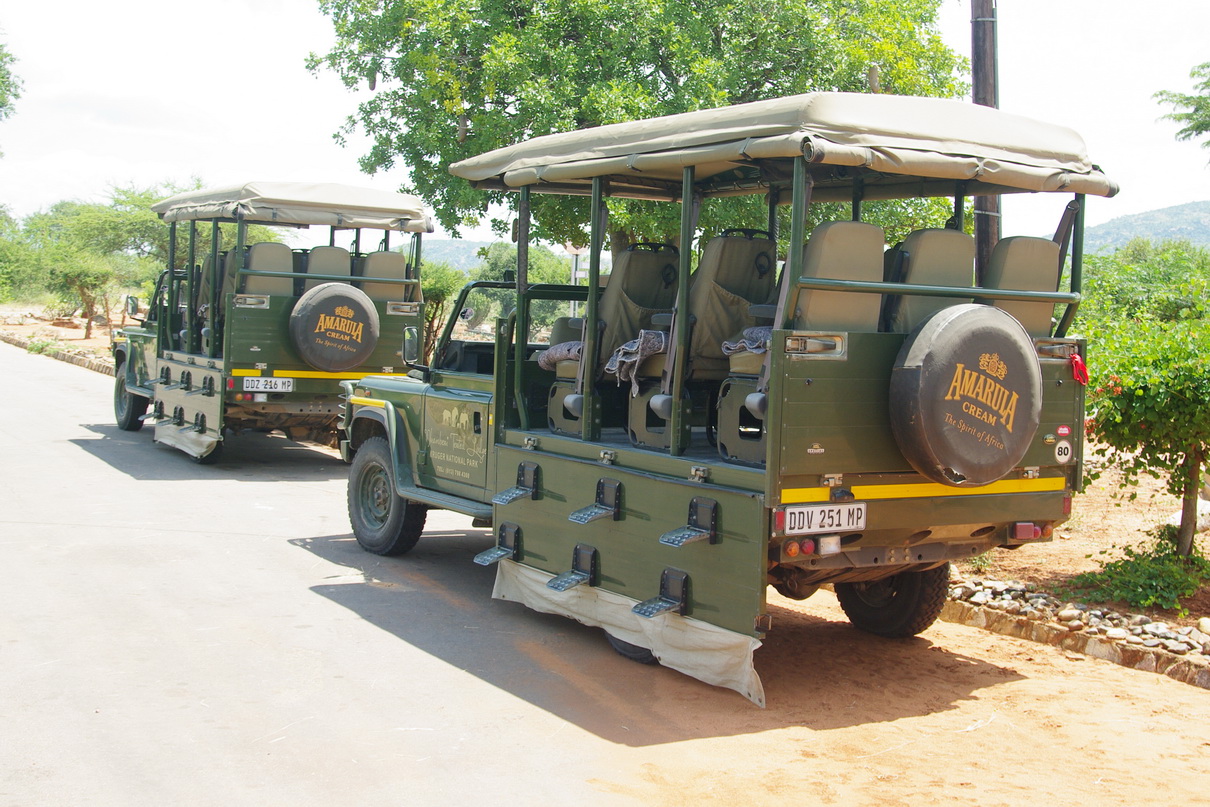
The biggest draw of Kruger is the nature. Flora, fauna, and beautiful landscapes all combine to make a generally pleasant and relaxing experience. It's possible to spend weeks in Kruger slowly driving around looking for animals, stopping at the various hides and other waypoints to see what's there, and just generally taking life at a snail's pace. However, Kruger offers a variety of ways to see things you wouldn't otherwise see with guided drives and walks, as well as a variety of other experiences both in and out of camp.
Wildlife experiences
The basic way to see the wildlife is to tour the park by car during the daylight hours when the park is open. This is a very effective way of seeing wildlife, even for first timers. There are many other wildlife experiences on offer.
Bush drives First-time visitors may want to consider to book a guided tour through the KNP with local park guides. Bush drives are available from Berg-en-Dal, Letaba and Skukuza camps and some other camps, and cost R380-490 per adult (50% less for children) (Mar 2023). Experienced rangers will take you in a 4x4 car to the KNP either for a sunrise or a sunset drive and explain to you and your party the finer details of game spotting. Night drives Discovering the KNP on your own is a great adventure, but there are a few things that you can not do without a ranger. One of them is to have a night drive through the park to see nocturnal creatures such as lions, leopards and hyenas. Tours take a couple of hours and leave usually shortly before the main gates close at night. Landrover Lebombo Eco-Trail The 3 brand new 'Transfrontier Trails do Limpopo' The Shingwedzi 4x4 Eco-Trail The Machampane Wilderness Trail The Massingir Hiking Trail Wildlife films Several rest camps show wildlife films 6 days a week in the evenings. These camps are: Berg-en-Dal, Letaba, Mopani, Satara, Shingwedzi and Skukuza.
Shopping
Bigger camp sites such as Lower Sabie and Skukuza have comfortable shopping facilities and you can buy drinks, foodstuffs, souvenirs, as well as some other travel items you may have forgotten. The range is more limited at the smaller or more remote camps. It is easy for them to run out of particular items, so you have to make do with what is available. Fresh milk particularly can be in short supply. Artistic wood carvings can be bought as well and is usually of reasonable quality and cheaper than in Johannesburg and Cape Town. Carvings can be found in and around the gates to the Kruger National Park as well. Animal skins and rugs are available as well.
Eat

Most of the main camps have shops where you can buy raw food to cook, as well as wood or charcoal for fires. All accommodations have areas for cooking. Campsites tend to have communal kitchens, but most rondavels, bungalows or cottages will have private kitchens or kitchenettes. There are also picnic areas out in the wild. Some of these areas, such as Tshokwane, will sell cooked food on site. Others only have braai facilities for you to cook for yourself. Many of the camps have cafeterias and restaurants, but in general there's not too much variety (see below). The menu is the same at each camp, with a range of only 10 or so dishes. Most visitors familiar with the park are self-catering in their lodges or at the picnic areas. Lodges in the private areas of the park and outside the park will cater food, often arranged in well-sheltered outdoor restaurants with open fireplace, and barbecue South African specialties such as:
wart hog sausage springbok tenderloin ostrich steak biltong (dried meat) made of game, like kudu, impala or zebra.
Restaurants at camps
Most of the main camps have a single restaurant each, which are franchised with various chains popular in South Africa. An official listing of restaurants at camps in Kruger is available on the SANParks website.
Drink
South African alcohol laws apply within the park. However, South African National Parks have some additional regulations regarding alcohol. There is a blanket ban on alcohol for day visitors - it is not allowed at picnic spots, in the day visitor areas at rest camps, and you are not allowed to drink alcohol whilst driving. (South African road law still applies in Kruger.) Day visitors are also not allowed to enter the park with any alcohol. Overnight visitors may bring alcohol in their cars for consumption at their accommodation, and the restaurants in Kruger do serve alcoholic beverages to overnight visitors. Overnight visitors are also allowed to purchase alcohol at the Parks Shops in the main camps. The bars in camp are visited in the evening by guests recalling tales of wildlife seen during the day. Generally people aren't visiting Kruger for the nightlife, but are more likely to spend the early evening with a braai, and retiring to bed for an early start the following day.
Sleep

Within Kruger there are a fair number of camps operated by SANParks, as well as some private camps operated on concessions. There are also several hotels and lodges outside of the park but near to a gate. Further, there are several private nature reserves that border Kruger and have agreements with the park for limited amounts of travel for their members.
SANParks camps
Most of the camps within the park are operated by South African National Parks. They are categorised by their size and facilities. The largest, Skukuza, has the most facilities, including a shop (selling food, drinks and curios), multiple restaurants, a library and museum, a swimming pool, a petrol station and a golf course. The smallest, Tzendze, is purely a tented campsite with communal ablutions and cooking facilities. The SANParks website allows bookings online for all parks, with instant confirmation and availability checks. You will need to register before you commence your booking, and the registration process can take around half an hour to be confirmed before you can commence booking. The SANParks site is not the first site returned by most search engines when searching for accommodation in Kruger, but it is the only site where you can book accommodation directly. All other sites will only take "provisional bookings", and are just agencies.
Bookings at SANParks, ☏ +27 12 428-9111, fax: +27 12 343-0905, reservations@sanparks.org. Getting a response from email sent to the reservations email address seems next to impossible. There are options to book activities (such as drives) online when booking accommodation, but your accommodation is booked the website does allow you to add or incorporate additional activities with your reservation. However, you can book them on arrival in camp (subject to availability) or in advance by phone.
Stay safe

In general, Kruger National Park is one of the safest areas of South Africa. However, there are still safety concerns visiting Kruger.
Malaria
The entirety of Kruger Park is a breeding ground for malaria-carrying anopheles mosquitoes. As such, it is important to take precautions against malaria. While the best advice for you will come from a doctor, you can use the Wikivoyage page about malaria as a starting guide. Avoiding mosquito bites by using mosquito repellent, covering your skin and using mosquito nets is especially helpful, but not sufficient on its own. Pharmacies in South Africa offer a wide variety of effective malaria tablets, often for cheaper than available elsewhere, but it is important to check with your doctor especially if you are taking any other medications, as there may be drug-drug interactions.
Animals
When entering Kruger National Park, you are entering the home of the animals in the park. It is important to be respectful, as harming the animals in the park comes with a stiff fine, potentially prison time, and in some cases an immediate death penalty enforced by elephant, rhino, lion or hippo. None of these are particularly positive outcomes, so you are encouraged to avoid such scenarios. Do not leave your vehicle except in camp or where there are signs allowing it. Even when there are signs noting that you may leave your vehicle, be sure to check the area around you before exiting. Do not feed the animals. Animals who are fed by humans tend to come back for more food and can end up becoming pests or even violent. You feeding an animal might be a step on the path to it having to be killed, and wildlife management hates to have to kill the animals.
Go next
Pilgrim's Rest and the Blyde River Canyon are often visited in the same trip as Kruger. Johannesburg (the biggest city south of the Sahara) and Pretoria in the Gauteng Province are busy cities of banks and government institutions and are 4 hours drive from the park. Cape Town is one of the largest cities in South Africa and is in the south-west corner of the country near the Cape of Good Hope. Cape Town is a stone's throw from South Africa's world-famous Cape Winelands around Stellenbosch and Paarl. Durban is primarily a holiday/resort city at the Indian Ocean but also boasts South Africa's busiest container port. Drakensberg -- Massive and spectacular mountain range. Peaks exceed 3000 meters above sea level. Climbing, hiking, wilderness trails, mountain biking, fly fishing, and more. Lesotho -- real Africa right on South Africa's doorstep. The border crossing into Mozambique within the greater park isn't really practical for overseas visitors. Rental cars are not permitted across the border and there is no transport to or from the border post to speak of. There are no facilities, apart from customs and immigration, at the border post. The customs, immigration and (Mozambique) tourism officials at the crossing are busy doing a range of activities, none of which actually involve processing people across the border.
More pictures of Kruger National Park


From this destination's category on Wikimedia Commons. Each photograph is credited to its own author under its own licence.
The guide text on this page is from the Wikivoyage article Kruger National Park, written by Wikivoyage contributors and published under CC BY-SA 4.0. The authors are listed in the article’s edit history. It has been shortened and re-laid-out for this page; that adapted text is available under the same licence. Nothing else on this page is.
Wikivoyage is written by travellers, not by us. Opening hours, prices and whether a place still exists are exactly the details that go out of date, so check anything you are relying on.
“603 readers a month” and the ranking are ours, counted from Wikimedia’s published pageviews (CC0) — the median of twelve complete months. They count people reading about a place, which is not the same as people going there.