
Cape Town
Cape Town (Afrikaans: Kaapstad, Xhosa: iKapa) is the second most populous city in South Africa. The capital of Western Cape Province, it is also the legislative capital of the nation. Cape Town is on South Africa's southwestern coast close to the Cape of Good Hope, and is the southernmost city on the African continent. It is the gateway to the globally renowned Cape Winelands which includes the towns of Franschhoek, Stellenbosch and Paarl.
Most read about in January, least in April. That is when people look it up, which tends to run a month or two ahead of when they go.
Before you book
The Foreign, Commonwealth & Development Office publishes the UK’s official travel advice for South Africa. It changes without notice and travelling against it usually invalidates your insurance, so read it at the source rather than anywhere else — including here.
FCDO travel adviceUnderstand

Cape Town is nicknamed the Mother City within South Africa. Compared to the more business oriented Johannesburg it is known for its relaxed and leisurely atmosphere. Compared to other parts of South Africa, Cape Town is also distinctly more "western".
Geography
The metropolis of Cape Town is spread over a wide area, from Somerset West and Durbanville in the east to Atlantis in the north and Cape Point in the south. The city centre is situated in a fairly small area between Table Bay and Table Mountain. The original Dutch settlement, and the heart of the current city, is southwest of Strand St, "Beach street" in Afrikaans, since it followed the original waterfront during the 17th century. Since then, centuries of landfills have successively moved the shoreline some 1,200 m (3,900 ft) northeast to its current position. The old city centre is intersected by avenues like Long St, St Georges Mall and Adderley St, and is approximately bounded by the Company Gardens in the southwest, the Castle of Good Hope in the east, and the slopes of Signal Hill in the northwest. During the 19th century, these slopes were settled by Cape Town's Malay Muslim population, creating the area Bo-Kaap, which translates into "Above the Cape" or "Upper Cape".
History
Before the European colonial era what is now the Western Cape was inhabited by Khoikhoi and San groups, whom the Dutch called "Hottentots", "Strandlopers" and "Bushmen" (terms that are now considered racist and offensive). From the late 15th century, European ships (primarily Portuguese) started to visit the area, firstly for fresh food and water, then later for whaling and trading with the locals. Cape Town's colonial history started in 1652, when founder Jan van Riebeeck established a trading post there for the Dutch East Indies Company (VOC), as a stopping point on the Cape Route. Even though South Africa is the part of Africa located furthest from Europe, it was the first, and up until the 19th century, only place which was substantially colonized by Europeans since the Roman Empire in North Africa. The reason is that the Cape, while being furthest from Europe, also is relatively far from the equator. The Europeans therefore found the climate temperate enough to grow European crops, and the Cape was in a strategically important position for intercontinental trade. The earliest European settlers were predominantly Dutch along with some Protestant Huguenots from northern France fleeing from being persecuted by the Catholics. These settlers over time explored the adjacent hinterland and founded the cities of Paarl and Stellenbosch in what is today the Cape Winelands. They were known as Voortrekkers ("Pioneers") when they ventured from the Cape region to explore, conquer and settle other parts of Southern Africa. The first people from Asia to arrive in Cape Town were the Malays from Java and other islands of the Dutch East Indies, brought in by the Dutch as slaves in 1654. Their descendants are today known as the Cape Malays. Soon the various ethnic groups intermingled leading to the emergence of the unique, mixed-race Cape Coloured community. Political control of Cape Town ping ponged between the Dutch and British during the late 18th and early 19th centuries until 1814 when it was ceded to the British. South Africa became a self-governing dominion of the British Empire (as the Union of South Africa) in 1910, and became a republic in 1961. Cape Town, as the seat of parliament, is South Africa's legislative capital. The city was ahead of its time as it developed into a global, multicultural metropolis much earlier than most other major cities of the world. Cape Town has many fascinating points of interest, a thriving nightlife, and a sizable LGBT presence.
Getting there

Cape Town International Airport
1 Cape Town International Airport (CPT IATA), Matroosfontein, ☏ +27 21 937-1200, customercare@airports.co.za. This is South Africa's second biggest airport (O.R. Tambo International Airport in Johannesburg being the biggest) and the third busiest in Africa. About 20 km east of the city centre, it is easily accessible via all national roads and is situated directly at the N2 near Bellville. There is no longer public transit serving this airport. People in Official Airport Taxi vests are waiting as you exit the customs. They are not official, and they are more expensive than a taxi requested via an app. They are unmetered, so if you choose to use them, make sure to ask for the rate before you get in the car, otherwise, you risk paying considerably more than the fair price. Using the ride hailing services Bolt and Uber are recommended for getting across Cape Town; a journey from the airport to the city centre costs only R150. There are several daily direct flights to Johannesburg, Durban and all other major South African cities, as well as Windhoek and Walvis Bay in Namibia, and Gaborone and Maun in Botswana. The main airlines locally and internationally as of 2022 are South African Airways (albeit with a diminshed network), Airlink (now the largest regional airline), and FlySafair. International airlines operating routes to Cape Town include:
Air Botswana - Gaborone, Kasane and Maun Air France - Paris Charles de Gaulle (seasonal) Airlink - Gaborone, Harare, Maputo, Maun, Saint Helena (seasonal), Victoria Falls, Walvis Bay and Windhoek Air Mauritius - Mauritius (direct) British Airways - London-Heathrow and London-Gatwick (seasonal) Condor - Frankfurt (seasonal) Delta Air Lines - Atlanta (sometimes may stop in Johannesburg) Edelweiss Air - Zurich (seasonal) Emirates - Dubai Eswatini Air - Lubombo Ethiopian Airlines - Addis Ababa FlyNamibia - Walvis Bay and Windhoek FlySafair - Windhoek Kenya Airways - Nairobi via Livingstone and Victoria Falls KLM - Amsterdam LAM Mozambique Airlines - Maputo Lufthansa - Munich (seasonal) and Frankfurt Norse Atlantic Airways - London–Gatwick (seasonal) Proflight Zambia - Lusaka via Livingstone Qatar Airways - Doha Singapore Airlines - Singapore via Johannesburg South African Airways - São Paulo TAAG Angola Airlines - Luanda Turkish Airlines - Istanbul United Airlines - Newark and Washington-Dulles Virgin Atlantic - London-Heathrow (seasonal) From October to March, many charter airlines fly directly from all across Europe to Cape Town. Many airlines sell spare seats at discounted rates though during the summer holiday period prices rise significantly.
Facilities
ATMs (In all terminals). All ATMs in South Africa have a R50 withdrawal fee for overseas bank cards. Baggage storage (In the Domestic Arrivals terminal), ☏ +27 21 936-2884. R15 per bag per day. Clinic (Southern Office Block), ☏ +27 21 936-2277. Foreign exchange (Located in International Arrivals and Departure Terminals). Master Currency and ABSA VAT Refunds (International Departures, between passport control and the gates), ☏ +27 21 934-8675, info@taxrefunds.co.za.
Getting around
By foot
Cape Town is not the most pedestrian-friendly city in the world. There are areas that are ideal for walking, such as the St George's Mall and Greenmarket Square areas in the city centre, the V&A Waterfront or some beach areas. Care needs to be taken when walking in other parts of the city, as the roads can be busy, and having pedestrian right of way does not necessarily mean that vehicles will cede to you. Pedestrians normally cross when the road is clear, regardless of red pedestrian lights. Outside of a few areas, there is very little pedestrian signage.
By bicycle
It is possible to get around by bicycle. There are some bike lanes in the center. More information about cycling in and near the city.
By car
Many car hire companies are based in the airport as well being found all over town. Note that South Africa is a left-hand traffic country. Visitors from countries where traffic moves on the right-hand side may need to take some time to get familiar with the different road rules. Getting a car with automatic transmission at some rental services is not always easy so try to reserve a car in advance if you prefer an automatic. Cape Town has some of the worst traffic jams in South Africa. During peak-hours traffic can grind to a total stand-still. Use an app like Waze or Google Maps to guide you around the worst spots. All fuel stations accept international credit and debit cards using chip and PIN. US and other card holders not yet converted to chip cards may find their cards not accepted. When you refuel your car you need to let the station attendants do it for you. You can just stay inside your car and they will ask you which type and how much fuel you want to put in your car. They will probably also wash your windscreen for you whether you need it or not, and it is also common to ask petrol attendants to check tyres and oil. In return a small tip is appreciated (around R5 is common) so it is advisable to collect a few of the low denomination coins you will receive elsewhere during your trip as change. Cape Town has several luxury chauffeur companies that do a variety of services including transfer to and from the airport, taking you to exclusive events and becoming VIP bodyguards.
See

Although the legislative capital of South Africa, Cape Town doesn't seem like part of Africa, in fact, the city provides a natural backdrop and Cape Dutch architecture.
1 Bo-Kaap (Malay Quarter). This neighbourhood, on a hilly area southwest of the city centre, is where historically Malay Muslim descendants of slaves had lived. It is a popular location to shoot films, since there are bright and colourful buildings, mosques, quaint streets, stunning views of Cape Town, and delicious street food sold along the side. It is worth exploring the quarter for about an hour, and then visiting the Bo-Kaap Museum, showing how a wealthy Malay family lived during the 19th century. Within the quarter is Atlas Trading, an old-fashioned spice shop. Ask the manager to mix the spices you need for making the meal you want. About 1 km from the Bo-Kaap is the Noon Gun which is a cannon used as a time signal. At 12:00 from Monday to Saturday the cannons are fired, never ceasing to amaze the crowd of people watching. Go and see the brief ceremony that occurs before and during the shooting. (updated Aug 2025)
2 Castle of Good Hope, Cnr of Castle St and Darling St, ☏ +27 21 7871260, info@castleofgoodhope.co.za. 09:00-17:00 daily. Tours are offered Monday through Saturday at 11:00, 12:00 and 14:00. Horse and carriage rides are offered daily at 10:30, 12:45 and 14:45. Booking is necessary. Popularly called 'The Castle' by locals, it is the oldest surviving building in South Africa, having been built from 1666 to 1679. The castle displays a vast range of historical military equipment and tools, an art collection and the William Fehr Collection, which includes antique Cape Dutch furniture. Visitors can buy wine and eat at the café or restaurant within the Castle . R50 entrance fee for adults, R25 for children and pensioners. (updated Nov 2017) 3 City Hall. This beautiful Edwardian building, completed in 1905, is where Nelson Mandela made his first speech after his release from prison in 1990. It no longer hosts municipal offices, but instead functions as a venue for exhibitions and performances, including those of the Cape Town Philharmonic Orchestra. (updated Nov 2021)
Do

The easiest way to get an overview on things to do, nice restaurants, clubs, tours etc. is to walk into one of the visitors centres which are in several areas (V&A Waterfront, City Bowl, Green Point, etc.)
1 Cable Car to the top of Table Mountain (Table Mountain Aerial Cableway), Lower Cable Station, Tafelberg Road (take a free schuttle from the bottom of the hill (Kloof Nek Parking) to Upper Tafelberg 1.), ☏ +27 21 424-0015 (general info), +27 21 424-8181 (weather info), toll-free: +27, info@tablemountain.net. 07:00-22:00 (usually 08:30), last car down varies: 21:30 during high season to 18:00 in mid winter. One-way and return cable car ticket available. Wheelchair accessible throughout, with a separate lift entrance and friendly staff will help accessibility visitors. Weather conditions at the top of the mountain are not the same as at the bottom so always take something warm to wear when going up the mountain, even if it is a nice toasty 30˚C at the bottom of the mountain. Wear sunblock and carry a water bottle (there is also a free drinking fountain at the top near the cable station). There is a cafe with a limited range of snacks, coffee, beer and wine at the top. Table Mountain is the home of a small animal, the rock rabbit (known locally as the 'Dassie') whose closest relative, DNA-wise, is the elephant, and you can see them running around on the rocks at the top of the mountain. If you want to see the sunset, you can go on the last car up which ranges from 17:00 (winter) and 20:30 (summer). R450 return ticket (bought online), R490 (bought on site), or R295 for one way; tickets for children R250 return, student special R300 return. (updated Nov 2025) Climbing Table Mountain (If you come by public transport, you can easily reach the trail using the MyCity bus to Kloof Nek bus stop from where there it a free shuttle going to the cable car. From the cable car, you can start the walk there, walking on the contour path. Or you can walk on the road to the Platteklip Visitor Center.). Platteklip Gorge is the most accessible and therefore the most popular route for climbing up Table Mountain. You start from Tafelberg Road and proceed up a steep gully to the top of Table Mountain. It's a steep two hours but well worth the effort and you can jump in the cable car back down to spare your knees. The cable car does not operate in strong winds so you need to check before departing. Remember to take water, sunblock, a hat and jacket. Climbing the mountain in the heat is a grueling task. But clouds can appear unannounced and the temperature then plummets. Poorly equipped hikers often have to be rescued. Although it is very steep this route is extremely popular and you are guaranteed to meet many people on the way up and down. The gorge is shaded in the afternoon but earlier in the day it can be extremely hot with very little shade. Most of the route involves rock steps which can be challenging and many people find coming down even harder than going up. Don't underestimate the time and energy required for the downward section of this hike. Wear appropriate hiking shoes. Leave plenty of time to get down before dark. As this is a well known route and easy accessible, many inexperienced hikers attempt the climb. Take care, or consider a guide. Meridian Hiking Club welcomes visitors on its organized hikes led by experienced climbers. There's a R20 daily charge per person. (updated Nov 2025) Cape Peninsula. Go to the Cape of Good Hope via Simon's Town and the African penguin colony at Boulders. Visit Cape Point in the Table Mountain National Park, maybe have lunch there before taking a hike in a quieter part of the reserve to immerse yourself in the essence of the landscape. Then take a scenic drive along Chapman's Peak Drive (if it is open) through Hout Bay and along the Atlantic seaboard via Llandudno and Camps Bay, stopping off at one of Clifton's famous four beaches. (updated Nov 2017)
Winelands. Tour the beautiful Constantia Valley wine estates Groot Constantia, Buitenverwagting, Klein Constantia and Constantia Uitsig before checking out the Cape Winelands around Stellenbosch, Paarl and Franschhoek. Stellenbosch has the added attraction of being an historical university town and Franschhoek, well established as the food capital of the Cape, is home to three of the country's top ten restaurants. The views are extraordinary. Have a drink and a snack at Dieu Donne estate for an unsurpassable vista of the entire valley, or take your own picnic to the top of a little hill they have by the parking area. Most wineries charge for a tasting session, but usually refund it on a purchase. It's right next to the botanical garden. (updated Nov 2017) Sunset cruise. On visiting Cape Town take the opportunity for a sunset cruise from one of the services lined up along the V&A dockside. Well worth seeing the sunset but also the view back towards the town and Table Mountain from the sea. Some tours include free wine and drinks, so you can get your sun-downer in as well. If you're lucky you may also see dolphins.
Shopping

The V&A Waterfront is the prime tourist destination for souvenirs, though these tend to be typically touristy (i.e. expensive and not necessarily authentic). More authentic curios for better prices can be found every Sunday at the Green Point market outside the Green Point Stadium on Sundays, in walking distance from the V&A Waterfront. Many of these same curios can be purchased during the week in the several multi-story shops at the lower end of Long Street. For the real deal with authentic artifacts complete with provenance and ethnographic background, go to Church Street where there are a couple of shops but be prepared for sticker shock. When buying African Curio, the price at open markets are almost always very negotiable and seldom does the item have a price sticker attached. People with foreign accents are often quoted twice to three times the price they sell to locals, so do negotiate.
1 Green Market Square, 54 Shortmarket Street. Originally a Farmers' Market dating back to 1710, Green Market is today one of the city's best flea markets. There's a range of local arts, craft and curios on offer and the vendors expect to bargain for their wares.
Wine
If you like South African wine, buy it here (or anywhere in South Africa) before you leave, because it is much cheaper and there is more availability than overseas. Top guide to wines is the John Platter's Guide, with a few others around too, and with thousands of wines available from the region, you will need a guide (see below for shops that have knowledgeable staff). Read Wine magazine (or the iconoclastic Grape) for the latest information.
Eat

Food in Cape Town is generally of high quality. The wines are much celebrated, but the surrounding region is also a major fruit producer, and the Karoo lamb is widely regarded. Seafood caught locally is superlative, but ironically much of it goes internationally (e.g., tuna for sushi) because of the prices that can be achieved. Ask about the local linefish—yellowtail, cape salmon, kingklip, cod and others are great eating. Oysters in season are also exceptional, farmed and wild from Knysna or wild flown in from Namibia. As one of the main tourist spots is the V&A Waterfront, you will find a broad range of restaurants, but they are often crowded and expensive. The area around Kloof St has many cafés and restaurants, as well as Long Street (frequented by a multi-ethnic clientèle), while the trendy area of De Waterkant between Bo Kaap and Green Point above Somerset Road also boasts good food and a great vibe. Dine with supermodels and other beautiful people in Camps Bay, which has many hip eateries and nightspots overlooking the beach along Victoria Road. Farther afield, Hout Bay on the west side of the Cape Peninsula is very good for fresh crayfish (lobsters - they have become quite expensive, around R300, though). Kalk Bay on the east side of the peninsula offers a big variety of fresh fish, do check out The Brass Bell. The restaurants in nearby Simon's Town are also good. Do not neglect the Cape Winelands for food if you have a car. In Stellenbosch, Spier has several restaurants, including the fun, afro-chic Moyo, and many wine estates offer food of different types and quality. The village of Franschhoek is the culinary navel of the wine region, with Le Quartier Francais a perennial five-star winner, but only one of many excellent restaurants. In the Constantia Valley there are a number of great restaurants including Pastis Brasserie, Wasabi, The River Cafe, La Colombe and the Constantia Uitsig Restaurant. Make sure you know what the price is before you order rare delicacies in restaurants as there have been a few rare but high-profile cases of heinous overcharging where the price is not on the menu, particularly for perlemoen (abalone) and crayfish (similar to lobster). Cape Town is a notably vegan and vegetarian friendly city. Most restaurants in Cape Town have some vegetarian item on the menu, many of them also offering vegan options. Even those without vegan options on the menu are usually happy to serve something vegan if you ask the waiter. Naturally, Cape Town is a great place to sample the unique Cape Malay cuisine. There are a few restaurants in Bo Kaap serving this cuisine; a must-try dish is bobotie, the signature dish of the community.
Budget
1 Eastern Food Bazaar, 96 Longmarket St, ☏ +27 21 461 2458. South Asian food court offering high quality meals for a fair price. 100% Halal. R20-35 (Jan 2013). (updated Aug 2022) 2 Best Of Asia Green Point, 105 Main Rd, Green Point. Sushi (updated Aug 2022) 3 Randy Warthog Bar & Grill, 107 Main Rd, Green Point. (updated Aug 2022) 4 Vasco da Gama Taverna, Schiebe St, De Waterkant. (updated Aug 2022) 5 Lusitania Fisheries, Waterkant St. (updated Aug 2022) 6 Meeting Point-Tanzanian East African Cuisine, 67 Strand St. (updated Aug 2022) 7 Chicken Licken, 48, 48 Adderley St. (updated Aug 2022) 8 Best of Asia Kloof Street, 3 Kloof St. (updated Aug 2022) 9 NY Slice Pizza Kloof Street, 49 Kloof St. (updated Aug 2022)
Mid-range
10 The Charles, 137 Waterkant Street, De Waterkant, ☏ +27 21 409 2500. 07:00 to 17:00. The Charles can accommodate 25–30 people seated. From R35 for small English breakfast (served with toasted white or whole wheat bread) 1 egg, rasher bacon, sausage, fried tomato and sauté mushrooms. 11 Africa Café, 108 Shortmarket Street, ☏ +27 21 422-0221, africafe@iafrica.com. Affordable and very good. Maybe the best restaurant in Cape Town for African cuisine. Lower to medium price range. Serves fixed menu, all you can eat of 12-15 different dishes. 12 Biesmiellah, Corner Upper Wale/Pentz Street, ☏ +27 21 423-0850. One of the oldest restaurants around, known for its Malay kitchen. No alcoholic drinks are available. 13 Col'Cacchio Pizzeria, 42 Hans Strijdom Avenue Foreshore (also at Eden on the Bay in Bloubergstrand) (Take N1 on M18, take right into River Rd and left into Hans), ☏ +27 21 419-4848. Italian dishes made to order. Mid-range. 14 95 Keerom, 95 Keerom Street, ☏ +27 21 422 0765. A top class Italian restaurant with modern décor and a trendy atmosphere. 15 Lolas, 228 Long St (Across from Long Street Café), ☏ +27 21 423 0885. Vegetarian food with local colour and great karma. Good conversation and even better meals. Mingle with dreadlocks, artsy types and brooding poets. 16 Long Street Café, 259 Long Street, ☏ +27 21 424 2464. Very popular, European kitchen, which serves up tasty drinks. 17 Mama Africa, 178 Long Street, ☏ +27 21 426-1017. Monday to Saturday: restaurant is open 19:00 till late, the bar is open 16:30 till late. African style tourist restaurant offering local and African meals, like Bobotie and Potjiekos, but also springbok, kudu and crocodile steak. Good range of wines at affordable prices. Live marimba music some nights. 18 Rhodes Memorial Restaurant, Rhodes Memorial, ☏ +27 21 689-9151, roy@rhodesmemorial.co.za. Situated in the Table Mountain National Park directly behind the famous Rhodes Memorial. The restaurant has stunning views over the northern and eastern Cape Town suburbs and the Hottentots Holland mountain range. The menu is diverse and caters to all tastes, but it's the desserts that really rate a mention, be sure to tuck into some scones! 19 The Ritz Hotel, cnr Camberwell and Main Roads, Sea Point, ☏ +27 21 439-6010. Has a revolving restaurant on the top floor of the hotel. Good food, good views, soft background live piano. A bar and smoking room is available one floor below the restaurant. You do not have to be a resident at the hotel to get a booking at the restaurant.(The floor has a small non-revolving ledge next to the wall. Do not put your valuables on it as your table will be half way around the building before you realize that you have been separated from your belongings.) 20 Willoughby's, Victoria Wharf, V&A Waterfront, ☏ +27 21 418 6115. Has some of the best seafood including excellent sushi at very good prices. 21 Table Mountain Restaurant, On top of Table Mountain, close to the Upper Cable Station. 08:30 to 18:30, with extended hours during December and January. Temporarily closed as of August 2022. A 120 seat, self-service restaurant. No booking required. Quality is variable. From R20 for a simple breakfast.
Drink
Long Street, which can be easily reached from St. George's Cathedral and the Greenmarket Square, is famous for its bars, restaurants and clubs. This is the ideal place if you want to end the day with a drink. It is also one of the few truly multi-ethnic, multi-racial nightspots in the city. See the new South Africa, not just other tourists. You will have live entertainment (normally something like jazz or kwaito music) in many bars and sometimes you will have to pay to get in. Observatory or better known as Obz is just north of Rondebosch (Southern Suburbs). There are several student residences of the UCT and Obz main street (Lower Main Road) has a vibrant nightlife with restaurants, bar, pool halls and pubs. Almost daily there is something going on. A popular destination with locals is Camps Bay, which offers a vibrant night-life and many bars, restaurants and clubs.
1 Bobs Bar, 187 Long street, ☏ +27 21-4243584. 07:30-04:00. A British-owned and -run bar with beer from R22. and breakfast from R19. (updated Feb 2016) 2 Club 169, 227 Long Street, ☏ +27 21 422 3903, info@club169.com. A dance club and cigar bar focusing on hip hop and RnB music. 3 Foresters Arms (Forries), 52 Newlands Ave, Newlands, ☏ +21 21 689-5949, admin@forries.co.za. Nestled at the foot of our majestic mountains, in the leafy suburb of Newlands, Cape Town, Foresters Arms Restaurant and Pub (fondly referred to by the locals as Forries), is one of the oldest pubs in South Africa and provides a retreat from the hustle and bustle of city life. They have a good selection of draught beers. 4 Marco's African Place, 15 Rose Street, Bo Kaap, ☏ +27 21 423-5412. Popular gay bar which serves up specialities such as Ulwimi (steamed ox tongue with mustard sauce) along with live African music. 5 Mitchells Ale House (Mitchells Brewery), Cnr East Pier & Dock Road V&A Waterfront, ☏ +27 21 419-5074, info@mftv.co.za. Great location, fun atmosphere, friendly staff and famous craft beers, amazing views of the Cape Town harbour and Table Mountain, and karaoke. 6 Sandy B, 69 Victoria Rd, Camps Bay, ☏ +27 21 437-9701, res@thebayhotel.com. Open to the public at The Bay Hotel over summer, Sandy B is a unique cocktail venue, accentuated by its glorious views of Camps Bay beachfront. 7 Zanzi-Bar, 255 Long Street (above Long Street Café.), ☏ +27 21 4232-9003. 17:00-02:00. Run by the Carnival Court Backpackers hostel. Good meeting place for other travelers visiting Cape Town. Live jazz on Sundays, DJ's on Friday & Saturday nights. Free entry most nights.
Clubs
8 Fiction Bar, 226 Long Street, ☏ +27 21 422-0400. Renowned club with weekly indie-, drum'n'bass- and minimal-electro-nights mostly around R30 admission. (updated Aug 2017) 9 Mercury Live & Lounge, 43 De Villiers Street, Zonnebloem, ☏ +27 21 465 2106. World-class live music, with students nights. R20-40.
Sleep
Accommodation in Cape Town ranges from hostels (of which there are many) to luxury accommodation. Actually, there are so many hotels, B&Bs and guest houses that it can be difficult to decide where to stay! Staying in the city centre often works out cheaper as all the attractions are nearby, but stick to one of the neighbourhoods next to the central area for better prices and a quieter night's sleep. The area around vibey Kloof Street in Gardens/Tamboerskloof with its young cafe culture and hip shopping is a good choice. You could consider sleeping in one of the suburbs. It is normally quieter and there is less traffic than in Central Cape Town. The suburbs in the south, like Muizenberg, Fish Hoek or Simon's Town, or near the winelands (see Cape Winelands) are ones to try. Areas along the western seaboard of the peninsula (such as Camps Bay) will be more expensive. Several township bed & breakfasts started to pop up in places such as Khayelitsha to offer tourists the chance to experience this side of South Africa. They mostly are redecorated shacks to fit the basic norms of tourists.
1 Liziwe's Bed and Breakfast, NY 111, No 121, Gugulethu, ☏ +27 21 633-7406. Township B&B. 2 Ma Neo's B&B, Zone 7 St, Langa, ☏ +27 21 694-2504. Township B&B.
Budget
Dorm beds under R500
Stay safe
While Cape Town is not a dangerous place for tourists, South Africans are significantly more safety-conscious than people in most other parts of the world. While you should take some care as a tourist in any city, you should be more careful in South Africa than in many other places. A large number of outdoor CCTV cameras have been installed by the municipality. These stretch from the city bowl, the suburbs, the townships and all the way to the outlying areas of the metropole. New cameras are installed in additional areas quite regularly as needed. The cameras are monitored 24/7, and police and emergency services respond quite quickly to any detected incidents. Central Cape Town is generally safe to walk around by day, though you should not take valuables with you and should avoid dressing like a tourist. You may encounter beggars and con artists, but they will usually accept a "no". Avoid "dressing like a tourist", i.e. wearing an outfit involving cameras, backpacks, jewellery and golf hats. Leave valuables in the safe in your hotel room or with staff for safekeeping. (Do not leave anything valuable in your room outside of the safe, and do not leave anything in view of an open window. If you leave valuables out in your room you may find the hotel takes them into safekeeping and leaves you a note - this is to avoid their hotel getting a reputation as a place where thieves will find an easy target.) Stay on reasonably busy streets. After sundown, you should take a taxi or ride-hailing service to and from your destination, rather than walking. Have the driver meet you outside the bar or restaurant (take a taxi card with you if needed). If walking at all, make sure you stay on well-lit and crowded streets. Pickpockets, persistent beggars and petty theft is rife. If visiting a township, go with one or more people who live there or know it well. Official township tours are your safest bet; revealing a very interesting lifestyle to the more curious tourists. Foreigners should avoid hitchhiking or using local commuter and metro trains. Be aware of automated teller machine (ATM) con artists. Under no circumstances allow a stranger to assist you in your transactions. Should your card become stuck in the ATM, call the helpline number on display at the teller machine for assistance and to cancel your card. If driving in a car, smash-and-grab theft is a risk. Keep your doors locked, ensure your windows are wound up when you slow down (including at traffic lights) and keep an eye out for people approaching you. Keep valuables out of sight and locked away. If you are driving to or from the airport, plan your route and do not stop at unknown spots. The airport is surrounded by some very dangerous areas that should be avoided. Watch out for the mini bus taxis. They often drive like hell disobeying many traffic rules, and are entirely unregulated except by organised crime. Watch out for pickpocketing. Glue sniffing children and junkies are a minor problem, called 'strollers' by the locals: these ragamuffins will strip you bare if you do not stay alert. Respect the mountains - dress correctly as temperatures can fall very quickly. Go in a group of at least 4 people, as robberies sometimes occur and accidents can happen. There are also robberies along the footpaths in Table Mountain. In particular, walking alone should be avoided.
From a fixed line
107 - Emergency. 10111 - Police. 10177 - Ambulance. 082911 - Netcare911. 0800055555-childline
Go next

Cape Town is perfectly placed for many one or two day trips, which offer a variety in experiencing fresh landscapes and cultures.
Cape Peninsula
Robben Island is located just off the coast from Cape Town, this was the location used during the apartheid days to hold political prisoners, including Nelson Mandela and the late Walter Sisulu. The tour consists of a guided bus tour around the island, before meeting a former political prisoner for a tour of the prison area. The island itself is quite scenic, with African penguins usually seen on the tour. The bus tour stops to allow you to take in the view, and buy a snack. Tours run several times per day, seven days a week from the Nelson Mandela Gateway near the clock tower at the V&A Waterfront. Tickets can be purchased online or by phone. There are three trips a day at 09:00, 11:00, and 13:00. The tour takes 3½ hours including the ferry ride to and from the island.
Boulders beach is famous for its penguin colony and you can watch penguins in their natural habitat. September is the breeding season and if you are very lucky you can see penguins hatching out of their eggs. Note that if you go into one of the paid access parts (which is not expensive anyway) if you hang onto the ticket it is valid in the other part too. If you're lucky in addition to the penguins you may well see Dassies in the undergrowth beside the path or even sitting sunning themselves on the path. Visit the Cape of Good Hope to experience the wildness of the natural habitat preserved here. Stunning views and for sure you will meet one of the local baboons or ostriches. Be sure to stop in Simon's Town on your way back to relax with a wonderful view on the False Bay. Hout Bay — also known as the "Republic" of Hout Bay by its locals — is a beautiful bay on the Atlantic coast. The bay is protected from the north westerly and south easterly winds, but is open to the south westerly wind and prevailing swell which can produce some of the world's biggest surf at "Dungeons" and "Tafelberg reef". It has a quaint fishing harbour, which provides protection from the south westerly swell. Boat trips to Seal Island (more accurately Duiker Island) operate from here. While you're there try the fish and chips at the Café on the Rocks at the end of the harbour road - a local secret. Chapmans Peak— Experience one of the most scenic drives in the world. As you drive up the Chapmans Peak Drive and look north over Hout Bay, the view of the bay and the fishing boats is stunning. Kalk Bay is a quirky seaside town. The Main Road is lined with interesting shops and cafes. The rocky shoreline is not swimming friendly except for the Dalebrook Tidal Pool.
More pictures of Cape Town

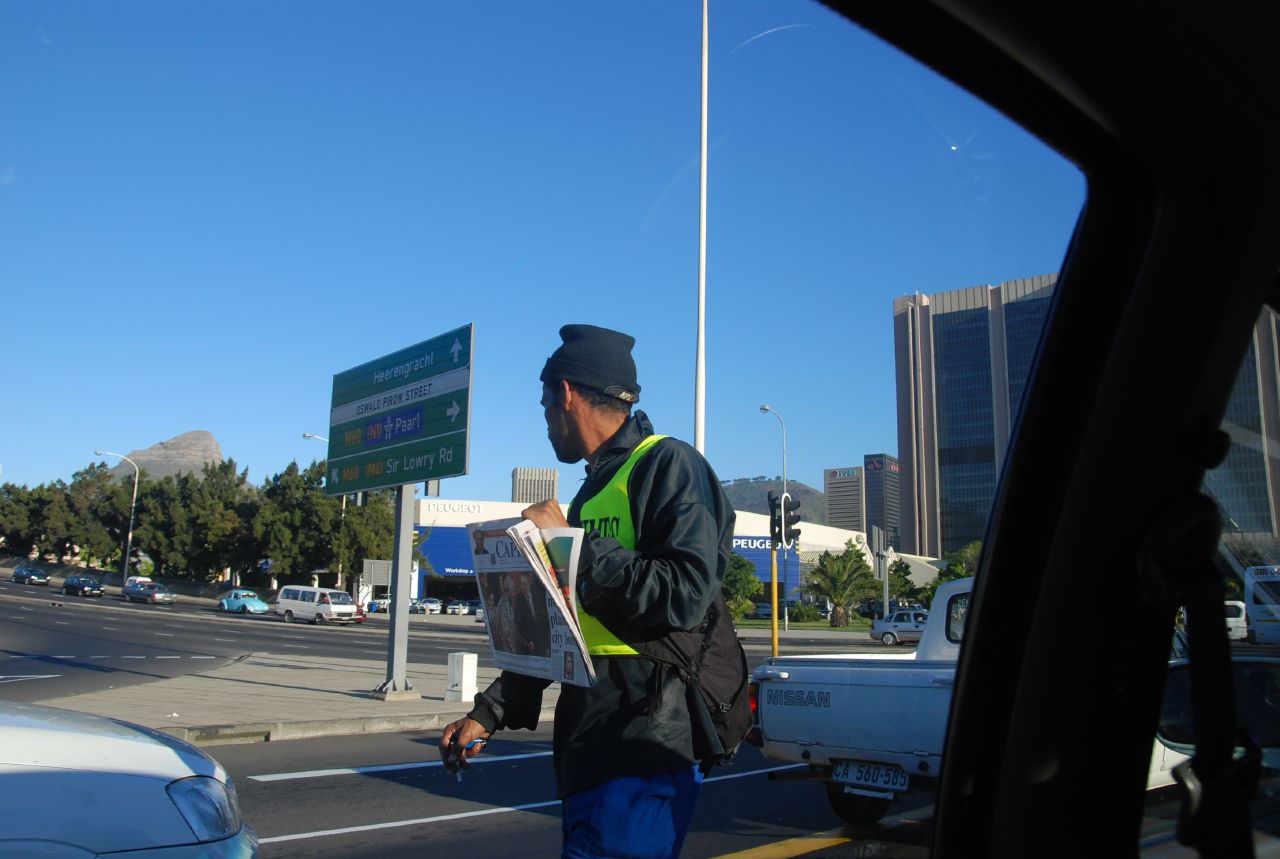


From this destination's category on Wikimedia Commons. Each photograph is credited to its own author under its own licence.
The guide text on this page is from the Wikivoyage article Cape Town, written by Wikivoyage contributors and published under CC BY-SA 4.0. The authors are listed in the article’s edit history. It has been shortened and re-laid-out for this page; that adapted text is available under the same licence. Nothing else on this page is.
Wikivoyage is written by travellers, not by us. Opening hours, prices and whether a place still exists are exactly the details that go out of date, so check anything you are relying on.
“2,207 readers a month” and the ranking are ours, counted from Wikimedia’s published pageviews (CC0) — the median of twelve complete months. They count people reading about a place, which is not the same as people going there.