
Budapest
Budapest is the capital city of Hungary. With a unique, youthful atmosphere, world-class classical music scene, a pulsating nightlife increasingly appreciated among European youth, and last but not least, an exceptional offer of natural thermal baths, Budapest is one of Europe's most delightful and enjoyable cities. Due to the exceedingly scenic setting, and its architecture it is nicknamed "Paris of the East". The modern-day Budapest results from the amalgamation of two historic cities lying right opposite each other over the Danube river. Buda is the western (right) bank side, with the high hill atop which the Buda castle sits. Pest is the relatively flat eastern (left) bank side, with the Parliament, numerous other stately buildings, and busy streets retaining all their 19th century architectural heritage. In 1987 Budapest was added to the UNESCO World Heritage Site for the cultural and architectural significance of the Banks of the Danube, the Buda Castle Quarter and Andrássy Avenue.
Most read about in August, least in December. That is when people look it up, which tends to run a month or two ahead of when they go.
Before you book
The Foreign, Commonwealth & Development Office publishes the UK’s official travel advice for Hungary. It changes without notice and travelling against it usually invalidates your insurance, so read it at the source rather than anywhere else — including here.
FCDO travel adviceUnderstand
Antiquity
The first settlement on the territory of Budapest is accounted to Celtic tribes. During the first century CE, the Roman fortification on the territory of present-day Óbuda (now part of Budapest) gradually developed into the town of Aquincum which became the capital city of the province of Lower Pannonia in 106CE. The Romans founded a fortress known as Contra Aquincum on the other side of the river which is assumed to have developed into the later town of Pest. This was part of the Limes, marking the eastern border of the empire, and was gradually given up by Rome during the early fourth century, becoming part of the Hun empire for a few decades. The Huns were a confederation of various nomadic nations and tribes inhabiting the Eurasian steppe, and not Magyars, but Attila, the King of the Huns, is considered a national hero and Attila is a common given name in Hungary.
Early Middle Ages
Once the horse-riding Magyar (Hungarian) tribes arrived in the Carpathian Basin in 896CE, Óbuda served as the seat of the Magyar high-chieftain (or prince) Árpád. After a century marked by frequent raids on Christian western Europe, the erstwhile Hungarian prince Géza realised that converting to Christianity was the key to survival in Europe. The Christian Kingdom of Hungary was founded by the crowning of his son, Szt. István (Saint Stephen) on 1 January 1001 (or possibly Christmas Day of 1000). As visitors will quickly realise, Saint Stephen became an omnipresent national symbol, as did the artefact known as Saint Stephen's Crown (the Holy Crown of Hungary) which was regarded as a legal entity that was by law equivalent to the country itself during medieval times. It is still unclear whether the millennium-old crown used in this function for many centuries and shown in the Parliament today, was used by Saint Stephen. In the following centuries, Buda emerged as the most important royal seat. In 1241/42 the Mongol Empire conquered the territory along with large parts of Europe - this short but devastating conquest of the country is still remembered as Tatárjárás - the name reflecting the erroneous confusion of Mongols and Tatars at the time. Medieval Hungary reached its zenith under King Matthias (Matthias Corvinus), the vividly remembered Renaissance ruler whose patronage of arts and sciences made Hungary, a notable power at the time, the first European country to adopt the Renaissance from Italy. However, after residing in Buda for decades, he moved his seat to Vienna in 1485 for the last five years of his life after defeating the Hapsburg Holy Roman Emperor Frederick III. In 1541, Buda and Pest fell to the Ottoman Empire and were taken back 1686, when the Hapsburg Empire centred in Austria conquered the country on its way to becoming a major European power. Marks of these two cultures are still part of everyday life in Budapest.
The 19th-century - formation of Austria-Hungary and Budapest
After the anti-Hapsburg revolution in 1848–49 (defeated through the decisive help of the Russian Czar) the 1867 Compromise (Kiegyezés) with a weakened Vienna made Buda the capital of a near-autonomous Hungary, a large, multi-ethnic kingdom comprising half of the newly created Dual Monarchy of Austria-Hungary. In this peculiar double-state the monarch was Emperor of Austria and King of Hungary, two autonomous realms. The following half century marked by peaceful development counts among the most successful times in the history of the country and its capital. With the 1873 unification of Buda, Pest, and Óbuda, the city of Budapest was created. It saw a leap in terms of industrialisation, urbanisation, population, and the development of a capitalistic society. It even aimed at rivalling with Vienna, the Millennium in 1896, marking a thousand years of Hungary, offered the perfect excuse for large-scale projects such as the Parliament, Vajdahunyad Castle, or the Grand Boulevard (Nagykörút) the first electric underground railway in the world (now Metro yellow line). Budapest was transformed to a world city during these decades, enriched by Austrian, Jewish, Slovakian, Serbian, Croatian, Roma and other cultural influence. This age is remembered as the 'Monarchia' (or as 'K. u. K.', abbreviation for Imperial-Royal in Austria and other parts of the Empire) and associated with the rule of Franz Joseph I. (I. Ferenc József) who died in 1916 after 68 years on the throne. In this period, the city was the home of two world-famous Hungarian inventors -- the father of the electric locomotive, Kálmán Kandó, and inventor of the match, János Irinyi -- and of two renowned composers, Béla Bartók and Zoltán Kodály. There is no other European city which had given so many Hollywood filmmakers in the early 20th century, such as Budapest.
What's inside
Although Budapest is administratively divided into 23 numbered districts (always written in Roman numerals) it is colloquially often divided into parts, roughly corresponding to the two major cities of Buda and Pest, which it comprises. Listings of particular points of interests - museums, historic monuments, restaurants, bars, hotels, shopping opportunities and such - can be found in the following articles:
Outer Pest
Of course, quarters often offer their own atmosphere due to their history and inhabitants. Roughly speaking, areas near to, especially inside of Nagykörút (Great Boulevard or Ringroad, served by Tram 4 and Tram 6) are considered central, even if some of these are in less than perfect condition and not typically frequented by tourists. In Pest, Kiskörút (Small Boulevard) is traditionally considered as the border of the centre proper, including some highly touristed areas.
Informally, quarters are known under their own historical name which are often referred to by the locals. The names are often linked to members of the House of Hapsburg or - in fringe areas - the names of villages or towns which later became part of Budapest. Particularly interesting quarters are Belváros (Inner City) and Lipótváros (Leopold Town), together form the Belváros district (a bit confusing but usually the biggest or oldest quarter gave its name to the entire district), the heart of Pest, including a number of major sights but also beautiful squares and cafés. With the Parliament, a number of ministries and banking houses, Lipótváros is also a major political and business centre of the country. The name refers to the Hapsburg Emperor Leopold I whose coronation to the King of Hungary in 1790 gave rise to the name of the then-new quarter. Újlipótváros (New Leopold Town) The inner part of the XIII. district (so called Angyalföld), just outside of the Great Boulevard north of Leopold Town with the marvellous Margaret Bridge at its corner, was built between the 1910s and 1930s. It is considered as one of the finest residential areas in Budapest with a relaxed, inviting atmosphere and a number of restaurants, cafés and small shops. It also comprises the Vígszínház (Comedy Theatre) and a few tiny off-mainstream cinemas. The quarter is traditionally home to a population with Jewish background as the activity of people such as Raoul Wallenberg, Giorgio Perlasca, and Carl Lutz was linked to this area (see history). Terézváros (Theresa Town) VI. district. Among others, it contains Nyugati pu. (Western Railway Station), an architectural sight, and areas neighbouring districts V. and XIII. The then-developing quarter was named after a visit of Habsburg Empress and Queen Maria Theresa in 1777. Erzsébetváros (Elisabeth Town) VII. District. While parts of it are not yet renovated, it contains the famous Synagogue in the Dohány street. The quarter was split off from Terézváros and asked for permission to be named after the wife of Franz-Josef I, popularly called Sisi, in 1882.
Getting there

By plane
Budapest has direct flights to most major European cities. Many of these are operated by the budget carrier WizzAir, which is based here and is now in effect Hungary's national airline. Other budget operators include Easyjet, Ryanair, Jet2, Norwegian and Vueling. This competition holds down prices on the traditional airlines such as KLM and Lufthansa. Direct destinations around the fringes of Europe include Reykjavik, St Petersburg, Moscow, Kyiv, Kutaisi, Baku, Astana, Tel Aviv and Agadir. Gulf carriers connect via Doha and Dubai to the Far East, Australasia and Africa. There are no direct flights between Budapest and North America: connect via London, Amsterdam or Paris. 1 Budapest Franz Liszt International Airport (BUD IATA Budapest Liszt Ferenc Nemzetközi Repülőtér pronounced "list-ferents", often still called by its old name Ferihegy) (It's located about 16 km (9.9 mi) south-east of the city centre), ☏ +36 1 296-7000 (call centre). Hungary's chief airport. All flights use Terminals 2A and 2B. Terminal 1 was closed in 2011. There's no practical distinction between Terminals 2A and 2B, and they're freely connected landside by corridors and airside by "SkyCourt" food & retail area. (Originally 2A served Schengen Area destinations, and 2B the rest of the world, but this has been dropped.) Check-in and bag-drop desks 1-30 are in Hall 2A and desks 31-60 in Hall 2B, but do not correspond to the gates. This means that if 2A has a long line for security, you can get airside through 2B (and vice versa), as both lead into the SkyCourt.There are several small cafes in Skycourt and in 2A & 2B near the gates. Duty-free stores are operated by Heinemann. They are seldom a bargain - by all means blow away your last local currency here. But if you're looking for something in particular (eg Tokay wine), check prices in advance on their website and compare with downtown supermarket prices. You can usually only buy duty-free if you're taking a direct flight: if you're transiting another European airport, security there will confiscate liquids.Central information: ☏ +36 1 296-9696Luggage services: ☏ +36 1 296-5965
Getting between airport and city: the main options are bus, bus & metro, bus & train, and taxi / transfer.
Bus line 100E Airport Express This runs from city centre to Airport Terminal 2 arrivals level 24 hours a day, every 7-15 minutes most of the day, and every 30 minutes between midnight and 5AM. The ride takes 30-40 minutes dependingon traffic. The city centre bus stop is by Deák ferenc tér at Károly krt in front of Városháza Park; look for a blue articulated bus with an airplane sign. The only stops on the way are called "Kálvin tér" and "Astoria tér" (city bound only). The fare is 2500Ft. You can buy the ticket by tapping your bank card on the machine inside the bus, or from the vending machines outside. Be careful not to buy the 450Ft tickets, these are not valid and if you stamp them in the bus, they will be wasted. Metro + Bus line 200E Bus line 200E runs between Terminal 2 and Kőbánya-Kispest Metro station, taking 25 min, bus fare Ft500. You there buy a Metro ticket for another Ft500 and ride line 3 to the city centre, about 20 mins to the main interchange at Deák Ferenc tér. The bus runs all day every day, with 7-8 minutes frequency during the day, 30-60 minutes at late night. The metro runs every 3-5 mins, 04:30-00:00. If the connections are slick, this route takes 45 minutes. Train + Bus line 200E Kőbánya-Kispest also has a mainline train station, with trains every 10-15 min to Budapest Nyugati in the northern city centre taking about 25 min. More likely you'd change here to reach eastern towns such as Szeged, Kecskemét, Debrecen, Miskolc for, and Szolnok where you can change again for trains into Romania. Do not board a train for Budapest Keleti: it will make a grand 6-hour scenic tour of the countryside before looping back to the city. Reach Kőbánya-Kispest from the airport on Bus 200E as described above.On the way, the bus runs past Ferihegy station, which used to serve the former airport Terminal 1. Trains do stop here but the place is dismal and dilapidated, you won't feel safe, and the ticket machine has probably been vandalised. Stay on the bus for another 5 min unless you're frantic to catch a last train. Taxi: the only licensed taxi operator at the airport is Főtaxi - don't accept offers from drivers or touts waiting around Arrivals. However, you can order via phone/app a taxi to the terminal from other company, too. A trip inbound to central Budapest will cost from Ft13000. Queue at the taxi stand first to receive a written quote for your fare, then pay it when you arrive at your destination. Pre-ordering by phone may get you a better price. Official taxi fares are fixed citywide. AS of 1 August 2026: 1,300 HUF base, 521 HUF/km, 130 HUF/minute waiting, plus a new 800 HUF airport surcharge. The same rate applies day or night, with no surge pricing. Note that Főtaxi does not provide child seats of any kind, whereas MiniSud shared shuttle does.
Getting around

Orientation
Orientation is not a big problem in Budapest. The river Danube splits the city into two areas: Buda and Pest. Aside from the very centre, the city's structure is quite logical. Landmarks in Buda as the Royal Castle or Citadella Castle also help you to find your way. Besides the Danube, the best reference points for orienting yourself are the bridges crossing the river. From north to south, they are:
5 Megyeri Bridge (Megyeri híd) (At northern city border). The newest one. A cable-stayed bridge. Built in 2008. There are 4 lanes and 2 hard shoulders. Part of the M0 motorway. 6 Árpád Bridge (Árpád híd). A modern bridge linking to Northern Margaret Island. The longest bridge in Budapest at 973 m. Also the busiest bridge in Budapest. 7 Margaret Bridge (Margit híd). Easily identified thanks to its distinctive shape: it makes an approximately 35 degree turn half-way across, at the southern tip of Margaret Island. Trams 4 and 6 cross the Danube here. Close to its on the Buda side is the northernmost destination of the Muslim pilgrims: the Tomb of Gül baba. 8 Chain Bridge (Széchenyi lánchíd). Completed in 1849, this is the oldest permanent bridge over the Danube. It’s also the least busy bridge in Budapest, since it’s not connected to any main roads arguably most beautiful and certainly the most photographed of Budapest's bridges, floodlit at night. (updated May 2026) 9 Elisabeth Bridge (Erzsébet híd). Completed in 1903. Its original chain structure was destroyed in World War II, and was substituted by a modern cable bridge which opened in 1964. The narrowest facade's building of Budapest is 6.2 wide. It is on the Buda side of the Elizabeth Bridge and can easily be spotted while crossing the Danube from Pest. 10 Liberty Bridge (Szabadság híd). Elegant and complex, opened in 1896; it connects the Gellért Baths (Gellért fürdő) in Buda with the Central Market Hall (Nagy Vásárcsarnok) in Pest. 11 Petőfi Bridge (Petőfi híd). For a long time the southernmost bridge, it links the inner ring road (Nagykörút) of Pest with Buda. 12 Rákóczi Bridge (Rákóczi híd). The second newest bridge in Budapest, with modern architecture and a spectacular lighting system where mirrors reflect the beam of the upward facing floodlights. Built very next to a railway bridge on its southern side. It was called Lágymányosi híd before 2011.
On foot
Many of Budapest's highlights are easy to approach walking, and in the centre you find more pedestrian zones from year to year. Car drivers tend to respect pedestrians and often give advantage on a cross-walk even if there is no traffic light. Due to the lack of bike lanes, cyclists have to weave around pedestrian traffic; be prepared. Don't wear high-heeled shoes in the centre as there are lots of stone pavements, especially in the Castle Hill.Exploring on foot is the best way to see the sights, but be prepared for uneven surfaces and cobblestones.
See
Individual listings can be found in Budapest's district articles
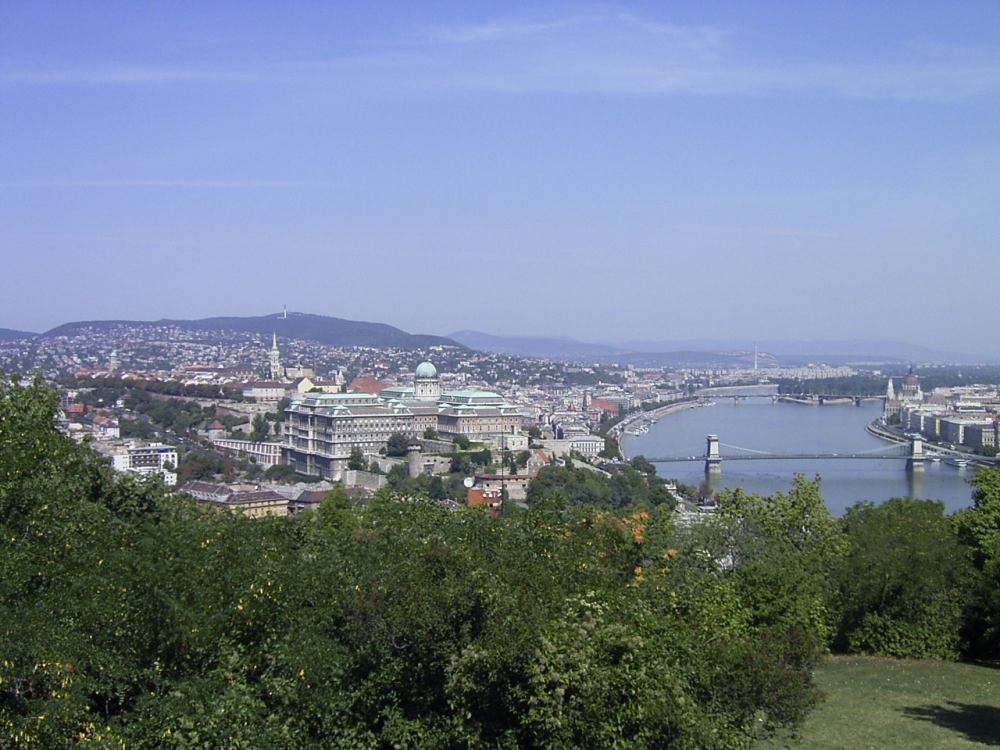
The Danube. This is what's unique about Budapest, the urban river landscape. This feature can be admired in several ways: from panoramic points, such as Fisherman's Bastion or Gellért Hill's Citadella in South Buda, promenading along the river banks, or from the river's perspective, from a boat. For romantic views of the city, go at night. There is a number of bridges (see Orientation above) that arch over the river and define Budapest. Most famous is the Chain Bridge (Széchenyi Lánchíd), owing its name to the suspension structure: the bridge is made of chains whose links are huge dog-bone shaped metal bars linked by pins at their ends. And there is also the magnificent Elisabeth bridge (Erzsébet híd) and the Liberty bridge (Szabadság híd). To get away from all the hustle of the city visit Margaret Island (Margitsziget), reachable from the Margaret bridge. Its large parks (see Buda) are a very pleasant place to relax and wander, perfect for a sunny afternoon.
Most of Budapest's famous sights are concentrated on Castle Hill on the Buda side, in downtown so called Belváros and along the riverside walkways. On Budavár the main highlight is the Royal Palace (Királyi palota), which is the most popular attraction on the hill. It is home to the National Gallery and the Historical Museum of Budapest, with exhibits about medieval Budapest and history of the Royal Palace. To the north you can find the funicular on a big square southestern corner, while in the eastern part there are some medieval excavations and castle ruins from 14-17th century. Towards the north, by the Dísz tér corner, is the Golden Eagle Pharmacy Museum (Arany Sas Patikamúzeum), with a collection of pharmaceutical objects from the Renaissance and Baroque eras. Near there is the Café Ruszwurm, or 'the Heaven for coffein and sweets addicts'. A hundred meters east is a local pride, the Matthias Church (Mátyás Templom), which is a Neo-Gothic church crowning Budapest's cityscape, and the 'Fisherman's bastion', (Halászbástya), a lookout terrace with impressive views across the Danube to Pest. In the next building is the Marzipan Museum, which is a children's favourite. On the castle northwest corner is the Military Museum if you interested for uniforms, weapons, maps and other Hungary-related military objects from 11th century until nowadays. If not, you must to go there because the view from there is worth a short detour. Almost all of west Buda hill is visible from here. Central (Belváros) of Pest is the administrative and business centre of Budapest and the whole of Hungary. Visiting first the Parliament Building (Országház) is good choice. A Neo-Gothic jewel, it is beautifully situated overlooking the Danube. It is very much worth going inside. Opposite the Parliament, the Museum of Ethnography is located, and just couple hundred metres is St Stephen's Basilica, the main church of Budapest and an important example of Neo-Classical architecture. Take 2 stops by M3 to Astoria station and visit the Jewish quarter (part of Unesco World Heritage), the main Hungarian Jewish holy place the Dohány Street Synagogue and Jewish Museum (Dohány utcai Zsinagóga), the largest and certainly among the most beautiful ones in Europe. Take the underpass toward National Museum, on the way admire the Eötvös Loránd University on Múzeum körút. It is worth dropping by for a short visit. Visitors can rest in the lush Trefort Garden or have a refreshment in the popular Bölcsész Terasz, an open-air cultural garden that has musical performances as well as food. If you take metro to Kálvin tér, you can visit another important museum which is the Applied Arts museum. Outside the centre towards the south take tram 2 to visit the famous Zwack Unicum, a type of alcoholic spirit, company museum, and the new culture hub near to Lágymányosi bridge include the Ludwig Museum of Modern Art.
Do

The simplest, and perhaps best of all: get a map, circle the things you want to see, divide up your time and stroll around in the city. Spend time in charming cafés or restaurants, preferably not right at the main tourist sites, look at the market stands, walk on a bridge in the evening. The lively atmosphere of this jewel of a city both by day and by night cannot be experienced via guided tours, locked into a tourist bus/boat. Locals are usually happy to help, also to tell you what they think is best to see, what is better to stay away from or for a little chat just to keep up their English or German. Don't hesitate to ask questions. Hungaria Koncert, ☏ +36 1 317-1377, hunkonc@ticket.info.hu. Operates cruises with lunch or dinner daily at 14:00, 19:00 and 20:00. This service is 90 minutes with hot buffet lunch or dinner. During the cruise, the Parliament, Chain Bridge, Royal Castle, Palace of Arts, etc. can be seen. Rent a bike. Rents are around Ft1,800 for half a day. Szentendre is a 2 hours ride from the centre and you get to see nice places, much of the way is at the Danube. If you prefer more organised ways, a guided bike tour gets you some exercise and introduces you to the local geography. For example, staff at Buda Bike [underground garage at the plaza in front of St Stephan's Basilica] are very friendly. They also rent bikes. Bike map on the Net Walk in the City park (Városliget) with your children. Walk around the lake and feed the ducks. See the statue of Anonymus at the Vajdahunyad Castle, a fairy-tale-like building. Széchenyi Spa, right next to the lake, is also enjoyable for children (see also the Baths section). In the winter, the same lake is transformed into the large ice-skating rink with an astonishing view during winter. It is a popular place for children and teenagers. The nearby Circus (Fövárosi Nagycirkusz - Great Circus of the Capital) offers performances with international artists. Next to it, the Budapest Zoo - one of the oldest in the world - offers more than 800 animals to be seen in a historic atmosphere. Experience an opera at Budapest's beautiful State Opera House or a performance of folklore or classical music at any of Budapest's many concert halls (details under Performing arts). Budapest River Cruise is an option to discover the city with Danube boat which takes 75 minutes and you can visit the most popular places with it.
Events
Budapest Spring Festival. In March, a dazzling variety of cultural events mainly revolving around classical music and performing arts - including folklore. Grand Prix or Formula One motor racing at Hungaroring in Mogyorod village. Firework above Danube River (Tűzijáték) (Between Petőfi Bridge and Árpád Bridge). 21:00 on 20 Aug. National Holiday. Sound & light show with fireworks. Around half hour open air show. Free except if you wish to see from the air. Jewish Summer Festival. Another array of cultural and music events, with a Jewish touch. Sziget festival attracts rock fans, world music hippies and the usual festival crowd every August. It has become one of the best-known festivals in Europe.
Performing arts and classical music
Apart from a renowned music scene, Hungary has a surprisingly rich theatre and art scene and, not surprisingly, Budapest is the epicentre of it. The season begins in mid-September and ends in June. Productions range from classic dramas and traditional operas to post-modern dance performances. The following venues can be particularly interesting for non-Hungarians. Tickets are bookable about one month beforehand at Interticket, the Hungarian theatres' official booking engine with a booking fee of 10% + Ft50.
Shopping

When receiving change from a taxi journey, make sure that the money is actually Hungarian. Some taxi drivers have been known to give unsuspecting passengers obsolete Romanian banknotes (lei).
Many reliable exchange bureaux can be found in the city centre near Deák Ferenc tér metro station. For example, there are two shops next to the tourist information. These shops as well as other shops in the area offer a better rate than other banks at tourist spots such as international bus stations and the castle hill. The rate might be even better than getting cash from ATMs. There is also no extra charge. If you're looking for money exchange in the Keleti station, be sure to check exchange rates at all the three money exchange shops along the platforms; they offer differential prices. See Hungary#Money for information on currency and exchange rates.
Most of the visitors from far away end up shopping in Pest in the middle of the city: Váci utca and nearby. It is historically the most expensive part of the city. You'll find Hungarian linens and lace, pottery, and other items, in souvenir shops. You definitely want to visit the Great Market Hall (Nagy Vásárcsarnok) at Fővám tér, the renovated market hall with essential atmosphere (it's at the south end of Vaci). Prices for the same items vary a lot between sellers and aren't set in stone so be sure to compare and bargain.
Eat

Individual listings can be found in Budapest's district articles Hungarian food deserves to be (and often is) mentioned among the country's main sites. As in other cultures, the Hungarian approach to food combines pride in their own traditions with a readiness to accept outside influences. The result is a vibrant restaurant scene where an Asian-Hungarian fusion restaurant may well be of genuine interest. Luckily, prices are significantly below western Europe's with around €4 for a budget lunch, and around €8-14 for a nice evening meal in a mid-range restaurant, depending on place and appetite. Above €20 per person is definitely considered expensive, but there are enough lavish places above this price range for those looking for something special. Local specialities often revolve around meat (pork, beef, veal, or poultry), often involve liberal use of paprika, however not necessary of the hot kind. Due to a historical translation error, "goulash soup" is indeed a soup, not the "goulash" that visitors may be familiar with from home which is known as "pörkölt".
Major specialities include:
gulyás (leves) usually translated as 'goulash soup' - a filling meat soup (usually beef) with potatoes and paprika, among other ingredients. Served as main dish or as a (heavy) starter. The name refers to the Hungarian version of a cowboy taking care of a 'gulya' (cattleherd). paprikás veal or chicken cooked in delicious creamy paprika sauce (not spicy) pörkölt a beef stew with sautéed onions and paprika. Similar to what is served as 'goulash' abroad. halászlé - fishermen's soup served differently depending on region töltött káposzta - stuffed cabbage, the cooked cabbage leaves are filled with meat and in a paprika sauce, served with sour cream (similar to crème fraîche or crème acidulée) Balaton pike-perch (fogas) gyümölcsleves - fruit soup - cold, creamy and sweet, consumed as a starter. From the desserts, you may not want to miss
Drink
Individual listings can be found in Budapest's district articles Budapest offers plenty of places to drink, from cool and ultra-hip to rowdy and down-market. If you are in the mood for a particularly Hungarian experience, visit a so-called borozó (wine pub). These offer cheap yet tasty Hungarian wine on tap at outright hilariously low prices if you manage to find one outside the tourist circuit. Budapest is known for its so-called "ruin bars", found mainly in Budapest’s Jewish Quarter. They are former abandoned buildings transformed into popular nightlife spots. The trend began in the early 2000s. These bars offer a relaxed, bohemian vibe with quirky decor, serving as places for drinks, food, dancing, live music, and community events. Today, they’re a major draw for both locals and tourists. Hungary is famous for its wines produced at Balaton area and Eger. Among red wines the best are Kékfrankos, Egri Bikavér "Bulls Blood” and white wines the Szürkebarát and Chardonnay are popular. One of the most favorite is the Tokaji, a sweet white wine. You should try not to miss out on the Hungarian spirit, pálinka, made from fruits such as plum, apricot, cherry or Williams pears. Unique Hungarian soft drinks to try are Traubi Szoda (a white grape soda) and Márka (a sour cherry soda).
Sleep
Individual listings can be found in Budapest's district articles Budapest offers a wide range of accommodation in all price classes from the hostels which start at €7 per night, to small cheap pension, to the luxurious 5-star hotels, although the costs of staying here are notably higher than elsewhere in Hungary. Arriving trains are often met by touts offering free rides to hostels, as well as little old grannies offering their apartments for rent. Try to figure out exactly where you're going before you choose - or, better yet, visit a travel agency to browse options in a more comfortable environment. The most expensive are on or near Castle Hill, dozens of reliable backpacker hostels are mostly across the river in Pest. However, Buda has better air quality due to the closeness of the hills and the forests lying to the west from the city. Apartments may be a cheap alternative for those making extended stays.
Stay safe

Central Emergency: dial 112 Ambulance: 104 Fire: 105 Police: 107
Crime
Budapest is potentially one of the safest cities in the world for its size. There are no slums or districts you should avoid, particularly not in the touristy areas or nearby. As a traveller, you should take only normal precautions: don't show off your money and don't wear flashy jewellery. Magyars tend to be friendly with foreigners; racism or xenophobia against tourists is practically unknown. As in most other big cities, pickpocketing is the most common crime against tourists. The rate of picked pockets is relatively low by Western European and U.S. standards, and you're unlikely to have any problem if you follow some basic rules you wouldn't forget in Paris, Brussels or Vienna. The most important rules are that you never wear a backpack or purse on your back in public transportation or other places with a lot of people, and make sure that you have your wallet in one of your front pockets. Younger Hungarian policemen mostly speak some basic English. Tourists have no reason to be afraid of them unless they break the law. During the peak tourist season, police patrolling major tourist areas are accompanied by bilingual or multi-lingual students who assist with problems or complaints. Police have also opened a 24/7 TourInform office in one of Budapest's busiest areas. It is located at Sütő Street 2, District V, and they are able to receive complaints and render assistance in English and German.
By night
Mostly there's no reason to have concerns about Budapest by night. In practice, the whole city, including all the touristy areas, Pest within the inner ring road (the line of Szent István körút–Teréz körút–Erzsébet körút–József körút–Ferenc körút, popularly known as Nagykörút), and Buda are safe even before dawn. Most locals avoid walking alone by night in outer zones of districts 8th and 9th in Pest, as these are shady, though not particularly dangerous, areas. Areas in 8th district behind Népszínház utca - József körút can be a bit risky, although the district is CCTV monitored by the police. If you don't have special thing to do there, try not to have a walk at night at Lujza, Dankó, Magdolna Streets and their surroundings: also, it's not a very attractive area. Népszínház utca itself is not a very nice place after dark, but usually not risky. Some big panel areas on the outskirts of the city (parts of Újpest and Kőbánya, residential areas unknown by tourists) also not the best places to have a walk without knowing where to go. The area around Keleti pályaudvar is also not very friendly, but usually nothing happens. Avoid homeless people asking for money or selling something in the big underpasses. The subway at Nyugati tér collects different types of people; it is generally not risky because of heavy traffic day and night, but try not to look very "lost" there. Beautiful during the day, bigger public parks like Városliget, are better avoided at night. Don't take a healthy walk at Népliget after dark. The famous 'chill-out' place at Római part (3rd district) can be deserted especially after 01:00 and in winter, although it's usually safe. Don't go to the dark paths alone around Citadella at night. Night buses and the tram no.6 passing through the city centre can be very crowded at peak socialising times on Friday and Saturday nights. You may come across aggressive drunk youngsters on the vehicles or at the stops. Keep a low profile or avoid the public transportation system on weekend nights. Major night lines are now guarded by security staff.
Go next

Day tours
37 Apaj (50 km from Budapest). Take a tour in the Upper Kiskunság Plain which is part of the Kiskunság National Park, the closest Puszta. (updated Sep 2021)
38 Arboretum of Alcsút (Alcsúti Arborétum), Fejér County, Alcsútdoboz (West 40 km - take M1 highway turn south after Bicske or By bus line 1253 to Felcsút from Népliget bus station and walk ~2 km (daily 3-5 times)), ☏ +36 22 353219, info@alcsuti-arboretum.hu. W-Su 10:00-18:00. This Nature reserve is part of the Danube-Ipoly National Park. Sights: Habsburg castle remains, Castle Chapel, Palm House ruins, House of Research, Dollhouse, Bear's House, Gloriette, Grotta, The Lion Fountain, Crowned Bridge, giant plane tree, giant thuja. Ft700, guided tours 2-hr-long Ft7000 per group. Budakeszi (take city bus #22 from M2:Széll Kálmán square) Located in a green area. The north gate of the Hegyvidék is a good excursion place. There is a significant German minority with own church and museum. Also famous for the Wildlife Park. 39 Érd, Pest county (the first train stop from Budapest/South Buda). - a suburb of Budapest, the biggest village in all Europe 40 Esztergom (50 km north - intercity buses from M3 'Árpád híd'/'Újpest-Városkapu' or train from Nyugati Railway Station (1 hour, ~Ft1500)). Site of the biggest basilica (church) in Central Europe include the world's largest altarpiece which painted for a single canvas, the richest collection of Hungarian ecclesiastical treasures, the only Renaissance memory, of Hungary, the red marble Bakócz chapel. Part of the UNESCO World Heritage Tentative List. 41 Fót, Pest county (17 km north of the edge of Budapest). Visit the Reformed church, a beautiful example of the Hungarian Romantic architecture painted boarded ceilings, sculptures of its made Carrara 's marble. The other main sight is the Károlyi Palace (1850)
42 Gödöllő, Pest county (by MÁV suburban rail – Keleti pályaudvar or HÉV ("local/suburban trains" supported by BKV) from M2: 'Örs vezér tere' to Gödöllő (to Csömör is wrong direction, be aware of the splitting of HÉV lines H8 and H9).30 km east). A town full of parks, and home to Grassalkovich-kastély (Grassalkovich Palace), formerly a Royal Palace also here is an Arboretum. This palace was the occasional residence of Sisi, Habsburg Empress Elizabeth. Visit the European rarity, a working, 200-year-old Baroque Theatre in the Palace. The great royal park became special with its old trees which could see Sisi in the 19th century. Take a walk in the Gödöllő Landscape Protection Area with lot of historical and cultural memories such Sarmatian, Scythian and Avar places: remains of cemeteries, earthworks, trenches in the neighborhood of Valkó, Szada, Pécel settlements and here is a part of the famous Devil's Dykes (Hungarian: Ördög/Csörsz árok or the Limes Sarmatiae). Also there is one of the biggest pilgrimage place, the Shrine Temple in Máriabesnyő village. Mogyoród (east toward Gödöllő). The Formula 1 racetrack is located here. Every year, hundreds of thousands of visitors come to enjoy the event. Kart driving all year round at the nearby Hungarokart Centre. (updated Jul 2023) 43 Pomáz, Pest county (Danube Bend east side). Teleki-Wattay Palace and the Stone Hill 44 Pusztavacs, Pest county (54 km south-east of Budapest). Equestrianism. 45 Ráckeve, Pest county (take suburban rail from 'Vágóhíd' terminal). Famous for being the only standing Gothic Serbian cathedral in Hungary and Savoya Castle. 46 Szentendre, Pest county (Danube Bend west side. From M2: Batthyany Square, take a suburban train 'HÉV' (supported by BKV) to Szentendre - 19 km north). A picturesque town, the Mediterranean atmosphere of its thanks to Greeks Dalmatians and Serbs who are settled since the 14th century. At city limit can find the biggest open-air ethnomuseum of Hungary. The most visited small town of Hungary. Also known for exquisite marzipan products. 47 Vác, Pest county (on the Danube bend east side - reached from Budapest by MÁV suburban rail – Nyugati pályaudvar, 32 km north). Visit a beautiful square, all houses on it are national level protected monuments. Also must-see is Memento Mori; this exhibition is unique in all of Europe. In the Dominican church crypt you can see naturally mummified corpses in coffins. Otherwise, the Arc de Triomphe, built for the visit of Empress Maria Theresa, is here. This is the only one of its kind in all of Hungary, and the only place in the country where you can walk on a Baroque bridge which decorated sculptures 48 Vácrátót, Pest county. There is the richest botanical garden of Hungary and the Manor of the Vigyázó Castle 49 Veresegyház, Pest county. Sight of the bear sanctuary, Roman Catholic Church: built in 1777, Roman Catholic cemetery: in 1806 and 1849, Reformed Church: was built in 1786.
More pictures of Budapest


From this destination's category on Wikimedia Commons. Each photograph is credited to its own author under its own licence.
The guide text on this page is from the Wikivoyage article Budapest, written by Wikivoyage contributors and published under CC BY-SA 4.0. The authors are listed in the article’s edit history. It has been shortened and re-laid-out for this page; that adapted text is available under the same licence. Nothing else on this page is.
Wikivoyage is written by travellers, not by us. Opening hours, prices and whether a place still exists are exactly the details that go out of date, so check anything you are relying on.
“2,980 readers a month” and the ranking are ours, counted from Wikimedia’s published pageviews (CC0) — the median of twelve complete months. They count people reading about a place, which is not the same as people going there.