
Vienna
Vienna (German: Wien; Austro-Bavarian: Wean) is the capital of Austria and by far its most populous city, with an urban population of 2 million and a metropolitan population of 2.9 million (2023). It is the country's artistic, cultural, economic and political centre. It is known for its high living standards, relaxed yet elegant lifestyle and rich musical life. Vienna, renowned as the former seat of the Habsburg court and its diverse empires, stands not only as a grand metropolis but also as a historical center that has perpetually thrived with a substantial population. This city's distinction lies in its privileged stature, fostering an environment that has nurtured numerous eminent artists, notably Beethoven, Haydn, Liszt, Mozart, Schubert, and Johann Strauss II, among others. It was long the largest German-speaking city in the world before being surpassed by Berlin. The large historic city centre of Vienna filled with monuments to its imperial past is inscribed on the UNESCO World Heritage List.
Most read about in August, least in April. That is when people look it up, which tends to run a month or two ahead of when they go.
Before you book
The Foreign, Commonwealth & Development Office publishes the UK’s official travel advice. It changes without notice and travelling against it usually invalidates your insurance, so read it at the source rather than anywhere else — including here.
FCDO travel adviceUnderstand

History
The low-lying Danube plain in and around what is now Vienna has had a human population since at least the late Paleolithic (see Prehistoric Europe); one of the city's most famous artifacts, the 24,000-year-old Venus of Willendorf, now in Vienna's Natural History Museum, was found nearby. Vienna's own recorded history began with the Romans, who founded it in the 1st century CE as Vindobona, one of a line of Roman defensive outposts against Germanic tribes. Vindobona's central garrison was on the site of what is now the Hoher Markt (the "High Market" so-called because of its relative height over the Danube), and you can still see astounding excavations of its foundations there today. Given its prestige, Vienna hosted the Habsburg court for several centuries, first as the Imperial seat of the Holy Roman Empire, then the capital of the Austrian Empire, and later of the Austro-Hungarian Empire, which finally fell in 1918 with the abdication of the last Emperor Karl I. The court tremendously influenced the culture that exists here even today: Vienna's residents are often overly formal, with small doses of courtliness, polite forms of address, and formal dress attire. One distinguishable paradox of the quirky city is that its residents can be equally modern and progressive as they are extremely old-fashioned.
The empires also served to make Vienna a very metropolitan city at an early time, and especially so through the years of industrialization and fall of the Austro-Hungarian Empire at the turn of the 20th century. Imperial Austria and Austro-Hungary were multilingual, multi-ethnic empires and although the German speakers normally played the dominant role in Vienna there has long been ethnic and linguistic diversity in the city. Proof of Jews in the city dates back to 10th century. After World War II many of the city's minorities had been exiled or killed and much of the city lay in ruin. When Austria was given sovereignty after the post World War II occupation, it was eventually established that Austria would be neutral and not join the Eastern Bloc. So the city became more isolated from its previous ties to its Slavic and Hungarian neighbors; the east of Austria was surrounded by the Iron Curtain. Vienna had gone from being the well-established metropolitan city of Central Europe to the capital of a small, predominately German-speaking nation of states with strong regional identities. But when the Iron Curtain came down in the early 1990s an influx of immigrants and Yugoslav refugees came to Vienna. In 1995 Austria joined the EU and her neighbors to the east joined in 2004. In addition, Vienna became a business hub between Eastern and Western Europe due to its imperial past and location, with many multinational companies having offices and facilities in the city and many Austrian companies investing in Eastern Europe. These series of events helped the city rise from the ashes. Vienna once more sits at the heart rather than at the edge of Central Europe, with connections that had been severed for decades slowly but surely being re-established. Since the formation of the first Austrian Republic and the first mayoral election 1919, the Social Democratic Party of Austria has had the majority of representatives on the common council and controlled the mayoral seat. During the early years, the socialist Red Vienna ("Rote Wien") revolutionized the city, improving the extreme conditions that the industrial revolution and rapid urbanization had created. Most famously the city built many housing projects (housing estates or "Gemeindebauten"), and they also began to offer many social services and made improvements across the board in quality of life. The public housing that was built at that time is now famous for its distinctive style. To this day the city continues to build public housing and about a third of the city's residents live in it, some 600,000 people! Through this high percentage, the quality, and the integration of public housing across the city have kept it from becoming as stigmatized as in most cities. The Viennese are used to having the city government in their lives, and of course have a love-hate relationship with it. Vienna functions on its own as a federal state in the Austrian system (along with 8 other states) and the sense of local pride and home is more of being Viennese than being Austrian, many say.
Culture
Traditional Vienna is but one of the many façades of this city; the historic center, a UNESCO world heritage site, is sometimes begrudgingly compared to an open-air museum. But Vienna is also a dynamic young city, famous for its (electronic) music scene with independent labels, cult-status underground record stores, a vibrant Monday through Sunday club scene, multitudes of street performers, and a government that seems overly obsessed with complicated paperwork. However, people are willing to go out of their way or bend the rules a little if they feel they can do someone a favor. The Viennese have a singular fascination with death, hence the popularity of the Zentralfriedhof (Central Cemetery), where there are more graves than living residents in Vienna, as a strolling location and of Schrammelmusik - highly sentimental music with lyrics pertaining to death. Old-fashioned Sterbevereine (funeral insurance societies-literally translated "death clubs") provide members with the opportunity to save up for a nice funeral throughout the course of their lives. This service does not exist solely to save their children the hassle and expense - it is considered absolutely mandatory to provide for an adequate burial. Vienna even has the "Bestattungsmuseum", a museum devoted to coffins and mortuary science. The country’s morbid obsession may be correlated with its higher suicide rate when compared with the rest of Europe. Here too, the socialist Vienna has its hand, the city also offers a socialized undertaking service, with hearses branded in the same department of public works logo as the subway cars, and a link to the transit-planner on their website.
What's inside

Vienna is broadly divided in inner (1–9) and outer districts (10–23). The 23 districts or wards each have a name and a number. They vary immensely in size and each has its own flair. These function subordinately to the city as decentralized administrative branches of the commune, and make local decisions. Wikivoyage has divided the 23 official districts of Vienna into 13 here for travel purposes.
Getting there

Vienna International Airport
2 Vienna International Airport (Flughafen Wien-Schwechat VIE IATA) (just outside the city limits of Vienna on the far side of the City of Schwechat). To get to Vienna, you have three different railway options. The cheaper but slower S-Bahn line S7 (24 minutes; €4.60) and the more expensive but faster City Airport Train (15 minutes; from €11) both go to Wien-Mitte/Landstraße. If you are taking the S7 train, and you have a valid Vienna public transportation ticket, you only need to purchase a ticket from the airport to Schwechat, as all onward stations are covered by the zone 100 ticket. To Wien Hauptbahnhof (central aviation) and onwards, there are long distance trains leaving every 30 min (15 minutes; €4.20). There are also buses (Vienna Airport Bus) and taxis. For details on the airport transfer see the Vienna International Airport article. (updated Jul 2025)
Bratislava Milan Rastislav Štefánik Airport
Another option if you're flying to Vienna is Bratislava Airport (BTS IATA) which is ~ 54 km (34 mi) from Vienna International Airport across the Slovak border and is the largest in the Slovak Republic. Budget airlines Ryanair and WizzAir have the most flights. Additional carriers are Norwegian Air Shuttle to Oslo and Copenhagen; UTair to Moscow and Sun d'Or to Ben Gurion Airport (seasonal flights). Transfer options:
FlixBus. 06:00-23:00. Services leave approximately every hour, but check schedule. Leaves from the airport terminal building and arrives at Erdberg (U3) in just over an hour. €4-10 each way. Postbus/Slovak Lines (Bus), ☏ +43 810 222 333 (Austria), +421 18211 (Slovakia), airportlines@postbus.at. 08:00-18:35. Leaves from the airport terminal building and arrives to Südtiroler Platz (U1) in under two hours. Intermediate stops in Bratislava, at Vienna Airport, some at Erdberg (U3). Check schedule. €5, €8 return. Train. Bratislava public bus 61 to final stop, Hlavná stanica/Main Station (buy bus ticket at yellow machine before boarding and stamp in the bus). Buy a ticket to Vienna and take the train to Wien Hauptbahnhof. Takes about 1 hour. €13 (return ticket, not one direction ticket). Late arriving flights:. Should an evening flight arrive late, after 22:30 you can bargain for a cab or spend the night in Bratislava (last bus for Vienna leaves from the airport at 22:45). Early departing flights:. Take a cab or spend the night at a hostel or at the airport or take the early train leaving from Wien Hauptbahnhof (~05:20) to Bratislava hl. st. (arriving ~06:30) and then take bus No. 61 to the airport (or take a cab). It is possible to catch 08:00 flights this way. Rosenov Airport Transfer, ☏ +43-1-485 77 77. M-F 09:00-18:00. Offer a flat rate transfer to/from Vienna. €75.
Getting around

Public transportation
Vienna has a good public transportation system, which includes rail, commuter rail, underground, trams (trolleys), and buses. The underground is very efficient and will take you to within a few minutes walk of anywhere you are likely to want to visit. The subway alone has the second highest per-capita ridership in the world, and that is not accounting for the 27 tram lines, dozens of train lines or numerous buses. Enquiries for routes and timetables are possible with the mobile application WienMobil, that is supplied by the public transport operator. The app is available for Android, iOS and can be accessed without installation on the internet. Ticket inspections are frequent. Ensure your ticket is validated (time-stamped) before your journey begins to avoid a penalty fare.
Accessibility
The entire U-Bahn system has step-free access, but entering the platform is only allowed with a valid ticket. Buses are all low-floor, with lifts for full wheelchair accessibility. The tram system runs a mixture of older high-floor and modern low-floor trams. At tram stops with digital displays, it is indicated whether the next tram arriving is step-free accessible. Wiener Linien generally schedules the trams so you won't have to let more than one go by before a low-floor one comes along. All U-Bahn stations have textured pavement on the platform to assist blind patrons in recognizing the platform edge. Service dogs can be taken anywhere on the system, but if they are not officially registered as such with the Austrian government, they must be muzzled (As a practical matter, the transit authorities will pretty much never question whether an obvious service dog is registered, though). Ordinary dogs can be taken almost anywhere on public transit, but must either be in an enclosed carrier or leashed and muzzled. More information about accessibility can be found online.
Fares
Public transportation within the city proper, including most everywhere you are likely to visit (the entire subway and tram network) is a single zone, the Vienna core zone (Kernzone Wien). Any transportation can be used: subway, any train – even high-speed ones – as long as you are traveling between two Vienna stations, trams, buses, night buses, most regional buses, and an interurban railway (the Wiener Lokalbahn) within the city limits. You must validate (stamp) your paper ticket if the time and date is not printed on it, before entering the subway platform or train or as soon as you get on a bus or tram. Digital tickets are valid from a start time selected by the purchaser. You do not need to show your ticket to the bus or tram operator. Although there are not many spot checks, the fee for traveling without a ticket is €100. Tickets are available at machines (Visa, MC accepted) and from counters at subway and rail stations as well as at tobacco shops ("Tabaktrafik"). They can also be bought online for printout or via a mobile app to present them via the mobile phone. From 1 January 2026 a new fare structure is in place.
See

Vienna has a rich history as the capital city of the monarchy, and thus, there is an abundance of historical buildings and museums. Most of these, including Stephansdom (St. Stephen's Cathedral) and the three most well-known museums, Kunsthistorisches Museum (Museum of Fine Arts), Naturhistorisches Museum (Museum of Natural History) and Albertina, are located in the Innere Stadt. The Ring Road (German: Ringstraße) is a circular road surrounding the Innere Stadt district of Vienna and is one of its main sights. Its architecture is typical of the eclectic, historicist style called Ringstraßenstil (Ring Road Style) of the 1860s to 1890s. Built in the style of the Renaissance according to plans by Heinrich von Ferstel, the MAK- Austrian Museum of Applied Arts/Contemporary Art is the first museum building on the Ringstraße. The Schloss Schönbrunn palace, a part of the UNESCO World heritage list, is located in the Outer West area. Probably the best (and cheapest) way to get an overview of the city is on a tip-based "free tour": Good Vienna Tours offers daily two-hour walking tours in English, meeting at 10:00 and 14:00 in front of the Albertina.
Do

Ball Season: One thing you should not miss when you visit Vienna during the carnival season is to attend one of the many glamorous balls in the city, some of them in wonderful elegant locations like the Vienna Hofburg or the City Hall (Rathaus). The most widely known and elegant balls are the Opera Ball in the State Opera or the ball of the Wiener Philharmoniker. Many professional guilds have their own ball, e.g. the Kaffeesiederball by the Vienna Coffee house owners. A different twist is the famous Life Ball, an AIDS/HIV benefit which features celebrities and other attendees wearing outrageous costumes. The ball calendar can be found on the pages of the Vienna City Council River and Canal tours — The canal tours are horrible. All you see are trees and industrial buildings. It's a waste of money and time. There are also a lot of other open-air-film festivals in summer, e.g. at Karlsplatz, the Vienna Turf Krieau, the Prater, the Arena, the rooftop of City Library on Urban-Loritz-Platz and Schloss Neugebäude. In the summer, there is also the ImPulsTanz Festival for contemporary dance & performance. They are also good if you are interested in dance workshops. Football: international soccer matches are played at Ernst Happel Stadium on the riverbank in the Inner East district. The city has two club teams playing in the Austrian Bundesliga, the country's top tier: SK Rapid Wien play at Allianz Stadium in the Outer West, and FK Austria Wien play at Generali (or Viola) Arena in the Outer South.
Classical music
Vienna is considered by many to be the spiritual home of European classical music, with many great composers such as Joseph Haydn, Wolfgang Amadeus Mozart, Ludwig van Beethoven, Franz Schubert and Johann Strauss II spending a significant part of their careers in Vienna. From May to December you can attend concerts of the Vienna Hofburg Orchestra which take place in the Festival Hall and the Redoutensäle of Vienna's Hofburg Imperial Palace. The orchestra's program is composed of Viennese waltz and operetta melodies by Johann Strauss, Franz Lehár and Emmerich Kálmán along with opera arias and duets by Wolfgang Amadeus Mozart. Each year on the evenings of December 31 and January 1 the Vienna Hofburg Orchestra performs traditional Viennese New Year's Eve and New Year's Concerts in the Hofburg's festival halls. These concerts however, along with those that are from similar ensembles, are quite expensive for what they offer, and are intended for the entertainment of tourists. For a more serious program, other concerts at the Musikverein and the Staatsoper can be attended for as little as €3-4 (standing room). They feature some of the best musicians in the world, including of course, the Vienna Philharmonic Orchestra. With concerts starting at almost the price of a cup of coffee, Vienna boasts a frequent and outstanding roster that is financially accessible to all. Much of the musical scene in Vienna is absent during the summer months, with the exception of the ensembles that cater to tourists. The solution would be to travel to Salzburg, where the Vienna Philharmonic resides during the summer. For those who wish to watch opera, the Vienna State Opera is the most famous opera house in the city.
U-Bahn-Stars
The Vienna U-Bahn-Stars are a free music event, daily running in the subway stations Westbahnhof, Praterstern, Karlsplatz, Stephansplatz, Neubaugasse and Spittelau.
Shopping

Store hours are generally M-F 08:00 or 09:00 to 18:00 or 19:00, and Sa 09:00 to 18:00, closed Sunday. There are slightly longer hours at some malls. Credit cards are normally accepted at large and at high-end stores. All chains that you can find in the malls also have stores on the city's shopping streets, which tend to be more accessible and tourist friendly. Flea markets are usually can be found on Sundays, where one can buy items at very reasonable prices.
Outdoor markets
There are 21 markets with stands and small characteristically Viennese hut-like shops that are open daily (except Sunday). Additionally many of these have true farmers' markets, often on Saturday mornings. There is a large variety of sellers and markets, from the upscale to the dirt cheap. Each has several shops of different kinds (butcher, bakery, produce, coffee, etc.) There is another handful of weekly farmers markets around the city and seasonal markets like the Christmas Markets.
Christmas markets
Open from November 15 or 20 to December 23 or 24, most Viennese Christmas Markets ("Christkindlmarkt", "Adventmarkt" or simply "Weihnachtsmarkt") are not so much for shopping as for eating and drinking. From midday until the late hours of the night, people gather at Christmas markets to drink mulled wine, punch, and chat to one another and the occasional stranger. Entry to all of these markets is free. While Vienna can be a delightful place to visit during the Christmas season, on December 25 and 26 the city is largely shut down.
Eat

Viennese restaurant menus offer a bewildering variety of terms for dishes, most of which the visitor will never have heard of and many of which aren't in the brief lists of menu terms included in phrase books. However restaurants that have any foreign patrons at all usually have an English menu, though you may have to ask for it: the phrase "English menu" usually will be understood even by wait staff who don't speak English. A small bilingual dictionary will be useful for trying to decipher menu listings: at least it will enable you usually to determine what sort of food (chicken, beef, potato, etc.) is concerned, even if you can't tell how it's prepared. Not only savoury but also sweet main dishes are common in Austria. Classic Viennese dishes to try are the famous Wiener schnitzel, a thin veal cutlet lightly breaded and fried, and the perhaps less well known Tafelspitz, where a beef roast is simmered in a broth with root vegetables and herbs. Schnitzel made from pork ("vom schwein", also called "schnitzel Wiener art") is also popular. By law, restaurant menus are supposed to clarify if anything sold as "Wiener schnitzel" is made from something other than veal. As is common in much of eastern and central Europe, mushrooms are very popular, and when they're in season, you'll find a plethora of varieties on restaurant menus and for sale in markets, often for surprisingly low prices, at least if you're from North America. Chanterelles for €10/kg, anyone? Viennese restaurant portions tend to be large. Many restaurants now include vegetarian options. Most restaurants have daily specials listed on a chalk board or sometimes on a printed insert in the regular menu. These are usually the best bet, though they may not be on the English menu, so you may have to ask to have them explained or try to translate them yourself. Bread in Viennese restaurants is usually charged as an extra; if there is a basket of it on the table, you'll usually be charged by the piece only if you take some. Hotel breakfasts vary, but typically consist mainly of a buffet with a variety of rolls, cold cuts, and cheese. Fruit, yogurt, muesli, and often other types of cold cereal are also typically available. Many places will cook some eggs if you ask, or sometimes, especially for guests that are American or British, will offer to do so, but that's mainly seen as something for foreigners, cooked breakfasts not being typically Viennese, and you're unlikely to find any cooked food besides eggs on offer. Still, while the overall style may be "continental," Viennese breakfasts are often considerably more substantial than many other parts of Europe. Vienna being a fairly cosmopolitan city, there is a wide variety of international cuisine available. Italian, Greek, and Japanese food are particularly popular, although any international food you can name is represented. Tipping customs are similar to those in Europe and America though tips are slightly smaller; ten percent is usually sufficient in restaurants. Traditionally the way to tip a waiter is to mention the amount of the bill plus tip when you pay; for instance, if the bill is €15.50 you could give the waiter a €20 note and say "siebzehn (seventeen)," meaning he is to take out €15.50 for the bill, €1.50 for the tip, and so give you only €3 change. In this situation English numbers will usually be understood. Sometimes in less formal restaurants you can alternatively drop the tip into the money pouch the waiter usually carries. Credit cards aren't quite as commonly used in restaurants in Vienna as in Northern European countries, so ask if it's important to know beforehand. Don't expect "service with a smile" at a Viennese restaurant or cafe. While some servers are friendlier than others, most practice a level of reserved formality that can strike foreigners from more outgoing cultures as austere or even rude. It isn't intended that way, it's mainly a cultural expectation that service should be unobtrusive. So don't be offended if a server doesn't volunteer to discuss the specials or if they don't come to check on you while you're eating - the general expectation is if you want something, you'll get their attention and ask for it, otherwise they should leave you alone.
Street food
The traditional Viennese fast food is sausage in all shapes and sizes. You can buy hot sausages and hot dogs at snack bars called "Würstlstand" all over the town. The famous Wiener Würstel is known as "Frankfurter" in Vienna, but many inhabitants prefer Bosna (with onions and curry), Burenwurst, and Käsekrainer or "Eitrige" (with melted cheese inside). A würstlstand will typically give a choice of sausages served as a "hot dog" (not a North American hot dog, it just means any kind of sausage served in a bun) or "mit Brot" ("with bread," i.e. cut into bite size chunks and served with a small disposable fork, with a roll on the side). You typically get a choice of mustard or ketchup and (rarely) other condiments, which the server will put on for you. Roast chestnuts ("Maroni") are a common snack during the colder months, and are sold from street stalls all over the city, especially near train and U-Bahn stations, and at Christmas markets. In addition to this, the local snack culture also includes more ex-Yugoslavian and Turkish varieties of fast food, such as the Döner Kebap, sandwiches of Greek and Turkish origin with roasted meat, lettuce, tomatoes, onions, and yogurt and/or hot sauce. Places that sell kebap often sell takeaway slices of pizza too. Good kebaps can be bought at the Naschmarkt. The lower end of the Naschmarkt (further away from Karlsplatz or city centre) is cheaper than the upper end (closer to Karlsplatz), and the right lane (facing away from the city centre) is reserved for mostly sit-down eateries. Another good place to find snacks (especially while going out) is Schwedenplatz. By far the cheapest way to get a fast food meal in Austria (and probably the only meal available for just over €1) is buying an Austrian sandwich (sliced brown bread + ham/cheese + gherkin) from a supermarket. Supermarkets with a deli counter (Feinkostabteilung) will prepare sandwiches to take away at no extra charge. You only pay for the ingredients. There is usually a large selection of meat products, cheese, and bread rolls available here, too. You point at the combination you want, can also mention the max total you can pay, and then pay at the cash register. One of the favorites is the "Leberkäsesemmel", which is lightly spiced, very finely ground meat baked in a pan, sliced, and served on a roll. If you know a bit of German, you'll note that "Leberkäse" literally translates to "liver cheese," but it contains no cheese and the Viennese version contains no liver. Freshness and quality at the grocery stores are normally better than at a sandwich stand on the street. Another great way to eat on a budget is at one of Vienna's hundreds of bakeries. They sell anything from cinnamon rolls to pizza for a good price. It's also a great breakfast-on-the-run alternative because they also have coffee/espresso to go. However, most places do have a couple of tables and chairs where you can enjoy your food.
Drink
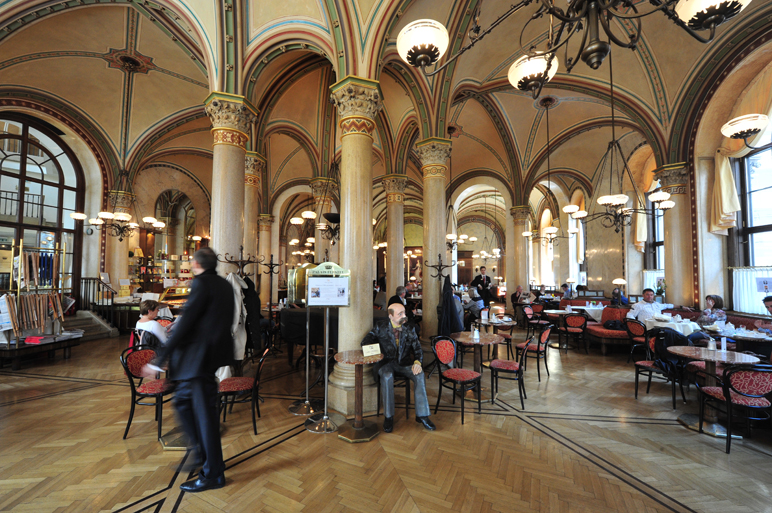
Cafés
Vienna's Kaffeehäuser (coffee houses) are world famous for their grandness and the lively coffee house culture. Skipping the Kaffeehauskultur is missing out a big part of Viennese culture. You should at least visit one of the countless traditional baroque 19th- or funky 20th-century coffee houses where you can sit down, relax, and enjoy refreshments. Most cafés also serve beer, wine and liqueurs. Many serve meals, especially at lunch, and these are often cheaper than in restaurants. Most have a fine selection of Torten (tortes or cakes), some offer other baked goods. In general some are more restaurant-like, some more café-like and some more bar-like.
Coffee
Coffee is obviously an important part of the coffeehouse culture. Vienna was not only the center of the Austrian Empire but also the center of a much larger coffee empire, and the local roasts were sold across Europe. Today many people are still familiar with the term Vienna roast. Vienna prides itself in its dozens of varieties of different coffees, although the Italian style and names are better known by many youth than the Viennese, the cafés are keeping the traditions alive. Most commonly:
Kleiner Schwarzer also known simply as a Schwarzer or as a Mokka is the Viennese version of espresso. It is made with a tick more water, a Viennese roast (the point between origin and roast flavor) and it is pulled slowly allowing it to oxidize. Großer Schwarzer is a double Schwarzer (similar to a double espresso). Kleiner Brauner is a mokka (espresso) with cream, often on the side. Großer Brauner is a double Mokka with cream. Melange is perhaps the most typical Viennese coffee. Similar to cappuccino but with the Viennese style mokka and more foamy milk in equal parts. Verlängerter is mokka (espresso) with extra hot water, similar to a small Americano. Kapuziner is a mokka (espresso) with a dollop of whipped cream on top. Kaffee Verkehrt (or in the more modern places Kaffee Latte) is the local version of a latte.
Sleep

Vienna is a major tourist hotspot and offers a complete range of accommodation options. Prices are relatively higher than in neighboring countries, or even in the rest of Austria. Many of the Viennese hotels, hostels and pensions, especially its centre, are housed in historic buildings dating from before the Second World War, most from the 19th-century Gründerzeit. This means that many of them offer relatively small rooms with sometimes compromised views, and rooms within the same property can vary widely, even at the same price. You will probably find that Viennese hotels usually offer very traditional decor, bathrooms with bathtubs and, again, relatively space-limited quarters. There are very few "modern design" hotels, and those looking for American-style over 30m² rooms should do good research before booking and make sure their booked room matches the expectations. On balance, breakfasts in Vienna are usually relatively good, with a good variety of products, even at the less pricey establishments. Moreover, you can count on many local cafes to offer you breakfast should your booking not include one. A typical Viennese hotel breakfast is buffet-style and fairly substantial, and consists of bread and rolls (usually very good quality), a variety of cold cuts, and fruit, as well as muesli and other cold cereals, and juice and coffee.
In choosing an accommodation it is important to know which part of the city you want to spend time in. Most accommodations claim to be centrally located, which for the Viennese would mean they should be in or next to the 1st District, few actually are. Many are even outside the core districts 2-9. Still, from the ones located within a 5-minute walk of an underground or at least a rail or tram station, you should be able to get to the center within 20 minutes or less on public transportation. Smoking rooms are relatively common. Non-smoking rooms are in limited supply, and hotels with non-smoking floors are less common. Sensitive non-smokers may be bothered that public areas of the hotel, including the hallways, are often heavy with tobacco smoke. During summer there can be several days where the temperature is over 30°C. There are very few hotels that have air conditioning. People who are used to sleeping in a cool environment should seek out hotels that have air conditioning or schedule their trips during those times of the year when the temperature will be cooler.
Stay safe

Vienna is potentially one of the safest cities in the world for its size. There are no slums or districts you should avoid. In general, you can visit any part of the city at any time of the day without taking many risks — just use your common sense. The Prater (fair grounds/amusement park area) is said by some locals to be less safe at night, though more in reference to pickpockets than anything else. The Praterstern railway station is a magnet for drunks, homeless people and drug addicts, but they generally do not bother passers-by. As a general rule of thumb, it's best to avoid train stations, parks (especially Reumannplatz) and some larger subway stations at night, but even then, nothing bad should happen to you. As in any major city, watch out for pickpockets who grab and run when boarding the U-Bahn. Petty crimes (like jackets 'going missing') are more common and normally go unreported and won't get much sympathy. There have been a very few racist assaults in Vienna (even some by the police themselves). One runs the risk of being pickpocketed. Schwedenplatz, along the Ring, is sleazy in the evenings, but basically harmless; the Stadtpark, along the Ring, to the East, is a bit deserted at night and therefore best avoided. Prostitution is legal, even on the street, and is common around the area of the Prater. Ironically, some of the areas are a stone's thrown from the UNODC Headquarters (the UN agency responsible for combating human trafficking) and are human trafficking hubs for all of Europe. Many of these prostitutes are not registered and a high number are known to be trafficked, so take care if seeking their services. It is safer for everyone involved to visit a brothel. Women dressed in a certain manner walking around these areas alone at night might feel uncomfortable being checked-out in a certain way but there is no real danger. (There is no male street-prostitution to speak of in Vienna.)
There have been some reports of fraud around Karlsplatz and the Ring. The usual scenario is that someone will stop you and ask for directions. A couple of other guys show up claiming to be police, showing a badge (must be fake). They ask if you were getting drugs from the other guy and then will ask for your passport and wallet for verification. When you are busy trying to convince them that your passport is valid, one of them sneaks out some money from your wallet. Best to tell them that you want to go to the police station — there is one at Karlsplatz U-Bahnstation. It's a minor annoyance, but it's better to be careful. In a different case of fraud they try to convince you that your money is counterfeit money and that they have to inspect it. As always use common sense: police are taught to approach you in a very distinctive way (you will notice if they do so), the badge must have Polizei ([ˌpɔlɪˈʦaɪ̯] police) and the Austrian coat of arms and/or the Austrian flag located somewhere on it, and they will be willing to bring you to the police station or a properly uniformed officer. Viennese police officers are virtually always honest and polite, and will do their best to assist you if you need them, although many of them, mostly older officers, have limited to non-existent English skills. If you need to report a serious crime and don't speak German, they will usually manage to round up an English-speaking officer. Do not walk on the bike lanes and cross them like you would cross any other road. Some bike lanes are hard to recognize (e.g. on the "Ring" in Vienna) and some cyclists bike rather fast. Walking on bike lines is not only considered impolite but it is illegal and you run the danger of getting hit. Pay attention to the tram tracks in Vienna. Unlike other cities, Viennese trams move very fast and can easily kill you if they hit you. The modern Viennese trams are hard to hear as well. If you encounter tram tracks and you must cross the road, make sure to look both ways before crossing. If you park near tram tracks and you have to get off on the same side as the street, make sure to look both ways as well. If you see people gambling on the streets (usually in popular tourists' destinations like Stephansplatz or Mariahilfer Straße), stay away! The modus operandi usually involves a guy playing the classic game of "hiding the ball". This involves covering the ball (or small trinket) with either a bottle cap or a match box and swirling it around with two other bottle caps asking people to guess the position of the ball. The game is set in a way that you can easily see the ball's position. This is done to lure the unsuspecting person into placing a wager. There are usually two main players and, between them, they will lose and win money back and forth to give the appearance that it is a fair game - do not be tricked! They are from the same gang. Once you get greedy and get lured in, you will surely lose your money! The person in control of the bottle caps will remove the ball from their position through sleight of hand and you will never see your money back. Besides the two or three other players involved, there are usually at least two lookouts - one on each side of 'stage'. Vienna has plenty of legal casinos if you care to try your luck.
In crowded areas such as train stations or the city center, it is not uncommon be approached by beggars. Some sell "Augustin", a homeless' magazine for critical journalism and social work. If they wear a badge, they are reputable: They received training and are obligated to follow social norms; they do not try to trick you, and can be fun to talk to. However, if they do not have a badge or insist on handing you something (such as a rose or a magazine), dismiss them by walking away and/or shaking your head and saying "Nein danke" ([naɪ̯n ˈdaŋkə] no thank you). Their typical ruse is to give you something and then demand payment for it. Similarly, it is best to ignore people asking for money for train tickets or the like. They can be obtrusive, but never violent.
Go next
Vienna area
Vienna's metropolitan area is large, and its suburban rail takes you to suburbs so large that they are worth a visit in their own right. All of the following places are within the metropolitan area and reachable on an all-zone Vienna travelcard (and yes, this also applies to Sopron).
Krems, a smaller and historic town at the entrance of the Wachau valley about 80 km east of Vienna. Reachable by rail from Wien Franz-Josefs-Bahnhof, Wien Spittelau (U4, U6) and Wien Heiligenstadt (U4) with suburban trains to "Krems/Donau". There are hourly connections and the travel time is about one hour. Krems is relatively small, so you can walk there or rent a bike. Baden bei Wien, is a smaller historic town 25 km south of Vienna. Famous for its bathes and thermal waters. It features many beautiful buildings and parks from the Biedermeier period. There is a direct tram line going from the Vienna Opera to Baden otherwise faster trains are available too. St. Pölten, the capital of Lower Austria, hosts many sights. One is the Dom zu St. Pölten, a baroque church which until 1722 served as a Roman basilica cathedral. The St. Pöltner Rathaus (city hall) and the Pottenbrunn Castle (which can only be seen from the outside) are also worth a visit. St. Pölten is accessible by an hourly suburban rail service from Westbahnhof station (U-Bahn U3) which takes 80 minutes to St. Pölten (passengers for Pottenbrunn Castle should get off at Pottenbrunn, one stop before St. Pölten). Total travel time from the city centre is 100 min. Wiener Neustadt also has a lot to offer for tourists: the cathedral, renovated in 1975-1999, the castle and the city museum to name a few. The city is reachable by suburban train from Wien Mitte station on the S-Bahn S6 (via Ebenfurth) and S9 (via Baden) routes, and the travel time is 75-80 min. Eisenstadt, the capital of Burgenland, hosts several large churches as well as the Esterházy castle which offers a wine cellar, gift shop, guided tours, and concerts in the famous Haydnsaal as well as the large garden on the back. There are two suburban rail connections: the direct service Hauptbahnhof - Eisenstadt - Wulkaprodersdorf - (Wiener Neustadt) which takes 67 min to Eisenstadt, and the Deutschkreutz-bound service from Meidling to Wulkaprodersdorf + connecting service on the Hauptbahnhof route (opposite direction, towards Hauptbahnhof) to Eisenstadt, which takes 1 hour from Meidling and is thus slightly faster. However, from the city centre both routes take 80 minutes so you might as well go with the direct service from Hauptbahnhof. Sopron, a historic town in Hungary which is also reachable by suburban rail: from Wien Meidling (U-Bahn U1 to Südtiroler Platz and suburban train to Meidling) the hourly service to Deutschkreutz takes you to Sopron in 70 min. Total travel time from the city centre is 90 minutes.
Capitals or other places
Salzburg is the fourth largest city in Austria. Its "Old Town", with its world famous baroque architecture, is one of the best-preserved city centers in the German-speaking world and was listed as a UNESCO World Heritage Site in 1997. There are direct trains from Vienna taking 2½ hours. Graz is the second-largest city in Austria. The City of Graz including its historic centre and Schloss Eggenberg is a world heritage site. There are direct trains from Vienna taking 2½ hours. Bratislava, the capital of Slovakia, is 55 km from Vienna and reachable by two suburban rail routes: one runs to Hlavna stanica via eastern Vienna and the other one to Petrzalka via the southeast. The latter takes 57 minutes and the former 71 minutes. Both lines originate at Hauptbahnhof station (U-Bahn U1 to Hauptbahnhof / Südtiroler Platz or suburban train to Hauptbahnhof). However, depending on your point of origin, taking U-Bahn U2 to Stadlau or U3 to Simmering and suburban train from either to Hlavna stanica may be faster than travelling via Hauptbahnhof. Travel time from the city centre via Hauptbahnhof (to Petrzalka) or Stadlau (to Hlavna stanica) is 75 min. You may also consider making the journey by ferry: The Twin City Liner makes the journey through the Danube. It takes about 75 minutes and costs €20. Brno, a city of around 400,000 people in the Czech Republic with close historical links with Vienna, is 1½ hours from Vienna by fast train. Prague, the capital of the Czech Republic, is a very well preserved medieval city. The city's historic buildings and narrow, winding streets are testament to its centuries-old role as capital of the historic region of Bohemia. Innsbruck, regional capital of Tyrol and largest city in the Alps. Budapest, the capital city of Hungary, is a beautiful city located on the banks of the Danube. It is a UNESCO World Heritage site for its cultural and architectural significance. Slovenia, a small but very beautiful country which offers a lot of tourist attractions (2012 European capital of Culture Maribor, charming Ljubljana, Julian Alps, gorges [Tolmin, Vintgar], caves [Postojna], coast [Piran] and amazingly beautiful Bled lake)
More pictures of Vienna




From this destination's category on Wikimedia Commons. Each photograph is credited to its own author under its own licence.
The guide text on this page is from the Wikivoyage article Vienna, written by Wikivoyage contributors and published under CC BY-SA 4.0. The authors are listed in the article’s edit history. It has been shortened and re-laid-out for this page; that adapted text is available under the same licence. Nothing else on this page is.
Wikivoyage is written by travellers, not by us. Opening hours, prices and whether a place still exists are exactly the details that go out of date, so check anything you are relying on.
“2,358 readers a month” and the ranking are ours, counted from Wikimedia’s published pageviews (CC0) — the median of twelve complete months. They count people reading about a place, which is not the same as people going there.