The £1,723 cap is in: what your winter bill will actually cost
Wholesale gas has more than doubled in a year and the Ofgem cap has ticked up 3.6%. Here is what that means for your heating costs, and what to check before the cold sets in.
The cap has risen, and wholesale gas is the main driver
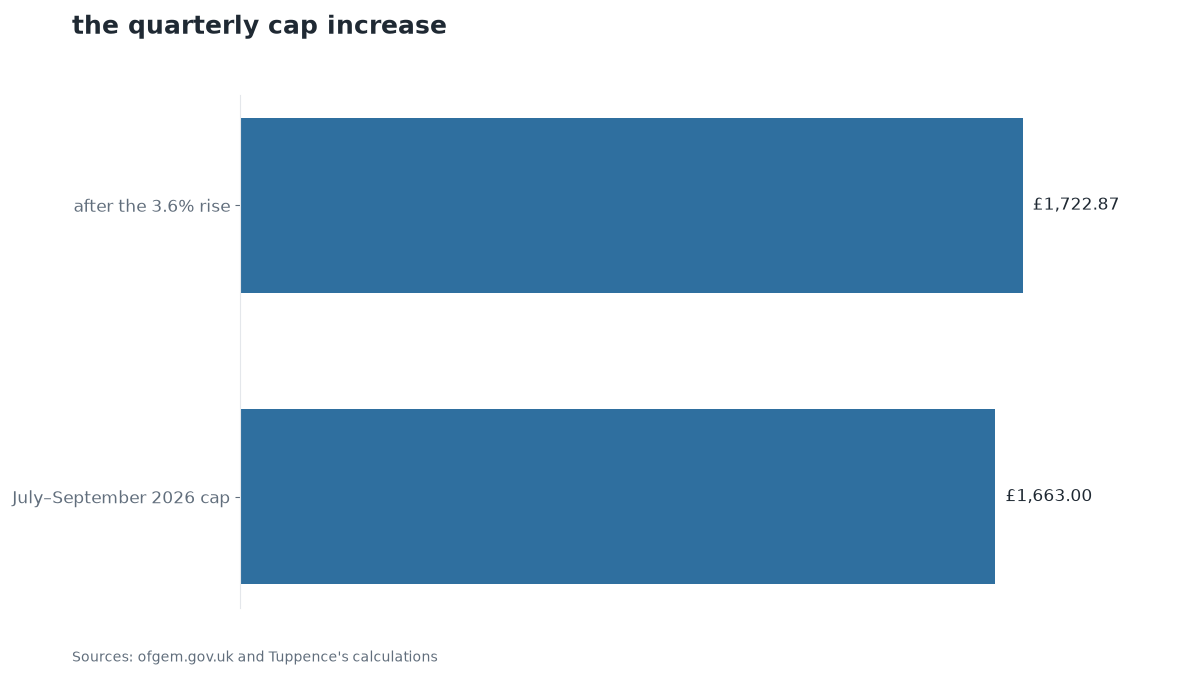
The Ofgem dual-fuel cap for a typical household on direct debit is £1,723 a year from 1 October to 31 December 2026. This is up 3.6% from the £1,663 cap in force during July to September. The rise is driven by wholesale costs, not supplier margins. Ofgem attributes 47% of the new cap, roughly £810, to the wholesale cost of gas and electricity, up from a 44% share previously.
Wholesale gas in Great Britain averaged 6.41p per kWh over the seven days to 11 October 2026, compared with 2.84p a year earlier, a 126% jump. To see the calculation, start with the previous £1,663 figure. Applying the 3.6% rise results in £1,722.87. The difference for the quarterly cap increase is £59.87. Your higher bill reflects this wholesale spike directly.
The cap is a ceiling, not a fixed bill
The cap limits the per-unit rate and the standing charge, not the total amount you pay. If you use more energy, you pay more. The figure cited earlier is a ceiling for a typical usage level, not a fixed bill for every home.
Ofgem calculates a typical household uses 9,500 kWh of gas a year. On that basis, each 1p-per-kWh shift in wholesale gas is worth roughly £100 a year once 5% VAT is added. This helps put the cost of wholesale moves into perspective.
Because the cap sets a maximum unit price rather than a maximum bill, higher-than-average usage will push your total above the annual cap figure. Your actual bill depends entirely on how much you consume.
Supplier complaints: a useful signal before you commit for winter
Complaint rates offer a useful snapshot of service reliability. In Q2 2026, suppliers reported 936 complaints for every 100,000 customer accounts, down 11% on a year earlier. The spread between providers is significant. Outfox Energy reported 10 complaints per 100,000 customer accounts, while Utility Warehouse reported 1,965 complaints per 100,000 customer accounts. These figures highlight how much experiences can vary. However, complaint rates are only one data point among several. They do not capture the full picture of day-to-day service quality, such as query resolution speed or communication clarity. Treat this metric as a signal, not a definitive score. Consider it alongside your recent interactions and specific support promises. A low count suggests fewer systemic issues, but it does not make sure a seamless individual experience. Use this information to ask targeted questions before committing to a new contract for winter.
Enforcement payments you might be owed
The majority of this money is destined for customers who had prepayment meters installed when they should not have been. If you are currently on a prepayment meter, or were moved to one recently, it is worth checking whether your situation falls within the cases Ofgem has listed. You may be owed compensation if the installation was inappropriate.
The recent cap rise makes the prepayment premium harder to absorb for many households. This is one reason the enforcement push matters now. Suppliers are being held accountable for past mistakes, and you should review your own history to see if you qualify. Do not assume you have missed the window; the listed cases cover a specific period and set of circumstances. Checking your records is a simple step that could result in a refund, helping to offset the higher winter costs you are about to face.
What to do before the cold sets in
Start by comparing your recent gas usage against the 9,500 kWh typical figure. This helps you determine whether your bill will sit above the cap, as higher consumption means higher costs. Next, look up your current supplier’s complaints figure before renewing or switching. Recent data shows a wide spread in service reliability, so checking these rates provides a useful signal. If you are on a prepayment meter, check Ofgem’s enforcement page to see whether you may be owed compensation for inappropriate installations. Finally, set a reminder for January to check the next quarterly cap, since it can move each quarter.
These steps matter most for households on fixed incomes, those who use more than average gas for heating, and anyone on a prepayment meter. They offer a practical way to review your position before winter peaks. However, these are general information steps, not personal financial advice. Individual circumstances, such as insulation, household size, and tariff type, will change the numbers.
- Compare your last two gas bills against the 9,500 kWh typical figure to see if your usage puts you above the £1,723 cap
- Look up your current supplier's complaints figure on Ofgem's website before you renew or switch
- If you are on a prepayment meter, check Ofgem's enforcement page to see whether your case may fall within the agreed enforcement payments
- Set a calendar reminder for early January to check the next quarterly cap, which can rise or fall
Sources
- Energy: Ofgem energy price cap, typical dual-fuel household paying by direct debit, 2026-10-01 to 2026-12-31 (Ofgem, via StreetOwl)
- Gas to energy bill: Energy price cap, typical dual-fuel household, direct debit, 1 October 2026 to 31 December 2026 (Ofgem, via StreetOwl)
- Gas to energy bill: Wholesale gas, Great Britain, seven-day average, seven days to 11 October 2026 (Office for National Statistics (source: National Gas Transmission), via StreetOwl)
- Gas to energy bill: What 1p a kWh on wholesale gas is worth a year, seven days to 11 October 2026 (StreetOwl arithmetic, via StreetOwl)
- Which energy supplier gets the most complaints: Energy supplier complaints per 100,000 customer accounts, whole market, Q2 2026 (Ofgem (suppliers' own figures), via StreetOwl)
- Which energy supplier gets the most complaints: Agreed by suppliers in Ofgem cases listed on the tile, May 2025 to 2026-10-14 (Ofgem, via StreetOwl)
This digest was drafted by StreetOwl’s own model from published figures and the sources listed, then read and approved by Michael Rossi on 19 October 2026 before it went up. It is general information, not financial advice: your circumstances are yours, and for a decision that matters, MoneyHelper (free, government-backed) or a regulated adviser is the place to go. General information, not personal financial advice. Figures checked on the dates shown.
← Back to StreetOwl