
Hong Kong
Hong Kong (香港 Hēunggóng in Cantonese) is a city with multiple personalities. The population is mainly Chinese, but British influence is still quite visible. It has absorbed people and cultural influences from places as diverse as Vietnam and Vancouver and proudly proclaims itself to be Asia's World City. Hong Kong is a global financial hub, and has been a major destination for tourists and business people from around the world for at least a century. Today it is also a major tourism destination for mainland China's increasingly affluent population. Hong Kong is much more than a harbour city with crowded streets: this territory with its cloudy mountains and rocky islands also offers rural landscapes with breathtaking views. Much of the countryside is classified as Country Park and, although 7.4 million people (2021) are never far away, it is possible to find pockets of wilderness that will reward the more intrepid traveller. Hong Kong has a subtropical climate with at least one season to match your comfort zone. Boasting one of the world's best airports, it is the ideal first stop for those on their way deeper into China and further Asia.
Most read about in January, least in February. That is when people look it up, which tends to run a month or two ahead of when they go.
Before you book
The Foreign, Commonwealth & Development Office publishes the UK’s official travel advice for People's Republic of China. It changes without notice and travelling against it usually invalidates your insurance, so read it at the source rather than anywhere else — including here.
FCDO travel adviceUnderstand

"Hong Kong" means "fragrant harbour" in Cantonese. Although part of China, Hong Kong operates as a Special Administrative Region under the slogan "One Country, Two Systems" with a high degree of autonomy, retaining most laws and government structures from colonial times. Visa requirements, laws, currency, culture and language have a heritage from the time of British rule, so for most tourists Hong Kong feels like a different country. Hong Kong enjoyed many Western-style freedoms and many locals were proud of it. The ideals of a free and open society were firmly rooted here, but a significant degree of freedom was curtailed when the National Security Law was imposed in 2020 and Article 23 was implemented locally in 2024.
History
The area of Hong Kong was incorporated into China during the Qin Dynasty in 214 BC. In 1841, Great Britain defeated China's then-ruling Qing Dynasty in the First Opium War, gaining possession of Hong Kong Island. After the defeat of China in the Second Opium War, the Kowloon Peninsula was ceded to Great Britain in 1860. The Opium War Museum is located across the border in Dongguan. The New Territories were leased to Great Britain in 1898 for a term of 99 years. Hong Kong was only a sparsely-populated backwater prior to the arrival of the British, but grew rapidly into one of the world's most densely populated areas following the establishment of a free port under British colonial rule. When World War II broke out, British Prime Minister Winston Churchill declared that Hong Kong was an "impregnable fortress". However owing to Britain's main war effort in Europe, Hong Kong was not given sufficient resources for its defence. After two weeks of fighting, Hong Kong was surrendered to the Japanese on 25 December 1941, and subject to a brutal occupation that lasted until the end of the war. Upon the resumption of British control, Hong Kong experienced an astonishingly swift post-war recovery. After the communists took control of mainland China in 1949, many Chinese people, especially businessmen, fled to Hong Kong to escape persecution by the government. The British government took a hands-off approach in Hong Kong, and allowed a high degree of economic freedom. Social problems persisted during the 1950s and 1960s, including the continuation of Communist-Nationalist conflict among residents, labour disputes, and widespread corruption. These problems, when combined with effects of the Cultural Revolution, culminated in the 1967 riots by communists, with an aim to overthrow the British administration. The riots were eventually suppressed by the authorities, but they forced the colonial government to take measures of reform, such as cracking down on corruption. Under reforms, businesses flourished in Hong Kong and its economy grew rapidly, earning it a place as one of the East Asian Tigers. Today, Hong Kong is an industrialised and developed economy, and is one of the world's most important financial centres.
In 1984 the Chinese and British Governments signed the Sino-British Joint Declaration, Britain agreeing to return Hong Kong to Chinese sovereignty. On 1 July 1997 Hong Kong became a special administrative region (SAR) of the People's Republic of China. As Hong Kong was the last remaining British colony with a significant population and economic importance, the handover was deemed by many to be the "end of empire". In theory, Hong Kong enjoys autonomy in most matters except foreign affairs and defence. In 2014, the Umbrella Protest was held to demand free elections for Hong Kong's chief executive. The Chinese government had proposed elections for the position, but would only allow candidates they had vetted to stand for election. The proposed amendments to the Basic Law (Hong Kong's equivalent of a constitution) were voted down by the pro-democracy legislators, meaning that the chief executive is still elected by an election committee with limited representation. The protests eventually died down without concessions from China, though there remain demands for more political autonomy, and even for independence from China. Simmering tensions eventually led to the breakout of massive and violent protests in June 2019. The protests began in opposition to a bill that would have allowed people to be extradited to mainland China to face criminal charges, but expanded into a wider anti-government movement, and continued even after the extradition bill was withdrawn. In response, the Chinese government imposed a sweeping national security law on Hong Kong in July 2020, outlawing many forms of speech and advocacy against the government. This crackdown has led to a massive brain drain, with many well-educated young professionals fleeing to Western countries, in particular the United Kingdom and Canada. Hong Kong participates in some international organisations such as the WTO and APEC, and in international sports competitions under the name "Hong Kong, China" (中國香港).
Getting there

Immigration
Hong Kong maintains a separate immigration system from that of Mainland China. Citizens of most Western countries do not need a visa to visit Hong Kong. The Hong Kong visa can be applied for at a Chinese diplomatic mission, but must be done so separately from the Mainland Chinese one; there is no single visa that serves both areas. A visa is required to enter Mainland China from Hong Kong and vice versa. Macau is also a separate jurisdiction with regards to visas. If you wish to re-enter Mainland China after visiting Hong Kong, make sure you have a multiple-entry Chinese visa. See Entry requirements to Hong Kong for a list of visa requirements or visa-free stays by country of citizenship. All holders of an APEC Business Travel Card can use the counters for Hong Kong residents at immigration control and can stay for up to 60 days in Hong Kong visa-free if their card has 'HKG' printed on the reverse. Foreign nationals who cannot enter visa-free, want to remain for longer than permitted by their visa exemption, or want to work, study or establish/join a business, can apply for one at a Chinese embassy or consulate, or directly through the Hong Kong Immigration Department. Those living in Macau can apply for a visa at the Office of the Commissioner of the Chinese Foreign Ministry. Those living in Mainland China may apply at the Hong Kong Economic and Trade Office in Shanghai, or at the Office of the Government of the Hong Kong SAR in Beijing.
Chinese (both PRC and ROC) citizens have a wide range of ways to enter Hong Kong depending on their household registration and residency. A visa (and sometimes even a passport) is not required. See the table below for detailed entry rules.
Holders of British National (Overseas) (BNO) passports cannot use these passports to enter Hong Kong and should instead use their Hong Kong passport, Hong Kong ID card, or Hong Kong document of identity when passing immigration and during their stay in Hong Kong. Indian nationals do not require a visa, however they need to submit a pre-arrival registration (PAR) form. The PAR is valid for six months from date of issue / registration and allows for multiple entries during the validity period, each for a maximum of 14 days. A visit to Macau and back shall be considered a new entry and restarts the 14 day clock. However visitors may be subject to enquiries by the immigration officials during the re-entry about the purpose & reason for re-entry. Expiry of the limit of stay is counted from the day after the date of entry. For example, if you have a 7-day visa and arrive on January 1, you are allowed to stay until January 8. If you are arriving late at night, you may want to wait until after midnight to clear immigration. Likewise, you may be able to clear immigration just before midnight on the last day that your visa is valid and then take a flight or boat in the middle of the night on the next day. For more information, see question #11 of the Visa FAQs. Hong Kong no longer issues passport stamps, and visitors are instead given an entry slip with their terms of entry. All entries and exits are recorded electronically as well. You do not need to fill out a paper or digital arrival card. Citizens of Afghanistan, Angola, Bangladesh, Burundi, Cameroon, Central African Republic, Cote d'Ivoire, Democratic Republic of the Congo, Eritrea, Eswatini, Ethiopia, Gambia, Ghana, Guinea-Bissau, Iran, Iraq, Liberia, Libya, Nepal, Nigeria, North Korea, Pakistan, Republic of the Congo, Rwanda, Sierra Leone, Somalia, South Sudan, Sri Lanka, Sudan, Syria, Togo, and Yemen are required to obtain a transit visa even for sterile transit through Hong Kong International Airport.
Getting around

Hong Kong has an excellent and cheap public transport system. Unlike in mainland China, Google Maps can be used in Hong Kong. Hong Kong has the world's highest use of public transport, with over 90% preferring the mode. The most convenient way to pay for this is the Octopus card, discussed below. Contactless payments with Visa, Mastercard, UnionPay, and China T-Union are being progressively rolled out. As of June 2026, they have become available on the Airport Express, buses, trams, some ferries, and the MTR at the light blue fare gates. For most visitors, an Octopus card is still best for complete peace of mind.
By MTR
Hong Kong's Mass Transit Railway (MTR) is the fastest way to get around, but it does not offer the views of buses and trams (note that the term 'Subway' in HK refers to underground walkways, not to the MTR, and "metro" or "underground" will mostly not be understood). It is clean, safe, reliable, efficient and affordable, with most journeys costing $5–20. There are 10 lines (including the Airport Express) and a network of modern light rail lines in the Northwest New Territories. All signs are in both Chinese and English and all announcements are made in Cantonese, Mandarin, and English. Staff in the station control room usually speak enough English to be able to help lost tourists. The most important lines for many visitors are
The busy Tsuen Wan Line (red), which runs from Central to Kowloon via tunnel and then down Nathan Road towards Tsuen Wan in the New Territories, The Island Line (blue) which runs along the north coast of Hong Kong Island. The Tung Chung Line (orange) is the fastest ways to get to Lantau. This line can also be used to change to the Disneyland Resort Line (pink) at Sunny Bay, which is also the station to catch a shuttle bus to the Hong Kong port for those who want to travel by bus to Macau. The South Island Line can also be used to visit Ocean Park. The East Rail Line which takes you to New Territories and contains First Class coaches. It is also linked with two border crossings with mainland China, at Lo Wu Control Point and Lok Ma Chau Spur Line Control Point The Airport Express line goes directly from the Hong Kong MTR station to Hong Kong International Airport. See #By plane for details. In Cantonese, the East Rail line is colloquially referred to as 火車 (fó chē, "train"), alluding to its origins as an intercity railway, while the other lines are referred to as 地鐵 (dei tit, "subway"). Fares depend on distance. Credit cards cannot be used to buy tickets on most vending machines. However you can tap contactless Visa, Mastercard or UnionPay credit cards (or Apple or Android pay devices linked to one of those) at the MTR fare gates to pay fares. Also Alipay and WeChat Pay can be used at faregates equipped with a QR code scanner. Rides on East Rail line First Class, the Airport Express, and to Lo Wu and Lok Ma Chau follow a separate fare structure. MTR system promotions (including the tourist day pass, and the fare saver machines) do not extend to these services. Fares in the first class car (with wider and more comfortable seats) is twice that of the regular cars on the same route, Fines for travelling with an ordinary ticket is up to $500. Considerations when using the MTR:
See

Hong Kong doesn't have street benches to sit down. Whilst "sitting out areas" are around, these are generally infrequent. Additionally, restaurants (especially cheap and quick ones) will prefer quick table turnover. All this adds up to spending a considerable amount of time on your feet in any given day. Make sure you have a pair of comfortable shoes, as even a good pair of shoes will still leave your feet sore after a full day on your feet.
Itineraries
Hong Kong Culinary Tour — gives a short tour to discover the unique cuisine of Hong Kong Hong Kong to Kunming overland — covers one route to or from Hong Kong
Guided walks
A list of guided tours is available on the website of the Hong Kong Tourism Board.
Do

Pop culture
Hong Kong was one of the main centres of Chinese pop culture from the communist revolution in 1949 until the 2010s, having given rise to many famous singers and actors. Hong Kong action cinema is legendary among Chinese people around the world. The city also played a key role in popularizing the genre of Cantopop, and some Cantopop songs have achieved cult status across the Chinese-speaking world, even among people who do not speak Cantonese. Television dramas by local station TVB also enjoyed loyal following among ethnic Chinese around the world. Since the 2010s, most of Hong Kong's top singers and actors have relocated to mainland China where they can make a lot more money. Nevertheless, the city continues to produce notable films on a regular basis, and Cantopop has experienced a revival of sorts in the 2020s, led by a new generation of local talent.
Music festivals
Clockenflap is Hong Kong's largest music festival, and includes popular artists, mainly from Europe and the US. It takes place in November on the Central Harbourfront Event Space.
Indie events
Cantopop is by far the most popular genre in Hong Kong and receives an immense amount of support from the media. Independent musicians and are often harassed and evicted from their rehearsal rooms and concert venues by the government because they are forced to illegally rent warehouse spaces due to unaffordable rents. A few small venues are open for indie shows, such as Hidden Agenda and The Wanch.
Shopping

The official currency is Hong Kong Dollar (HKD). Credit or debit cards are widely accepted in Hong Kong, but street vendors and most taxis still expect cash, so it's wise to have some on hand. Octopus payments are common for smaller purchases like transport, convenience stores and chain restaurants. Mobile/QR code payments are gaining traction but remain far less common than in mainland China.
Banknotes
The Hong Kong dollar, denoted by the symbol "$" (港元 or 港幣, ISO code HKD), is the territory's currency. In Cantonese, one dollar is known formally as the 圓 (yùn) and colloquially as the 蚊 (mān). It is subdivided into 100 cents (symbol ¢). In Cantonese, one cent is known as a 仙 (sīn), and ten cents is known as a 毫 (hòu). You can assume that the '$' sign used in this travel guide and in the territory refers to HKD. The HKD is also widely accepted in Macau in lieu of its own currency at a 1:1 rate. The official exchange rate is fixed in a range of HK$7.75-7.85 to US$1, although bank rates may fluctuate slightly. When exchanging currency at a big bank, be prepared to pay a small fixed commission, usually about $40 per transaction. If exchanging large amounts, this commission will have a negligible impact on the transaction. If exchanging small amounts, it may be advantageous to exchange at one of many independent exchange stalls or pawnshops found in tourist areas. Although their exchange rates compared with big banks may be slightly less favourable, most do not charge a commission. They may also be more convenient and a faster way to exchange (no queues, in shopping centres, open 24 hours, minimal paperwork, etc.) However, be wary of using independent exchangers outside banking hours because, without competition from big banks, their rates may be very uncompetitive. Hong Kong is a right place where to exchange money, a noticeable industry of economy, the private exchanging shops are everywhere on streets (not just within airports or shopping malls). For these shops, it does not follow the standard rate you check online. Changing money at the airport, train stations, hotels, or at street blocks or buildings with only one exchange stall since the rates offered there are usually less favourable. Street money exchange vendors will often offer different rates and you may be able to save around 10% if you can compare several different places rather than using the first one you see. From one currency to another, as some places offer very good exchange rates with low or no commissions, and without the various restrictions and paperwork you have to deal with to exchange money in mainland China. One competitive place to exchange money is Chungking Mansion in Tsim Sha Tsui, with a high density of Pakistani and Indian currency sellers. However, the money changers at the entrance generally have worse rates than those in the interior. Getting money by withdrawing with Automated Teller Machines (ATMs) or debit cards may have competitive exchange rates and most big banks do not charge an ATM usage fee, though your banks may impose their own fees (including foreign exchange markups and fixed withdrawal fees). Some smaller banks do not accept ATM cards from overseas customers though. The best banks for foreign tourists to use are HSBC, Hang Seng and Standard Chartered, and ATMs from those banks are widespread and can be found at any MTR station and along every major street corner. Other than the $10 banknote, all others are issued by multiple banks in Hong Kong, namely the Hong Kong and Shanghai Banking Corporation (HSBC), Standard Chartered Bank and the Bank of China. Although they have slightly different designs, notes of the same denomination have the same colour and all of them can be used anywhere in Hong Kong. They come in denominations of $10, $20, $50, $100, $500 and $1000. Some shops do not accept $1000 notes due to counterfeiting concerns.
Coins come in units of $10, $5, $2, $1, 50¢, 20¢ and 10¢. Typically you will want to avoid change less than $1 because there are not many things to buy with coins under that, and some shops may refuse them outright. An Octopus Card is the best way to avoid dealing with large amounts of small change.
Eat

Individual listings can be found in Hong Kong's district articles
Cuisine plays an important part in many peoples' lives in Hong Kong. Not only is it a showcase of various regional Chinese cuisines, but there are also excellent Asian and Western options, and creative fusion between the various cuisines. Although Western food is often adapted to local tastes, Hong Kong is a good place for homesick travellers who have had enough of Chinese food. Due to its history as part of that region, unsurprisingly, much of the local cuisine in Hong Kong is very similar to that of neighbouring Guangdong. That being said, over a century of British rule means that the British have also left their mark on the local cuisine, with cakes and pastries being fairly popular among locals. Hong Kongers are also somewhat less adventurous than their fellow Cantonese speakers in mainland China, with several exotic ingredients such as dog and cat meat being banned in Hong Kong. Indian immigrants brought over by the British have also left their mark on Hong Kong cuisine, and curry (咖喱) is a popular condiment. While authentic Indian curries can certainly be found, Hong Kong curries are generally adapted for the Cantonese palate, with the spice level dialed down drastically. It is also possible to find cuisine from practically every part of China, as many famous chefs fled from the mainland to Hong Kong to escape persecution by the communists in the aftermath of the Chinese Civil War. In particular, the Hakkas and Teochews have left a significant impact on Hong Kong's culinary culture, and there is no shortage of good Hakka and Teochew restaurants for those who have grown weary of Cantonese food. You may meet some local people who haven't cooked at home for a decade. Locals love to go out to eat since it is much more practical than socializing in crowded spaces at home. A long queue can be a local sport outside many good restaurants during peak hours. Normally, you need to register first, get a ticket and wait for empty seats. Reservations are usually only an option in upmarket restaurants.
Eating etiquette
Chinese food is generally eaten with chopsticks. However, restaurants serving Western food usually provide a knife, fork and spoon. Do not stick your chopsticks vertically into a bowl of rice, as this is reminiscent of incense sticks burning at the temple and has connotations of wishing death on those around you. In addition, chopsticks should not be used to move bowls and plates or make any noise. Dishes in smaller eateries might not come with a serving spoon, although staff will usually provide one if you request. A few Hong Kong customs to be aware of:
Drink
Tea
As with the rest of China, tea is a popular beverage in Hong Kong, and is served at practically every eatery. Chinese teas are the most commonly drunk in Hong Kong, but there is also a distinct Hong Kong-style milk tea that is served in chaa chaan teng, and traditional English milk tea can be found in higher-end Western restaurants. In summer 'Ice Lemon Tea' is a common option that is rather bitter and needs some syrup to counter this.
Alcohol
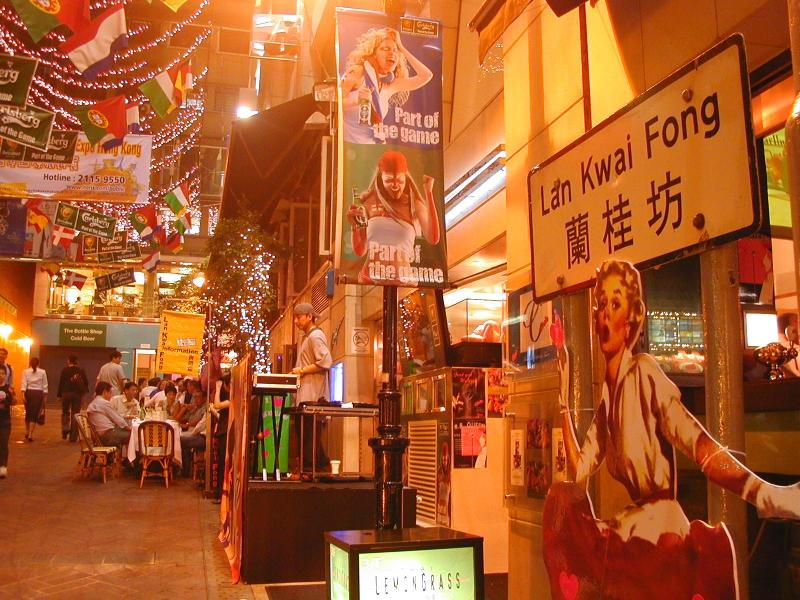
Hong Kong does not have a culture of heavy drinking, and there are many neighbourhoods without much in the way of a bar or pub. Drinking alcohol with food is acceptable, but there is no expectation to order alcohol with your meal in any restaurant. A number of popular restaurants do not sell alcohol because of a licence restriction. In addition, alcohol in Hong Kong is expensive, and half a pint of beer in a bar or restaurant costs about $70 (in 2025). Lan Kwai Fong (Central), Wan Chai, and Knutsford Terrace (Tsim Sha Tsui) are the three main drinking areas where locals, expats, and tourists come together. Lan Kwai Fong is known for its lively, block party atmosphere, attracting many expats and tourists. The rooftop bar Faye on the 25th floor of the California Tower at Lan Kwai Fong is a hotspot for European exchange students. Some clubs in Lan Kwai Fong enforce dress codes, and tourists are expected to comply. As a rule, avoid wearing shorts or pants that are above knee length. Just a short walk away, Peel Street and the surrounding SoHo area have emerged as the preferred hangout for long-term expats, offering more relaxed bars, better cocktails, and a more laid-back atmosphere than the tourist-heavy clubs of LKF. Wan Chai is known less for its drinks than for its dated seediness. Once the centre of nightlife for US servicemen, today it is still popular with a certain crowd of older expats and bar girls, but it has a sleazy reputation and is generally avoided by younger locals and newer expats looking for a more contemporary vibe. Girlie bars or hostess bars are bars in which attractive bar girls drink and flirt with male patrons in exchange for tips. Cover charges and drink prices at these establishments are usually exorbitant, and you will be pressured to buy drinks for the bar girls. Generally speaking, the bar girls will not leave the bar with you; they are professional flirts, not prostitutes. Another popular nightlife option is Wednesday nights at Happy Valley Racecourse. Go past the fancy luxury cars and oligarchs to the standing section with a vibrant social scene, drawing large crowds for horse racing, casual drinking, and a lively party atmosphere. The races usually conclude around 10:30 pm, making it a perfect mid-week night out. Gay bars and clubs are concentrated in Central, Sheung Wan, Causeway Bay and Tsim Sha Tsui (TST). The quality of these venues varies considerably and may disappoint those expecting something on the level of London, Paris or New York. The minimum age for drinking alcohol is 18 years. There is usually a requirement for young adults to prove their age, especially when going to a nightclub. The accepted ID in clubs is either your passport or a Hong Kong ID card. Photocopies are rarely accepted due to minors using fake documents. Drinking out in Hong Kong can be expensive. Beer usually starts from $50 for a pint and more in a bar popular among expats. However, away from the tourist trail, some Chinese restaurants may have a beer promotion aimed at meeting the needs of groups of diners. In cooked food centres, usually found at the wet markets, young women are often employed to promote a particular brand of beer. Convenience stores and supermarkets sell a reasonable range of drinks. During Wednesdays and Thursdays, Ladies night applies in some bars in Wan Chai and Lan Kwai Fong, which in most cases means that women can enter bars and clubs for free, and in some rare cases also get their drinks paid for the night. On weekends, several bars and clubs in these areas also have an open bar for some of the night, which means you can drink as much as you like. San Miguel (Cantonese name: Seng Lik), Tsing Tao (Ching Dou), Carlsberg (Ga Si Bak), Blue Girl (Lam Mui), Heineken (Hei Lik) and Sol are popular in the town. There is no longer any tax on wine or beer in Hong Kong.
Sleep

Individual listings can be found in Hong Kong's district articles With more than 50,000 rooms available, Hong Kong offers a huge choice of accommodation from shockingly cheap digs to super luxury. However, budget travellers who are spoiled by cheap prices elsewhere in Asia are often shocked that the accommodation cost in Hong Kong is closer to that of London and New York. A 3% hotel accommodation tax is levied on hotel rooms, excluding service charges. You will pay the tax when you pay for hotel rooms. For long-term accommodation, be prepared to splurge as real estate prices in Hong Kong are among the highest in the world, and many locals are forced to live in cramped "shoebox" apartments due to the astronomical rents in the city.
Budget
While it is possible to get a dorm bed for $120–150, a single room for $270–400, and a double room for $400–500, you should not expect anything in these rooms except a bed, with barely enough space in the room to open the door. Accommodation with reasonable space, decoration, and cleanness is usually priced from $150–200 for a dorm bed, $450–600 for a single room, $700 for a double room, and $800 for a triple room. Most cheap guesthouses are found along Nathan Road between Tsim Sha Tsui and Mong Kok. Expect a tiny, undecorated room with just enough room for a bed. Bathrooms are often shared and noise could be a problem for light sleepers (not all customers are interested in sleeping). Be sure to read the online reviews before booking as bed bugs, dirty beds, and unclean bathrooms have been reported. Keep your expectations as realistically low as possible. Popular guesthouse clusters are inside the 17-floor 1 Chungking Mansions (Nathan Road 36-44) (重慶大廈 in Chinese, nicknamed Chungking Jungles by some local people), Mirador Mansions (美麗都大廈) in Tsim Sha Tsui, and New Lucky House (華豐大廈) (15 Jordan Road). These towers are all in the city center and close to the buses to/from the airport. While these towers are regarded as slums by the locals, if you ignore the fake watch sellers and disturbing pimps, they are well-patrolled and safe. Another cluster of hostels and guesthouses can be found on Paterson Street near Causeway Bay. While not as central as the mansions, the internet connections are more reliable and the rooms are generally clean. However, they are still small and cramped. Do not expect a great atmosphere or spacious rooms. Notice that some drab "guesthouses", especially those in Kowloon Tong, Mong Kok, and Causeway Bay, may actually be love hotels. The Hong Kong Youth Hostel Association operates 7 youth hostels. All of them are outside of the city and cost $100–$300 to reach via taxi when public transport service is not operating. All but the one on Hong Kong Island also have strict curfew rules and require guests to leave the site from 10AM to 4PM (1PM-3PM on public holidays). Free shuttle bus service is provided by several hostels but the service stops at 10:30PM. The government advises travellers to stay in hostels with licences, this website may help you a lot: The Office of Licensing Authority maintains an online list of licensed accommodation establishments. There are 41 camping sites in Hong Kong. The facilities are on a "first-come-first-served" basis and places are booked quickly during weekends and public holidays. You are not allowed to camp other than in a designated camp site (identified by the sign board erected by the Country and Marine Parks Authority) and this rule is strictly enforced.
Mid-range
If the mansions and hostels are too cramped for you, Hong Kong is a good place to spend a bit extra and get a proper hotel room. Many rooms in basic business hotels in the city center can be had for $700 per night. Rooms at mid-ranged hotels in Hong Kong tend to clean but cramped.
Local customs

Manners and etiquette
See the Respect section of the China article for more details. Hong Kong is a fast-paced society where the phrase "mm goi" (唔該), which literally means "I should not (bother you)", is used pervasively in a situation that you would say "Excuse me" or "Thank you". mm goi mentality extends to a way that they don't want to bother anyone as long as possible. When you get a cough, always cover your mouth with the inner side of your elbow, as that area of your arm does not frequently come in contact with other people, thus avoiding the spread of pathogens. When having a fever, wear a mask. Spitting and littering, an offence subject to a penalty of $3,000, is considered rude because it disturbs others. Hong Kong is noisy due to its huge population density but adding more noises, which will certainly disturb others too, is not welcome. Speaking vociferously over the phone on the bus, for example, will be viewed as egocentric and boorish. When entering people's homes, always be sure to remove your shoes before you do so. Hong Kong follows the British tradition in that queue jumping is taboo and you may easily get into an argument or be denied service if you do so. Everyone wants to go orderly and speedily on their way with the least disturbance. Even if an arriving bus is empty, and there are only two people waiting in line, they are expected to enter the bus in order of queue. Jumping a queue in order to ask a question is not tolerated either. When smoking in front of a non-smoker, always ask for permission. Many smokers will just walk away to smoke, even in a place where smoking is legally allowed.
Unlike public transport in some large cities such as Tokyo or London, where it is common to see passengers eat or drink (even in a cautious manner that keeps the surroundings clean), such behaviour is strictly prohibited in all areas of MTR stations, train compartments (except intercity trains), and most buses. This is due to concerns about maintaining cleanliness of public facilities. If someone asks you to stop consuming or even dispose of your food when you're eating it obviously (for example, eating a hamburger and holding a coke), just obey the request and reply politely, and you'll always be out of trouble. It is considered strange to strike up pleasantries with a stranger unless they are pregnant, disabled or senior citizens who are obviously in need. Saying "good morning" to a person you don't know at a bus stop will probably be viewed with suspicion. Like their mainland Chinese counterparts, saving face is a part of Hong Kong culture. Mistakes are usually not pointed out directly in order to avoid causing embarrassment, and it is generally considered poor taste to brag about your achievements or flaunt your wealth in the face of your less well-to-do peers. Naming customs and modes of address are generally the same as in mainland China, the main difference being that the names and titles are pronounced in Cantonese instead of Mandarin. Some upper class married women add their husband's surname in front of their surname, as in the examples of Carrie Lam and Anson Chan. Formally they should be referred to their husband's surname, though using both surnames is common in unofficial usages.
Examples of addressing titles specially in Hong Kong
policeman and -woman: Sir and Madam, "Ah Sir", (no "ah") "Madam" (阿sir / madam) senior men or women: 師兄 師奶 (see-hing, see-nie)
Stay safe
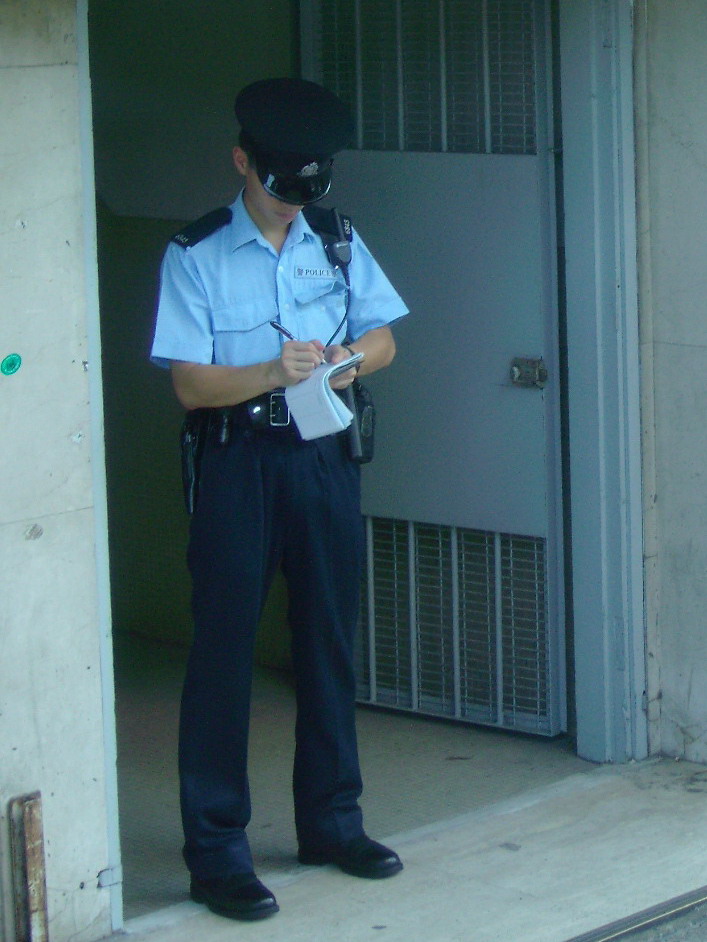
Hong Kong is one of the safest cities in the world, with a large high-density population with diverse socio-economic backgrounds managed very effectively. The city experienced significant large-scale protests against new legislation with increasingly violent clashes with police between 2014 and 2019. The arbitrariness and broad applicability of the National Security Law imposed by China in 2020 has ended most public protest.
Crime and other emergency services
Even female travellers usually do not encounter any problems roaming the streets alone at night. Violent crime is extremely rare, though petty crime occurs from time to time. Pickpockets operate in crowded areas; be particularly careful on public transport during peak hours.
The Hong Kong Police Force is Hong Kong's law enforcement agency. Most officers wear light blue uniforms, though higher-ranking officers wear white uniforms. All police officers are required to carry their warrant cards while on duty, and must present it to members of the public on request. English proficiency among lower ranking police officers can be limited, though they will always have English-speaking interpreters on call to assist you. Police corruption is exceedingly rare. Bribery is a crime that is punishable by imprisonment. Hong Kong films have often portrayed triads (Chinese organised crime syndicates) as gun-wielding gangsters who fear nobody, but that only happens in the movies. Gang violence does occur, but is generally limited to rival triads. Stay away from the triads by avoiding loan sharks and illegal betting, and they will not bother you. Call 999 when you urgently need help from the police, fire and ambulance services. 999 operators can speak English, and in case if you don't know your current location, you can be located by finding your nearest lamppost and replying the lamppost's number. The police should show up within 10 minutes in most cases. If you are deaf or have speech impairment, you can report your emergencies by SMS to 992 with your registered phone, which requires registration at a police station beforehand. The 999 system, local police stations and reporting centres may be inaccessible during protests and incidents. Dial the following emergency numbers in case when the 999 system is down:
Go next

Macau, the former Portuguese colony and largest gambling haven in the world, is an hour away by TurboJet ferry (around HK$200) from the city centre (near the Sheung Wan MTR station on Hong Kong Island), or 40 minutes away by shuttle bus (HK$65) over the Hong Kong–Zhuhai–Macau bridge (but requiring another bus and an MTR ride to get to the bridge port). Shenzhen, mainland China's boomtown just across the border, can be reached by high speed rail in less than 20 minutes. The MTR East Rail Line takes longer at about 45 min, but is cheaper, and is connected to the Shenzhen Metro on the mainland side of the border. Another alternative, especially if you are starting from the island, is the ferry to Shekou, which takes around 50 minutes and costs around $100. Depending on your nationality and method of transport, you may need to pre-arrange a visa to enter Shenzhen. Many locals head over to Shenzhen for cheaper shopping, dining and spa experiences than what would be available in Hong Kong. Zhuhai in mainland China, across the border from Macau, is 40 minutes by shuttle bus over the Hong Kong–Zhuhai–Macau bridge or 70 minutes away by ferry. Guangzhou, capital of mainland China's Guangdong Province, can be reached by train in around 45 minutes by HSR from West Kowloon station. If you are on a budget, many cross border buses are available throughout Hong Kong. The trip will take more than 3 hours, including going through customs at the border and changing buses. Taiwan, a common short-term destination for locals that is 1.5 hours away by plane. It is both a world-class technology hub and another great example of traditional Chinese culture. Singapore, a Southeast Asian city-state that is often regarded as a rival of Hong Kong, about 3.5 hours away by plane. Given its small size, a trip to Singapore by Hongkongers will almost always be coupled with visits to neighbouring Malaysia and Thailand.
More pictures of Hong Kong


From this destination's category on Wikimedia Commons. Each photograph is credited to its own author under its own licence.
The guide text on this page is from the Wikivoyage article Hong Kong, written by Wikivoyage contributors and published under CC BY-SA 4.0. The authors are listed in the article’s edit history. It has been shortened and re-laid-out for this page; that adapted text is available under the same licence. Nothing else on this page is.
Wikivoyage is written by travellers, not by us. Opening hours, prices and whether a place still exists are exactly the details that go out of date, so check anything you are relying on.
“5,626 readers a month” and the ranking are ours, counted from Wikimedia’s published pageviews (CC0) — the median of twelve complete months. They count people reading about a place, which is not the same as people going there.