
Santorini
Santorini is an archipelago of 5 volcanic islands in the Cyclades group of the Greek islands in the southern Aegean Sea, about 200 km southeast of mainland Greece. It used to be a single island, but was obliterated around 1600 BCE by an enormous volcanic explosion that destroyed the earliest settlements on the former island and created the current geological caldera. It is famous for dramatic views, stunning sunsets from white clifftop villages, the ancient city ruins of Thera and Akrotiri, unique wines, artists and craftsmen, an active volcano, and strikingly colorful pebble beaches.
Most read about in July, least in April. That is when people look it up, which tends to run a month or two ahead of when they go.
Before you book
The Foreign, Commonwealth & Development Office publishes the UK’s official travel advice. It changes without notice and travelling against it usually invalidates your insurance, so read it at the source rather than anywhere else — including here.
FCDO travel adviceUnderstand
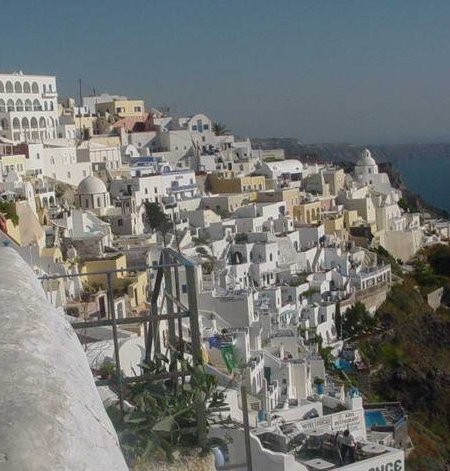
Santorini is between Ios and Anafi islands in the southern Cyclades. On a clear day, you may be able to see Crete, about 100 km to the south. The name is a contraction of Saint Irene, after an old church in Perissa. The Santorini archipelago used to be a single island, until a volcanic eruption around 1600 BCE tore it apart. The eruption was among the most massive in human history. There is a local legend that Santorini was once home to the Lost City of Atlantis, destroyed by the eruption. Most historians dispute this claim, but the myth's parallels to Santorini's explosive past are tantalizing. Eruptions still occur; the central Nea Kameni has grown substantially in modern times, as recently as 1950. The eruption left behind today's caldera, an expansive crater rimmed by three fragments that survived the eruption, filled in with sea water and the two newer islands. The interior caldera walls are steep, up to 300 m high, and mostly impassable, although a number of villages are built along its ridge. It is one of the most distinctive landscapes in the entire Mediterranean. Traditional Cycladic architecture — dense clusters of cubic whitewashed stone buildings — fills most of the villages, interspersed with villas and wineries. Much of the island has been restored since a major earthquake in 1956, which spurred this relatively remote outpost to rebuild itself into the iconic tourism destination it is today.
Climate
In April and May, temperatures are pleasant and the chance of rain is low, which is ideal to hike from one town to the other, such as the famous Fira - Oia hiking trail. Wildflowers blossom and the otherwise barren islands turn into a colourful sea of wild flowers. After May, temperatures soar with an extreme UV index: summers are extremely hot. With very few trees to provide shade, the weather becomes too hot to do anything but stay inside the cooler cave houses. Public life slows down, restaurants and amenities close during the hottest hours of the day (noon - 15:00), and the beautiful spring flowers are scorched away with only dried out grasses left. From September, the weather becomes cooler again and more attractive for a visit, although the chance of rain also gradually increases towards the end of the year — Santorini receives most of its annual precipitation during the winter months. For milder weather, prices and crowds, the ideal times to visit are the shoulder seasons of April–June and September–October. The 'season' starts April 1, or around the Greek Easter. In the summer, not only is the region unpleasantly hot, but it is also overcrowded with cruise ships and beach-goers. Seasonal businesses start closing for the season towards the end of October, and by December most businesses, including hotels and guest houses, are shuttered until spring. December through March is very much the off-season and marked by cooler temperatures with occasional rain and winds. While Fira stays more-or-less open and supports over a dozen year-round restaurants, smaller villages may only have one or two places open. Although it is rare for the temperatures to get very low, the poor weather makes for a less than optimal experience on this beautiful island.
Watch and listen
Due to the spectacular and unique natural beauty of Santorini, many Greek singers have chosen the island as the setting of their videos. Greek and Brazilian TV series have been shot of Santorini, as well as some Hollywood movies (e.g. Tomb Raider II). Generally Santorini is a pole of attraction for Greek and international celebrities. World-famous Greek composer Yanni wrote the song "Santorini", inspired by the beauty of the island. It is worth checking out, especially the version performed live at the Acropolis with the Royal Philharmonic Concert Orchestra.
What's inside
The Christiana Islands (Christiani, Eschati, and Askania) about 20 km southwest of Santorini are sometimes counted as part of the archipelago, but actually are a separate group of islands. They have remained uninhabited since the late 19th century, although the largest of the islands does have archaeological evidence of a Neolithic settlement. They are privately owned, and there are no scheduled ferry services to them.
Getting there

The main options are ferries from Pireaus (standard ferryboats and high-speed catamarans) and flights from Athens. Getting in from Athens by air is faster and you avoid possible sea sickness. However, in season air tickets sell out well before most of the ferries.
By plane
There are regular flights from Athens by Aegean Airlines, Sky Express, and Volotea, with a flight time of 30-45 minutes. Volotea also has a regular service from Thessaloniki. From May till October many charter airlines fly directly to Santorini from many European airports. Listed below is commercial air service.
1 Santorini (Thira) National Airport (JTR IATA) (north of Monolithos). The airport is very small, so passengers are allowed to drop off their luggage only two hours before their flight. There is a large number of seats outside of the terminal with a cafeteria, where passengers may wait. In the gate areas, seating is very limited. There is a cafeteria upstairs with outdoor tables for a view of planes. Getting there:
Getting around

By bus
KTEL Santorini, the public bus service, connects all points of the island with Fira, costing €2.00-2.80 one way (2025), depending on the route. This is probably the only cheap thing you'll find on the island considering the buses are comfy and air conditioned! Tickets can be purchased on the bus, with cash only — so bring some coins. The fare collector can (usually) make change. 4 Fira Bus Station is the hub of the bus network, and almost all the lines "branch out" from this hub. This means, if you wish to go from one side of the island to another, you need to transfer at Fira and pay for the second leg of your journey. There are no route numbers and not all buses display their routes; ask the drivers or the ticket office for the bus number that would take you to your destination. The bus routes are:
Oia (via Imerovigli & Firostefani) Perissa (via Pyrgos) Airport (via Karterados, Megaria). Some buses also continue to Monolithos. Kamari Akrotiri museum (via Megalochori & Akrotiri village) Ferry terminal Schedules highly vary depending on the season, with low season services ending by 19:00 (even already until 15:00 weekends on all routes except Oia) and most buses running only every 90 minutes. During peak season, buses run up to every 15 minutes from/to popular spots such as Oia, Kamari, and Perissa, with services ending until midnight. The most recent timetables are obtainable at the KTEL website. Buses generally leave Fira on schedule, but can drift pretty far from the published return times. There are also buses that travel to the ferry port, however their schedules are normally handwritten and displayed only at the Fira bus stop the day before, as ferry departure times are different every day; conversely there are always public buses standing by at the port upon the arrival of each ferry. The buses occasionally miss trips, and some drivers are less than friendly. In peak season the buses would have already fill up at their starting points and will skip intermediate stops, so keep this in mind when considering where to stay. The buses are tourist coaches with luggage compartments for large backpacks or cases. When the bus is full however, you have to stand up at the corridor and it will be difficult to get off at an intermediate stop.
By boat
Boats run between major coastal towns in the archipelago, notably between Fira, Nea Kameni, Palea Kameni, and the old port of Thirassia. Tickets can be purchased at ticket offices in most of the ports. The ticket will list the port of departure, port of arrival, and the number of the vessel instead of its name. The vessel number is always printed on the lifeboats, when in doubt. A single journey between Fira and Thirassia starts at €10 (Apr 2022). It's also possible to book a 6-hour "tour" around the caldera, which costs €30 per person. Larger boats have a bar where drinks and snacks can be purchased.
See

For an archipelago its size, Santorini has a wealth of attractions to offer a curious traveller. From fascinating museums to Bronze Age city ruins to black sand beaches, Santorini is a worthwhile visit in every season.
Scenic villages
Fira is the fiery capital, a marriage of Venetian and Cycladic architecture, whose white cobblestone streets bustle with shops, tavernas, hotels and cafes, while clinging to the rim of the caldera 275 m (900 feet) above its port. Just above Fira is Imerovigli, where you can take in the magnificent views of the island's unique scenery from the tiny town, as it is the highest point of the Caldera cliffs.
At the north end of the island is the quintessentially Santorininian town of Oia, also sometimes spelled Ia, with its whitewashed walls sunk into the volcanic rock and its blue domes rising above the sterling beauty of the stunning, russet Ammoudi Bay. At dusk, the town attracts crowds of people venturing to see the sunset, reputed to be among the world's most beautiful.
Do

Santorini's breathtaking volcanic landscape, with steep cliffs and smouldering craters, is what draws more adventurous travellers to the archipelago. It does not have water parks, theme parks, or zoos, but when strolling through narrow streets in villages such as Pyrgos or Oia gets monotonous, there are ample opportunities for hiking and water activities.
Hiking
There aren't as many dedicated footpaths as one might expect, and cycling or mountain biking infrastructure is absent entirely. That said, there are several hiking trails on Thira illustrating that quality is more important than quantity in this case. The best example is the famous Fira to Oia trail that follows the crater ridge, and offers spectacular views of the caldera along the way. From Oia it is easy to take a ferry to the neighbouring islands Nea Kameni or Thirasia, which offer good hiking opportunities. The volcano craters of Nea Kameni in particular are worth seeing. Instead of taking the ferry from Oia, a connecting hiking trail branches off at Finikia for the Finikia to Cape Koloumpos trail. This 5 km long route passes through Finikia, and continues around the volcanic cones through vineyards, passing caves and a Minoan cistern along the way. In the southern half of Thira, the most scenic route is the Pyrgos to Kamari trail, starting just south of Pyrgos and passing the highest point of the island at Profitis Ilias monastery. The descent passes the Zoodochos Pigis cave on the southern flank of the hill before reaching Kamari. From Kamari, the trail continues over the hill and passes the archaeological site of Ancient Thera, which is best visited in the morning. Descending the other side of the hill leads into Perissa. For those preferring an easier route with less climbing, the Perissa to Agios Georgios trail starts at the Basilica ruins of Perissa and follows the beach for 3 km. Continuing the walk to Exomytis is also possible, for a total length of 5 km, and it passes the necropolis of Ancient Eleusis on the way.
Beaches
Owing to Santorini's volcanic legacy, the island coastlines along the caldera edge are typically steep cliffs where there are no beaches. Instead, beaches are on the outer side of the semi-circular archipelago, most of them on Thira. A young archipelago on geological time scales, the sea hasn't had the time yet to erode the volcanic rocks fine sand, and therefore you won't find sandy beaches. Instead, beaches are generally composed of pebbles of varying sizes, and proper footwear is required to traverse them comfortably. An unusual feature of Thira is that eroding cliffs have greatly varying colours across locations, resulting in beaches that are equally colourful. The most common beach colours are black, white, and red. Some of the most interesting beaches are listed below.
Shopping
There is generally at least one supermarket in each village where the locals shop, for example Lidl near Mesaria and Sklavenitis in Fira, Mesaria, & Perissa. Otherwise there are plenty of mini markets, which are convenience stores that can be found near town centres and on secondary and tertiary roads. Expect prices there to be inflated by at least 25%.
Eat

Specialities
Santorini's volcanic soil, dry climate, and near absence of tree coverage has had its impact on the island's agriculture. It forced the cultivation of carefully selected variants of fruits and vegetables. Since the 1980s, several factors have contributed to the decline of the archipelago's agricultural diversity. The introduction of desalination plants has largely resolved the traditional water scarcity, which enabled cultivation of fruits and vegetables with higher yield that are not traditionally native to Santorini. The growth in tourism has also led to farmland being sacrificed to build hotels, villas, and other tourist accommodation. And finally, the popularity of Santorini wines abroad has caused a shift from traditional crops to a near-monoculture of vineyards across the island since the early 2000s. The result is that many Santorini specialities that used to be served in many restaurants on the archipelago, have now become extremely rare or extinct. The most infamous example is Santorini's white aubergine. White aubergines have fewer seeds than their mainland counterparts and a much sweeter taste. Dishes with white aubergines have a unique flavour, but in the 2020s they have become an increasingly rare product, only served in the most exclusive restaurants. Krinak in Finikia is one of the only restaurants still serving white aubergine puree.
Another famous Santorini speciality are tomato keftedes. These tomato fritters traditionally use Santorini's sweet cherry tomatoes and are served as appetisers or condiments, and consist of tomato slices in a batter of bell peppers, onions, mint, and aromatic herbs, deep fried in olive oil. Fava is possibly the most popular Santorini speciality. It is a split-pea puree, usually served warm, that is topped with olive oil, lemon, and occasionally chopped onions. Onions are sometimes substituted for capers which are another traditional favourite on Santorini. Fava is considered a healthy comfort food by the locals, and it is served as a side dish or as a main dish with bread. It is sometimes also served with chlorotyri, a local cheese made form goat milk that is used in salads or spread on bread. As a resource-constrained island, livestock other than goats and donkeys is uncommon on Santorini, and meat dishes are not part of the traditional diet. One notable exception is apochti: pork loin salted and pickled before being air-dried in the heat of the summer sun. After drying, a mix of pepper and cinnamon is rubbed on the meat, and then cured. Apochti are used in different recipes, often accompanied with red wine. Nowadays meats are imported from the mainland to satisfy tourist expectations, and both souvlaki and gyros can be found in every tourist town. Seafood is very popular, in particular grilled octopus and deep fried fish. Many traditional seafood restaurants along the coast have disappeared and converted into generic "Greek" tourist restaurants. Traditional restaurants can still be found in Vlychada, such as the Fisherman's House in the harbour, where fresh fish is served while watching small fishing vessels enter and leave the marina. Asking for the catch of the day is always a good idea! For dessert, baklava can be found everywhere. Kopania are traditional Santorini sweets made of powdered barley rusks and mixed with raisins, sesame seeds, or other nuts. The dough is rolled in balls and sprinkled with roasted sesame seeds. Kopania can be found in traditional bakeries. Around Orthodox Easter, towards the end of April, a traditional sweet cheese pie called melitinia can also be found in bakeries. It is prepared in a wood-fired oven, using fresh mizithra cheese, sugar, and mastic powder.
Where to eat
The archipelago doesn't have many large supermarkets, but there are many smaller shops and convenience stores where food can be purchased to take away. Bakeries can be found in every town or village, and serve bread as well as a variety of pastries such as the traditional saganaki (fried cheese in filo pastry covered in honey) or spanakopita (spinach pie). These are good hearty options when hiking across the island. There is no lack of restaurants, although the ones serving authentic Santorini cuisine are in decline, usually morphed into generic Greek restaurants aimed at a tourist clientele. The most extreme example is probably Oia, where Greek fast food at elevated prices is the norm in almost every restaurant. As a rule of thumb, look at the menu displayed outside: if the menu has moussaka but not fava, you're probably better off looking elsewhere. Many restaurants overlooking the caldera in Oia, Imerovigli, Fira, Megalochori or Akrotiri will charge a premium for the view, especially those advertising "sunset views". Expect prices that are at least 30-50% higher than what is charged for comparable food in side streets a bit further away from the caldera. Stay away from places that are overtly commercial and instead visit family-run fish taverns near the smaller beaches and communities. If you want to learn how to make Cycladic cuisine, Kokkalo in Fira offers cooking courses.
Drink
Water
Because the island receives so little rain, and has no rivers or lakes, fresh water is scarce. Prior to the early 1990s, water was delivered via tanker from Crete. However, most hotels and homes now have tap water from a few desalination plants scattered across the island. This water is potable and meets minimum EU safety standards. However, it is rather salty, and there are health concerns around its long-term consumption, so most everyone drinks bottled water while visiting. Bottled water is widely available in supermarkets and its price is regulated, which means it's relatively cheap at €2 for a 6-pack of 1.5L bottles. Dehydration is, together with sunburns, the most common health issue encountered on Santorini.
Wine
Santorini is one of Greece's most prominent wine regions, and the wines enjoy EU protected designation of origin (PDO). The dry soil and windy climate create wines that are well thought of, if not world famous. The island is famous for the Assyrtiko grape, which is grown as a shrub rather than a vine, and is visible in vineyards across the island. The Santorini Wine Museum in Vothonas is a good place to educate yourself on the wine region. You can tour local wineries in Megalochori and Pyrgos, and enjoy the local wines in practically every restaurant across the island.
Sleep

Santorini can be divided into the inner caldera side, where the villages like Fira and Oia are built on the cliff, and the outer side, which resembles the rest of the Cyclades islands. Santorini is popular mainly for features of the caldera side, along the western edge of Thira. Many hotels here have terrific views of the caldera, volcano, the sea and sunsets. Most of the luxury resorts are on this side. There is of course a drawback to the caldera views: most of the hotels have many stairs. Some hotels do not offer any children's facilities or even accept children under 13, due to their dangerous location on the cliff. Instead, hotels tend to be oriented to couples and honeymooners. Note that not all hotels on the western side offer views, as some are in town. The eastern side of Thira has many beach hotels, especially in Kamari, that also attract a lot of tourists, mainly youngsters and families. These hotels usually offer larger rooms and pools than those on the other side of the island. Keep in mind that the room rates are often set according to the view of the room, which makes the hotels on eastern side much cheaper than those on the western side. Book your accommodation well in advance, as most hotels have no more than 20 rooms and fill up quickly. Most hotels are closed during winter. They open during or after Greek Orthodox Easter (April or May) and usually close by the end of October. As in other Greek Islands, July, August and September are considered high season.
Stay safe

There are no hospitals on Santorini, but there is a clinic in Fira that is reasonably well equipped. Their phone number is ☏ +30 228 602-2237. Smaller clinics can be found in Emporio, Kamari, Oia, Pirgos, and Thirassia. For serious medical attention or emergencies, you are likely to be airlifted to Athens. Let this be your reminder to get travel insurance! The UV index on Santorini is 9 or 10 throughout the year which is considered extreme. SPF 50 sunscreen is an absolute necessity, even under T-shirts! Avoid going out into the sun during the hottest hours of the day (12:00 - 15:00). Don't be deceived by the cool sea breeze that lowers the temperature, the sun burns regardless. Compared to mainland Greece, there are no dangerous fauna to be concerned about on Santorini. The 2 species of snakes on the island, the leopard snake (Zamenis situla) and cat snake (Telescopus fallax), are completely harmless to humans. There are also 2 species of scorpions which have the tendency to hide in cracks in stone walls, but are likewise harmless. The only significant health hazard are drunk tourists, who can be found in abundance in the touristic areas of major towns between midnight and the early morning hours.
Be aware of rental scams, especially with agencies working only with motorbikes and ATVs. There are a lot of rental agencies, and some of them are ready to cheat. They will offer faulty motorbikes or ATVs for a lower price, but in case of accident they will demand that the customer pay for the whole cost of damage. They are offering only basic insurance but will present it like full insurance. Also, there is a possibility of serious injuries. These rental agencies aggressively attract tourists and offer lower prices than others. Employees in front of these type of agencies will be loud and ready to promise everything until the contract is signed. Check the vehicle before making any decision: their vehicles are in many cases dusty, dirty and look old. Santorini is relatively crime-free: you are quite unlikely to be pick-pocketed. On the other hand, you may feel you have been ripped off by some restaurant or bar bills. Remember not to shop at stores or order at restaurants without posted prices. The cliffs and low walls guarding large drops pose a danger to children. The elderly may encounter problems with the many steps. Cave exploring can be fun, but do not deviate from the paths because of the unstable rocks made of tufa. Don't linger under cliffs, as they are prone to rockslides. Santorini is vulnerable to earthquakes. A major earthquake devastated the island in 1956, leading to substantial reconstruction efforts. In 2025, a swarm of smaller quakes closed attractions and services islandwide as a precaution. Take note of the assembly points set up in each settlement. In the event of an earthquake, obey orders from officials, and be prepared to evacuate.
Go next
Ferries are available to Anafi, Chalki, Folegandros, Heraklion (Crete), Ios, Karpathos, Kasos, Katapola, Kos, Koufonissi, Milos, Mykonos, Naxos, Paros, Piraeus, Rafina, Rhodes, Serifos, Sifnos, Sikinos, Sitia, Syros, Thirasia, and Tinos.
More pictures of Santorini


From this destination's category on Wikimedia Commons. Each photograph is credited to its own author under its own licence.
The guide text on this page is from the Wikivoyage article Santorini, written by Wikivoyage contributors and published under CC BY-SA 4.0. The authors are listed in the article’s edit history. It has been shortened and re-laid-out for this page; that adapted text is available under the same licence. Nothing else on this page is.
Wikivoyage is written by travellers, not by us. Opening hours, prices and whether a place still exists are exactly the details that go out of date, so check anything you are relying on.
“1,248 readers a month” and the ranking are ours, counted from Wikimedia’s published pageviews (CC0) — the median of twelve complete months. They count people reading about a place, which is not the same as people going there.