
Athens
Athens (Greek: Αθήνα, Athína) is the capital city of Greece with a metropolitan population of 3.6 million inhabitants (2025) based on ELSTAT Census but with undocumented population it reaches 5.2 million. It was a major cultural, political and religious centre of Classical Greece, a place that deeply influenced the course of Western civilization. Don't come expecting a philosopher's theme park; contemporary Athens is the graffiti-coated, fast-beating urban heart of the country, where modern Greek culture, business and social life flourish amidst ancient monuments.
Most read about in August, least in December. That is when people look it up, which tends to run a month or two ahead of when they go.
Before you book
The Foreign, Commonwealth & Development Office publishes the UK’s official travel advice. It changes without notice and travelling against it usually invalidates your insurance, so read it at the source rather than anywhere else — including here.
FCDO travel adviceUnderstand

Ancient Athens
According to mythology, the Greek Gods Poseidon and Athena wanted to claim the city for their own. To persuade the people to accept them, they granted gifts. Poseidon struck his spear into the ground and produced running water. Athena gave the city olive trees, which provide food and economic prosperity through trade. The people were then asked to vote for the Gods, and Athena won by a single vote, resulting in the city bearing her name. The first pre-historic settlements were constructed in 3000 BCE around the hill of Acropolis. According to legend the King of Athens, Theseus, unified the ten tribes of early Athens into one kingdom in around 1230 BCE. This process of synoikismos (συνοικισμός) – bringing together in one home – created the largest and wealthiest state on the Greek mainland, but it also created a larger class of people excluded from political life by the nobility. By the 7th century BCE, social unrest had become widespread, and the Areopagus appointed Draco to draft a strict new law code (hence "draconian"). Still, the Draconian laws were a big advancement, as they codified crime and punishment unlike the previous arbitrary judgments of the rulers. When Draco's system failed, they appointed Solon, with a mandate to create a new constitution (594 BCE). This was the great beginning of a new social revolution, which was the result of the democracy under Cleisthenes (508 BCE). When Roman historians wrote the history of their own republic, they fudged the date so that their republic would be older than Athenian democracy, but today's scholarly consensus is that Rome "got inspiration" from the Greeks.
In the 5th century BCE, Athens reached the peak of its fame. It was the most powerful Greek city-state, and the center of Greek cultural life, claiming many important cultural advances within European history. Fields of study like science, philosophy, history, and medicine were advanced by Athenian scholars in the timeframe between 480 (the battle of Salamis) and 343 (when Aristotle went to Macedonia to assume teaching duties to Alexander the royal heir), known as Athens' "golden age" - although political dominance came to an end after the Peloponnesian War (431-404 BCE), most famous because of its History written by the Athenian general and scholar Thucydides, the "Father of Scientific History". Later on, Athens became part of the Macedonian empire under Alexander, and still later part of the Roman Empire. While it was decreasingly politically significant, its intellectual reputation gave it a special status, until, in the year 529 CE, Emperor Justinian issued an edict imposing a perpetual silence on all its schools, and the empire's intellectual center moved to Constantinople. Athens was thriving and prosperous during the Crusades, actually benefiting from the Italian trade during this period. However, this fruitful period was short-lived, as Greece suffered badly under the Ottoman Empire, only to recover in the 19th century as the capital of independent Greece.
Modern Athens
Athens was just a small provincial city when it was chosen in the 1830s to serve as the national capital of the modern Greek State. Although it had a prestigious past, the city's political, economic and cultural importance had declined over the centuries, leaving behind only its classical ruins as a reminder of better times. With the decision to move the national capital from Nafplio to Athens, architects and city planners were hired to build a new city next to the classical ruins, with grand neoclassical homes and public buildings, large city squares, green spaces, and wide avenues, making a conscious, decisive turn from the city's Ottoman past. The city regained its importance in Greek civilization, and by 1900 had evolved into a very attractive cosmopolitan city, with abundant neoclassical architecture harking to the nation's past.
What's inside
Athens is the largest city in Greece, and sprawls across the majority of the Attica region. Most areas of interest to visitors will be found within the central Athens municipality. The following are the five main regions.
Central Athens - The active heart of the city. Most ancient sites as well as museums can be found here. North Athens - A mainly residential area. Contains some museums, high end restaurants and malls, and activities. West Athens - Residential with some malls. Piraeus (Area) - Athens' main port. Location of National Library as well as some activities. South Athens - The location of most beaches accessible by public transport.
Getting there

By plane
1 Athens Eleftherios Venizelos International Airport, located 27 km (17 mi) east of the city centre near the suburb of Spáta (Σπάτα), is a major hub in the Aegean, Balkan and East Mediterranean regions. American, Air Canada, Air Transat, Delta, Emirates, Norwegian Air Shuttle and United maintain non-stop flights from North America (some are only seasonal), while a large number of European carriers fly direct into Athens. ATH was opened in 2001 as part of the infrastructure improvements in preparation for the Olympics. It is now one of the more attractive and efficient major European airports, though some old Athenian hands say they miss the messy atmosphere of the old Hellenikon. The airport has the usual array of fast food restaurants, duty-free shops, lounges, and other airport services. Free Wi-Fi used to be time-limited, but now is free to use for unlimited time. There is a landside convenience store open 24 hours opposite the car rental counters. Luggage storage, run by Care4bag, can be found at the south end of the airport, landside, on the arrivals level. Storage time varies from 6 to 36 hours, no automatic lockers. Like many midsize airports, ATH is using remote hard stands and shuttle buses as an interim measure to expand capacity until it can justify building more permanent gates and jetways. However, the shuttle bus rides can lead to significant delays if your plane is parked at a remote hard stand and not at a jetway next to the terminal.
By bus
KTEL regional coaches connect Athens to other cities in Greece. The fleet of buses has been upgraded, which makes the journey pleasant and safe. For some destinations one can also use the buses of the railroad company (OSE, see next section) that might be international, but can also be used for in-country transport. At times there are collaborations with companies from adjacent countries such as Turkey, Bulgaria, Serbia, North Macedonia and Albania, so it's advisable to ask on both the bus and the train companies about the available options. There are two KTEL coach stations:
2 Liosion KTEL Station (Σταθμός Λιοσίων), Liosion Avenue (near Aghios Nikolaos station on the Green line), ☏ +30 2108317186. (updated Dec 2025) 3 Kifissos KTEL Station (Σταθμός Κηφισού), Kifissos Avenue. Bus routes X93 (Athens International Airport), 051 (Athens center), 052 (Elaionas Metro station), 420 (Piraeus port). (updated Dec 2025) Construction on a single consolidated terminal is underway in Eleonas, expected to open in 2026.
Getting around

Transport for Athens (OASA) operates public transportation in Athens. Its subdivisions include STASY and OSY. A single ticket allows you to travel on any types of transport, metro, trams, buses, with unlimited transfers anywhere time within Athens for 90 minutes. If you do not read Greek, signs on Athens transit always have a transliteration into Roman letters. Transliteration can vary; for example, Ellinko and Helliniko are both spellings for Ελληνικό. English information is abundant and most staff can communicate in English.
Fares
The base ticket price is €1.20. This covers all OASA routes except for Airport Express lines (Line M3 and Route X80). There are also Daily, 3-Day + Airport, 5-Day and bulk ticket packs. See details on the OASA fare table.
(As of Dec 2025) The standard fare to or from the airport is €9 each way. This includes the full journey between any point in the Athens public transport system and the airport. The contactless payment system "tap2ride" is available on all means of transport. Just tap your contactless Visa or Mastercard card or mobile phone (GPay, Apple Pay) on the reader! This will pay for a €1.20 simple ticket (or the airport fare). The cost is billed at the end of the day and capped at €4.10. Discounted fares (students, seniors) are only available through a personalised ATH.ENA card, though the hassle and one-time cost of €4.50 will probably not be worth it for a short stay. Please note that the ATH.ENA card and ticket are different: they have different regulation. For example, the ticket is the better choice for tourists (easier and temporary) and does not allow to use for Athens Airport.
See

At first glance, Athens seems entirely to be composed of unremarkable, four- to six-story concrete buildings, lacking character and badly in need of a paint job. But if you look beyond that, you will find little gems tucked in among the grey. The areas at the foot of the Acropolis, Anafiotika, Plaka, Monastiraki and Thissio are home to many wonderful Neoclassical buildings, trendy and traditional cafes and shops, narrow winding streets, and incredible views of the Acropolis. Little Greek Orthodox churches are tucked in among the concrete, often in the most unexpected places. These are usually beautifully decorated with icons and brass fixtures inside, but make sure you're appropriately dressed (no short sleeves or bare legs is a good rule of thumb, as a mark of respect).
Acropolis
1 Acropolis of Athens, ☏ +30 210 3214172. It was the ancient fortified town of Athens, dating back to the Late Bronze Age. It is now a UNESCO World Heritage Site for its historic role and the many iconic buildings of the Greek Classical age, among them the Parthenon, the Erectheion, and the Temple of Athena Nike. The key landmark of Athens, visible from afar, the Acropolis dominates the Athenian sky and symbolizes the foundation of modern culture and civilization. The Acropolis is considered to be an enduring symbol of Western civilisation. (updated Dec 2025) Atop the Acropolis are several dramatic ruins, in various states of restoration:
2 Propylaea. The monumental gate at the western end of the Acropolis with Doric columns of Pentelic marble. In a prominent position on a steep bastion to the right of the entrance is the Temple of Athena Nike (updated Dec 2025)
Do
If you're lucky enough to be in Athens for the Easter Weekend, you'll see the spectacular sight of hundreds of people making their candlelit way down the hill on Holy Saturday night as part of the Easter Vigil procession. If the weather is good, head to the beaches in south Athens. Take buses A2, B2 or E22 from metro station Sygrou, or the tram from Syntagma. Just get off wherever the sea takes your fancy. Beach-side cafes can hit you hard with prices of food and drinks. If you are the only person getting on the bus, you must flag the bus down to get it to stop or it will just fly on by. See the articles on Piraeus, Palaio Faliro and Vari-Voula-Vouliagmeni for more details.
Parks and nature
Several of Athens' hills - Lycabettus and Pnyx (see above), 1 Philopappos hill, 2 Ardettos hill - are planted with pines and other trees, and are more like small forests than typical urban parks.
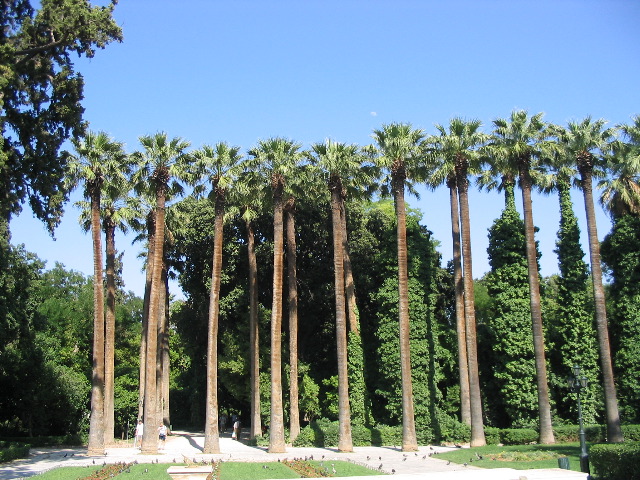
3 National Gardens (Between the Parliament and Zappeion buildings). Dawn-Dusk. A Peaceful and beautiful park in the centre of Athens, easily the coolest place to hide from the summer sun. Wander around, check out the quirky art that seems to sprout up every now and again, look on in disbelief at the "zoo", sit on one of the benches, enjoy the luxuriant flowers and vegetation, marvel at the turtle and duck ponds, have a frappe in the cafe, and spot one of the resident tortoises exploring... it's a fun place to hang out. 4 Pedion tou Areos (Field of Mars). Covers 27.7 hectares, near the National Archaeological Museum. (updated Dec 2017) 5 Dionysiou Aeropagitou Street. This landmark street starts from the Temple of Olympian Zeus at Vasilissis Olgas Avenue, continues under the southern slopes of the Acropolis near Plaka, and finishes just beyond the Temple of Hephaestus in Thiseio. The street has been pedestrianised, forming a scenic route. The entire route provides visitors with views of the Parthenon and the Agora (the meeting point of ancient Athenians), away from the busy city centre. 6 Parnitha National Park. Well-marked paths, gorges, springs, torrents and caves do the protected area. Hiking and mountain-biking in all four mountains remain popular outdoor activities for many residents of the city. Attica Zoological Park in nearby Spata.
Shopping

Although a huge city, Athens has relatively few shopping malls or large department stores; the small, family run shop still conquers all. Souvenirs are of course available everywhere that tourists go. Other shopping opportunities are antiques, museum reproductions, embroideries and other folk art goods, and Greek food and drink products. Plaka is lined with souvenir shops, most of them selling cheap souvenir knick-knacks, though there are a few higher-quality shops. Prices can be high for good quality items.
Flea Market could refer to two places. The sign next to Monastiraki station at the beginning of Ifaistou Street claims that you are entering "the Flea Market of Athens." The street is lined with second-hand and surplus shops of every description. Few are of much interest to the visitor, though towards the west end of the street there are some interesting shops selling old books, posters, and Greek and other music recordings. The real Flea Market is held on Sunday mornings in Plateia Avissinia at the western end of Ifaistou Street. There is incredible assortment of used objects, antiques, and junk. Among all the souvenir and second-hand stores in the area, Martinos at 50 Pandrossou (☏ +30 210 321-3110) stands out as a genuine antique shop, offering top quality items from Greece and the Eastern Mediterranean. Prices are also top of the line, so this is a shop for knowledgeable antique buyers in the market to do some serious spending. Remember that taking antiques out of Greece and into your own country may be subject to the laws of both countries and be sure you're familiar with them before taking anything old home. Kolonaki is the upscale, hip, and artistic shopping area. Kolonaki offers the usual range of shops for an upscale neighbourhood; art galleries, hip clothing boutiques, and antique stores are common. The area is small and along with the small streets north of it, including Skoufa, Anagnostopoulou and the pedestrianized Tsakaloff, are ideal for simply wandering around. 1 Plateia Kolonaki(Kolonaki Square) There are also plenty of shops along Patriarchou Ioakim and Haritos streets and their cross streets. For a more reasonable price tag, try Ermou Street, beside Syntagma Square. Turn right off Ermou at the MAC makeup shop and you'll find yourself on Aghiou Markou and other small streets which have a wide range incredibly cheap shoes, bags, jewellery, gifts and homewares. Street vendors, with their wares laid out on blankets on the pavement, can be found in many places where tourists congregate, especially in Plaka and Monastiraki. Their goods are mostly forgeries, cheap knock-offs, and illegal CDs. A surprising number of them sell large collections of coins, most of them fairly modern, which may be of interest to the numismatically inclined, though anything especially antique is likely a reproduction. These vendors are unlicensed, which is in violation of Greek law, and you may notice them vanishing as soon as a policeman is in sight, to reappear the instant the police have gone. They are best ignored. (This warning doesn't apply to vendors of fruit, nuts, etc., from street carts, who are usually legitimate.) The main supermarket chains are Sklavenitis and Masoutis. Most Greek supermarkets are closed on Sundays. If you need to buy groceries on Sunday, you must find one of the rare exceptions which opens for business on Sunday, find a well-equipped convenience store, or simply do without groceries until Monday.
Laiki (People's market), Divaki Pindou and Ioanni Theologou, and in several other places in Athens neighbourhoods. A fruit, vegetable and fish market. Good fun. (updated Nov 2018)
Eat

The districts Kolonaki and Plaka are especially good areas for dining out.
Fast food
For a quick, decent and low-budget meal, try a souvlaki (σουβλάκι, soo-VLAH-kee), meat (usually pork or chicken) grilled on a skewer. They are typically served with tomato, onion and tzatziki (τζατζίκι, tzah-TZEE-khee), yogurt enriched with garlic and cucumber, wrapped inside a pita (πίτα, PEE-tah), a thin pan bread. Prices of souvlaki vary according to the confidence and/or nerve of the cornershop owner, but usually cost from €1.70 to €3, and another €5 for drink, salad and French fries for a total no more than €7. Take away is cheaper than if you sit at a table. You can get souvlaki just about everywhere, especially in tourist areas.
At the end of Mitropoleos, just around the corner from the Monastiraki Metro station, is a trio of famous souvlaki shops — Thanasis, Savvas and Bairaktaris (Μπαϊρακτάρης) — which are, depending on who you ask, the Zeus or the Hades of souvlaki lovers. At any of the three, if you take a seat and ask for a souvlaki, you'll be served a plate with meat, pita and chips for around €9. But, if you ask cashier for a pita-souvlaki, you'll get the same stuff in a sandwich to take away for around €1.70. 1 Σουβλάκι Κώστας 1950 συνταγμα (Kostas), 5 Pentelis (take Metropolis from Syntagma Square, turn left on Pentelis). It's authentic, friendly and fast. (updated May 2022) 2 The 2 Brothers (Τα δύο αδέλφια), Leof. Stratarchou Alexandrou Papagou 81 (around Alexandri Square (Gardenia)). The best souvlaki in this part of Athens. A giro will cost around €2. If you're interested in a sandwich, cheese pie, spinach pie or the equivalent of a fast snack, try Grigoris (Γρηγόρης) or Everest, two chains of fast food in most districts of Athens and the rest of Greece. Goody's is the Greek equivalent of McDonald's and offers a fair variety of tasty meals, including pasta, different salads, burgers etc. McDonald's is the same like everywhere, but here it has a slight Greek slant.
Drink

Greeks love to socialize, and Athens buzzes long after its other European counterparts have laid their heads down to sleep. 20:00 is the earliest most Greeks will consider going to eat out, and clubbers start to get ready at about midnight. Many Athens clubs relocate to the beach during the summer months. Cafes spill onto the streets and the sound of lively conversation is everywhere in the evenings. Go to the Psyrrí area (Monastiraki or Thissio station, Lines 1 and 3 and Line 1 respectively) for a number of smart bars and small clubs. It is the area immediately north of Ermou street between these two metro stops. There are more and better bars in the area north of Ermou street between Monastiraki and Syntagma than there used to be. Aiolou and Kolokotroni streets offer a fair variety of cafés and bars. Magazé, six dogs, Booze and all the bars on Karytsi square (a small square at the end of Christou Lada street, behind Klafthmonos square on Stadiou avenue) can get very busy on Fridays and Saturdays, with visitors having their drinks even on the streets outside from spring through autumn, when the weather is nice. The area around the Kerameikos station, called Gazi (Γκάζι, gas) has been the gay village of Athens for quite a few years. Since the opening of the metro station, in 2007, the neighbourhood has attracted all kinds of crowds. This is a home to dozens of bars, cafés and clubs, gay or not, and to small theatrical scenes, the latter one especially to the northeast of the area, towards Metaxourgeio.
Balux, Vassileos Georgiou B No. 58 Asteria, Glyfada. One of the best bars in Athens for the specific style, to call it a bar is an understatement. Balux is large complex set right on the water in Glyfada, one of the trendiest areas of the city. It is open during the summer for swimming in the ocean or pool all day and turns into a lounge and full club at night. Where Athens' wealthy go to party. The Plateia Exarcheia square and nearby streets like Solomou have lots of clubs and bars.
Taximi, Cnr. Harilaou Trikoupi and Isavron, ☏ +30 210-363-9919. Rebetiki Istoria, 181 Ippokratous, ☏ +30 210 2587455. One of the best rebetica clubs, often open in summer when most others are closed. Kolonaki Square (Plateia Kolonaki; its official name is Plateia Filikis Etaireias, but no one ever uses it) is bordered with cafes whose customers tend to be mature Athenian movers and shakers for whom the area is the traditional in-town home. Most of these cafes serve desserts, light meals and drinks, and most of them are expensive. They tend to be liveliest late at night. One of the best established, and most prestigious, is Lykovrisi. Not many foreigners visit these cafes, but the visitor may find they make for interesting people-watching.
Sleep
Athens has a wide variety of accommodation options, from camping and hostels, right up to 5 star luxury hotels. For most tourists, the primary question is Plaka or not Plaka. For the latter, the next question is whether to stay just outside of Plaka, or along one of the main routes going to the coast (e.g., Leoforos Andrea Siggrou is home to the Grand Hyatt, Marriott, and InterContinental hotels), or in one of the coastal suburbs like Glyfada or Piraeus. These latter options may allow for staying in more modern hotels or with a scenic coastal view, but then one has to travel to Plaka and back for sightseeing. For hotels near the airport, see listings in Spata and Rafina.
Camping
1 Dionissotis Camping (on the road that leads to Varibobi/Tatoi (Parnitha)), ☏ +30 210 8001496, +30 6977-261615, fax: +30 210 8001512, dionissiotis@hol.gr. It has a hall for breakfast, a minimarket, a swimming pool and a playground for the children. 115 places for tents. €6 per person, €4 per small tent, €6 per large tent/caravan. (updated Jun 2015)
Budget
2 Athens Backpackers, 12 Makri Street - Makryanni, Athens, ☏ +30 210 32 25 891, info@backpackers.gr. Standard backpacking hostel offering clean and comfortable beds, 24 hr reception access, and discounted wifi access. Great spot to meet other travellers. 3 Athens Psiri Hotel, 32 Sofokleous street (next to Monastiraki metro and Plaka), ☏ +30 2105234329, info@athenspsirihotel.com. Check-in: 13:30. Fully renovated in 2020. All rooms include private bathrooms, free wifi, air conditioning and heating. €35. (updated Apr 2021) Safestay Athens Monastiraki (formerly Athenstyle), Ag. Theklas 10 Monastiraki (2 mins from Monastiraki metro station), ☏ +30 2103225010, safestayathens@safestay.com. Studios and hostel beds within walking distance of the metro. Each dorm has lockers. Artists have painted murals in the reception and some of the rooms, and there's a basement lounge with art exhibitions, pool table, home cimena and internet corner. The small rooftop bar is ideal for evening drinks. It produces a weekly art and culture guide. Yellow and green building. €15-50. (updated Feb 2026) 4 Hotel Dioskouros Athens, 6 Pittakou Street, Plaka, Athens, ☏ +30 210 3248 165, fax: +30 210 3233359, hoteldioskouros@gmail.com. Offers simple clean accommodation in a central location. €15-20 per person in high season. 5 Tony Hotel, 26 Zaharitsa Str., Koukaki, ☏ +30 210 9235761, tony@hoteltony.gr. Hostel Aprodite (Aphrodite), 12 Einardou and Michail Voda corner 65, Athena 10440, Greece, ☏ +30 210-8810589, info@hostelaphrodite.com. Low-budget backpackers' hangout not too far from Larissa train station and Victoria Square, a bit north of the Omonia district. €12 for a 6 bed dorm, €14 for a 4 bed dorm, and more. Air conditioning €3 extra per person. 6 Orion, 105 Emm. Benaki & Anexsartisias str, ☏ +30 210 33 02 387-8, fax: +30 210 38 28 575. This small hotel is next to Strefi hill, offers nice view from its terrace and is in a calm area. Freshly renovated rooms and breakfast in communal kitchen. Internet included and sister hotel offers nice breakfast at the terrace, too. from €28 double. 7 Hotel Elite Athens, 23 Pireos str Athens, ☏ +30 210 32 25 891. 10 minutes walk from Monastiraki; simple, decorated rooms with air conditioning and TV. There is also a bar and coffee shop on the ground floor.
Stay safe
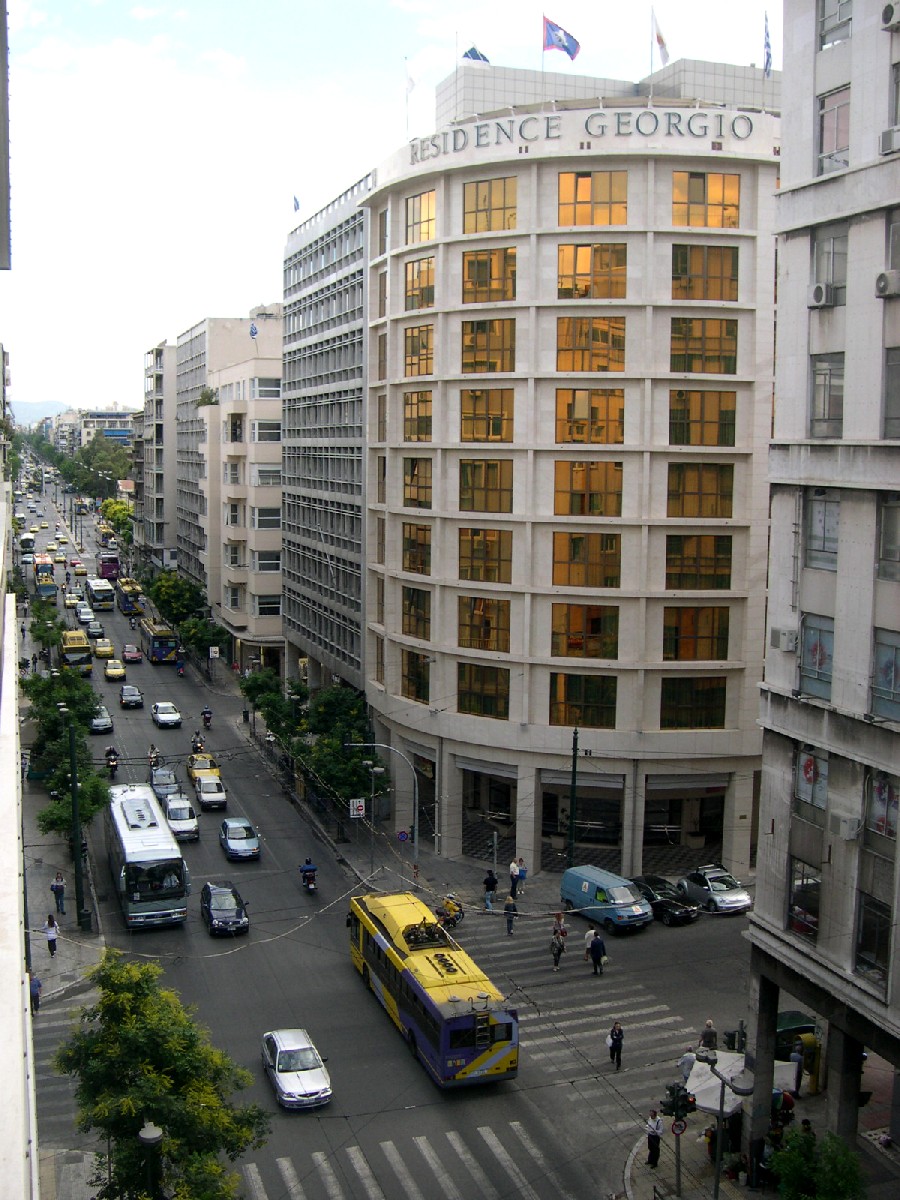
Athens is generally a safe city. There are many police officers and security guards around the city. Many places have CCTV. Street crime is rare. Violent crime against tourists is rare. There are pickpockets on the Metro (especially at the interchanges with the line from the Airport), buses and in other crowded areas, including Plaka. You will notice that natives travel with their hands on their bags and pockets, and keep their bag in front rather than on their side or back, which unfortunately is not without reason. If any pocket, purse, or backpack is visible as you travel on the Metro, assume it will be targeted by pickpockets. Assume that any stranger on the Metro (no matter how well-dressed) is a potential pickpocket and take appropriate precautions. Beware of dense crowds at Metro vehicle doors, especially when a door seems to be broken or jammed. The friendly stranger bar scam has been reported from areas of central Athens frequented by tourists, including Omonia, Syntagma, and Plaka. There have been some reports of fraud. Usually, someone will stop you and ask for directions. A couple of other men then arrive claiming to be police, showing a badge (obviously a fake one). They ask if you were getting drugs from the other man and then ask for your passport and wallet for verification. While you are busy trying to convince them that your passport is valid, one of them sneaks out some money from your wallet.
Demonstrations and riots are common and accepted as part of everyday life and democracy by most Athenians. (You shouldn't expect any less from the cradle of democracy!) Keep abreast of news of demonstrations, and avoid them if you don't want to risk being arrested or tear-gassed, which often happens near Syntagma. Anarchist groups often clash with police, or target government buildings or perceived representations of capitalism during the night, mainly in Exarcheia (Εξάρχεια). It is unlikely that tourists would be harmed, as the anarchists usually take care to attack only property and police as opposed to civilians. However, parking in Exarcheia overnight could result in damage to your car. Anti-Israel pro-Palestine activities (such as graffiti) are common seen on the streets. The football rivalry between local club Panathinaikos and Piraeus-based Olympiacos is notoriously intense, and has on occasion resulted in violent confrontations between opposing fans. To be safe, avoid wearing Olympiacos shirts while you are in Athens, especially during matchday, or it could result in you being harassed or even singled out for violence by opposing fans. In the summer, the weather is very hot. Remember to drink enough water and apply sunscreen to your skin. Athens has poor urban planning, especially poor road planning. When walking around, the greatest danger is on streets where sidewalks/pavements are nonexistent or too narrow for pedestrians to pass each other. If a car or motorcycle comes around the corner too fast at that very second, someone may get run over. In case of emergency, dial 112. This is the pan-European emergency number that connects to police, ambulance, and fire services free of charge.
Rough areas
Athenians hold negative perceptions of the areas around Omonia Square. Locals advise you to avoid these areas late at night. The area is notorious for pickpockets and prostitutes, and there are many people who use drugs in the open, even during the day. Other places to avoid are Vathi square and the area between Agiou Konstantinou and Karolou/Marni. The Philopappou Hill area should be avoided at night. The back streets of Piraeus are probably also places where it's unwise to wander around late at night.
Go next
Islands
Piraeus - the harbour of Athens, and Rafina (on the east coast of Attica) are the departure points for a large number of ferry services to the Greek Islands and other destinations in the eastern Mediterranean, including ports in Italy, Egypt, Turkey, Israel and Cyprus. The closest islands, suitable for a day trip from Piraeus, are in the Argosaronic (or Saronic) gulf:
Hydra Aegina Poros Spetses Kea (also pronounced Tzia) is a very nearby destination, too, less than two hours from the port of Lavrio. Evia, or Euboea, is the second-largest Greek island in area and population, after Crete, and in close proximity to Athens. In less than 1.5 hours by bus, train, or car, you can reach Chalkis, or Halkida, the island's capital city and enjoy the local beaches, Ottoman castle on the hill, the promenade with bars & restaurants. From here you can continue to Kymi and take the ferry to Skyros island or choose to explore the islands hidden gems. If what you are thinking is an island further away, like Paros, Naxos, Ios, Santorini or any of the Dodecanese or Northern Aegean isles, consider extra days off Athens because of their distance from the mainland. Flying is also an option to the more distant islands.
Nearby
Sounio, Ktel bus starts from central Athens and also stop in some areas in south Athens. 1 hour from central Athens by car. Day trips to the Corinth Canal, the ancient theatre at Epidaurus and to the ancient sites of Olympia, Delphi and Mycenae are easy with a rental car. Towns along the Peloponnese such as Nafplion are charming and worthwhile.
More pictures of Athens


From this destination's category on Wikimedia Commons. Each photograph is credited to its own author under its own licence.
The guide text on this page is from the Wikivoyage article Athens, written by Wikivoyage contributors and published under CC BY-SA 4.0. The authors are listed in the article’s edit history. It has been shortened and re-laid-out for this page; that adapted text is available under the same licence. Nothing else on this page is.
Wikivoyage is written by travellers, not by us. Opening hours, prices and whether a place still exists are exactly the details that go out of date, so check anything you are relying on.
“2,553 readers a month” and the ranking are ours, counted from Wikimedia’s published pageviews (CC0) — the median of twelve complete months. They count people reading about a place, which is not the same as people going there.