
Reykjavík
Reykjavík is the capital of and largest city in Iceland and with an urban area population of around 233,000 (2019), it is the home to two-thirds of Iceland's population. It is the centre of culture and life of the Icelandic people, and is one of the focal points of tourism in Iceland. The city is spread out, and has sprawling suburbs. The city centre, however, is a very small area characterised by eclectic and colourful houses, with good shopping, dining and drinking. Reykjavik has the distinction of being the world's northernmost capital city of a UN member state, though its winters are surprisingly mild for a city of its latitude.
Most read about in July, least in October. That is when people look it up, which tends to run a month or two ahead of when they go.
Before you book
The Foreign, Commonwealth & Development Office publishes the UK’s official travel advice for Iceland. It changes without notice and travelling against it usually invalidates your insurance, so read it at the source rather than anywhere else — including here.
FCDO travel adviceUnderstand

History
When it started to develop as a town in the 18th century, Reykjavík had already been inhabited for almost a thousand years. Legend has it that the first permanent settler in Iceland was a Norwegian named Ingólfur Arnarson. He is said to have thrown his seat pillars into the sea en route to Iceland, and decided to settle wherever the pillars were found. The pillars washed up in Reykjavík, and so that was where he set up his farm. Although the story of Ingólfur Arnarson is not widely believed to be true by modern historians, it's clear that Reykjavík was one of the first settlements in Iceland. Archaeological remains confirm that people were living there around the year 871, and for the first few centuries of Icelandic settlement, Reykjavík was a large manor farm. Its fortunes steadily waned as other centres of power increased in importance. By the 18th century, the farm of Reykjavík was owned by the king of Denmark (under whose domain Iceland fell at the time). In 1752, the estate was donated to a firm, Innréttingarnar, led by Icelandic politician Skúli Magnússon. Innréttingarnar were meant to become an important industrial exporter and a source of development in Iceland, and their main base was in what is now the heart of Reykjavík. Although the company didn't achieve all its high ideals, it did lay the foundations of Reykjavík as it is today. In 1786, Reykjavík got a trading charter and it soon started to grow in importance. In 1801, Reykjavík went from being the largest town in the country to its capital. That year a new supreme court, Landsyfirréttur, was set up in the city after the abolition of Alþingi (which no longer had any legislative functions). The same year the office of the Bishop of Iceland was founded in Reykjavík, merging the bishoprics of Hólar and Skálholt. In 1845, Alþingi was re-founded as an advisory council to the king on the affairs of Iceland, located in Reykjavík and in 1874 it regained legislative powers. As the sovereignty of the country grew, so too did Reykjavík, which by the beginning of the 20th century had been transformed from a small trading and fishing village to a fully fledged capital. The Second World War was a boom era in Reykjavík. The city wasn't directly affected by the many horrors of the war, but the occupation of Iceland by first the UK and later the US provided increased employment opportunities and inflows of cash that enabled the rapid expansion and modernisation of the Icelandic fishing fleet. Reykjavík was a leader in this development and it grew very rapidly in the years following the war. New suburbs were built and the city started to reach across municipal limits, subsuming various surrounding communities. The city continued expanding until the financial collapse of 2008. Because it is young, and in particular it expanded rapidly in the late 20th century, Reykjavík is very different from the other Nordic capitals. It lacks their grand buildings and the picturesque old quarters. Instead it has come to resemble American cities with their sprawling suburbs and big motorways, as was recommended by the urban planners of the post-World War II era. Nevertheless Reykjavík has a charm of its own, quite unique, shaped by the dualistic nature of this place which still doesn't seem to have made up its mind on whether it's a small town or a big city.
Climate
The weather in Reykjavík is notoriously unpredictable. One minute the sun may be shining on a nice summers day, the next it may change into a windy, rainy autumn. Temperatures in Reykjavík are quite bland: they don't go very high in the summer, nor do they go much below zero during winter. It follows that the differences between seasons are relatively small compared to what people experience on either side of the Atlantic. January is the coldest month and usually has some snow, while there is frequently no snow on the ground during Christmas in December. Summer is without a doubt the favorite season of most Reykjavík inhabitants. Many of them seem to imagine their city is slightly warmer than it really is and it takes little to get them to start wearing shorts and t-shirts, or to go sunbathing in parks. Don't think too much about how silly it may seem, just join them in enjoying the season! Wind is the main problem with the Reykjavík weather. The city is quite open to the seas, and the winds can be strong and chilling to the bone.
Read
The Fish Can Sing (Halldór Laxness, 1957). A story of a young boy growing up on a farm on the outskirts of Reykjavík in the early 20th century, during a period of rapid change in Iceland. Like many of the stories by Nobel laureate Halldór Laxness, The Fish Can Sing (Brekkukotsannáll, "The Annal of Brekkukot", in Icelandic) is partly based on real people and places, although names have been changed. 101 Reykjavik (Hallgrímur Helgason, 1996). The quintessential book about downtown Reykjavík, capturing its spirit in a way no other book has. The main character never leaves postcode 101 if he doesn't need to, and spends his time either in bars and clubs or at home doing nothing. He has since become seen by many (who don't live in central Reykjavík themselves) as the model for the "101-type". Jar City (Arnaldur Indriðason, 2000). A crime novel about the detective Erlendur, with the Reykjavík criminal police department. Portrays the grittier sides of the city, although perhaps slightly exaggerated for the sake of writing a good story. The book has also been translated as Tainted Blood, but the original Icelandic title (Mýrin, "the swamp") refers to the Norðurmýri neighbourhood, by the city centre. Arnaldur has written 10 further books about the detective, most of them happening in or around Reykjavík.
Getting there

By plane
Two airports serve the Reykjavík area, one for international flights and another for domestic flights. They are 50 km away from each other.
1 Keflavík International Airport (Icelandic: Keflavíkurflugvöllur, KEF IATA), ☏ +354 425 6000, fax: +354 425 0610, kefairport@kefairport.is. Iceland's main international airport is 50 km (31 mi) southwest of Reykjavík on the road 41 "Reykjanesbraut", in the town of Keflavík. It is served by several airlines with destinations on both sides of the Atlantic. (updated Jul 2019) 2 Reykjavík Airport (Icelandic: Reykjavíkurflugvöllur, RKV IATA), ☏ +354 424 4000, fax: +354 424 4001. 08:00–16:00. Next to the city centre, mainly used for domestic air traffic and flights from Greenland and the Faroe Islands. Two airlines have scheduled flights to Reykjavík airport: Icelandair — operates domestic flights to Akureyri, Egilsstaðir and Ísafjörður, international flights to the Faroe Islands and several airports in Greenland. Leaves from a terminal on the west side of the airport. Eagle Air — operates domestic flights to Bíldudalur, Gjögur, Sauðárkrókur, Höfn and Vestmannaeyjar. Leaves from a terminal on the east side of the airport.
By bus
Strætó. operates buses from North, West and South Iceland, stretching from Egilsstaðir in the east to Höfn in the south-east. The main terminal for Strætó's long distance buses is Mjódd. Strætó also operates buses to the Reykjanes peninsula including the town of Keflavík and the airport. Otherwise Reykjavík Excursions and Gray Line operate buses between Reykjavík and Keflavík International Airport. 670 ISK within Reykjavík. (updated Jun 2025)
Getting around

On foot
Walking in Reykjavík is highly recommended, the downtown is very compact and many attractions are within walking distance from most hotels. The city is very beautiful, and the sidewalk and pathway system is first-rate. Reykjavík drivers are in general very friendly, and will sometimes stop for you even when there is no crossing facility. Unknown to many tourists a very long and scenic pathway for walking and cycling circles almost the whole city. A good starting point is anywhere where the city touches the sea. The path leads by an outdoor swimming pool, a sandy beach, a golf course, and a salmon river.
By bus
Reykjavík has a public bus system that is clean and reliable, called Strætó. There are several different methods of payment:
Single rides cost 670 kr in cash (March 2025). If you need to switch buses to get to your final destination, ask the driver for an exchange ticket (skiptimiði), which is valid for the next 75 minutes on any bus. Tickets from the app are also valid for 75 minutes, once activated. Single rides can also be paid for through the Klappið app connected to your credit card. As of January of 2025 you can pay the $4.50 fare with contactless Mastercard, Europay or Visa credit/ debit cards. [1] Sets of tickets are available only through the app, but have no discount. If you're staying outside the city centre it may be best best to get a Reykjavík City Card, which allows unlimited access to the buses, along with free museums and free internet at the hostel. The tourist cards are available at the Tourist Information Centre by Ingólfstorg, and also at some hotels and convenience stores. A 24-hr card costs 4,770 kr, a 48-hr card 6,630 kr and a 72-hr card 8,180 kr, as of December 2023. The Reykjavik Card is also available online. If you're staying for longer you can buy a long-term pass: A green pass lasts a month and costs 9,300 kr, a red pass is for three months and costs 21,000 kr and a blue pass lasts nine months and costs 49,900 kr.
See
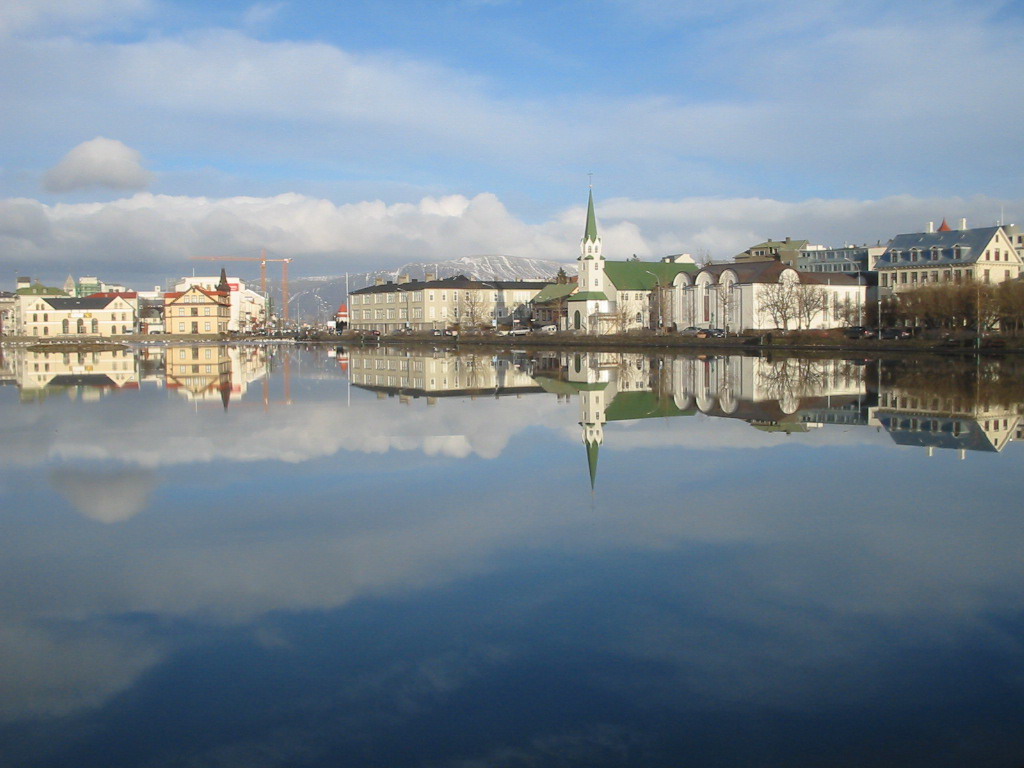
Reykjavík's old town is small and easy to walk around. The houses have some very distinct features, most notably their brightly colored corrugated metal siding. Plan to spend at least a couple hours just wandering around, taking in the city. And for further feasts of the eyes, there are several museums and art galleries in the city, most of them within easy reach of the downtown area.
Parks and open areas
1 Tjörnin (The Pond). A small lake in the centre of the city where young and old often gather to feed the ducks. The Icelandic name, Tjörnin, literally means "The Pond". Tjörnin is mostly surrounded by a park called Hljómskálagarðurinn (Music Pavilion Park) which gets very popular in good weather. The southern end of Tjörnin links it to the Vatnsmýri swamp, a small bird reserve with paths open to the public except during egg hatching season. Built into Tjörnin on the northern side is Reykjavík City Hall. 2 Austurvöllur. A small park (or square, depending on definitions) in the heart of Reykjavík. It's many locals' favorite place to spend sunny days, either at one of the cafés lining the north of the square or simply having a picnic on the grass. The parliament and the national cathedral both stand by Austurvöllur. 3 Klambratún. Klambratún is a park just east of the city centre on an area which remained farmland while the city was built up around it. The area was later converted into one of the largest public parks in the city and often hosts various events. One of the houses of the Reykjavík Art Museum, Kjarvalsstaðir, is inside the park. 4 Reykjavík Botanical Gardens (Grasagarður Reykavíkur), In Laugardalur. The Reykjavík Botanical Gardens are not large, but they're nice for a short stroll and a good place to see some of the plants that grow in Iceland. Free. 5 Viðey. Viðey is a large island in Kollafjörður, the fjord to the north of Reykjavík. It used to be inhabited, and in the early 20th century it had a small fishing village. Nobody lives there anymore apart from the birds, but it's a popular way to get away from the city without leaving it. During the summer, a café is operated in one of the houses on the island. The building was built for Skúli Magnússon, an 18th-century politician often called "the founder of Reykjavík" and designed by the same man as the royal palace in Copenhagen - although it is not quite of the same scale. Among its more modern architecture, Viðey is home to the Imagine Peace Tower by Yoko Ono (see below). To get to Viðey you must take a ferry from Sundahöfn, some distance from central Reykjavík (on bus route 5). The schedule and prices can be found here. 6 Grótta. At the far western end of the peninsula on which Reykjavík sits there is a small island. This island, called Grótta, is connected to the mainland on low tides and open to the public most of the year (closed May 1-Jul 15). Just make sure you don't get stuck on the island when the tide comes in!
Buildings
Reykjavík has a very eclectic building style, which is mainly the result of bad (or no) planning. Many of the oldest houses still standing are wooden buildings covered in brightly coloured corrugated iron. Don't be surprised to see that the next buildings down the street are an ultra-modern functionalist cube followed by early 20th-century neoclassical concrete. Some of the most interesting buildings you'll see in Reykjavík are those you find wandering about. Some deserve a special mention, however.
Do

There is a lot to do in Reykjavík, despite being a small city. There is a vibrant music scene with concerts most evenings in the centre of the city. For theatre enthusiasts the city boasts two main theatres staging around 10 domestic and foreign plays a year each, and a number of smaller theatre groups specialising in different kinds of modern theatre. There are a number of opportunities to experience at least a bit of Icelandic nature without leaving the city itself, and outdoors activities in the immediate vicinity of the city are easy to find. And no visit to Reykjavík would be complete without going to at least one of the geothermal pools. For more information about tours and attractions, it may be a good idea to pay a visit to the Tourist Information Centre located in a beautifully renovated old building by Ingólfstorg.
Music and theatre
Reykjavík has a remarkably active cultural scene for a city of its size. There are a number of art galleries, theaters and concert venues. Some of these are listed below, but many of the places mentioned in the “drink” section below also frequently host concerts. There are no dedicated literary locations listed here, but for book readings it may be best to visit book stores and libraries and ask the staff what's coming up.
1 Nordic House (Norræna húsið), Sturlugata 5 (in Vatnsmýri, south of Tjörnin), ☏ +354 551 7030, nh@nordice.is. Exhibition space open Tu-Su 12:00-17:00, irregular opening hours for other events but the building is generally open during office hours. A cultural centre in Vatnsmýri designed by Finnish architect Alvar Aalto, just south of the city centre. Art exhibitions, concerts, poetry readings and other cultural events frequently take place here. 2 Harpa, Austurbakki 2 (just east of the old harbour), ☏ +354 528 5050 (tickets). The new home of the Icelandic Symphony Orchestra and regularly host to other acts as well. Delayed by the economic collapse, this building was under construction for several years before finally opening in May 2011. This marked the end of a long wait for the symphony orchestra, who had been using a cinema as their main venue the last 50 years. Today the symphony plays a concert every Thursday evening from September through June (although often at other times as well), but the building is rarely empty at other times with Iceland's lively music scene having embraced this new location. (updated Apr 2023) 3 National Theatre of Iceland (Þjóðleikhúsið), Hverfisgata 19, ☏ +354 551 1200 (tickets). A theatre in the centre of Reykjavík, in many ways the focal point of Icelandic theatre. The repertoire is a mix of Icelandic and international plays, both new and old. 4 Reykjavík City Theatre (Borgarleikhúsið), Listabraut 3 (adjecent to Kringlan shopping mall), ☏ +354 568 8000 (tickets). Like the national theatre, the city theatre puts on a mix of new Icelandic plays and highlights of international theatre. 5 Vesturport, Tjarnarbíó, Tjarnargata 12 (on the west bank of Tjörnin), vesturport@vesturport.com. This experimental theatre group has toured the world and won many prizes for its daring productions which include Romeo and Juliet, and Woyczek. They have also made films including the acclaimed Children and Parents, in 2006 and 2007 respectively.
Shopping

1 Laugavegur is the main shopping street of Reykjavík and has many funky boutiques, with both Icelandic and international designs. 2 Skólavörðustígur, running from Laugavegur up to Hallgrimskirkja, has a range of souvenir and craft shops. Record shops and bookstores are also located on these streets, where you can find Icelandic music and literature as well as a wide range of foreign music and books in English. European plug adapters are available at the Eymundsson bookstore on Laugavegur. Reykjavík has one flea market, 3 Kolaportið, in a warehouse by the harbour and open Sa Su 11:00-17:00. In addition to stalls selling clothes, antique furniture, old books and other typical fleamarket wares, there is a food section where you can buy many Icelandic specialities as well as cheap and fresh fish and potatoes. If you yearn for international chains such as Zara and Debenhams, then head to one of 2 malls in the capital area; 4 Kringlan in Reykjavík and the newer 5 Smáralind in neighboring Kópavogur. Everything in Iceland probably costs more than it does back home. Items can be as much as 3-4 times the price in neighboring countries, mainly because of taxes (24.5% sales tax on products, 7% on books), import duties and so on, though there are exceptions to this rule. Sales tax is always included in the sticker price. All foreign visitors are entitled to claim back up to 14% of the sales tax if they spend 12,000 kr or more in one shop in one day. Iceland is not a member of the European Union, so visitors from all European countries are entitled to sales tax refunding. Icelanders living abroad are also entitled to sales tax refunding. ATMs are found throughout the city, and they should accept any foreign cards. Currency exchange is mainly done at banks, there are very few special currency exchange shops. Icelanders make very little use of cash, paying for even the smallest of things with their cards. Foreign cards will generally be accepted in stores and restaurants, although there may be problems with American Express in some places. Minimal Icelandic cash is needed for a visit to Reykjavik. You must have a PIN to use your card. Iceland is one of only a few countries to participate in whaling and hunting of various marine mammals. Many shops have souvenirs made from seal pelts and sometimes even whale or dolphin bones. These are illegal to import or possess in most countries due to the Convention on International Trade of Endangered Species (aka CITES) and attempting to bring back such goods might result in a hefty fine. Tipping isn't done in Iceland, not under any circumstances; not for any service, not for restaurants or for hotels, or any other place.
Eat

Budget
Food in Iceland can be expensive. In order not to break the bank, you'll need to be smart when eating. On the budget side, you're mostly looking at international-type fast food options common to what you'd find in Europe and America. Alcohol in particular is expensive in restaurants: a pint of beer is typically 1000-1300 kr. Beer can be purchased for under 300 kr in most convenience/grocery stores, but wine and spirits are available only in the few government-controlled shops. As Iceland is not part of the EU, duty free purchases can be made by all international passengers who have just arrived at the airport, so that is another way to pay less for alcohol. 10-11 is a chain of convenience stores (open 24/7) with plenty of ready-to-eat items such as sandwiches, wraps, and surprisingly enough, tacos. 10-11 is always open but also more expensive than supermarkets, that's why you see most Icelanders shop for food at Bónus (open 10:00-18:00), a low-cost supermarket chain. Even better, you can find a fish shop which sell ridiculously fresh and absolutely delicious fish, at a very reasonable price, and cook it yourself with some potatoes and vegetables. The fish shop could be in Kolaportið, a central market which only opens on weekends, or alternatively one of the many fish shops (fiskbúð) all around the city. Try one of the hot dog places that are found everywhere. This German import has become thoroughly Iceland-ized. A hot dog should cost 820-900 kr as of June 2026. Ask for "Eina með öllu", a hot dog with everything on it. Fast food – Apart from the usual suspects such as KFC and Subway (McDonald's was re-branded Metró by the local franchise holder in 2009, but kept a similar menu) and the hot dog stands mentioned above, Reykjavík has home-grown fast food restaurants. In the city centre many are open 24/7 in weekends, serving the partying crowd. Names include Nonnabiti and Hlöllabátar (subs and sandwiches), Kebabhúsið and Ali Baba (kebabs), Serrano (burritos) and Pizza Pronto (you can guess what they sell). You should be able to fill your stomach at each of these for 1000 kr or less. The most local street food you can find is kjötsúpa, Icelandic meat soup. It is a spicy vegetable soup with lamb meat. They have a vegetarian version of it too, that is just the same soup minus the meat. You can find vans selling it next to the Hallagrimskirkja and at the northeastern corner of Tjörnin. A small bowl costs about 700 kr and a large one 1100 kr as of August 2014. Thai restaurants – Thais form, along with Poles, the largest immigrant community in Reykjavík and as a result there are a lot of good and cheap Thai restaurants around the capital, often run by Thai families. You will usually get large portions without paying much more than 1000-1500 kr. Options in central Reykjavík include Krua Thai (Tryggvagata 14) and Núðluhúsið (Laugavegur 59, 2nd floor). There are tons of cafes everywhere in the city that are relatively inexpensive and a great place to sit, relax and warm up. You can also check your e-mails if you bring your computer, as there is free Wi-Fi in most of them. Kaffitar and Te & Kaffi are comparatively large chains and serve great barrista style coffee, that might however be on the expensive side.
1 Bæjarins beztu pylsur, Hafnarstræti 17 (by the harbor). 24/7. The name of this popular hot dog stand literally means "Town's Best Hotdogs" and, based on the queues, it seems to deserve the name. Hot dog 820 kr, soda 420 kr. (updated Jun 2026) 2 Hamborgarabúllan, Geirsgata 1 (by the harbour), ☏ +354 511-1888. Small hamburger cafe next to the old harbour designed in the traditional American diner style. Very popular with locals and a reliable alternative to the absent international burger chains. 3 Múlakaffi, Hallarmúli 8. A bit away from the city centre, this place is very like an office cafeteria. It prides itself on selling authentic Icelandic home cooking. The sparse menu varies between days. Due to its location surrounded by offices, it caters more to a lunch than dinner and closes at 20:00 weekdays, 14:00 Saturdays and is not open Sundays. It also seems to stop serving main meals some hours before closing. 4 Perlan. In addition to its famous restaurant, Perlan also has a café offering food. You can eat with (almost) the same view and a much cheaper price. 5 Sægreifinn (Seabaron), Verbúð 6 (At the harbour, near the whale watching kiosk). Winter: 11:30-22:00, Summer: 11:30-23:00. An extremely authentic seafood place, serves a wonderful lobster soup and offers grilled cod, whale, shrimps, salmon, etc. 800 - 2500 kr. 6 Tian, Grensásvegur 12, ☏ +354 568-1919. to 22:00. This little Chinese restaurant near Laugardalslaug parc and the Arctic Comfort Hotel is a quiet little spot with great food and friendly service. The prices are quite low. 7 Café Haiti, Geirsgata 7b (At the port near the whale watching kiosks). A cafe serving coffee and light food. Note that this is not their original location, although you can see their sign still painted on the side of nearby building where they began. They roast their own coffee. 8 Kaffismiðja Íslands, Kárastígur 1 (Down Frakkastigur, to the left when you are on the road and facing Hallgrímskirkja. Will be on your left), ☏ +354 517-5535. M-F 08:30-17:00; Sa 10:00-17:00. This cafe supposedly employs some of Iceland's best baristas, and does serve great coffee. Also offers a selection of French and Icelandic pastries. On the small side with just a few tables, but big windows let in lots of light. Friendly staff and student clientèle. 9 Kaffiport (inside Kolaportið, the flea market). Sa Su 11:00-17:00. The small restaurant inside the flea market is one of the cheapest places to eat in the city. They have kjötsúpa (Icelandic lamb soup), pylsa (hot dogs), some desserts and drinks. (updated Oct 2017) 10 Kolaportið (flea market). Sa Su 11:00-17:00. If you're in Reykjavik on a weekend, don't miss the farmers market. Many vendors have free samples of Icelandic chocolate, Icelandic liquorice, Icelandic desserts, and even hakarl (fermented shark). Even without the free samples, the prices are reasonable. (updated Oct 2017)
Mid-range
There are many fantastic fish restaurants in Reykjavik. The more expensive ones are by the harbour or in the centre, if you're not so rich try heading towards the old town. Though generally not listed here, most bars serve some food, often better than what you would expect from the look of the place but generally with relatively uninspired menus: Expect to see a few burgers, a pasta dish or two, some salads and maybe a burrito. Plan on at least 3,000 kr for any meal not in a budget/fast-food restaurant. Seriously.
Drink

Reykjavík is considered to have some of the best nightlife in all of Europe and it can be almost guaranteed that you haven't really "partied" until you've done it here. This fact is proven by the number of celebrities who come specifically for it. Drinking is expensive - expect to pay between ISK 1.000 and 1.400 (2021 prices) for a draft pint at a bar. Bottled beers and mixed drinks are more expensive, sometimes outlandishly so. Despite the cost, going out in Reykjavik is a fun experience. Since alcohol is expensive at Reykjavík bars and clubs, Icelanders usually buy their alcohol at the government owned liquor stores (Vínbúðin, called Ríkið by locals) and stay at home drinking until about midnight (or later), then they will wander to the bars. Do not expect bars and clubs to become crowded during weekends until about 1AM (at least). Cover charges are very rare in Reykjavík, unless there is live music or some other sort of event going on. Note that although the legal age for entering clubs is 18, the legal drinking age is 20 and many places set higher entry age limits themselves. Bars are open to 01:00 on weeknights, but most will stay open until 06:00 or 07:00 on Friday and Saturday. The clubs and bars themselves are mostly found in a very small area of the city centre, it's easy to just walk around and follow the crowds. You're sure to find somewhere to go, but if you're not sure, groups of drunken Icelanders will usually be eager to help a tourist out! During weekends, live music is easy to find in some of Reykjavík's bars. During the day, be sure to pick up the free English-language magazine The Reykjavík Grapevine for information on live music events for that evening. It is easy to find in shops, restaurants and bars around the city. There is an ice bar in Restaurant Reykjavík where all the furniture and the bar are made from glacial ice. This seems like an interesting place to go, however, you will be charged 1300 kr for entry which includes a single vodka-based cocktail in what is effectively an atmosphere and music-free deep freezer. You cannot bring in or buy more drinks, if you are keen for novelty it is good, otherwise perhaps not worth the money.
Bars
The distinction between bars and clubs is not very clear in Iceland, with most clubs being more like bars until a little before midnight. However, the following venues can be said to be purely bars - places to go and drink with your friends, rather than to dance or listen to music.
1 Den Danske Kro (Danska kráin, the Danish Pub), Ingólfsstræti 3. This place tries to imitate a Danish bodega, although it really feels much more Icelandic than Danish. 2 The English Pub, Austurstræti 12, ☏ +354 578 0400. Very popular English-style pub in the heart of the city, with a wide range of beers and a wheel of fortune. Beware troubadours in the weekends, though (they're very bad)! 3 Ölstofa Kormáks og Skjaldar (Ölstofan), Vegamótastígur 4, ☏ +354 552 4587. A small, cozy and extremely popular bar. The decorations seem to be taken from the living rooms of Icelandic grandmothers and include a number of cross stitched pictures. Uniquely for Reykjavík bars they have their own beer called Bríó, brewed for them by a microbrewery within the larger Egils brewery.
Sleep

Budget
Be warned that there is very little in the way of affordable lodging in Iceland, particularly if you are travelling with a family. The cheapest option in Reykjavík, by far, is to stay at the city's only campsite. If that's not for you, there are several hostels with affordable dorms located in and around the city centre. Fortunately for the traveller on a budget, this seems to be the fastest growing type of accommodation in Reykjavík. Most of these hostels also offer single or double bedrooms, and a few small guesthouses have rooms at similar prices.
1 Guesthouse Aurora, Freyjugata 24, ☏ +354 899 1773, siggi@danol.is. A friendly little guesthouse in a residential part of the city centre. 15,000 kr. 2 Guesthouse Sunna, Þórsgata, ☏ +354 511 5570. Great guesthouse located in one of the most iconic places in Reykjavik, right across the square from Hallgrimskirkja. Very clean, very comfortable, with friendly service, and internet. They also include breakfast in the morning, with fresh bread baked on the premises. A little on the expensive side—11600 kr for a single room. Another great feature is their airport/tour bus service. Summer: 15,600 kr double room; winter: 8,900 kr double room. 3 KEX Hostel, Skúlagata 28, ☏ +354 561 6060, booking@kexhostel.is. Check-in: 14:00, check-out: 10:00. A hostel that was opened in a former biscuit factory down by the sea. Very cozy and looks distinctly unlike a hostel, which is not surprising given that a set designer created the appearance. Has a bar and restaurant which serve non-residents as well. Staff are very helpful. Dorm: 3,000 kr winter, 5,100 kr summer; double room: 8,000 kr winter, 14,400 kr summer. 4 Laugardalur Campsite, Sundlaugavegur 34, ☏ +354 568 6944, info@reykjavikcampsite.is. Open 15 May - 15 September. The cheapest place to stay in Reykjavík, and an approximately 30-min walk from the city centre, or a short bus journey. The campsite is big and offers decent washing and cooking facilities and people often leave their leftover camping stove fuel for others after leaving Iceland. (Fuel is really expensive in Iceland!) On cold and rainy days, Iceland's biggest pool is situated right next door. Clothes can also be washed at the neighbouring youth hostel. 1,100 kr per person, per night. 5 Reykjavík Downtown Hostel, Vesturgata 17, ☏ +354 553 8120, reykjavikdowntown@hostel.is. A hostel in an old apartment building right next to the city centre, by the harbour. 3,500 kr dorm. 6 Víkingur Guesthouse, Þverholt, ☏ +354 896 4661, ghviking@simnet.is. Just outside the city centre. In addition to accommodations, they also offer car rental services. 13,990 kr double room. Guesthouse Tunguvegur, Tunguvegur 23, Reykjavik, ☏ +354 8647504. Check-in: 15:00, check-out: 10:30. Clean, spacious guest house with impeccable bathrooms, plus kitchen, dining room, living room and terrace. Excellent & free WiFi. On a main road into the centre if you want to drive, if not there is bus 11. €78, twin or double room. Atlantic Apartments & Rooms, Grensasvegur 14, Reykjavik, ☏ +354 6997313. Check-in: 16:00, check-out: 11:00. Large budget hotel with bathrooms in the corridor on each floor. Fridge & microwave in each room, but no crockery. Excellent & free WiFi. Very near the 41 & 49 roads, so easy to reach from Keflavik. Various restaurants in the same street and a few minutes' walk to a large shopping area. Staff are not always at reception, but guests are e-mailed a code to open the front door. €79, twin or double room. 7 Reykjavik City HI Hostel, Sundlaugavegur 34, ☏ +354 553 8110. While it takes about 30 mins to walk into downtown, the cheaper accommodation cost more than make up for the minor inconvenience. It has both 2-person private room as well as dorms. A bonus for this hostel is that it is located right beside Laugardalslaug (the heated public swimming pool). (updated Jul 2018)
Mid-range
8 Fosshotel Lind, Raudarastígur 18, ☏ +354 562 3350, lind@fosshotel.is. Located one minute walk of the city centre close to the main shopping street Laugavegur. Rooms on the upper floors have great view of the Hallgrimskirkja. There is a restaurant at the hotel called Confusion. It offers aperitivos for reasonable price. Tours are bookable at the reception. 10,000-30,000 kr. 9 Best Western Hotel Reykjavík, Rauðarárstígur 37, ☏ +354 514 7000, info@hotelreykjavik.is. Just outside the city centre, 10–15 minutes walking, but well located with regards to the bus system. 17,000-30,000 kr. 10 Fosshotel Baron, Barónsstígur 2-4, ☏ +354 562 3204, baron@fosshotel.is. Located on the eastern edge of the city centre close to the main shopping street Laugavegur. Rooms on the upper floors on the northern side have great views across the sea. There is a 24/7 supermarket right behind the hotel. There is a restaurant, bar and tour desk. There are many types of rooms and price ranges. 10,000-30,000 kr. 11 Hótel Björk, Brautarholt 22-24. A 15-minute walk away from the city centre in an office neighbourhood. 15,000-30,000 kr. 12 Hótel Frón, Laugavegur 22a, ☏ +354 511 4666, fax: +354 511 4665, info@hotelfron.is. By Laugavegur, the main shopping street. 20,000 kr. 13 Hotel Klöpp, Klapparstígur 26, ☏ +354 595 8520, klopp@centerhotels.is. In a side street close to Laugavegur. Very close to a number of bars and clubs, but surprisingly quiet apart from one bar across the street which often has live jazz or folk music on weekends. Part of the CenterHotels chain like Hotel Plaza below. 14 Hótel Leifur Eiríksson, Skólavörðustígur 45 (facing Hallgrímskirkja), ☏ +354 562 0800, fax: +354 562 0804, info@hotelleifur.is. A rather basic hotel, but at a good price given its location just across the street from Hallgrímskirkja. Rooms have satellite TV which includes one English-language channel. The hotel also has a bike rental. 21,000 kr. 15 Hotel Óðinsvé, Þórsgata 1 (by Óðinstorg), ☏ +354 511 6200, fax: +354 511 6201, odinsve@hotelodinsve.is. In a side street a few meters off Skólavörðustígur. Comfortable rooms which include free wi-fi and satellite TV, but breakfast is not included in the price. 17,000-27,000 kr. 16 Hotel Plaza, Aðalstræti 4 (By Ingólfstorg square in the city centre.), ☏ +354 595 8550, plaza@centerhotels.is. Literally in the centre of Reykjavík, by the oldest street in the city (Aðalstræti) and the Ingólfstorg square. Close to the heart of the nightlife, and so noise is to be expected (at least in rooms facing the square). Free wi-fi. Part of the CenterHotels chain like Hotel Klöpp above. 15,000-25,000 kr.
Stay safe
Iceland is one of the safest countries in the world, and Reykjavík is one of the safest cities you will ever visit. Just be sure to avoid the fights that break out among the most intoxicated partiers in bars on the street on weekends. However most people are incredibly friendly and police are also friendly and very helpful. Petty thefts in Reykjavík have occasionally occurred. In addition, the female traveller would do well to exercise good judgment when walking alone at night. Rape is rare, but can occur. Still, even with these issues, Reykjavík is much safer than most other Western cities, and certainly safer than the larger capitals of other countries. Homeless people generally hang in the area around the Hlemmur bus station or on Austurvöllur park. They usually don't bother people, not even to ask for spare change even though they might seem to act strangely.
Go next
Golden Circle - a marketing term for a one-day circuit from Reykjavik. It can be easily done by car or by tour. Tours are usually 7.5-hr long and stop at these 3 locations: Þingvellir National Park is located about an hour and a quarter's drive to the east of Reykjavík, here you can see the canyon caused by the Eurasian and North American plates moving apart. It is also home to the original Alþingi (Parliament) and several other cultural treasures. These factors have seen it added to the UNESCO World Heritage List. Gullfoss A spectacular waterfall (which translates as Golden Falls) and one of the nearest big waterfalls to Reykjavík Geysir Geothermal hot spot Hafnarfjörður is a town just outside Reykjavík Blue Lagoon (Bláa Lónið in Icelandic language) is a famous and amazing geothermal spa with the water temperature around 40 °C all year round, even in freezing conditions, located south-west of Reykjavík, not far from the main airport at Keflavík. The Iceland Ring Road is a staple for many tourists who wish to explore what Iceland has to offer by seeing volcanoes and icebergs, waterfalls and fjords that are peppered island-wide. By booking a trans-Atlantic ticket on Icelandair with a free "stop-over" of up to a week in Reykjavík, you can follow a visit to Iceland with a visit to London, Paris, Glasgow, Oslo, Stockholm, Copenhagen, Amsterdam, Frankfurt, or another city in Europe, or to Washington, D.C., Boston, Orlando, New York, Minneapolis, San Francisco, Seattle, or another U.S. city.
More pictures of Reykjavík


From this destination's category on Wikimedia Commons. Each photograph is credited to its own author under its own licence.
The guide text on this page is from the Wikivoyage article Reykjavík, written by Wikivoyage contributors and published under CC BY-SA 4.0. The authors are listed in the article’s edit history. It has been shortened and re-laid-out for this page; that adapted text is available under the same licence. Nothing else on this page is.
Wikivoyage is written by travellers, not by us. Opening hours, prices and whether a place still exists are exactly the details that go out of date, so check anything you are relying on.
“1,372 readers a month” and the ranking are ours, counted from Wikimedia’s published pageviews (CC0) — the median of twelve complete months. They count people reading about a place, which is not the same as people going there.