
Doha
Once little more than a minuscule pearl fishing village, Doha (Arabic: الدوحة ad-Dawḥa), Qatar's capital, with more people than the rest of Qatar combined, has emerged to become one of the pearls of the Middle East. It is one of the most rapidly-developing cities on the Persian Gulf, akin to the development seen in nearby Dubai and Abu Dhabi, and is aiming to become a centre of international trade and travel. We also cover the neighbouring cities of Al Rayyan and Lusail in this article, as they are effectively part of the Doha urban area.
Most read about in July, least in March. That is when people look it up, which tends to run a month or two ahead of when they go.
Before you book
The Foreign, Commonwealth & Development Office publishes the UK’s official travel advice for Qatar. It changes without notice and travelling against it usually invalidates your insurance, so read it at the source rather than anywhere else — including here.
FCDO travel adviceUnderstand

For most of its history, Doha was a poor fishing village dependent on pearl diving, and was regarded as a sleepy backwater until the early 1990s. Following the accession of Sheikh Hamad bin Khalifa Al Thani as Emir in 1995, however, Qatar quickly began to modernize, and Doha is now taking huge strides to catch up with other nearby Gulf cities. Development was accelerated by hosting the Asian Games in 2006 and the FIFA World Cup in 2022. The city is very much a work-in-progress, with a rapidly growing skyline and new buildings sprouting up almost like mushrooms. For most visitors, Doha is synonymous with Qatar, as the vast majority of the country's population resides in the capital city. Doha has an astonishingly diverse population – only 13% of its residents are Qataris. Although Arabic is Qatar's official language, English is the lingua franca; most retail and service staff are foreigners and do not speak Arabic. Doha is also now one of the fastest-growing cities in the world, as workers continue to pour in to help build the developing economy. Doha is fairly liberal by the standards of the Islamic world, though less so than its main rival Dubai and most Western countries. Alcohol and pork are legal for non-Muslim foreign residents, and non-Muslim women are not required to wear the hijab, though dressing in very skimpy outfits is still illegal. That said, Qatar is an absolute monarchy, so criticising the Emir is a crime. Homosexuality is also a crime that carries the death penalty (though not actively enforced), so gay visitors should be as discreet as possible. If you've visited before, be assured that Doha today is not the same as it was just a couple of years ago, and will be very different again in a few years time.
Read
Mohanalakshmi Rajakumar, From Dunes to Dior. Written by a resident Indian-American, this is a collection of insightful essays about life as an expatriate in Doha. Mohanalakshmi Rajakumar, Love Comes Later. Set in Doha and London, this novel examines Qatari culture and how young Qataris are now challenging the status quo. The book is not available in Qatar as it has been banned by the Qatari Ministry of Culture.
Getting there

By plane
1 Hamad International Airport (DOH IATA). The primary point of entry for most travellers, it is the hub and base for Qatar Airways, which has positioned itself as one of the "Big Three" Middle Eastern airlines. It has built a far-reaching network, flying to destinations in Europe, South and East Asia, Australia, Africa and the Americas. Compared to Dubai, the home of Qatar Airways' arch-rival Emirates, Doha is served by much fewer other carriers. The major European airlines usually provide a single connection to Doha from their main hubs (e.g. Lufthansa from Frankfurt, KLM from Amsterdam), but minor ones do not. Pretty much all airlines of the Middle East, Turkey included (but not Israel), provide connections to Doha. Relatively few Asian airlines do so, however, with the exception of a relatively good choice of connections to India and Pakistan. Qatar Airways is a member of the Oneworld alliance (which includes e.g. British Airways), and an increasing number of their connections are also on offer as codeshare flights by Oneworld members. If you're arriving from outside of the Persian Gulf region, probably the most economical way to visit is to use Qatar as an intermediate stopover en route to another destination. Prices of tickets originating in or terminating in Doha are artificially high because of limited competition, while prices for transit tickets are very competitive, as Qatar Airways continues working to build Doha as a global transit hub. Public Wi-Fi is provided free of charge throughout the airport.
By car
Doha is the heart of all activity in the country, so most travellers will start off in the city. All highways and roads throughout Qatar will most likely connect to Doha, so look out for the signs. Qatar's only land border is with Saudi Arabia in the south. However, this is rarely an option, as obtaining permits to drive through Saudi Arabia can be extremely difficult. The Qatar article provides more information. Early plans are underway to connect Qatar using bridges with both Bahrain in the northwest and the United Arab Emirates in the southeast.
Getting around

By metro
The Doha Metro, which opened in May 2019, is the third rapid transit system in the Gulf, representing a new wave of transit projects in the region. It has three lines: the Red Line from Lusail in the north to Al Wakra in the south or the airport depending on the train, the east-west Gold Line that features a stop at the National Museum, and the Green Line, which focuses on educational institutions in particular and has a stop at the National Library. Msheireb serves as the transfer station between every line. Like the Dubai Metro, there are premium cars with better seating and higher prices. A one-way trip costs QR 2 (QR 10 for VIP) and a day pass costs QR 6 (QR 30 for VIP). You pay by tapping your card when you enter and exit the system. Cards are not expensive and can be purchased at any station. You don’t have to do anything special to get the day pass; after you pay for 3 rides the system will not charge you for the rest of the day. There are free "metrolink" feeder bus services for "last-mile" connectivity to areas not served by the Metro (see the link for schedules and routes). In addition, there is a free (with Metro trip) ride-sharing service called "metroexpress", but it only serves two stations (West Bay and DICC) and requires registration and a separate account. Every metro station has a restroom with baby changing table and an ablution room, right after the turnstiles. The two rooms are next to each other; the women’s rooms are indicated by a person wearing black clothing, and the men’s rooms by the person wearing white clothing.
By bus
2 Public bus, Al Ghanim (main bus station) (near the Gold Souq), info@mowasalat.com. The public bus system is operated by the government-owned Mowasalat, which runs a wide network of routes catering for most of Doha, along with adjacent and surrounding towns. Fares within the city cost between QR 3-9 and are payable with exact change, or with a Karwa Smartcard , available for purchase at the bus station. For visitors, the route maps can be cryptic, with fairly infrequent service on some routes; additionally buses are frequently behind schedule. There are dedicated sections at the front of buses for women and families; however, in practice, some routes, particularly those to and from industrial areas, are used predominantly by male labourers and best avoided by women travellers. Timetables are online, some available to download; route maps are available only at the main bus station. Shuttle bus, ☏ +974 4458 8888 (Mowasalat), info@mowasalat.com. Daily 06:00-00:00 every 15 min. In order to ease ever-increasing traffic congestion, Mowasalat operates a free shuttle bus service, servicing passengers with two routes in the West Bay (downtown) area; plans are underway to offer more routes. A route map (Arabic and English) is available for download. Friday service is 'family only', i.e. solo men are not permitted. Free.
By tour bus
Doha Bus, ☏ +974 4442 2444, +974 5534 2964 (mobile), admin@dohabus.com. It offers a hop-on, hop-off tourist bus service, with stops at various locations between the Marriott Hotel and the Pearl-Qatar. Buses arrive at each stop every 20 minutes. Tickets are QR 180 (adult), QR 90 (children) and valid for 24 hours; bookings can be made on-line at its website, also via telephone and email. If you're doing this on your last day in Doha, they will arrange to pick you up at one of the main stops along the route and transfer you back to the airport for a not-unreasonable QR 50. (updated Mar 2023)
See
Museums
The National Museum, Museum of Islamic Art, and Museum of Modern Art have a single three-day ticket for QR 85. Alternatively you can visit just one of them for QR 50.
1 Museum of Islamic Arts, Next to Doha Port, on the Corniche (Route 76 bus; shuttle bus), ☏ +974 4422 4444. S M W 10:30-17:30; Th Sa 12:00-20:00; F 14:00-20:00. Doha's flagship museum. Housed in a building designed by I.M. Pei, the museum hosts artefacts from Muslim dynasties all over Asia, Africa and Europe. Also present are items from the Al-Thani dynasty, as well as art from all parts of the Middle East. Gloriously air conditioned, there is also a cafe and gift shop. The permanent exhibition is on the 2nd and 3rd floors, with temporary exhibitions on the ground floor. Free wi-fi in the museum building, dress appropriately. An hourly shuttle service provides free transportation between MIA and Mathaf W-Su 11:00-17:00; driving time between the two museums is 25-35 minutes. Free. 2 Mathaf: Arab Museum of Modern Art, Al Luqta St, Education City (shuttle bus), ☏ +974 4402 8855, mathaf_info@qma.org.qa. Sa-Th 11:00-18:00, F 15:00-21:00. A specially designed building housing a collection of modern art from the Arab world, based on a personal collection amassed by Sheikh Hamad bin Khalifa Al Thani. The museum also hosts occasional exhibits featuring internationally-recognized contemporary artists. An hourly shuttle service provides free transportation between MIA and Mathaf W Th Sa Su 11:00-17:00, F 15:00-20:00, no shuttle M Tu; driving time between the two museums is 25-45 minutes. QR 50, or QR 85 for a museum pass. 3 National Museum of Qatar, End of Al Muthaf St. Opened in early 2019. The original museum was housed in an early 20th-century palace; its extension, now under construction, was designed by French architect Jean Nouvel and inspired by the desert sand rose. The extension and original palace can both still be viewed from the outside. 4 Orientalist Museum, Off Al Muthaf St (Mirqab), ☏ +974 4436 7711. Su-Th 07:30-14:30 by appointment. The Orientalist Collection of the State of Qatar is one of the most significant collections ever assembled in the world. The approximate 700 paintings, water colours, drawings and prints trace Orientalism back to the early 18th century. The museum closes sporadically and it may be difficult to get an appointment. 5 Arab Postal Stamp Museum, off of Lusail St (Katara Cultural Village, Bldg 22A), ☏ +974 4409 1077. Daily 07:00-13:30, 16:00-21:00. Established in 2010, this small museum exhibits stamps from 22 Arab countries. 6 Sheikh Faisal bin Qassim Museum: West Bay Branch, City Tower, 6th Floor, Omar Al Mukhtar St (Renaissance Doha City Center Hotel, near City Center Mall), ☏ +974 4422-3899, visitors@fbqmuseum.org. 09:00-17:00 by appt only (specify 'West Bay Branch'). An extension of the Sheikh Faisal bin Qassim Museum in Al Shahaniyah, this branch displays carpets from various Middle Eastern countries, and furniture and domestic objects from Qatar and the Gulf region. It is eventually planned to make the collection accessible without appointment. 7 VCUQatar Gallery, Virginia Commonwealth University in Qatar, Al Luqta Street, Education City (enter Education City through Gate 2, then right at the 2nd roundabout), ☏ +974 4402 0555. VCUQatar have a small gallery, with exhibitions which change every few months, in their campus on Education City, which is open to everyone (sign in at reception). Because of the ongoing building works at Education City, it's a nightmare to get from Mathaf to here, but when the trams are running it should be an easy side-trip from there! 8 Msheireb Museums (متاحف_مشيرب). M-Sa 09:00-17:00; open F until 21:, closed Su. A collection of four historic houses in the new downtown district of Msheireb: Mohammed bin Jassim House, Company House, Bin Jelmood House and Radwani House. They feature exhibits on the Msheireb community, traditional Qatari family life, the history of the oil industry, and slavery and exploitation. Free. (updated Apr 2025) 9 Firestation Artist in Residence, Mohammed Bin Thani St, ☏ +974 4422-4222, contact@firestation.org.qa. Sa-Th 09:00-19:00; F 11:00-19:00. Has an art supply store and cafe on site. Free. (updated Sep 2019)
Cultural heritage
10 Al Koot Fort (Doha Fort), Jassim Bin Mohammed St (parking lot near Souq Waqif). Built in 1880 during the Ottoman period, this big white fort is in what is now the parking lot of Souq Waqif. At the time it was built, however, the fort was on the outskirts of the city. It was used as an ethnographic museum, the building is undergoing renovations and is closed, although it is still a popular place to take photos. 11 Fanar Qatar Islamic Cultural Center, Abdullah Bin Jassim St (near the Corniche and Souq Waqif), ☏ +974 4425 0169, info@fanar.qa. Daily 08:00-12:00, 16:00-20:00. Easily spotted from the Corniche with its distinctive spiral minaret, the center aims to educate non-Muslims about Islam by offering free Arabic classes as well as art and calligraphy exhibits. The center conducts bi-weekly tours of local mosques followed by a traditional dinner (abayas provided for women, registration required), and also hosts weekly coffee mornings with presentations on Qatari culture and lifestyle (registration required). Free. 12 Clock Tower. Next to the Grand Mosque, this old clock tower features Arabic numerals on its face. The tower is also on a hill, and as such offers some wonderful views of the Corniche. 13 Windtower House, Grand Hamad St & Ali bin Abdulla St (enclosed within Souq Najada). One of the last traditional windtowers in Qatar. Windtowers were used in the days before air conditioning, functioning by sucking cool air into a house. The house is not open to the public, but can be viewed from the outside. 14 Souq Waqif. Closed for lunch 12:30-15:30. Souq Waqif is the renovated Arabic market quarter, where one can easily wander around the maze-like corridors for hours. The souq is organized more or less by what is sold. There is a section of spice shops, another of textiles, and even a quarter with falcons for sale. Stables with Arabian horses are not far from the falcons, and camels are kept near Al Koot Fort and the parking lot. Also look for places to buy souvenirs, sit down to smoke a Sheesha, or enjoy food at one of the restaurants bordering it. Traditionally-dressed Qatari police occasionally patrol the souq area, in the morning mounted on camels and in the evening on horseback. The souq was completely rebuilt on the site of an older souq, and therefore can feel somewhat artificial; however it is a very popular place for locals, particularly on weekends. 15 Msheireb Enrichment Centre, barge docked off the Corniche, next to the Sheraton, ☏ +974 33197482, +974 33192305, mec@msheireb.com. M-Th 09:00-20:30; Th 12:00-20:00; Sa 15:30-18:00. A small museum with photographs and artifacts illustrating the historic development of Doha from small fishing town to modern city. The exhibit is sponsored by developer of the Msheireb project near Souq Waqif. Free. 16 Heritage Library (near Education City). Over 51,000 books in Arabic and other languages on Qatar and the Middle East, together with 600 antique maps, 2,000 manuscripts and 6,000 original photographs, form the Arabian and Islamic Heritage Library in Qatar, another initiative of HH Sheikha Mozah Bint Nasser Al Missned through Qatar Foundation. It is one of the largest research centres in the Middle East, and is based on a collection started by Sheikh Hassan Bin Mohamed Al Thani in 1979. Tours of the collections are offered twice on Sunday and Tuesdays, at 10:00 and 11:30, no appointments required. Free. 17 Qatar National Library (Education City). Opened in April 2018, the building was designed by renowned Dutch architect Rem Koolhaas. 18 Virginia Commonwealth University Gallery, Al Luqta St, Education City (entrance at Gate 2), ☏ +974 4402 0555, info@qatar.vcu.edu. M W Sa Su 10:00-17:00; Th 10:00-17:30. The gallery at the VCU-Q campus in Education City regularly hosts visiting exhibitions and the work of faculty members and students. On those occasions, the gallery is open to the general public. The collection includes Arab manuscripts, a foreign language section dating back to the 15th century, and 20th century books about art and politics. Free. 19 Heritage Village (along the Corniche adjacent to Al Rumeilia Park). Its buildings are modeled on a traditional Qatari village. Visitors can expect to see weaving, pearl trading, and a dhow (traditional boat). The village is open only for Ramadan, Eid, and special cultural festivals. 20 Al Najada (south of Souq Waqif). For a glimpse of some older Qatari architecture, it can be worthwhile to wander around some of the older neighborhoods surrounding Souq Waqif, particularly the small neighborhood to the immediate south of the souq. There are still a few notable old villas and mosques which predate the mostly 1970s-era buildings; given the pace of redevelopment in Doha it is unclear how much longer they will survive. Best explored on foot. (As the current inhabitants are exclusively male immigrants, women will feel uncomfortable without a male companion.) (updated Jan 2024) 21 House of Sheikh Abdullah bin Thani Al-Thani, Al Luqta St (near the Education City Roundabout). A traditional Qatari home, remarkable because it has two instead of one 'majlis' (guest reception area). Built in 1935 using traditional materials and techniques, it has been fully restored. The building is not open to the public, but can be viewed from the outside.
Do
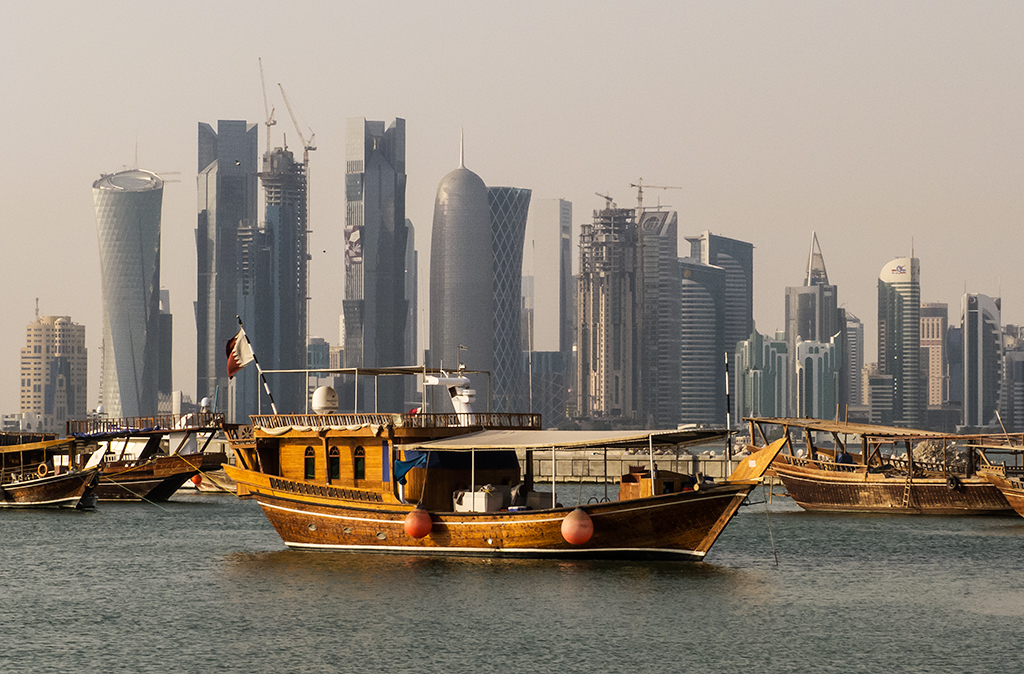
Doha has a reputation for not being the most exciting place on earth; however, should you find yourself here for a longer visit, there is a variety of activities and events. Start off with a tour of the city, which should take you about 2 hours and from there you will have a good idea of what you would like to see.
Beaches. There are well-maintained private beaches in Doha owned by hotels, which permit public access for a fee. Hotels with beaches include the Grand Hyatt, Diplomatic Club, InterContinental, Sheraton, Sharq Village, and the Four Seasons, with fees ranging from QR 180 for weekday passes to annual family memberships. Additionally, the Katara Cultural Village operates Doha's only public beach, with an entry fee of QR 100. On private beaches western swim wear is acceptable, but on public beaches women should dress more modestly (i.e. with long water shorts and t-shirts). Dhow tour. Day or evening dhow cruises can be arranged with any of the dhows docked along the Corniche. Many cruises offer meals and entertainment, and can be booked for large tours or for more informal arrangements. Doha Film Institute. Showcasing a wide range of international and art films, DFI also hosts two international film festivals, in November and in March. Films are screened at the Museum of Islamic Art and at Katara Cultural Village; tickets can be booked online. 1 Doha Golf Club, West Bay, ☏ +974 4496 0777, fax: +974 4483 4790, info@dohagolfclub.com. 06:30-23:00 daily. The only golf club open to the general public. QR 590 weekdays, QR 795 weekends (nonmembers). 2 Drag racing, 52nd St (near the intersection with E Industrial St in the Industrial Area, Al Rayyan), ☏ +974 4450 9357, +974 4469 9114, +974 4469 9358, +974 4469 9113, fax: +974 4469 3938, +974 4469 2192. Drag racing is promoted by the Qatari government on an organized racetrack so young drivers do not feel the need for crazy driving on the streets of Doha. For a fee you can race your own car, or you can watch one of the regularly-scheduled professional races. Football: Qatar hosted the 2022 FIFA World Cup and 2024 Asia Cup. The men's national soccer team don't have a fixed stadium but most internationals are played in Doha. Qatar Grand Prix: Formula One motor-racing is held at Losail Circuit, 45 km north of the city. The next are 28-30 Nov 2025 then 27-29 Nov 2026. 3 Jungle Zone, Hyatt Plaza (near Khalifa Stadium). 3500 m² of animal-themed children's attractions, Qatar's most popular indoor theme park. Kayaking, ☏ +974 3311 6249, entalek.org@gmail.com. Entalek Adventures offers guided sea kayaking trips within Doha, or further afield along coastal mangroves and secluded beaches, with opportunities for birdwatching and camping. They also conduct guided snorkeling trips, and can rent out fully-outfitted kayaks (QR 200/day). 4 Qatar Racing and Equestrian Club, Al Rayyan, ☏ +974 4480 8122, info@qrec.gov.qa. Horse racing takes place during the winter months, with races scheduled every Thursday beginning at 16:00 and lasting until about 21:00 Gambling is prohibited, but attendees can enter free raffles to guess the winning horses, with substantial prizes (including cars). These races are very popular. The showpiece race here is the HH The Amir Sword, held in February every year, one of the most prestigious races in the world for purebred Arabian horses. The Club also hosts an Arabian horse show every March; details are published in the local press. Free. 5 Sailing, Al Isteqlal Rd (West Bay Lagoon, near the InterContinental Hotel), ☏ +974 4442 4577, regatta@qatar.net.qa. Regatta Sailing Academy offers sailing courses and a range of boats for hire, including funboats, dinghies, and two 30-foot yachts. Sheesha. A typical Middle Eastern activity in the afternoons is to find a sheesha cafe and smoke some fruit-flavoured tobacco. One of the best places in Doha is Ras-Naswa at the non-Sheraton end of the Corniche. It's in a picturesque old-style building reminiscent, in colour and texture if not grandeur, of the red Mughal structures in India. Ras-Naswa has a nice outdoor garden and serves decent Middle Eastern food. 6 Al Shaqab Horse Centre (Just "Al Shaqab"), Al Shaqab, ☏ +974 4454 6320, ridingacademyinfo@qf.org.qa. 07:30-15:30. A state of the art horse riding facility and equestrian centre highlighting the importance of the Arabian horse and the detailing the history of equestrianism in the area. Varies. (updated Jul 2016) 7 Aspire Park. The largest park in Doha. Lots of grass, trees, playgrounds. Free. (updated Apr 2018)
Shopping

You can buy pretty much anything you want in Doha, apart from pork products and alcohol (except with a licence or in the major hotels). Shopping is a major leisure pursuit of many Qataris and expats; prices however are somewhat higher than in Dubai. As with in most of the Middle East, be prepared to bargain. Also, be aware that most of the luxury malls and some souks schedule "Family Days", most commonly Fridays, weekends and public holidays, where all single men should in theory be turned away at the door. In practice, however, most Qatari and white men will be allowed in with no issues, but African and non-Qatari Asian men (particularly South Asians in their native dressing) will be turned away.
Souqs
The best shopping experiences are undoubtedly to be had in the various souqs (markets).
1 Souq Waqif, Al Jasra (near the Emiri Diwan and Al Koot Fort). Daily 10:00-12:00, 16:00-22:00. Also referred to as the Old Souq, this is the best place to pick up souvenirs and rub shoulder with locals. There are good restaurants and sheesha cafes here. There are also falcon shops, and some dealers will allow you to handle and photograph them. Also worth visiting are the horse stables (near the falcon shops) and the camels (near Al Koot Fort). 2 Gold Souq, Ali Bin Abdullah St (Old Al Ghanim, near HSBC by the bus station). The place to buy gold and jewellery. The purity of gold is strictly regulated, so you can be sure of the quality. 3 Fabric Souq, Al Ahmed St (near Fanar Mosque, with the distinctive spiral minaret). This comprises three different neighboring souqs (Al Ahmed, Al Asiery, and Al Dira). Here you can choose from a selection of exotic fabrics and have clothing designed and tailored to your specifications. For a complete outfit, allow about a week or two for completion. 4 Omani Souq, Bu Hamour (near the Wholesale Market, parallel to Salwa Rd). Here you can buy things like spices, incense and woven baskets. Next door is a vegetable market.
Eat

Given the population diversity in Doha, there is a large variety of different types of cuisine, including Indian, Thai, Chinese, Italian, Korean and, of course, typical Middle Eastern food. Since Qatar is a Muslim country, all food is certified halal. Zomato is a popular restaurant review site and Talabat is a common delivery site. If you are visiting during Ramadan, keep in mind that it is illegal to eat and drink in public during daylight hours, and all restaurants, including those in hotels, are not permitted to serve dine-in customers during this period. However, some restaurants remain open to sell takeaway meals to non-Muslims that you can take back to your hotel room and consume in private. However, iftar or the breaking of the fast after sunset, is a very elaborate event, as locals gather for large communal meals. Many establishments set up large tents for iftar, and non-Muslim visitors are welcome to partake in them; just make sure you reserve way in advance due to their popularity. As Qatar is a Muslim country, nearly all food in Doha is halal. Pork is not served at restaurants, but is available to foreign residents with a liquor license at the two liquor stores run by the Qatar Distribution Company (QDC). This license is not available to tourists.
American
Most major American fast food chains have multiple branches here, including McDonald's, KFC, Hardee's, Arby's, Burger King, Subway, and Dairy Queen. Pizza places include Pizza Hut, Little Caesars, Pizza Inn, and Papa John's. Many of them are in the major shopping centres, and at Ramada Junction (the intersection of C-Ring and Salwa Rds). There are also a number of more upscale American chains, including TGI Fridays (in the Landmark, Villaggio shopping malls, Bin Omran Opposite the Civil Defense and Suheem Bin Hamad Street, Al-Sadd), Applebee's, Chili's, Fuddruckers, Bennigan's, and Ponderosa Steakhouse.
1 Ric's Kountry Kitchen, Sana Complex, Ras Abu Abboud St (southeast corner of Ras Abu Abboud St and D Ring Rd), ☏ +974 4443 7846. Serves up large classic American breakfasts, and one of the few places in Doha with real bacon and pork sausages. Yellow Cab Pizza, several branches, ☏ +974 4488 8310. 11:00-01:00 daily. This is undisputedly the most popular pizza in Doha, surprisingly offered by a well-established and efficient Filipino operation. The barbequed chicken pizza is particularly tasty. Delivery and pick-up available.
Drink

Alcohol
Alcohol is strictly regulated in Qatar, as it is a Muslim country, and for visitors is only available in bars attached to large 5-star international hotels. Bars are required to see identification (i.e. a passport) at the door, although this is rarely enforced. Residents with a special liquor license may purchase alcohol at the QDC (Qatar Distribution Company) on the outskirts of town. The importation of alcohol is strictly disallowed – all bags are scanned by x-ray upon arrival at Hamad International Airport and customs will confiscate any bottles of alcohol they find. They will issue a claims receipt, which will allow you to pick up your bottles again when you leave Qatar. Some of the places favoured by local expats are the Crystal Lounge and Waham Poolside Lounge (W Doha Hotel), Sky View Bar (La Cigale Hotel), the Belgian Café (InterContinental at West Bay Lagoon), and Trader Vic's (Hilton). The Irish Harp (in the basement of the Sheraton near City Center Mall) has frequent live music.
Tea and coffee
Karak is the local specialty, a very sweet concoction made from tea and evaporated milk available from stalls everywhere, some of them drive-through (just park your car outside and honk). A particularly popular place is Chapati & Karak (☏ +974 4408 1408) at Katara Cultural Village. Most international coffee chains (including the ubiquitous Starbucks) are well-represented here, especially in shopping malls.
1 PappaRoti, C Ring Rd, ☏ +974 4421 2001, info@papparoti.ae. Daily 12:00-00:00. This branch of the popular Malaysian café chain offers a good selection of coffee and teas, along with special roti buns.
Sleep
Compared to Dubai, which has hundreds of accommodation facilities, Doha does not offer that much variety with less than a hundred hotel properties and some other accommodations. There are quite a few 5-star international chain hotels in Doha and there are scores of new 5-star hotels on the rise, such as the Ritz-Carlton, Four Seasons, and Intercontinental. More modest choices come in shorter supply.
Budget
1 Doha B - Qatar Youth Hostels Association, 17 Al Rayyan St (behind Al-Ali market), ☏ +974 4421 7157, info@qataryha.com. La Villa Hotel, QR 130 if you book online. Includes breakfast. Victoria Hotel, QR 135 if you book online. Has a pool and gym.
Mid-range
2 Al Madina Suites, Al Nada St #42 (across from Qatar Petroleum), ☏ +974 4431 8800, fax: +974 4431 8811, info@almadinasuites.com. The hotel offers well-furnished suites all equipped with air-conditioner, Internet connection, cable TV, and coffee/tea maker. Some of its facilities are fitness room/gym, airport and city transfers, tours and excursion desk, and laundry service. Rates on official website start at QR 450. 3 Al Muntazah Plaza Hotel, Al Mansoora, ☏ +974 4435 5677, fax: +974 4435 5757, info@almuntazahplaza.com. Fully furnished 2- to 3- bedroom apartments and standard hotel rooms, on the prestigious Al-Muntazah Road convenient for the corniche, city centre, airport, supermarkets and the shopping centres. 4 Hotel Crystal Palace, corner of Al Fairouz St and Al Fayaa St (off of Al Rayyan Rd), ☏ +974 437 3331, fax: +974 437 3332. The hotel offers cozy rooms, all of which have air-conditioner, cable TV, mini-bar, and safe. Some of its amenities are Wi-Fi connectivity, health club, business centre, and laundry service. Rates on official website start at QR 239. 5 Doha Marriott Hotel, Ras Abu Aboud St, ☏ +974 4429 8888. In a slightly out of the way location, but since nowhere in Doha is really walkable, that's not a huge strike against it. It has two towers of excellent 4-star rooms and a selection of restaurants few hotels can match: the Mexican is acceptable, the pan-Asian quite good, the buffet nothing special, and the Indian really great. Alcohol is available in the restaurants, but there is no cocktail lounge or bar. There is a disco attached to the hotel that has a door policy to match Studio 54 at its 1970s' peak (again though, showing up in a Maserati will get you whisked inside). 6 Mercure Doha, Wadi Musherib St, ☏ +974 4446 2222, fax: +974 4443 9186, reservations@mercure.com.qa. A 4-star hotel belonging to the Accor group pretty much in the town centre. It has a sauna, a swimming pool and various restaurants. Shuttle buses go regularly from and to the airport. You can walk around and see things just outside the door (unlike most Doha hotels, which are someone isolated), but it is also a little less tranquil. 7 Mövenpick Hotel Doha, The Corniche, ☏ +974 429 1111, hotel.doha@moevenpick.com. 4-star hotel on the Corniche with an all day dining restaurant and piano bar. 8 Ramada Encore Doha, Ahmed Bin Mohammed Bin Thani St (intersection of A-Ring Rd), info@ramadaencoredoha.com. A comfortable 4-star hotel with a few pleasant surprises. The Indian restaurant is one of the best in town (and, because it's in a hotel, it serves alcohol). The pub on the hotel's ground floor is a large club that on weekends comes alive as a disco under the guidance of a Filipino cover band and hundreds of Asian workers letting loose after a hard 6-day work week. The Library Bar, on the hotel's top floor, has a small, slightly worn clubby field populated by large-bellied expats. But the beer is cold and the mural around the walls is something to behold. 9 Somerset West Bay Doha, Diplomatic Area, ☏ +974 4420 3333, enquiry.doha@the-ascott.com. The property offers 2- and 3-bedroom apartments. Facilities include a gymnasium, recreation room, indoor swimming pool and children’s playroom. (updated Nov 2017)
Stay safe
If you need emergency medical treatment, the government-owned Hamad General Hospital provides A&E (accident and emergency) care to everyone regardless of insurance status, and has the most advanced and best-equipped facility. Other smaller, private hospitals will charge for any emergency services. 999 is the emergency number for ambulance, police, and fire service. You will likely need to give directions or a nearby landmark. Response times in Doha are dependent on traffic, and there have been reports of long waits for ambulances, along with long waits for English-speaking operators. Medical teams however are highly skilled and all fluent in English. HMC operates A&E departments at the medical centers listed below.
1 Hamad General Hospital, Hamad Medical City, Al Rayyan Rd, ☏ +974 4439 4444. 24 hours. 2 Abu-Bakr Al-Sidiq Health Center, Furousiya St (Al Rayyan), ☏ +974 4468 1792. 3 Airport Health Center, Al Matar St (Old Airport, near Family Food Center), ☏ +974 4467 5633. 4 Umm Ghuwailina Health Center, Simaisma St, ☏ +974 4443 3892. 5 Al Rayyan Health Center, Furousiya St, ☏ +974 4481 2668.
Doha is a very safe city as far as crime goes, but exercise the usual precautions. You can call 999 if you need emergency police assistance.
Go next

8 Singing Sand Dunes. In the desert 40 km southwest of Doha are the so-called Singing Sand Dunes. This is one of 30 sites in the world with "singing" sand, once attributed to evil djinn. When the humidity is low and the wind blows along the sand, an eerie humming sound can be heard, which can be amplified by running across the sand, or by sledding down it. Large plastic bags (e.g. garbage bags) or large pieces of cardboard work particularly well for this. The dunes are a bit off road and can be tricky to find. Head SW of Doha on Salwa Rd; after about 13 km you will pass a large roundabout; after you come to the Mobil Petrol station make a U-turn and turn right on Messaieed Road. Drive past two roundabouts, then take the next right. Take the left fork at the T-junction, and you will see the dunes on your right. It is possible to make the trip in a 2WD, but a 4WD is better to get close to the bottom of the dunes. Free.
Caves
There are a number of karst caves in Qatar, the most well-known of them a short distance from Doha. All caves have not been fully explored, and it is believed that there is an extensive network of tunnels connecting many of them.
9 Dhal Al Misfir (Misfir Sinkhole) (north of Salwa Rd). The most well-known of Qatar's caves, this 40 m-deep formation contains fibrous, faintly phosphorescent gypsum crystals. There is also a resident flock of cave-dwelling Little Owls (Athene noctua). For safety reasons the site is surrounded by a chainlink fence but the gate is unlocked and visitors may enter freely. 10 Mudhlem Cave, Mukaynis (south of Salwa Rd near Earth Satellite Station). A 150 m-deep cave not far from the Misfir Sinkhole. The mouth is about 15m wide and there is a pool of brackish water at the bottom, which was once used as a source of drinking water by the local Bedouin. The cave is now a popular geocache site.
More pictures of Doha


From this destination's category on Wikimedia Commons. Each photograph is credited to its own author under its own licence.
The guide text on this page is from the Wikivoyage article Doha, written by Wikivoyage contributors and published under CC BY-SA 4.0. The authors are listed in the article’s edit history. It has been shortened and re-laid-out for this page; that adapted text is available under the same licence. Nothing else on this page is.
Wikivoyage is written by travellers, not by us. Opening hours, prices and whether a place still exists are exactly the details that go out of date, so check anything you are relying on.
“1,405 readers a month” and the ranking are ours, counted from Wikimedia’s published pageviews (CC0) — the median of twelve complete months. They count people reading about a place, which is not the same as people going there.