
Delhi
Delhi (Hindi: दिल्ली Dillī, Urdu: دہلی Dihlī, Punjabi: ਦਿੱਲੀ Dilī), India's largest city, is the country's thriving melting pot. Home to New Delhi, the country's capital, Delhi is at the centre of India's arts, commerce, education, tourism and transit. As the capital of several empires over the last 2000 years, the city contains a striking array of well-preserved historic sites for tourists to visit. Delhi is the core of the National Capital Region (NCR), one of the world's largest metropolitan areas, with nearly 30 million inhabitants in 2025.
Most read about in August, least in March. That is when people look it up, which tends to run a month or two ahead of when they go.
Before you book
The Foreign, Commonwealth & Development Office publishes the UK’s official travel advice for India. It changes without notice and travelling against it usually invalidates your insurance, so read it at the source rather than anywhere else — including here.
FCDO travel adviceUnderstand

Travellers with little experience of visiting developing megacities may find Delhi to be chaotic at its worst, crowded and for much of the year, polluted. Air pollution has been a major problem in Delhi since the 1980s, with much of the day dominated with a very unhealthy amount of particles. During the late spring and early summer months, the city is scorchingly hot. Dig a little deeper, however, and you will get a glimpse of order beneath the chaos, as well as India's traditional and modern cultural richness flourishing side by side. First-time visitors experiencing culture shock are advised not to compound it by visiting during adverse weather conditions, and get a decent hotel room so you can stay in comfort between your sightseeing trips. In addition, read up on the various scams and other uncomfortable situations travellers to India often encounter. Prepaid SIM cards for tourists are readily available at the airport arrivals hall and convenience stores. They offer generous data packages at low rates.
Name
The name "Delhi" (Hindi: दिल्ली Dillī, Urdu: دهلی Dihlī, both roughly DIHL-lee) refers to the National Capital Territory (NCT) in Northern India, whereas New Delhi is the capital city within the NCT. The NCT is also considered a city of its own, governed by the Municipal Corporation of Delhi (MCD). The modern English, Hindi and Urdu names are derived from the archaic Hindi-Urdu name Dehlī (देहली / دهلی). There has been much debate regarding the origin of that name, as well as various myths and legends. One of the most popular theories is that the name Dehlī is a corruption of the Persian word dahlīz (دهلیز), meaning "threshold" or "gateway", which is considered symbolic of the city as a gateway to the Indian Plains.
History
With evidence of continuous settlement dating back to the 6th century BCE, Delhi is one of the oldest inhabited cities in the world. Thought to have been built and destroyed eleven times, evidence of at least eight distinct settlements can still be seen in Delhi. The most well-preserved historic sites are from the periods of Muslim and British rule, between 1193 and 1947. The legendary city of Indraprastha from the epic Mahabharata is said to have been situated where Delhi now lies, but no remains of it have been found.
What's inside
For travel purposes, this article divides Delhi into seven districts. Much of Delhi's pre-colonial wonders is spread across South Delhi, South East Delhi and Old Delhi. The British first settled at North Delhi before moving to the new capital New Delhi in 1911.
Getting there

By plane
1 Indira Gandhi International Airport (DEL IATA, sometimes abbreviated as IGI). The arrival point for many visitors into Delhi. There are several security checkpoints in the airport and you may have to show your boarding pass and passport a dozen times before boarding the plane. When leaving Delhi from the international terminal, arrive three hours before the time of departure. For domestic flights, two hours should suffice, depending on whether or not you must wait in the queues to check luggage. While sometimes time-consuming, the process is smooth, and the new terminal's shops and restaurants are sensibly located at the gate area, not before security. However, if you wish to change Indian rupees back into foreign currency, you must do this before clearing security. There is a complimentary inter-terminal bus that can take you between terminals, but it requires that you present your boarding pass within the terminal and get a coupon that entitles you to travel for free on the bus. Note that unlike western airports, these buses can go into city traffic and be subject to rush hour or other reasons why you can get delayed. (updated Sep 2022) 2 Noida International Airport (DXN IATA), Jewar, Uttar Pradesh (70 km (43 mi) SE central Delhi). Due to massive growth in air travel, a new airport has been built at the southeastern outskirts of the Delhi metro area. It only serves domestic destinations as of June 2026. Sadly, the faraway airport lacks public transport, so buses and taxis are your best bet to get into the city centre. (updated Aug 2026) 3 Hindon Airport (HDO IATA), Ghaziabad, Uttar Pradesh. Serves some regional flights as a civil enclave inside an air base. (updated Oct 2025)
By bus
Buses arrive from Kathmandu and Chitwan in Nepal (36 hr+) and virtually every city in India. Although not as comfortable as the trains, buses are the only choice for some destinations, mainly those in the mountains. Delhi has three major Inter-State Bus Terminals (ISBTs): Kashmere Gate, Sarai Kale Khan and Anand Vihar. The Delhi Transport Corporation (DTC) is the major operator, but every state also runs its own buses and there are some private operators too.
4 Kashmere Gate ISBT (Maharana Pratap) (Metro Kashmere Gate, Line 1/2), ☏ +91 11 43090100, info@dimts.in. This is "the" ISBT and the largest of the lot. Buses to points north: Punjab, Haryana, Chandigarh, Garwhal, Rajasthan, Himachal Pradesh, Jammu and Kashmir and Nepal 5 Sarai Kale Khan ISBT (Vir Hakikat Rai) (next to Hazrat Nizamuddin railway station). Buses to points south, (Agra, Madhya Pradesh) 6 Anand Vihar ISBT (Swami Vivekanand) (On the east bank of Yamuna, M: Anand Vihar). Buses to points east (Lucknow, Kumaon) 7 Bikaner House, Pandara Rd, New Delhi (metro: Central Secretariat 2 6 ). Buses, including air-conditioned Volvo buses from Jaipur arrive at this place. For travel between Jaipur and Delhi, this bus stop is very clean, less crowded than ISBT, and easy to reach. 8 Majnu ka Tilla, New Aruna Nagar, (Tibetan colony, a short rickshaw ride from Metro Vidhan Sabha). Buses to Dharamsala
Getting around

Getting around Delhi is always an adventure. Traffic is, by and large, horribly congested and many drivers will think nothing of quoting ten times the going price to a tourist. Use the prices below as broad guidelines and agree on prices before setting off. The best way to travel is via metro, where there are separate cabins for women (which prove to be very useful during rush hour). Metro is clean, efficient, and typically ridden by relatively affluent middle-class students or commuters en route to/from work; there is almost nowhere in the city that you cannot get to by metro.
By metro
The fast-growing Delhi Metro network provides a cheap, quick, mostly hassle-free and air-conditioned way of zipping around the city, although its increasing popularity means that rush hour crowds at key interchanges are starting to resemble Mumbai. As of 2026, there are 9 lines operational with 12 branches spanning over 370km and 271 stations:
Red Line 1 : Dilshad Garden–Rithala Yellow Line 2 : Samaypur Badli–HUDA City Centre Blue Line 3/4 : Dwarka Sector 21–Noida Electronic City Blue Line branch: Yamuna Bank–Vaishali Green Line 5 : Mundka–Inderlok Green Line branch: Ashok Park Main–Kirti Nagar Violet Line 6 : Kashmere Gate–Ballabhgarh Orange Line Airport Express : New Delhi–IGI Airport–Dwarka Sector 21 Pink Line 7 : Majilis Park–Shiv Vihar Magenta Line 8 : Krishna Park Extension –Botanical Garden Grey Line 9 : Dwarka–Dhansa Fares range from ₹10-60, just buy a token, change lines as necessary, and deposit the token in the slot as you exit. Tokens can be used only from the station they are bought, so you can't buy two and use the second to return home. If you're planning on sticking around for a while, you can buy a "Smart Card" for ₹200, which is worth ₹150 and includes a ₹50 deposit; using this saves 10% and, more importantly, lets you avoid the queues. There is also a "Tourist Card" allowing unlimited use for ₹150 (1 day) or ₹300 (3 days), but it's highly unlikely that you'll travel enough to make this pay off. Special fares apply for travel on the Airport Express. During rush hour, you might have to queue up for more than 20 minutes due to security checks, especially in the central stations. The Yellow Line, in particular, is useful for getting to the Delhi Junction (Chandni Chowk, Jama Masjid) and New Delhi railway stations, the ISBT bus terminal, the backpacker ghetto of Paharganj, Hauz Khas and Qutub Minar. The Blue Line is also handy for visiting Akshardham, Botanical Garden and accessing the western parts of Paharganj through RK Ashram Marg station. The Magenta Line is also useful for getting to the Terminal 1 of Delhi Airport and visiting Hauz Khas, Lotus Temple, Okhla Bird Sanctuary and Botanical Garden. The first coach in every train is reserved for women only; violations incur a penalty. Male passengers accompanying women or girls are forbidden, too. Be aware that if you wish to exit at a main station during rush hour, you will have to tackle your way through in order to get out before the opposite flow of passengers push you back inside. Don't be afraid of using your strength to push yourself out.
See
Individual listings can be found in Delhi's district articles Delhi is known for its impressive range of structures — fortifications, mosques, and tombs — built during the centuries when Delhi was the centre of large Muslim empires. There are dozens of notable sites scattered around the city, and several of them are internationally famous as UNESCO World Heritage Sites. Detailed listings of all sights in Delhi can be found in the district articles. The most visited sites are the Red Fort (the 17th century palace of the Mughal emperor), the Jama Masjid (a vast and beautiful 17th century mosque), the Qutb Minar (a 73-meter high tower, dating to the 13th century but still with well-preserved intricate carvings), Humayun's Tomb (the vast 16th century tomb of the Mughal emperor Humayun), and the Purana Qila (a 16th-century Mughal citadel). Newcomers often confuse between Delhi and New Delhi. In fact, New Delhi, the capital of India, is a city within the Delhi metropolis. New Delhi was built in 1911–12 under the British rule. Being centrally planned in the modern era, it features wide boulevards, large parks, and roundabouts between its government buildings. Popular sights here are the India Gate, the Kartavya Path "national mall" connecting the main government buildings, and Rashtrapati Bhavan (presidential palace). Many of the most important museums in Delhi are located here too. Another popular attraction is the Bahá'í Lotus Temple in the South East, a modern structure built with a flower-like shape. It is one of the most visited buildings in the world. The Akshardham is another such attraction in East Delhi.
Do

Individual listings can be found in Delhi's district articles
You can find many major sports venues in Delhi such as the Arun Jaitley Cricket Stadium, the Ambedkar Stadium for football and the Indira Gandhi Arena - one of Asia's largest indoor arenas in the southeastern corner of Central Delhi. A bit further south is the Jawaharlal Nehru Stadium, home to the national football team and the venue for major sports events in the city.
Events
The Republic Day Parade at Kartavya Path in New Delhi is worth watching. It begins on Republic Day in 26 January and lasts for three days. The parade begins with the flag unfurling of by the President. This is followed by marching from several military regiments along with their bands, and tableaux from various states signifying their cultures are displayed. They march from the Rashtrapati Bhavan on the Kartavya Path to the India Gate. After that, they march north to the Red Fort in Old Delhi. A beating retreat ceremony signifies the end of the parade. During the Independence Day on 15 August, the flag of India is hoisted at the Red Fort, and the Prime Minister addresses the nation. This includes the past year's achievements, current challenges and call for further development. The speech is followed by a march past of the Indian military. Parades and pageants showcase scenes from the independence struggle and India's diverse cultural traditions. The airspace around the Red Fort is declared a no-fly zone during that day. The New Delhi World Book Fair is India's second-oldest book fair. It is held on mid-January at Bharat Mandapam in South East Delhi.
Shopping

Individual listings can be found in Delhi's district articles
If you're not afraid to haggle and bump elbows in bazaars, Delhi is a great place to shop. Most of the well-known bazaars are located in the most central parts of Delhi, both Old and New Delhi. Western-style malls are plentiful and are found further south—in South Delhi and South East Delhi, as well as the satellite cities of Gurugram and Noida. Many shopping districts are overcrowded on Saturdays and closed on Sundays.
Clothing
Delhi is a shoppers' paradise when it comes to clothing. From centuries-old bazaars selling traditional fabrics and bridal wear to trendy street markets and luxury malls with international labels, travellers can find almost any style here. Bargaining is common in street markets, while fixed prices are the norm in malls and branded stores. If you're looking for ethnic wear, Chandni Chowk can be a good place with historic lanes filled with sari and lehenga shops, ideal for weddings and festive attire. In Karol Bagh you can find affordable salwar kameez, saris, and everyday Indian wear. If you prefer to shop at a chain store, look for FabIndia with multiple outlets around Delhi. They have high-quality handloom cottons and silks in elegant, contemporary cuts. For Western wear, some options include the Sarojini Nagar Market, famous for trendy, fast-fashion style clothing at bargain prices and the Janpath Market for youth-oriented clothing and accessories, with a bohemian touch. The Select Citywalk Mall (Saket) is a popular mall featuring both Indian and international fashion brands. There are also some options if looking for both Indian and western clothing. The Lajpat Nagar Central Market is a blend of ethnic and Indo-western outfits at mid-range prices. Shahpur Jat features designer boutiques offering fusion fashion, popular with young professionals. Also, the state-run handicraft market Dilli Haat sells regional textiles, kurtas, and unique handmade clothing.
Eat

Individual listings can be found in Delhi's district articles
Delhiites complain about many things in their city, but the food will satisfy even the most demanding gourmet. Not only can you find some of the best Indian food on the subcontinent, but there is also an increasing number of excellent (if often pricey) international restaurants offering cuisine from around the world. When ordering, do remember that Delhi is about 1,000 km from the nearest ocean, so vegetarian, chicken and mutton dishes are the way to go. Do visit Paranthe Wali Gali in Chandni Chowk. This street has shops that make and sell solely parathas (stuffed Indian bread). Delhi has arguably the best street food in India. However, do not eat unhygienic or open food. There are plenty of restaurants offering street food in a potentially more hygienic environment. You can join local groups of foodies who go out regularly to sample and savour what new and old dishes the city has to offer. If you want a fully customized food tour tailored specifically for you, then Food Tour In Delhi is a good choice. The guests can explore the street food of Delhi in a fun and safe manner. Their tours cover food joints which are in business for 50 to 120 years and serve some of the best street food in the world. The tours cover winding streets of Old Delhi as well as swanky upscale markets located all over the city. The food tours are led by chefs and culinary experts with extensive experience and offer facilities such as pickup and drop, unlimited food which covers all major varieties of food available in the city. Another one of the most active groups is Food Enthusiasts of Delhi. They organize regular food walks, better known as Raids to various parts and joints in the city. It's a non-commercial group, brought together by their passion and love for food.
Drink
Individual listings can be found in Delhi's district articles Delhi's nightlife scene has changed since the beginning of the millennium. There are plenty of modern, cosmopolitan places to separate you from your rupees. In a desperate attempt to keep the sex ratio vaguely equitable, many lounges and clubs have couples only policies (that is, no single men or men-only groups), enforced with varying degrees of strictness. While everything is supposed to shut down by 1AM, things can keep going much longer. The coffee culture in Delhi consists mostly of large, heavily standardised chains. The two most common, Barista and Cafe Coffee Day, can be found in multiple locations across the city, most notably around Connaught Place. The UK-based Costa Coffee and the US-based Starbucks have also made a foray into the market. For listings of independent coffee shops, see the district articles.
Sleep
Individual listings can be found in Delhi's district articles Prices quoted may not include taxes of up to 22.5%, calculated based on the published rack rates - not necessarily the price that you actually pay, which could be discounted. Smoking is not allowed in Delhi hotels.
Budget
Delhi has plenty of budget accommodation options, priced from ₹400-2,500. Many of them are in the city centre, while others are further south, in the affluent southern areas or towards the airport.
Mid-range
Delhi's chronic lack of quality hotels has led to a mushrooming of guest houses of widely varying quality and price. The new official 'Delhi Bed and Breakfast scheme' has also contributed a range of private rooms available for bed & breakfast accommodation. These rooms range from cheap dumps to classy rooms in the best areas of Delhi.
Stay safe
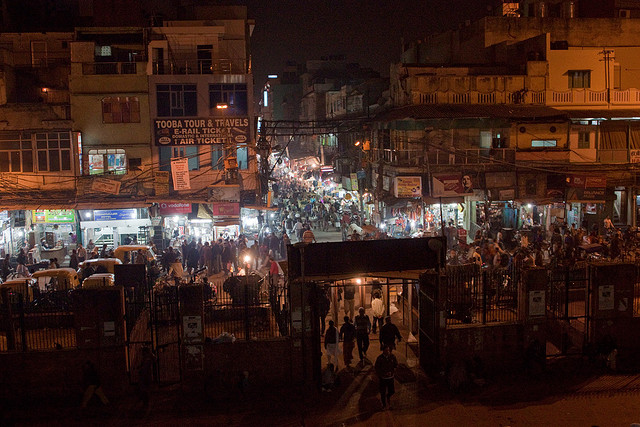
Many first-time travellers to India find themselves falling victim to scams and touts, and unfortunately Delhi has a lot of both. Be on guard for anybody trying to help you by giving you unsolicited directions or travel advice. Do not blindly rely on the advice of taxi and auto drivers. If this is your first time to India, do not openly admit it, as this will make you more vulnerable to touts. Delhi is very unsafe for women travellers, and is among the three most unsafe cities for women in India. It is considered as the 'rape capital of the world'. It is not uncommon in some areas to receive lewd remarks or even physical touching. If you are arriving into Delhi for the first time at night, stay in either the airport or station lounge, or well-lit areas until daybreak if you haven't booked a hotel yet. Never use public transport, or travel outside your hotel during the night, to avoid sexual harassment. Dress conservatively (preferably in Indian clothing so as to blend in). Learn to shout and consider carrying mace/pepper spray. It is recommended to walk with a male that you know, to avoid this. Carry your cash, passport, and cards in a secure money belt, with only enough cash for a few hours at a time in your wallet or other accessible place. Some recommend carrying an expendable wallet with a few ten rupee notes in it in an obvious place such as your hip pocket as a decoy to Delhi's ubiquitous pickpockets. Several tourist agencies have been known to swindle tourists, such as by changing their travel plans or charging them extra commissions and fees. You should book your flight tickets online, as all the airlines have online booking systems. Otherwise, prepare to spend a good hour sorting through the charges that the tourist agency will charge. The best way to secure train tickets is by navigating through IRCTC website. If you have problems booking online - the IRCTC site is unreliable - you can buy tickets in person. The best place to do so is at the Tourist Information Centre, these are within transit hubs. Be very careful, there are many scammers surrounding the railway stations looking for anyone on foot and out-of-place who will "help" you find a "ticket office for foreigners", usually in a nondescript building some blocks from a station, where you will be overcharged and cajoled into signing up for cars, tours, etc. When in doubt, look at reviews for the information centre you are at (for example, on Google Maps). Some scammers will stand at the entrance to the station and physically try to block you from entering, demanding to see your tickets (never mind that you need to enter the station to buy tickets!). Remember - you should be able to enter any station just by going through a metal detector. Nobody will check your tickets before you get on a train (As a measure to control crowding at stations, many stations may require you to purchase a platform ticket (usually costing only ₹10-20) if you are just visiting and do not have a railway ticket with you. If arriving late at night at the airport or railway station, be very wary of taxi drivers trying to scam tired and unprepared tourists. A common scam is to drive you an area where there are roadworks or a roadblock, and tell you that the path to your hotel is blocked off and it's not possible to take you there. They'll then suggest to take you to another hotel, where they receive a commission for bringing customers. They may take you to a number of hotels first which all say they are full up, so as to increase your desperation and make you pay more. There have been reports also, of bringing tourists to a "travel agent", who will feign ringing your booked hotel to confirm that either the way is blocked, or they are overbooked and there is no room available. If you've let on that you were only staying in Delhi for the night, they may also try to convince you, that there are no hotel rooms available anywhere, and sell you an extremely overpriced private car ride to your next destination. This can be a very confusing and tiring process if you've just come off a long flight. If you're arriving after midnight, it is therefore highly advisable to have accommodation pre-booked and arrange pick-up from the airport or station with your hotel, or at least have the phone number with you, so that should you get lost or caught in a sticky situation you have someone reliable to call up. Practically everyone who handles your cash in Delhi will shortchange you, including the clerks at the police taxi kiosk at the airport and ticket sellers at historic sites and museums. It will be your word against theirs, so the only protection is to just not need change. Learn the money as soon as possible. Count out the smallest sum you can produce that is at least the price you need to pay. If they claim you didn't pay what you actually paid, write the cash off, walk away, and go somewhere else.
Delhi Police
The Delhi Police (DP) is the police force serving the Delhi metropolis. Some police officers may be corrupt and unhelpful. Police vehicles (called PCR vans) are parked on almost every major intersection.
Summer begins in early April and continues till the end of June, with the heat peaking in May. By the latter part of April or during early May. The temperatures regularly exceed 40 °C (104 °F), meaning that proper hydration is of the utmost importance. Keep yourself covered in summer to avoid heat stroke. Drink a lot of water — around 3 litres a day — particularly in the summer. Keep in mind that the water is almost always purified by reverse osmosis (RO), so it is low on electrolytes (dissolved minerals). You could dissolve some ORS into your water, or just eat a snack now and then. Winter arrives in Delhi by late November or early December and continues till mid-February. In winter there can be seasonal fog; on particularly foggy days, it can be difficult to see across the street. If you are flying in or out Delhi during the winters, be aware of fog-related flight delays. Drink only packaged bottled water to avoid water-related illness. Sticking to freshly- and well-cooked food will lessen your chances on acquiring the "Delhi belly". Delhi is one of the most polluted cities in the world, with pollution levels often in the "poor", "severe", or "hazardous" range. Keep an eye on air quality data. Air quality is especially bad around the crop burning season, which begins in late September and extends towards early November. Consider wearing a surgical mask or other approved N95/N99 mask, especially if spending an extended time in Delhi or North India. For travellers with significant respiratory problems, a P100 mask isn't overkill, though remember that wearing rubber masks will often cause skin irritation if worn for prolonged periods in high heat and humidity. Some high end hotels have built in air filtration systems, and the additional expenditure may be worth it.
Go next

Delhi is a major international transit hub for trains, planes and buses as well as a great connection point for domestic destinations within India. It's also a great base for exploration of the famous hill stations.
Nearby
Agra and the Taj Mahal are a 3-6 hr drive or 2-5 hr train ride each way. By road, the Taj Mahal can be reached in 3 hrs through Yamuna Expressway from Delhi. Book tickets in the train cars with seats far in advance, and look for the seats set aside especially for tourists. You can also rent a car and driver for the day and shouldn't pay more than ₹5,000 roundtrip. The Taj Mahal is closed on Friday. Jaipur and Rajasthan are reachable by plane or overnight train. As of 2026, the fastest trains make the journey to Jaipur in about 4 hours. Gurugram (Gurgaon) a southern satellite city, is a 1 hr drive or a metro ride away. The small Sultanpur National Park is described as a birdwatcher's paradise. There are a few daily trains from Delhi to Farrukhnagar stopping at Sultanpur station a couple of kilometres west of the park. It's also possible to take a Delhi metro train or bus to Gurugram and a taxi from there. Sariska Reserve and National Park, about 200 km west of Delhi is famous as a tiger reserve. Take the train (2-3 hours) or bus to the nearest major city, Alwar, and from there bus or taxi. Vrindavan an important Hindu pilgrimage destination related to Lord Krishna, reachable by rickshaw from Mathura (which is 2-3 h by train from Delhi towards Agra)
Further away in India
Bandhavgarh National Park and the Bandhavgarh Fort are the tiger reserves in Madhya Pradesh. This is a tiger preservation project and has the highest density of tigers in India. Char Dham of Uttarakhand - Delhi is the starting point of the famous pilgrimage centres of the Himalayan state: Badrinath (the abode of Vishnu), Kedarnath (the abode of Shiva), Gangotri and Yamunotri (the origin of sacred rivers Ganges and Yamuna respectively). Corbett National Park, the first national park of the country, is around 5 hours' drive from Delhi Dharamsala, the seat of the Dalai Lama's government-in-exile, is 10-12 hr to the north. Tickets can be purchased from Main Bazaar tourist offices, Majnu ka Tilla Tibetan settlement or the ISBT. Ride the Maharajas' Express, a luxury train running between Delhi and Mumbai. The holy cities of Haridwar and Rishikesh, in the foothills of the Himalayas, are a 5-6 hr bus or train ride away. Mussoorie - one of the original British hill stations in India; also known as The Queen of the Hills. Nainital - another beautiful hill station in the Kumaon hills with the magnificent Naini Lake. Shimla - the summer capital of British India, now the state capital of Himachal Pradesh. It has many scenic and historic locations and is about an 8 hr drive or 10 hr in a bus. A direct flight from Delhi takes just 1 hr to reach Shimla.
More pictures of Delhi


From this destination's category on Wikimedia Commons. Each photograph is credited to its own author under its own licence.
The guide text on this page is from the Wikivoyage article Delhi, written by Wikivoyage contributors and published under CC BY-SA 4.0. The authors are listed in the article’s edit history. It has been shortened and re-laid-out for this page; that adapted text is available under the same licence. Nothing else on this page is.
Wikivoyage is written by travellers, not by us. Opening hours, prices and whether a place still exists are exactly the details that go out of date, so check anything you are relying on.
“3,007 readers a month” and the ranking are ours, counted from Wikimedia’s published pageviews (CC0) — the median of twelve complete months. They count people reading about a place, which is not the same as people going there.