
Cairo
Cairo (pronounced KY-roh; Arabic: القاهرة al-Qāhirah) is the capital of Egypt (until the New Administrative Capital is completed) and, with a total population of Greater Cairo metropolitan area in excess of 16 million people, one of the largest cities in both Africa and the Middle East (the regions which it conveniently straddles). It is also the 19th largest city in the world, and among the world's most densely populated cities. On the Nile river, Cairo is famous for its own history, preserved in the fabulous medieval Islamic city and Coptic sites in Old Cairo — with historic Cairo inscribed on the UNESCO World Heritage list. The Egyptian Museum in the city centre is a must see, with its countless Ancient Egyptian artefacts, as is shopping at the Khan al-Khalili bazaar. No trip to Cairo would be complete without a visit to the Giza Pyramids and to the nearby Saqqara Pyramid Complex, where visitors will see Egypt's first step pyramid built by the architect Imhotep for the third dynasty pharaoh Djoser. Though firmly attached to the past, Cairo is also home to a vibrant modern society. The Midan Tahrir area situated in downtown Cairo, built in the 19th century under the rule of Khedive Ismail, has strived to be a "Paris on the Nile". There also are a number of more modern suburbs including Ma'adi and Heliopolis, while Zamalek is a quiet area on Gezira Island, with upmarket shopping. Cairo is best in the autumn or spring, when the weather isn't so hot. A felucca ride on the Nile is a good way to escape from the busy city, as is a visit to Al-Azhar Park.
Most read about in July, least in February. That is when people look it up, which tends to run a month or two ahead of when they go.
Before you book
The Foreign, Commonwealth & Development Office publishes the UK’s official travel advice for Egypt. It changes without notice and travelling against it usually invalidates your insurance, so read it at the source rather than anywhere else — including here.
FCDO travel adviceUnderstand
Cairo is on the Nile, and has ancient origins in the vicinity of the Pharaonic city of Memphis. The city started to take its present form in 641 CE, when the Arab general Amr Ibn Al-Ase conquered Egypt for Islam and founded a new capital called Misr Al-Fustat, "the City of the Tents". The legend is that Al-Ase, on the day he was leaving to conquer Alexandria, found two doves nesting in his tent. Not wanting to disturb them, he left the tent. Upon returning victorious, he called his soldiers to pitch their tents around his, and this became the site of the new city in what is now Old Cairo. The name may have been a pun – Misr/Masr is the Arabic word for city, but it is also the Arabic name of the entire country of Egypt. The Tunisian Fatimid dynasty captured the city in 969 CE and founded a new city, Al-Qahira ("The Victorious") just north of Al-Fustat. Al-Qahira gave the city its English name, Cairo, but the locals still call it MàSr (مصر), which is also the Arabic name of the entire country of Egypt (similar to Mexico City in Mexico).
Climate
See also: Egypt#Climate
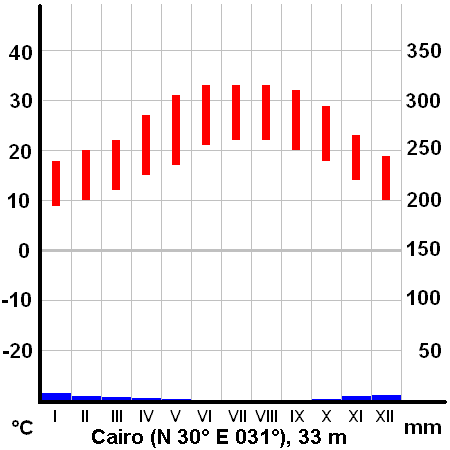
The best time to visit Cairo is during the winter from November to March, when daytime highs mostly stay below 26°C (79°F), with night time lows around 10°C (50°F) with occasional rain showers clearing the air, but still, you do not need an umbrella, even the rainiest months of the year rarely top 10 mm (0.4 in). If visiting during winter, be aware that not all buildings are equipped with heaters, including some hotels and hostels. Visitors should always pack a few warm jumpers (sweaters) and a warm jacket for evening wear. In Cairo, in indoor buildings without air-conditioning, temperatures are about 15°C (59°F) in the coldest winter days and about 34°C (93°F) in the hottest summer days. The brief spring from March to May can be pleasant as long as there are no sand storms, but summer temperatures, on the other hand, can reach a searing 38°C (100°F). In September and October, the period of late summer and early autumn, farmers burn rice husks to ash after sunset near Greater Cairo and this makes the air smokey.
What's inside
Greater Cairo is vast; with more than 20 million people (2018), it's the largest metropolitan area in Africa and the Middle East.
Getting there

For more information on visa requirements, see the Egypt article.
By plane
Cairo International Airport (CAI IATA), in Heliopolis, to the northeast of the city around 15 km from Cairo's city centre – The busiest airport in Africa with more than 16 million passengers per year, it is also the largest in Egypt and is the main hub for the flag carrier EgyptAir and Nile Air as well as several other airlines and the primary entry point to the country.
Other airports
Borg el Arab (HBE IATA) near Alexandria has far fewer flights and poor ground connections. 1 Sphinx International Airport (SPX IATA). As of 2025 it is served mainly by budget airlines, including Air Arabia, Air Cairo, Condor, EasyJet, Edelweiss Air, Flydubai, Flynas, Jazeera Airways, Norwegian Air Shuttle, Pegasus Airlines, SalamAir and Wizz Air. (updated Jun 2024) 2 Capital International Airport (CCE IATA). The airport in the New Administrative Capital sees very limited flights. As of 2025 it has only seasonal charter services operated by Smartwings. (updated Jun 2025)
Getting around
You will find that it's useful to have several maps handy if you are looking to get around Cairo on your own. Spellings of street and place names can vary from map to map and from map to actual location, and not every street will appear on every map.
By metro
Cairo is home to Africa's first and largest metro system. While modern and sleek, the three lines are all too limited in scope. As of October 2024, a single trip ticket ranges from LE8-20, depending on the number of stations covered:
LE8: up to 9 stations (yellow ticket) LE10: 10-16 stations (green ticket) LE15: 17-22 stations (purple ticket) LE 20: more than 23 stations (beige ticket) It is a crowded subway, but no more than Tokyo, Paris or London. If you are used to the metro in big cities and/or can deal with the crowding (be extra careful to avoid pickpocketing), it is the best way of avoiding traffic jams while travelling. The key interchanges are Shohadaa (Martyrs) (formerly Mubarak) at Midan Ramses, Sadat at Midan Tahrir, and Attaba (Ataba; عتبة). You'll need to be assertive (but not stroppy) when trying to buy tickets - Egyptians don't queue. First get your small change ready in a quiet area, so you're not fumbling with wallet and big notes and dropping your passport amidst the crowd. Then steadily press through the crowd to the ticket window, as they are doing. If you intend to make a return or future trip, buy multiple tickets, so you only have to scrummage once. There are ticket vending machines available, though sometimes they're low on change. The Cairo Metro has stations in Dokki and Maadi, among other places. To reach the Giza Pyramids, take the metro to Giza town then pick up a bus or taxi for "Al-Haram". You can also reach Heliopolis (Masr el-Gedida) using line 3, at the stations: Al Ahram (Korba) and Koleyet El Banat (Merghani). The extension of this line to the airport was due in 2020 but still isn't finished yet. As of June 2025, line 3 has one branch ending in Adly Mansour. The station to the airport is still under construction. Two cars in the middle section of each train are reserved for women. One of them is for women only till 9PM, while the other is for women all the time. The metro stops running at around 12:20AM and starts up again around 5:15AM. There are no timetables for lines 1 and 2, but departures are very frequent. Line 3 runs every 8 minutes.
See

Cairo is a vast metropolitan cityscape. It includes an array of modern skyscrapers, mosques, bazaars and ruins of associated ancient monuments outside the city. Cairo has an overwhelming array of attractions, listed under their individual districts along with transport and other practicalities. Some highlights:
Pyramids of Giza and the Sphinx. The oldest and only surviving monuments of the Seven Wonders of the Ancient World, it is the country's most famous tourist attraction. See it now before the hordes return. 1 Grand Egyptian Museum (المتحف المصري الكبير al-Matḥaf al-Miṣriyy al-Kabīr), El Remayah Square, Cairo-Alexandria Desert Road, Giza (2 km northwest of the Pyramids), ☏ +20 235317344, tourism_info@easwaaqmisr.com. 09:00-18:00, W and Sa 09–21. The Grand Egyptian Museum is the primary replacement for the venerable Egyptian Museum in Midan Tahrir, with much bigger exhibition, storage and workplace areas. Not to be confused with the Egyptian Museum or the Museum of Egyptian Civilisation. The main galleries cover Egyptian history from prehistory to the Greco-Roman period. The highlight is the Tutenkhamun gallery. At least four hours are needed to see the whole museum at a comfortable pace. LE1490. (updated Apr 2026) 2 Egyptian Museum (250 m north of Tahrir square), ☏ +20 2 25796948. Much of its collections were moved to the Grand Egyptian Museum in 2022. Adult 550 LE, student: 275 LE; photography (personal use) free; video 300 LE. (updated Oct 2025) Citadel and Mosque of Mohamed Ali Pasha, in Islamic Cairo. A grand castle built by Salah Al-Din. Also parts of the water pipes (Majra Al-Oyouon) are still there, these pipes used to carry the water from the Nile River to the citadel. Mohamed Ali is considered to be the founder of modern Egypt, the ancestor of the last King of Egypt, King Farouk. Al-Azhar Mosque. One of the pillars of Islamic thought and home to the world's oldest university. 3 National Museum of Egyptian Civilization (NMEC). Daily 9AM-5PM. A relatively small museum, with a main hall, a textile hall, and a Royal Mummies Hall. The main hall covers Egyptian culture including prehistory, the dynastic period, Greco-Roman period, Islamic period, the modern and contemporary era, as well as exhibits of Coptic art and traditional art. The highlight is the underground hall of mummies. LE550 (students LE300). (updated Oct 2025) Ibn Tulun (مسجد أحمد بن طولون) (close to Sayida Zeinab). Arguably the oldest mosque in Cairo, built between 868-884. The Coptic Quarter, in Coptic Cairo, notably the museum and the "Hanging Church" (Church of the Virgin Mary) Cairo Tower (185 m./610 ft.) on Gezira Island offers a 360-degree view of Cairo, along with the Giza Pyramids off in the distance to the west. 4 Al-Azhar Park. A landscaped garden overlooking the Citadel 5 Khan El Khalily. Cairo's souk area where visitors will find many merchants selling perfume, spices, gold, Egyptian handicrafts. 6 Abdeen Palace. About 1 km east of Midan El-Tahrir, it was the royal residence until the Egyptian monarchy was deposed in 1952. (updated Jan 2018) Pharaonic Village. Welcome to Egyptland! Especially if you've kids in tow, this showground and retail park will give you an instant Egypt-in-miniature. In Giza about 20 minutes drive from Downtown. (updated Jan 2018)
Further afield
7 Dahshur Pyramids. For a contrast to touristy Pyramids of Giza, head south to the oldest known pyramid, the Red Pyramid. The neglected Dahshur Pyramids are interesting and worth a visit, considering its history and the hassle-free atmosphere. Also, see the weird Bent Pyramid there and hike around the area to the Black Pyramid. The Red Pyramid has an entrance to the inside, which you can climb down. (updated Jan 2018) Also, the pyramids of Saqqara and Memphis offer an easy day trip out of Cairo.
Do
Coffee and shisha
Have a coffee, mint tea or Cola at El Fishawy's coffee shop in Khan El-Khalili. Smoke a shisha water pipe (try the "double apple" flavor) and watch the world go by. Great cheap entertainment.
Felucca
Ride a felucca along the Nile River. A great way to relax and enjoy a night under the stars in Cairo. Feluccas are available across from the Four Seasons Hotel in Garden City. Pay after your ride, or you may get much less than you bargained for. Public boats with loud noisy music and a giggling crowd are also available for 1/2 hour, but are very uncomfortable.
Parks
Cairo has a shortage of parks, but a few of them exist.
Shopping

ATMs are found in various places throughout downtown. A more secure option are the ATMs in the five star hotels. There also are numerous places that handle currency exchange, or you can try any major bank such as HSBC or Commercial International Bank. Foreign currencies can also be exchanged for Egyptian pound in all the Egyptian banks like Banque Misr, National Bank of Egypt, Banque de Caire, Arab African Bank, the United Bank, or the large branches of Bureau de Change. Many merchants will try to scam you out of as much as they possibly can. A particularly common trick are the papyrus museums. They come in many different flavours, but they often call themselves galleries, museums or workshops. You will be given a brief talk or demonstration on how papyrus is made, and warned against cheaper shops that make their papyrus from banana leaf (though no matter where you go, no one has a sample to show you, questioning the legitimacy of this "warning"). The prices will be in the hundreds, and you will be offered what appears to be an excellent discount. If you look around, however, you will see most of what they offer is worth very little. Tour guides, taxi drivers and hotel staff are all in on this, and will often get a 50% commission if they lead an unwitting tourist into this trap.
The Khan El-Khalili bazaar is a giant souq in Islamic Cairo. The merchants here are ravenous and skilled, so don't fall for the hard sell and be prepared to haggle. This is a great place to buy rustic glassware and perfume bottles. Be choosy. Zamalek has a number of small, but high-end shops, along with shops selling crafts, jewelry and other items. Fair Trade Cairo in Zamalek is a great shop selling high quality crafts made by local artisans. Nefertari, also in Zamalek, has wonderful organic cotton linens, skin care products, and the like. There is also Nomad, that has a small, charming second floor showroom in Zamalek, as well as Nagada, and Khan Misr Taloun. Diwan, in Zamalek, is a very nice primarily English-language bookstore. Midan Talaat Harb and surrounding streets, including Talaat Harb Street, are home to countless shops, selling everything from shoes and books to sweets. The Midan Ataba area in Downtown Cairo is home to large bookseller markets, where you can find inexpensive books, as well as electronics and clothing markets, but be aware of the over crowding, as it is easier to pickpocket.
Eat

Individual listings can be found in Cairo's district articles Cairo has an enormous number of restaurants, catering to most needs. Ironically though, one may want to avoid any restaurants listed in popular guidebooks. Egyptian restaurants have a habit of after being listed, cooking up a special English menu with vastly inflated prices. That said, cheap food can be found everywhere in street restaurants and snack stalls. The top notch restaurants are often, but not always, found in hotels and Nile boats. The borders between restaurants and cafes are not crystal-clear in the Egyptian capital. In many places it is perfectly acceptable to just have a drink or sheesha. Medium and high-range outlets might have a minimum charge. Cheaper restaurants will normally not serve alcohol as well as some more expensive outlets. In general, downtown is good for budget eating, while for higher quality eating you should head to Zamalek, Mohandiseen or any of the other more affluent parts of town.
Egyptian and Middle Eastern food
Traditional Egyptian staples are available almost everywhere. In stalls and street restaurants you will find traditional dishes like fūl (bean paste), falāfel, moussaka, koshari (rice, macaroni, lentils, chick peas and tomato sauce), feTīr (pancakes with different fillings) and shawarma (an import from Lebanon and Syria — pieces of roasted meat usually wrapped in bread). Cheaper places will only serve up vegetables and maybe beef hot dogs or corned beef. Eggs, fried potatoes and salads are also usually available. Hygiene varies wildly and the best advice is to go for the most visited places. Avoid empty restaurants as the food will be less fresh. Especially downtown, you can find many good koshari shops, including many outlets of the excellent Koshari Tahrir chain. Delicious and cheap fūl, falāfel, and shawarma sandwiches can be bought at the many outlets of popular Gad fast food chain dotted around Cairo. In the medium and upper price range your choice of traditional Egyptian food will be more limited. Although the situation is improving, traditionally Egyptian gastronomical experiences are still mostly restricted to private homes. Quality chain restaurants like Felfela (several outlets), Abou El Sid (Zamalek, Maadi and Dokki), Cairo Kitchen (Zamalek and Maadi), and Abou Shakra offer authentic Egyptian food. Otherwise oriental or Middle Eastern restaurants tend to mix styles or completely go for more Lebanese-style eating, considered more stylish by rich Cairenes. The good side of this is that Cairo is blessed with many quality Lebanese outfits, from chains like Dar Al-Qamar to stylish restaurant establishments. Additionally, Turkish food and restaurants catering to Gulf visitors can be found.
Western and Asian food
Cairo has a number of Western fast food outlets available. McDonalds, Hardees, Pizza Hut, and KFC are spread about the city, but they are relatively more expensive. Most of these also offer free wireless internet. Lighter meals like sandwiches and salads as well as pastries can be found in western-style bakeries and cafes. Popular chains like Cilantro, Beanos and Costa as well as individual outlets all offer more or less similar dishes. Most of these places also offer free wireless internet. Maison Thomas has several branches throughout Cairo, including Mohandiseen, Zamalek, and Maadi, and serves some of the best pizza in Cairo. If you prefer more stylish international dining, Cairo offers a wide variety: Italian, Chinese and Japanese outlets in addition to the ambiguous continental cooking abound, especially in areas like Zamalek, Mohandseen and Dokki.
Drink

Individual listings can be found in Cairo's district articles
Cairo has a wide range of drinking options from the very traditional to fashionable and modern. At the other end of the scale, almost any street in Cairo has a traditional coffee house, ´ahwa, a traditionally male institution of social life tracing many hundreds of years back in history. Besides that you'll find everything from fruit stalls to patisseriés and bakeries and modern cafés whipping up all varieties of modern European coffee. In addition to the traditional Turkish coffee and shai tea, virtually everywhere you'll find drinks like hibiscus tea kerkedeeh, served warm or cold depending on season, sahleb, a milk-based drink usually served in winter, fakhfakhenna (a kind of fruit salad), sugarcane juice, mango and tamarind juice, Tamr hindi.
Traditional coffee houses
Cairo remains one of the best cities in the world to sample the traditional coffee house culture of the region. They are called maqhâ in Standard Arabic, but in the local dialect this is turned into ´ahwa. The Turkish coffee remains an invariable ingredient in any Cairene coffee house, and water pipe (sheesha) and tea is even more popular. While considered "old fashioned" for a time, these places are again turning fashionable among younger crowds and even smoking a water-pipe is no longer a male-only pastime. Places vary from just a small affair—plastic chairs and tables put out on the street—to more elaborate cafes especially in upscale and tourist areas.
Sleep
Cairo has a tremendous range of accommodation, from low-rent budget hotels downtown to five-star palaces along the Nile. See individual district articles for hotel listings. You can also stay in an accommodation in Giza directly at an entrance to the pyramid area. Many of these accommodations have a pyramid view.
Stay safe
Scams against tourists are almost a national sport, though they're usually obvious. A good rule of thumb is that if someone approaches you on the street, they're trying to scam you. Don't talk to them. Common scams are:
The place you're going to is closed, why don't you take my tour? (Taxi drivers may use this. You can avoid this by using Uber or Careem.) You need help crossing the street? Come, let me help you! Let me show you my shop, it's just on this corner. No this corner, no this corner, etc. Let me show you how to get to the mosque - no baksheesh, just LE100 to get in and go up to the roof. (Your new friend then tips the mosque guardian LE20 and pockets the rest.) During politically-calm times, you can walk around the main streets anytime you feel like roaming. It is fairly safe and you will always find lots of people around smiling and offering to help. Women alone can expect to be the target of an excessive amount of catcalling, but it rarely goes beyond that. Around the more touristy locations there is an abundance of 'helpful' people, but be careful who you go with and under no circumstance let anyone push or guide you anywhere that you do not want to go! If you get lost look for the security and police officers. Many speak some English, and most know their local area very well as well as the tourist spots. Crossing streets is another major challenge in Cairo. Traffic lights, which only exist in a few locations, are routinely disregarded. In downtown Cairo, police officers may be controlling traffic at key intersections at busy times. Crossing the street is like playing the video game "Frogger", hurrying across the street one lane at a time, when there is a small break in traffic. One way to cross a street that proved to be effective is to place yourself next to an Egyptian who wants to cross the street and follow. Also, when riding in a taxi, the driver may go quite fast and drive erratically. If at any time you feel unsafe, tell the driver to stop and get out. Be careful about wearing the jerseys of local football clubs Al Ahly and Zamalek, as violent incidents have been known to occur between the supporters of both clubs.
Emergency services
Police, ☏ 122. Ambulance, ☏ 123. Fire, ☏ 180.
Go next
The Japanese Gardens in Helwan are a 20-min drive from Downtown or by Metro. They're a good spot for an afternoon picnic away from the city. Alexandria can be done as a day-trip, though it deserves longer. Top sights are the new library, the national museum, and Qaitbey fortress; then enjoy a fish dinner on the Corniche and maybe a drink. The train takes about 2½ hours, see section on "Get in by train" above for times and fares. Ain al-Sukhna is the closest Red Sea resort to Cairo and easily reached on a day trip. This place is growing rapidly to become the getaway for Cairo's moneyed elite. To get here, hire a taxi for the day. Fayoum is another popular place for Egyptians to picnic. While the city offers little in itself, the Qaroon lake and Wadi Al-Rayyan both offer scenic spots for relaxing and the area also contains some of the first pyramids in history. Get there by bus and then get a taxi to drive you around for the day. It's possible to stay overnight at the scenic Tunis village. Siwa and Bahariyya are oases in the desert, far from the city hubbub. The other major centres in Egypt, needing several days to visit, are Luxor and Aswan for antiquities, and the Red Sea resorts such as Hurghada and Sharm el-Sheikh.
More pictures of Cairo


From this destination's category on Wikimedia Commons. Each photograph is credited to its own author under its own licence.
The guide text on this page is from the Wikivoyage article Cairo, written by Wikivoyage contributors and published under CC BY-SA 4.0. The authors are listed in the article’s edit history. It has been shortened and re-laid-out for this page; that adapted text is available under the same licence. Nothing else on this page is.
Wikivoyage is written by travellers, not by us. Opening hours, prices and whether a place still exists are exactly the details that go out of date, so check anything you are relying on.
“1,742 readers a month” and the ranking are ours, counted from Wikimedia’s published pageviews (CC0) — the median of twelve complete months. They count people reading about a place, which is not the same as people going there.