Why the Bab el-Mandeb strait matters: Saudi Arabia's Hormuz bypass meets a second choke point
Drop this at dinner: Saudi Arabia built a pipeline across the desert to dodge Hormuz, but most of that oil still has to sail past a 30-kilometre gap whose coast the Houthis now hold.
On 15 November the Saudi-backed forces fighting Yemen's Houthis announced they were pulling out of Dhubab and the coast beside the Bab el-Mandeb strait, to shore up the defence of Aden. They called it a redeployment; analysts called it a retreat, the end of a six-week counter-offensive, and it leaves the Houthis holding the shore of the narrow gate between the Red Sea and the Gulf of Aden. Why that matters so much this year comes down to plumbing.
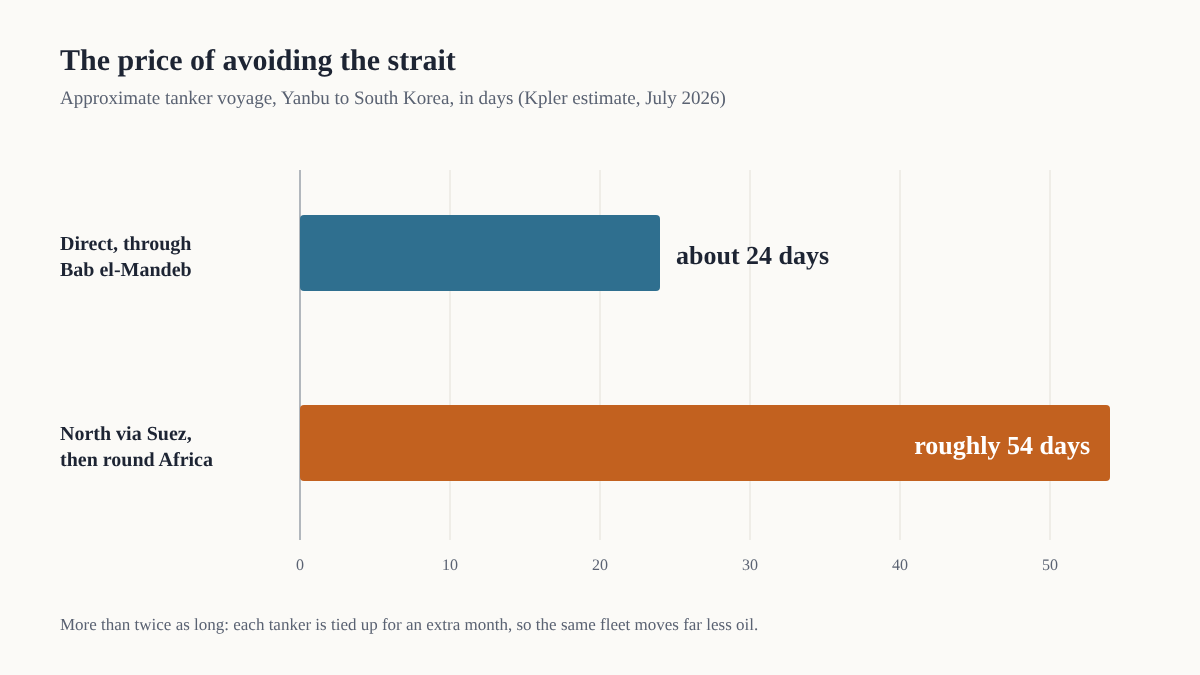
With the Strait of Hormuz all but shut by the war with Iran, Saudi Arabia has leaned on its escape route: the 1,201 km East–West pipeline, which carries crude across the desert from Abqaiq to Yanbu on the Red Sea, and which was pushed to 7 million barrels a day in March. But a bypass moves a choke point; it does not remove it. Oil loaded at Yanbu has two ways out. Heading north to Europe, it can go through Suez or Egypt's SUMED pipeline, about 1.3 million barrels a day this month according to Kpler. Heading south to Asia, where most Saudi customers are, it has to pass Bab el-Mandeb, about 30 km wide at its narrowest. In July Kpler reckoned some 6 million barrels a day of crude was going through the strait towards Asia, two-thirds of it Saudi; it carries more than half of India's crude imports and nearly a third of South Korea's. The alternative, north through Suez and all the way round Africa, stretches a tanker's voyage to South Korea from about 24 days to roughly 54.
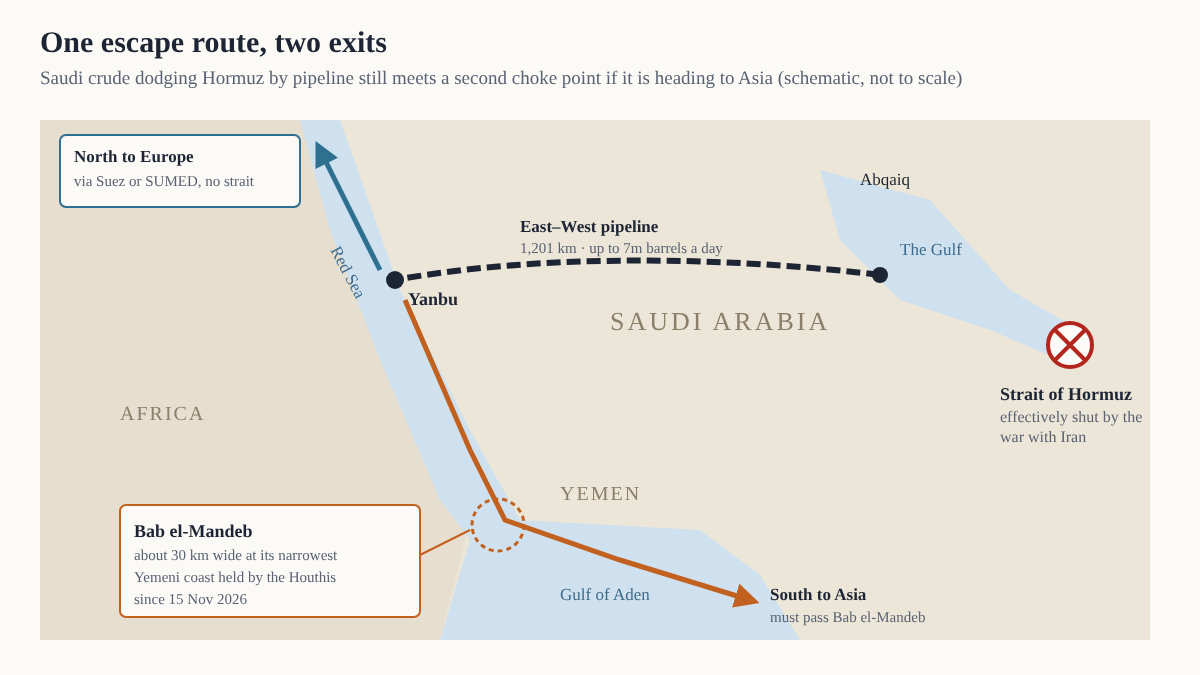
The Houthis have not shut the strait outright. Since declaring a blockade of Saudi-linked shipping on 20 July they have attacked about ten ships, then gone quiet after late August, behaviour the conflict monitor ACLED describes as “calibrated coercion rather than maximum disruption”. That is the point: the Houthis barely need to fire. Holding the shore is enough to make shipowners think twice and to give them a hand on the valve of the very route built to avoid Iran. Saudi Arabia escaped one choke point only to find that its exit runs through another.
Sources
This piece was drafted by AI from the public sources named, then read and approved by Michael Rossi before it went up. It explains how something works; it is not advice of any kind.
← Back to StreetOwl