Why nuclear arms control breaks down when there are three players
Drop this at dinner: For the first time since 1972 there’s no limit on American or Russian nuclear weapons, and a new deal is so hard because arms control was built for two players, and now there are three.
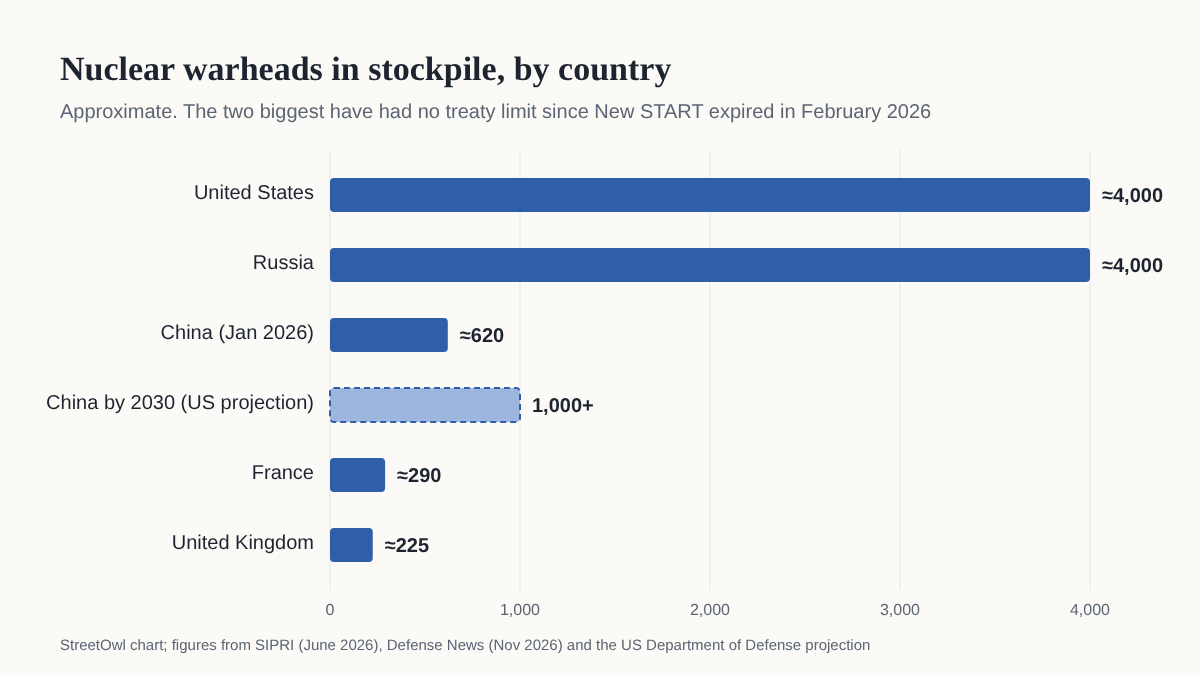
On Thursday 19 November in Shenzhen, on the sidelines of the APEC summit, Xi Jinping will host Donald Trump and Vladimir Putin for the first three-way meeting of the leaders of the world’s three largest nuclear powers. Trump wants to talk about cutting nuclear weapons, and the timing is pointed: since New START expired in February, the American and Russian arsenals, roughly 4,000 warheads each, have had no numerical limit for the first time since 1972. Expectations are low. The likeliest result is a joint line that a nuclear war cannot be won, or a pledge to keep humans, not AI, in charge of launch decisions.
Why is a real deal so hard? Because arms control was invented for two players, and there are now three. In a duel the maths is simple: each side matches the other, parity is agreed, and both count down together. Add a third and that logic breaks. Washington argues it must deter Russia and China at once, so it needs more than either; Moscow then sees an America bigger than itself and wants to grow; Beijing looks at two arsenals six times its own and sees no reason to stop. Each country’s idea of “enough” rests on the fear that the other two might act together, so no single number satisfies all three. Physicists know the same trap in orbits as the three-body problem: two bodies settle into a stable pattern, three rarely do.
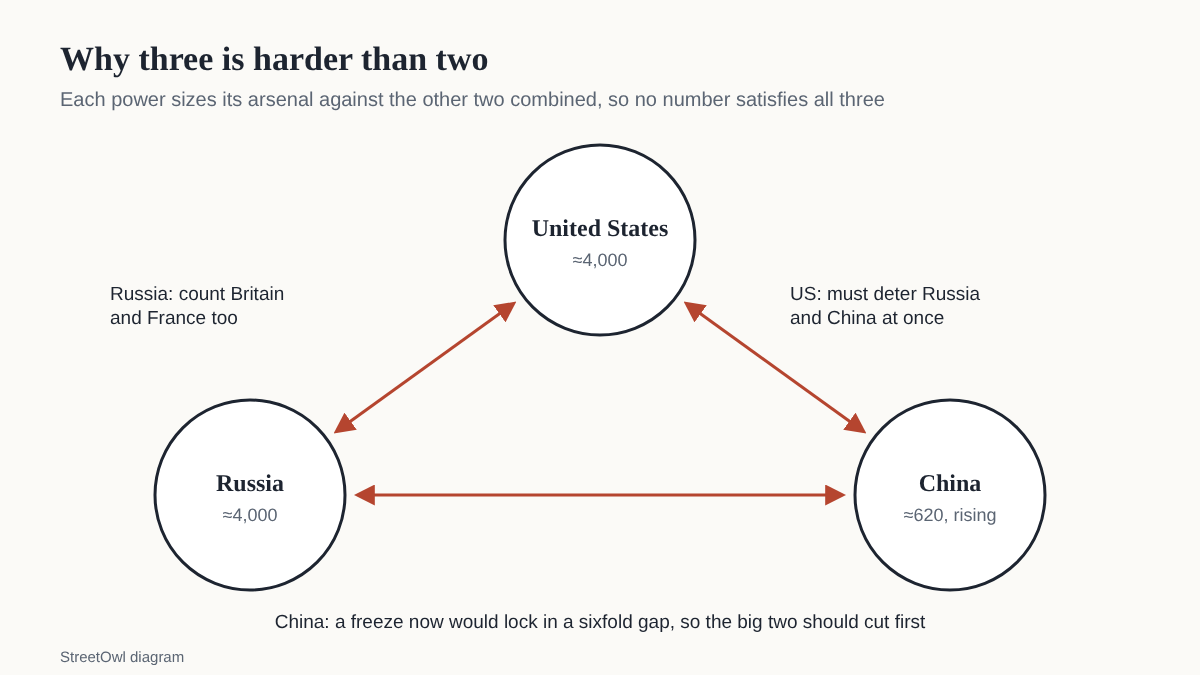
China’s stance follows from the arithmetic. SIPRI counted about 620 Chinese warheads in January, the fastest-growing arsenal anywhere, and the Pentagon projects more than 1,000 by 2030. Freezing now would lock in permanent inferiority, so Beijing calls three-way talks “neither fair, reasonable nor realistic” and says the big two should cut first. Russia adds that any new deal must also count Britain’s and France’s warheads, dragging in a fourth and fifth player. And trust has to be checked, not assumed: New START allowed 18 on-site inspections a year, and there have been none since Russia suspended them in 2023.
Sources
This piece was drafted by AI from the public sources named, then read and approved by Michael Rossi before it went up. It explains how something works; it is not advice of any kind.
← Back to StreetOwl