Why are mortgage rates higher than the Bank of England base rate?
Drop this at dinner: The Bank of England's rate is 4 per cent, but a five-year fix costs 6, because your mortgage isn't priced off today's rate at all: it's priced off the market's bet on where rates will average for the next five years.
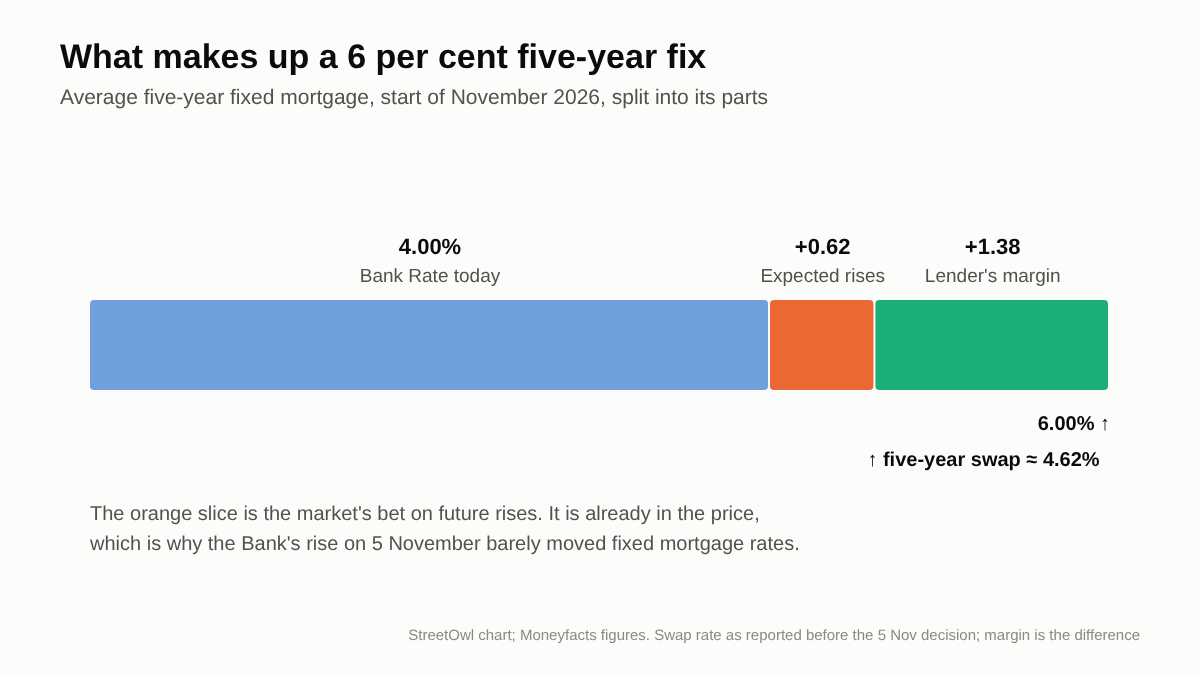
Three weeks ago the Bank of England raised Bank Rate for the first time since August 2023, from 3.75 to 4 per cent, on an eight-to-one vote, with the next decision due on 17 December. Yet the average five-year fixed mortgage already costs 6.00 per cent, according to Moneyfacts, the first time it has reached that level in three years, and the two-year fix is 5.97 per cent. Stranger still, the Bank's rise barely moved them, because lenders had priced it in weeks earlier. A fixed mortgage is not priced off today's Bank Rate at all. It is priced off the swap market.
A lender funds itself largely with money whose cost floats with Bank Rate, such as savers' deposits, but promises a homeowner a fixed rate for five years. If rates climb, it is squeezed in the middle. So it hedges with an interest-rate swap: it agrees to pay a fixed rate to another bank for five years and to receive in return a floating rate that tracks SONIA, the overnight rate that sits almost exactly on Bank Rate. The floating money coming in covers the floating cost going out, and what is left is fixed.
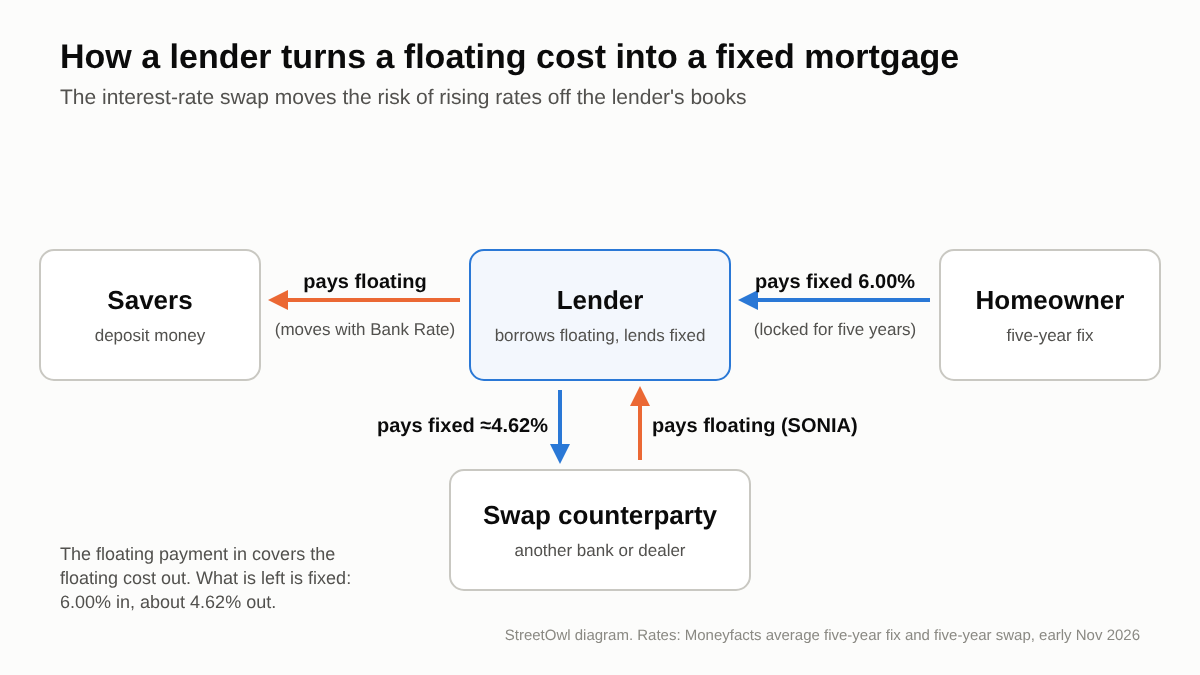
The fixed leg of that deal, the five-year swap rate, was about 4.62 per cent before the November decision, and it is in effect the market's best estimate of the average Bank Rate over the next five years. With traders pricing roughly three more quarter-point rises by the middle of 2027, that average sits well above today's 4 per cent. Add the lender's margin for risk, running costs and profit, here about 1.4 percentage points, and the result is 6 per cent.
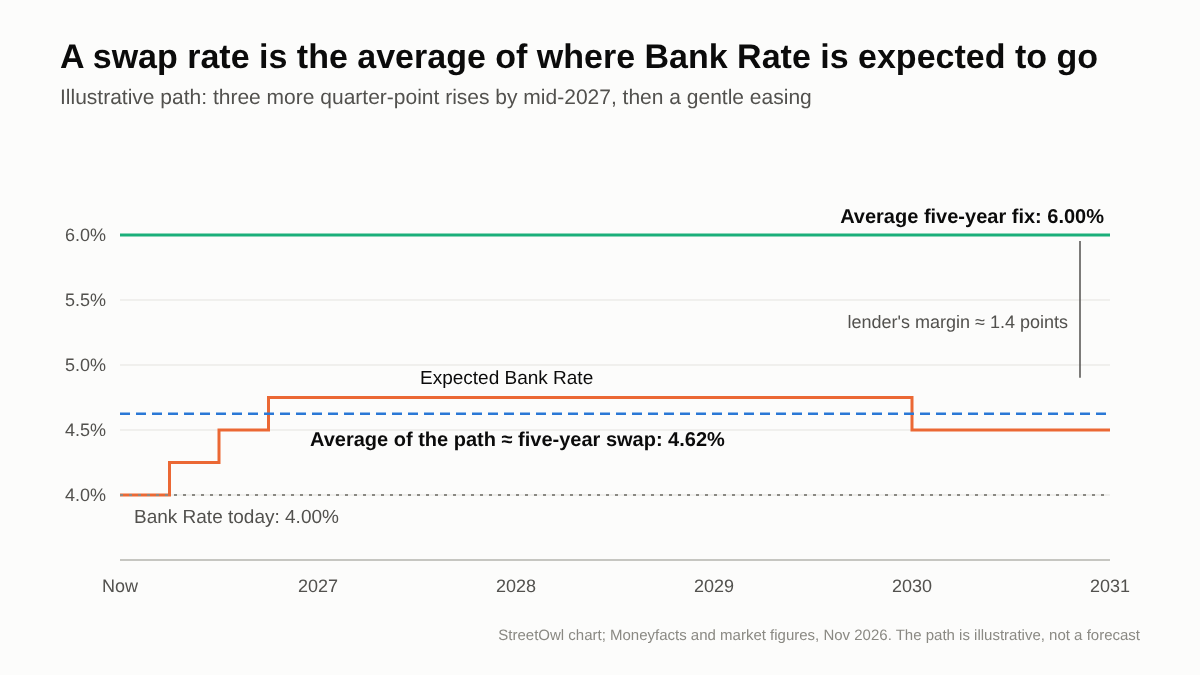
That is why mortgage rates often move before the Bank does, can fall while Bank Rate is still rising, and can jump on a day with no decision at all: an inflation figure or a jobs report shifts the expected path, swap rates move within minutes and lenders reprice. When October's inflation came in at 3.6 per cent, a touch under forecast, the odds of a December rise slipped from 90 to 80 per cent. And in September the average mortgage deal stayed on sale for just 13 days, against 43 days in 2019.
Sources
- Fox Davidson, Mortgage rates today UK: November 2026 averages (Moneyfacts figures), 4 Nov 2026, updated 15 Nov 2026
- Property Industry Eye, Mortgage rates jump again as lenders pull deals at record pace, 19 Oct 2026
- Mortgage Soup, Walter's Watch: gilt yields climb as rate rise bets grow, 16 Nov 2026
- Trading Economics, UK gilt yield news, 14 Oct to 20 Nov 2026
This piece was drafted by AI from the public sources named, then read and approved by Michael Rossi before it went up. It explains how something works; it is not advice of any kind.
← Back to StreetOwl