Where a trillion dollars goes
Drop this at dinner: China has sold the world a trillion dollars more than it bought this year, and its biggest headache is stopping its own exporters bringing the money home, so its banks now pay four times as much interest on a dollar as on a yuan.
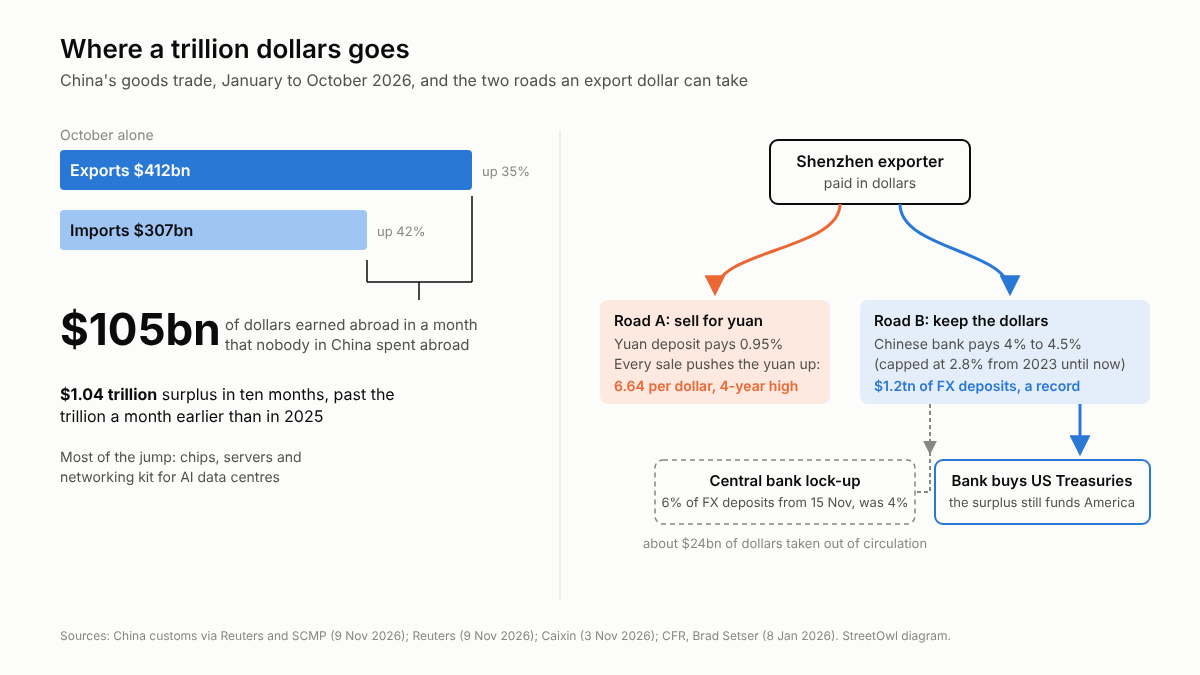
On Sunday 8 November China's customs office reported that the country had sold the world $1.04 trillion more than it bought in the first ten months of 2026, crossing the trillion mark a month earlier than in 2025, when the full-year surplus came to about $1.2 trillion. October's exports were $412 billion, up 35 per cent on a year earlier, against imports of $307 billion, and the bulk of the jump was AI hardware: chips, servers and networking kit for data centres. Xi Jinping and Donald Trump meet at the APEC summit in Shenzhen on 18 and 19 November with the trade truce freshly extended by two months.
The puzzle is what happens to a trillion dollars. A factory in Shenzhen is paid in dollars but pays its wages in yuan, so it has to sell. A trillion dollars of selling pushes the yuan up, and it has risen more than 4 per cent this year and nearly 10 per cent since the start of 2025, closing at 6.6458 per dollar on 2 November, its strongest in more than four years. For exporters working on margins of a few per cent that hurts, and it arms anyone in Washington or Brussels who wants tariffs.
The carrot
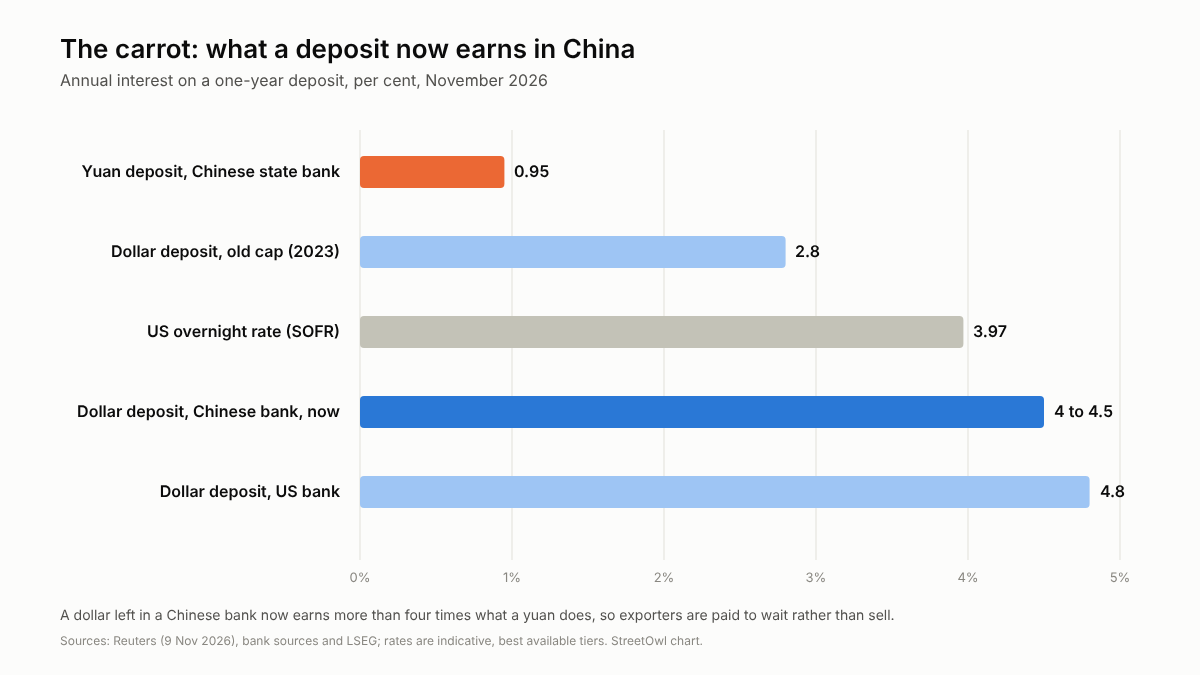
In the 2000s Beijing's answer was to buy the dollars itself: the central bank's reserves reached almost $4 trillion by 2014, and the charge of currency manipulation has followed China ever since. Today's answer is quieter: persuade the exporters not to sell. A yuan deposit at a big state bank now pays 0.95 per cent. A dollar deposit at the same bank, held under a de facto cap of 2.8 per cent since 2023, now pays 4 per cent and more, as high as 4.5, and one state bank offers its most creditworthy clients the US overnight rate itself, about 3.97 per cent. More than six banks have moved in recent weeks, to levels not seen since at least 2023.
The result is a record $1.2 trillion of foreign currency sitting in Chinese banks at the end of September, up 17.7 per cent in a year. The banks need somewhere to put it, so they buy US Treasuries. The surplus still finances America's deficit, as it did in 2005; it simply flows through commercial banks rather than the central bank. Brad Setser of the Council on Foreign Relations estimates that the state banks are adding roughly $300 billion of foreign assets a year, just under the threshold of 2 per cent of GDP, now about $400 billion, that the US Treasury uses to judge manipulation.
The stick
When the carrot is not enough there is a stick. From 15 November banks must park 6 per cent of their foreign-currency deposits at the People's Bank of China instead of 4 per cent, the first rise since late 2021, which pulls about $24 billion of dollars out of circulation. The same dial was turned the other way in 2022 and 2023, when the problem was a yuan falling too fast; the ratio had been raised to 9 per cent in 2021 to curb an earlier rally. On 3 November the central bank also set its daily reference rate 692 pips weaker than the previous close, a signal that the yuan is not a one-way bet.
Sources
- Startup Fortune, citing Reuters and the South China Morning Post on China customs data, 9 November 2026
- Reuters via Yahoo Finance, Chinese banks boost dollar deposit rates as Beijing seeks to smooth yuan rally, 9 November 2026
- Caixin Global, China to raise forex deposit reserve requirement to curb yuan's rally, 3 November 2026
- Council on Foreign Relations, Brad Setser, China's currency is now facing substantial appreciation pressure, 8 January 2026
- ABC News Australia, markets live, 10 November 2026
This piece was drafted by AI from the public sources named, then read and approved by Michael Rossi before it went up. It explains how something works; it is not advice of any kind.
← Back to StreetOwl