Two prices for the same gas: Europe pays €100 while China pays Moscow half price
Drop this at dinner: Europe is paying its highest gas prices since 2022, and Russia's own budget papers show it is selling the same gas to China at half price, because a pipeline can only go where it goes.
Last Wednesday, 28 October 2026, the European benchmark gas price, the Dutch TTF front-month contract, closed above €100 a megawatt-hour for the first time since December 2022, at €100.37. It was about €32 before the war with Iran began in late February, and it peaked near €340 in August 2022. The cause is the Gulf: shipping disruption has kept Qatari LNG almost entirely out of Europe since the summer, and EU gas storage stood at 75 per cent on 21 October against the usual 90 per cent target for 1 November. The EU's energy commissioner, Dan Jørgensen, said the same day that "once again, due to geopolitical turbulence, Europe faces another energy crisis".
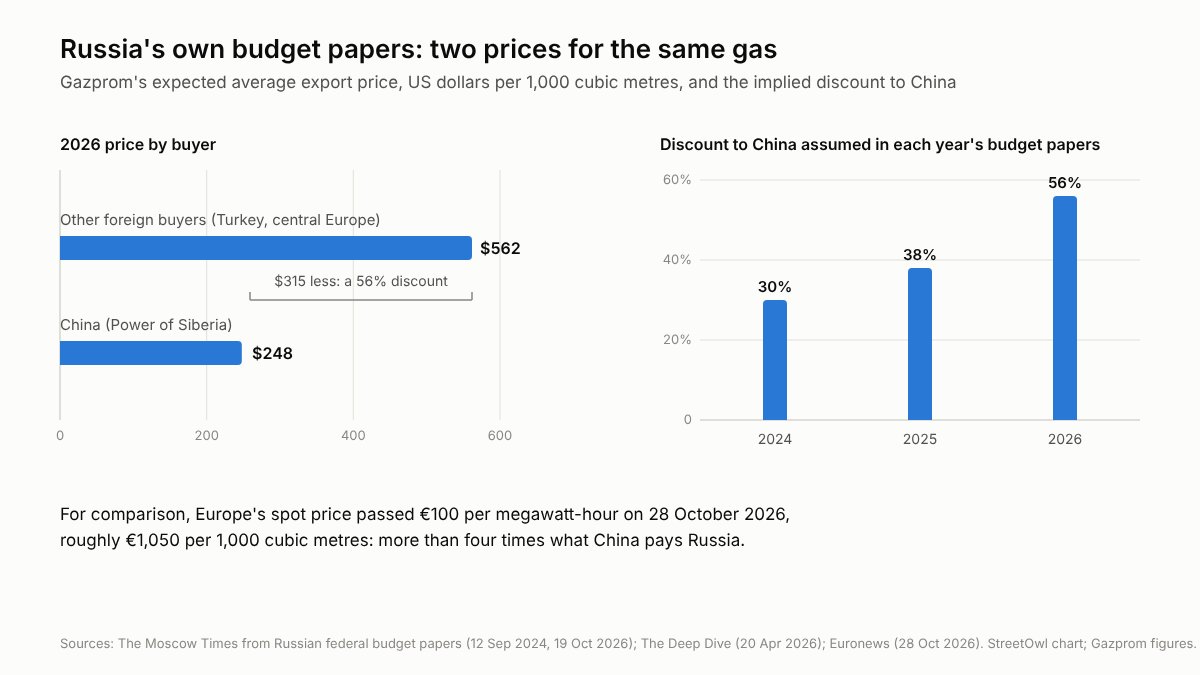
Nine days earlier a quieter number had appeared in the State Duma's database, in the papers filed with Russia's draft federal budget for 2027. Gazprom expects to sell gas to China in 2026 at an average of $247.90 per thousand cubic metres. Its other foreign customers outside the former Soviet Union, mostly Turkey and the central European states still supplied through TurkStream, pay $562. That is a gap of $315, a 56 per cent discount, and it is widening: Moscow's own budget papers assumed a discount of 30 per cent for 2024 and about 38 per cent for 2025. Converted, €100 a megawatt-hour is roughly €1,050 per thousand cubic metres, so Europe is paying on the spot market more than four times what China pays Russia under contract.
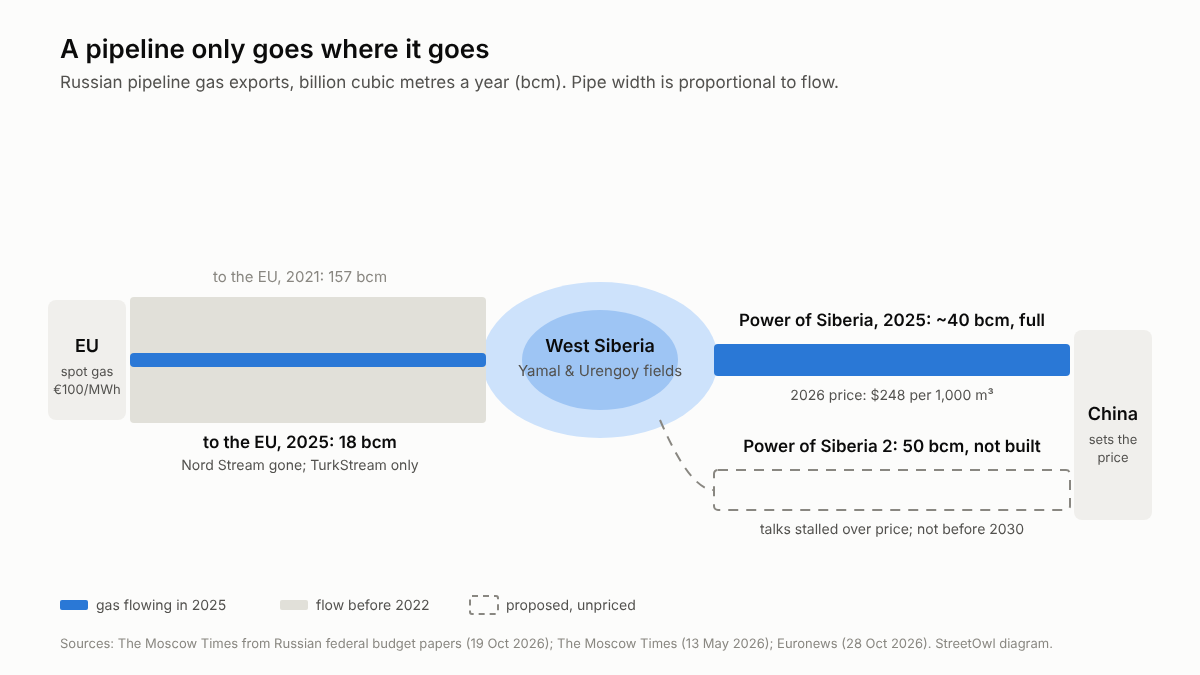
How does a seller end up giving half-price gas away in the tightest market in four years? Geography. Oil goes in a tanker to whoever bids highest; pipeline gas goes only where the pipe goes. Before 2022 Gazprom sent 157 billion cubic metres a year to the EU; in 2025 it sent 18, after the loss of Nord Stream and the Ukrainian transit route. The fields in Yamal and Urengoy that fed Europe have no other outlet, and the one pipe to China, Power of Siberia, is already full at close to 40 billion cubic metres a year.
The proposed Power of Siberia 2, which would carry 50 billion cubic metres a year through Mongolia and lift Russia's share of China's gas supply from about 10 to about 20 per cent, has been "agreed" repeatedly since September 2025 but never priced. Beijing reportedly wants a price close to Russia's domestic tariff, Moscow wants terms similar to Power of Siberia, and the talks stalled again in October. Analysts do not expect it to run before 2030. As Laurent Ruseckas of S&P Global put it, Gazprom has no one else to negotiate with, so all the leverage is on the Chinese side.
The twist is that the war with Iran, which should have strengthened any gas seller, has weakened this one. Middle East LNG made up about 30 per cent of China's LNG imports in 2025, so Beijing values an overland pipe more than ever; but it can afford to wait until the next decade for it, and a Gazprom that has lost its European market cannot. Russia's gas-related tax revenue fell 7 per cent and its gas production 3 per cent as European sales dwindled, and the discount to China has grown in every budget since.
Sources
This piece was drafted by AI from the public sources named, then read and approved by Michael Rossi before it went up. It explains how something works; it is not advice of any kind.
← Back to StreetOwl