The village vote that cost two trillion dollars
Drop this at dinner: The AI trade lost two trillion dollars on Thursday, and the trigger wasn't a chip or a model; it was forty-one town votes on data centres, and forty of them said no.
The story of the week was not Tuesday's election but what happened to it on Thursday. The Nasdaq 100 fell 6.3 per cent in a single session, about $2.3 trillion, the Philadelphia semiconductor index lost 12 per cent, Micron 14 and Nvidia 9, and the VIX, Wall Street's fear gauge, had its biggest one-day jump in more than two years. By Friday it had reached Asia: the Nikkei dropped 6 per cent into a bear market, Seoul tripped its circuit breaker, and SK Hynix shed 11 per cent. No one had shipped a bad chip or a disappointing model. What had changed was a set of ballots in places like Ashville, Ohio.
Alongside the midterms, 41 towns and counties in ten states voted on data centres, and 40 went against them. Thirteen Ohio municipalities banned them outright; Edgewater, Florida, wrote a ban into its charter with 77 per cent; Ashville voted by more than 80 per cent to tear up a deal for two centres already under construction. The one exception, Harwood in North Dakota, declined to add a review step. Ohio's governor-elect campaigned on a moratorium unless data centres pay 100 per cent of their utility costs, Georgia's new governor opposed them, and Texas, which holds close to 30 per cent of the capacity pencilled in for 2028, froze permits on 21 September.
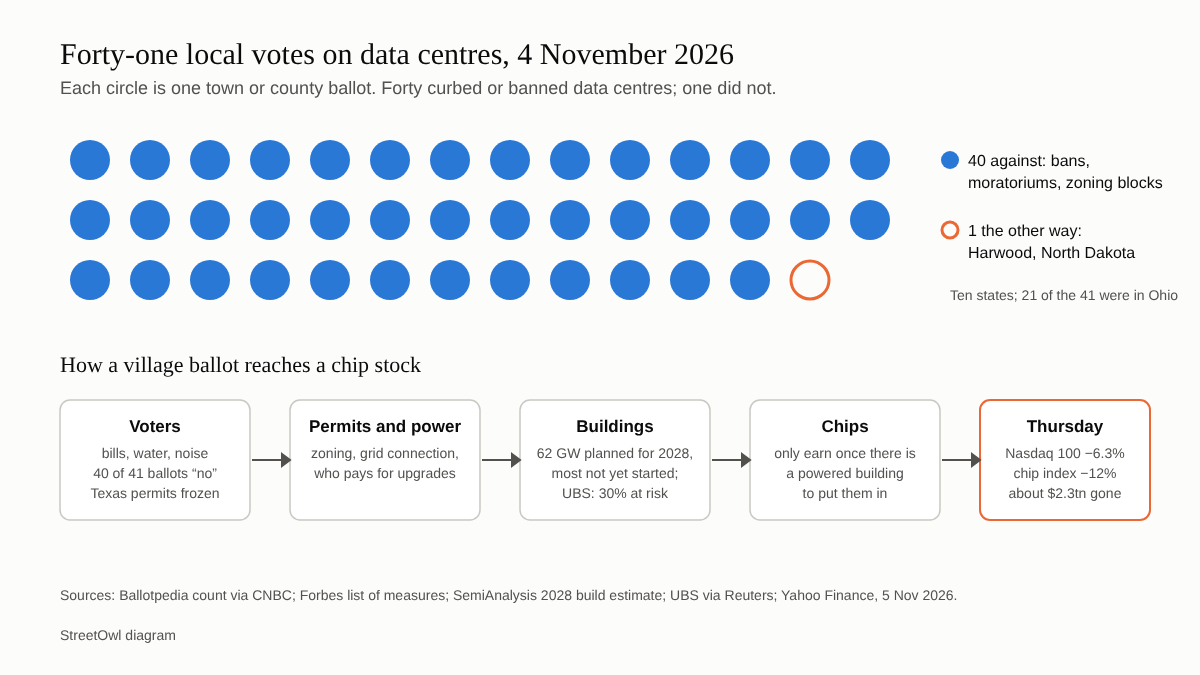
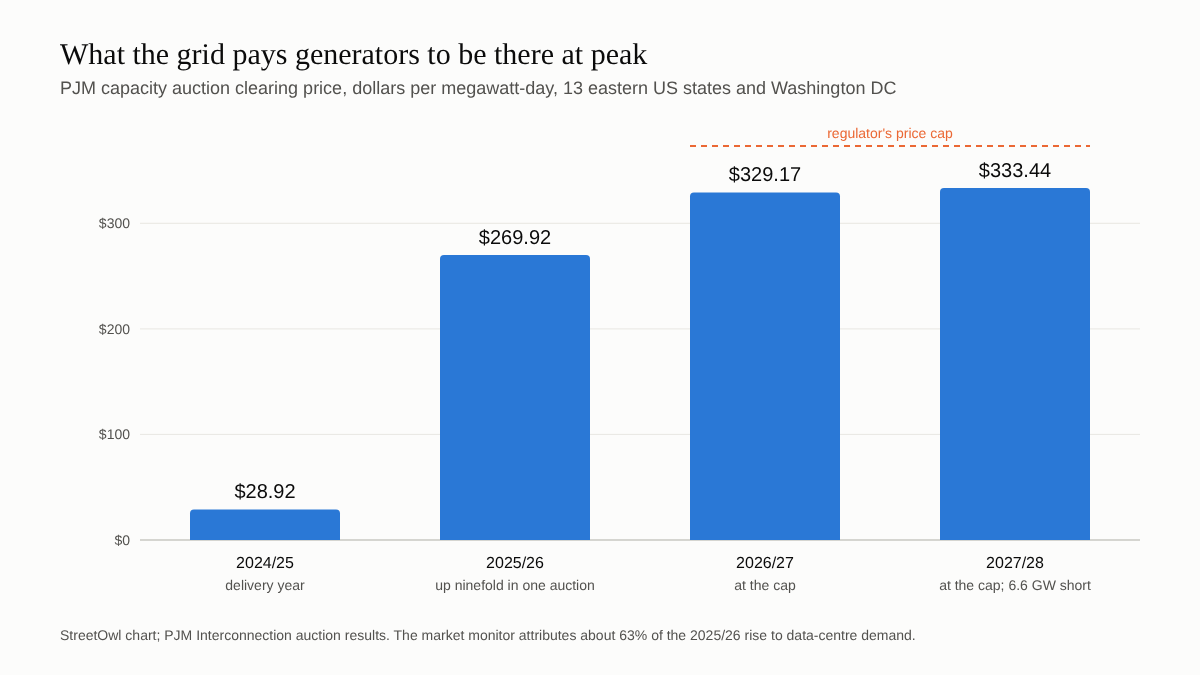
Why would a village vote move Nvidia? Because the AI trade is, at bottom, a construction trade. A chip earns nothing until there is a building with power to put it in. SemiAnalysis reckons the United States needs about 62 gigawatts of new data-centre capacity in 2028, most of it not yet started, and on Thursday UBS put 30 per cent of that year's additions at risk. The reason voters mind is on their bills. In PJM, the grid that serves 13 eastern states, the price paid to generators simply to be available at peak went from $28.92 per megawatt-day to $269.92 in one auction and has since sat at the regulator's cap of about $333, with the market monitor blaming data-centre demand for roughly two thirds of the jump; the latest auction cleared 6.6 gigawatts short of what reliability requires. Electricity is the one input the AI build-out cannot import, and the one that gets decided at the parish council.
Sources
- Yahoo Finance, stock market live blog, 5 Nov 2026
- Foreign Affairs Forum, "The day the AI trade cracked", 7 Nov 2026
- Anadolu Agency, Asian tech stocks plunge, 6 Nov 2026
- Forbes, where voters are rejecting data centres, 4 Nov 2026
- Tech Insider, 40 of 41 votes curb data centres, Nov 2026
- SemiAnalysis, "The datacenter backlash goes bipartisan", 1 Nov 2026
- Finimize on the UBS note, 6 Nov 2026
- Introl, PJM capacity auction prices and the market monitor, 28 Feb 2026
- Society of Environmental Journalists digest of the New York Times, 14 Jul 2026
This piece was drafted by AI from the public sources named, then read and approved by Michael Rossi before it went up. It explains how something works; it is not advice of any kind.
← Back to StreetOwl