The shop that paid a third of the rent: why a 188-year-old department store collapsed
Drop this at dinner: A department store pays about a third of the rent of the shops around it, because it's the bait; a 188-year-old one went under in Australia this week when it asked for a bigger discount and the landlord said no.
On Thursday 5 November 2026 David Jones, the Australian department store founded in Sydney in 1838, entered voluntary administration and receivership for the first time in its 188-year history. The chain has 38 stores, one of them in Auckland, and more than 6,000 staff. It lost A$74.1 million in 2024 and A$95.5 million before tax in 2025, missed the deadline for filing its 2026 accounts, and has paid no rent since the end of September. Its directors appointed McGrathNicol as administrators; its lender, Hilco, which had advanced a further A$10 million in October to pay for Christmas stock, appointed FTI Consulting as receivers. The shops and the website are still trading.
The trigger was a failed negotiation with Scentre Group, which owns the Westfield centres that house 17 of the 38 stores. The day before the collapse Scentre told the Australian stock exchange what the tenancy was worth. David Jones occupies about 200,000 square metres in those centres, and Scentre's share of the gross rent for 2026 is A$45 million, which it put at A$352 a square metre. The average across all the stores in the same portfolio is A$942. The department store pays a little over a third of the going rate.
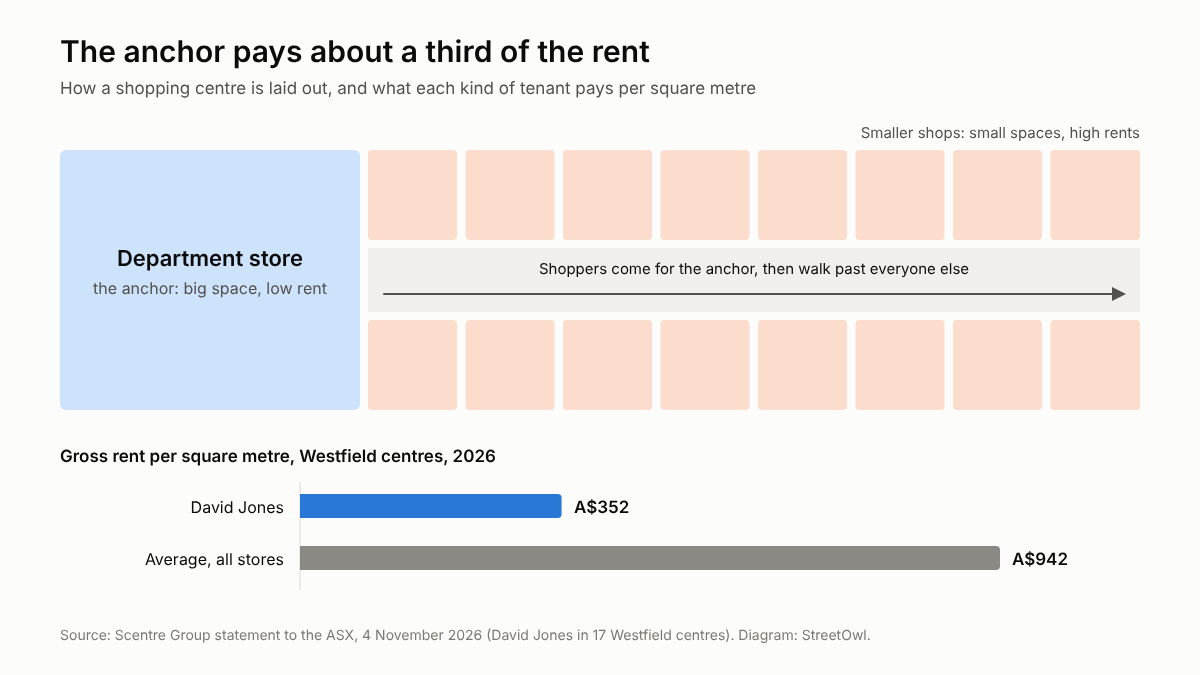
That gap is not generosity. It is how a shopping centre is designed to work. A department store is the anchor: it is the reason people make the trip, and on the way in and out they walk past dozens of smaller shops that could never draw that crowd alone. The landlord charges the smaller shops for the passing trade and gives the anchor cheap space for creating it. Two economists, Peter Pashigian and Eric Gould, measured the arrangement in American malls in a paper published in 1998 and estimated that anchors received a discount of at least 72 per cent on the rent per square foot paid by other tenants. The landlord is, in effect, buying footfall and paying for it in floor space.
The bargain lasts only as long as the anchor still pulls. Before the collapse David Jones wanted to shrink to between 12 and 20 stores and asked its landlords for steep rent relief, reportedly including a rent-free December. Scentre's chief executive, Elliott Rusanow, said the company had made "a generous offer" that would have kept the stores trading, and that the owner, Anchorage Capital Partners, rejected it. Scentre's position is easier to understand in the light of Westfield Tuggerah, on the New South Wales Central Coast, where it has already filled former David Jones space with JD Sports and Rebel: visits to the centre rose 6.2 per cent in the eight weeks after they opened. Scentre also holds about A$30 million in bank guarantees, equal to eight months of David Jones's rent, which it required as a condition of approving the sale of the business in 2023.
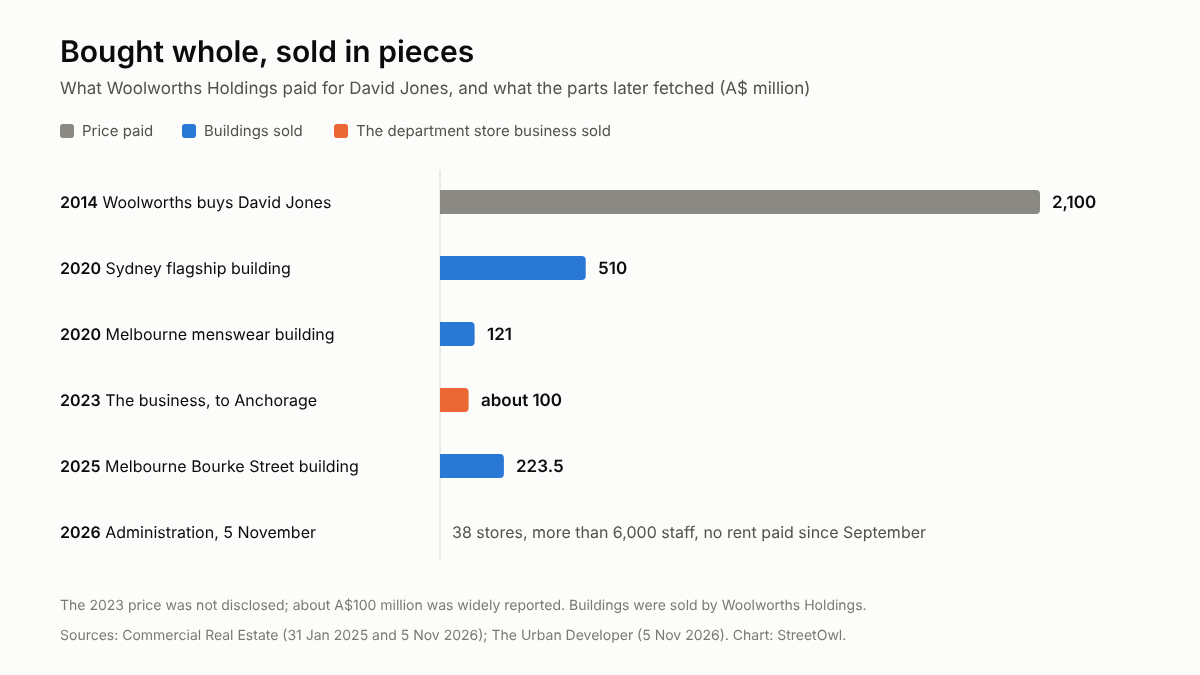
The second lesson is in the price. South Africa's Woolworths Holdings paid A$2.1 billion for David Jones in 2014, when the company still owned its flagship buildings. Woolworths then sold those buildings separately. The Elizabeth Street store in Sydney went to a consortium managed by Charter Hall in 2020 for A$510 million, with David Jones staying on under a twenty-year lease that began at A$25.5 million a year and rises by at least 2.5 per cent annually. The menswear building in Melbourne fetched A$121 million the same year, and the main Bourke Street store A$223.5 million in January 2025, with 18 years left on its lease.
The business itself went to Anchorage, a Sydney private equity firm, in a sale announced in December 2022 and completed in 2023, for a price that was not disclosed but was widely reported as about A$100 million. The three buildings raised about A$855 million between them, more than eight times what the department store fetched without them. What remained was a retailer with no property, long leases, and rents that rise every year whatever happens to sales. The receiver, Christopher Hill of FTI Consulting, blamed rising costs, "a significant and outdated retail footprint" and supply chain problems, and said that steps to reduce the number of stores were likely in the near term.
Sources
- ABC News, 5 November 2026
- ABC News business live blog, 5 November 2026
- Commercial Real Estate, 5 November 2026
- Ragtrader, 4 November 2026
- The Nightly, 4 November 2026
- The Urban Developer, 5 November 2026
- Shopping Centre News, 5 November 2026
- Inside Retail Australia, 5 November 2026
- 1News, 5 November 2026
- Commercial Real Estate, 31 January 2025
- Yahoo, 20 December 2022
- Pashigian and Gould, Journal of Law and Economics, April 1998
This piece was drafted by AI from the public sources named, then read and approved by Michael Rossi before it went up. It explains how something works; it is not advice of any kind.
← Back to StreetOwl