The Ship of Theseus has a real address: Japan's shrine that is rebuilt every twenty years
Drop this at dinner: Japan's holiest shrine has been pulled down and rebuilt every twenty years since 690, so it is either thirteen centuries old or thirteen years old, which is the Ship of Theseus with a real address.
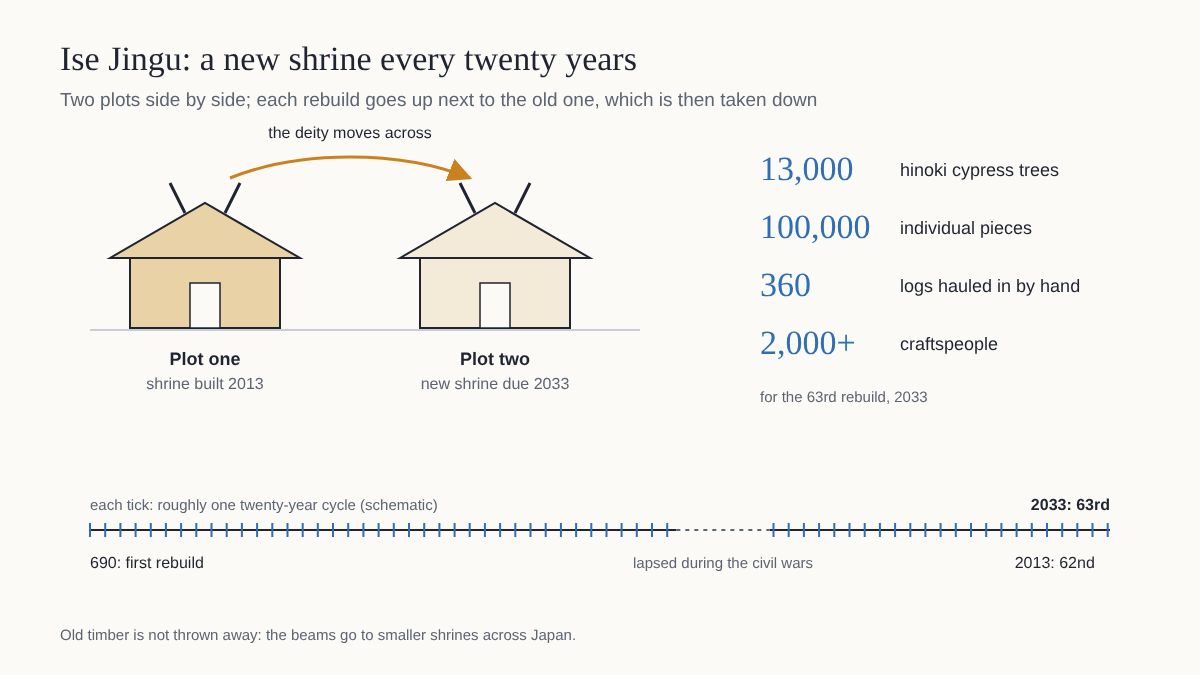
In April, crowds in Ise, central Japan, began dragging cypress logs through the streets on wooden sledges, the first of 360 for a building that will not be finished until 2033. Ise Jingu, Japan's most sacred Shinto shrine, is taken down and rebuilt on the plot next door every twenty years, and has been since 690. The coming rebuild is the 63rd: about 13,000 hinoki trees, some 100,000 pieces, more than 2,000 craftspeople, and the old beams sent off to smaller shrines around the country. Which raises an old question: is the shrine thirteen centuries old, or thirteen years old?
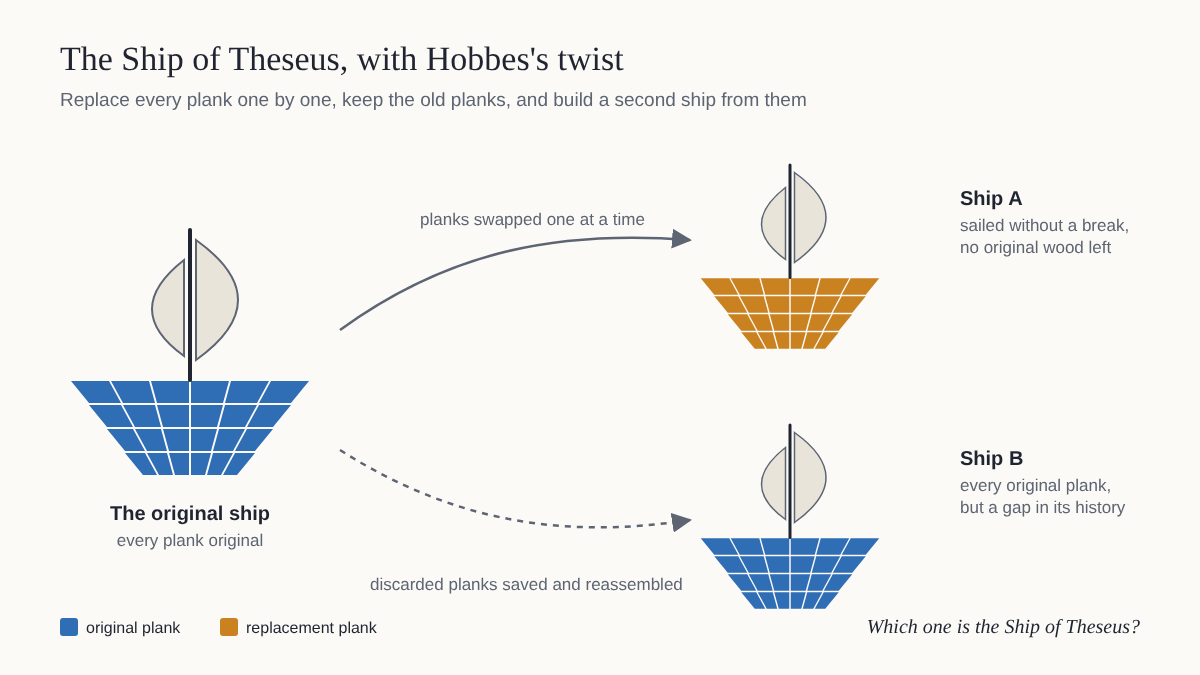
That is the Ship of Theseus, the oldest puzzle about identity in Western thought. Plutarch recorded that the Athenians kept the hero's ship for centuries, swapping each rotten plank for a sound one, until philosophers argued over whether it was still the same ship. In 1655 Thomas Hobbes made it nastier: suppose someone saved every discarded plank and put them back together. Now two ships claim the name, one with the unbroken history, the other with every original piece of wood, and whichever you choose, you have given something up.
The usual way out is to admit that “same” has more than one meaning. There is sameness of material, sameness of form, and sameness of an unbroken history, and in ordinary life they travel together, so we never notice they are separate. The puzzle only bites when they come apart. Ise has chosen plainly: what it preserves is the design, the joinery passed from carpenter to apprentice each cycle, and the ritual itself, not the wood. That choice reached international conservation. In 1994 Japan hosted the meeting that produced the Nara Document on Authenticity, which accepted that a heritage site's authenticity can lie in its form, techniques and traditions, not only in its original material. And the question is not idle: a company can replace every employee and keep its name, and a football club can change its owner, ground and players and still be the same club to the people who have followed it for generations.
Sources
This piece was drafted by AI from the public sources named, then read and approved by Michael Rossi before it went up. It explains how something works; it is not advice of any kind.
← Back to StreetOwl