The rate rise that can't touch the price of oil
Drop this at dinner: The Bank of England is expected to raise rates on Thursday because of an oil price it cannot move; what it is really bidding against is next April's pay rises.
On Thursday 5 November at noon the Bank of England is expected to raise interest rates for the first time since August 2023, taking Bank Rate from 3.75 to 4 per cent. Reuters-polled economists and the prediction markets both point the same way. Australia went first on Tuesday morning, lifting its cash rate to 4.85 per cent, the highest since December 2008 and its fifth increase this year, and futures markets put the odds of a Federal Reserve rise in December at about 76 per cent. All of it traces back to energy: wholesale gas is close to three times its January price, crude nearly double, and UK inflation jumped to 3.5 per cent in September from 3.1 per cent in August, mostly on petrol and diesel.
Here is the puzzle. A rate rise cannot touch the price of oil. Brent fell nearly 8 per cent on Monday 2 November, to just below $105 a barrel, on reports that Washington and Tehran were looking for a diplomatic way out of the war, and no vote in Threadneedle Street moved it a cent. So what does a rate rise actually buy?
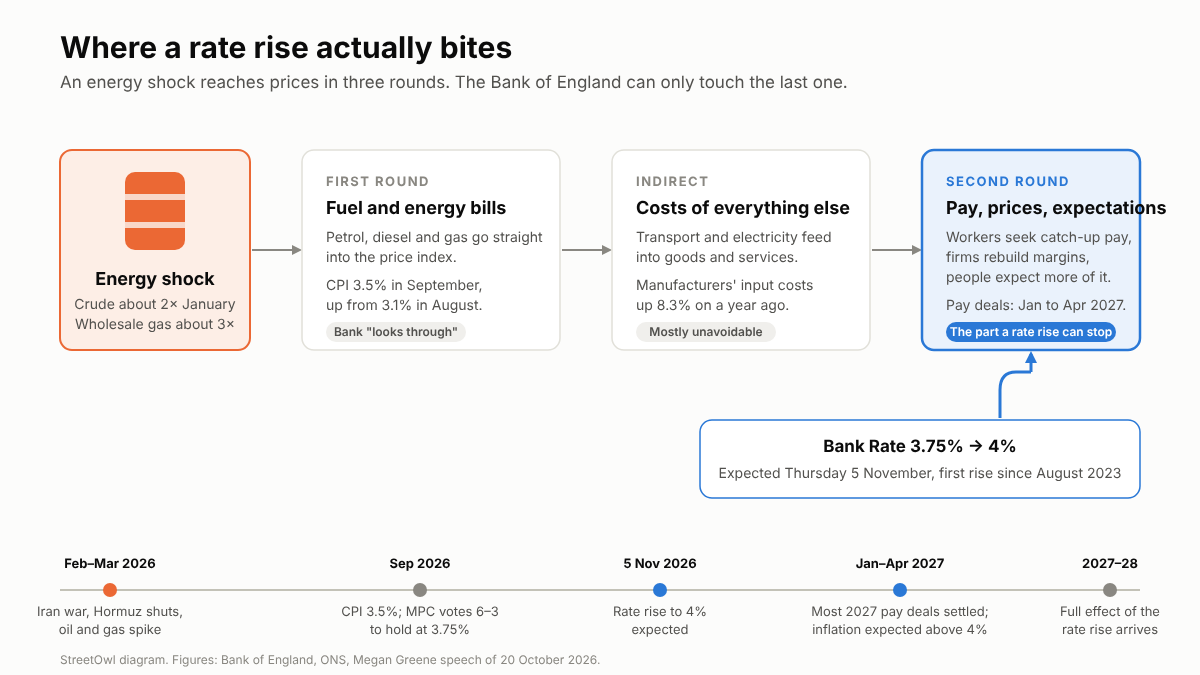
Three rounds, and the one a central bank can reach
The answer is in the phrase economists keep repeating: second-round effects. The first round is the energy bill itself, the fuel and gas that go straight into the consumer price index; central banks say they “look through” that because it is unavoidable. An indirect round follows as transport and electricity costs pass into the price of everything else, which is why manufacturers' input costs were 8.3 per cent higher than a year earlier in September. The second round is what happens when workers ask for pay to catch up and firms, having absorbed costs for several years, put prices up to protect their margins. If both happen, a one-off jump in oil becomes a lasting rise in the rate of inflation. That is the part a central bank can do something about, by cooling demand enough that the pay rises do not stick.
The timing is what makes it a bet. Most UK pay deals for 2027 are settled between January and April, exactly when the Bank expects inflation to run above 4 per cent, the level at which households start to pay attention to it. A change in Bank Rate takes a year or more to have its full effect. So the Monetary Policy Committee, which voted six to three to hold in September, would be raising now against negotiations that have not yet begun.
Why the soft jobs market may not save the Bank
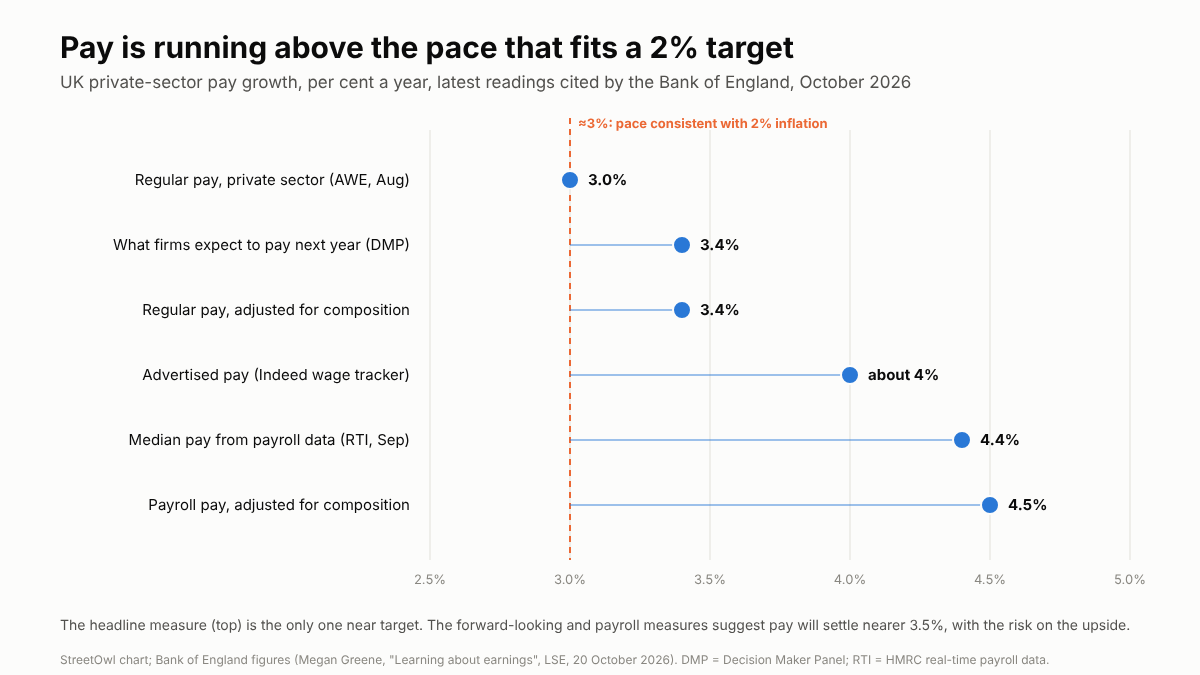
Megan Greene, one of the three members who voted to raise in September, told the LSE Economics Society on 20 October that waiting for the pay settlements to arrive would be too late, and that the committee's hope that a slack labour market would hold wages down looks less justified than it did. Unemployment has fallen from 5.2 per cent in the three months to January to 4.7 per cent in August, and redundancies are down from a peak of about 150,000 a quarter to around 100,000. The headline measure of private-sector regular pay is growing at 3.0 per cent, close to the roughly 3 per cent she judges consistent with the 2 per cent target, but the other readings run higher: firms expect 3.4 per cent, the Indeed tracker of advertised pay is near 4 per cent, and median pay from HMRC payroll data is 4.4 per cent, or 4.5 per cent once changes in who is employed are stripped out. Firms' expectations of their own price rises have climbed to 3.7 per cent and households' to 4.5 per cent.
The scar the committee carries is 2022. In the middle of that year firms expected pay growth of about 5 per cent; a year later realised pay growth in the same survey was close to 7 per cent, and the official measure reached 8 per cent. Staff simulations shown to the committee suggest that setting policy as though second-round effects will be strong, and easing if they are not, produces a better outcome than the reverse.
What history says
The shock itself is not the problem. Oil roughly doubled in 1990 and again in the run-up to 2008, and on both occasions inflation faded and central banks ended up cutting rates as growth stalled, because expectations were anchored and labour markets were soft. It stuck in the 1970s and again in 2022, when expectations were loose, workers could bargain and people had recent memories of high inflation. Work by Royal London Asset Management on UK data back to the 1970s finds that energy shocks on average leave no lasting mark on core inflation, that pay typically responds three to six quarters after the shock, and that the pass-through becomes significant only when those three conditions are met. Thursday's decision rests on which of those Britains this is.
Sources
This piece was drafted by AI from the public sources named, then read and approved by Michael Rossi before it went up. It explains how something works; it is not advice of any kind.
← Back to StreetOwl