The peninsula with two doors: why Saudi Arabia's Hormuz bypass is now under fire too
Drop this at dinner: Saudi Arabia built a 1,200-kilometre pipeline in 1981 precisely so it would never depend on the Strait of Hormuz, and this month the Houthis are shooting at that too, so for the first time both of the kingdom's exits are under fire at once.
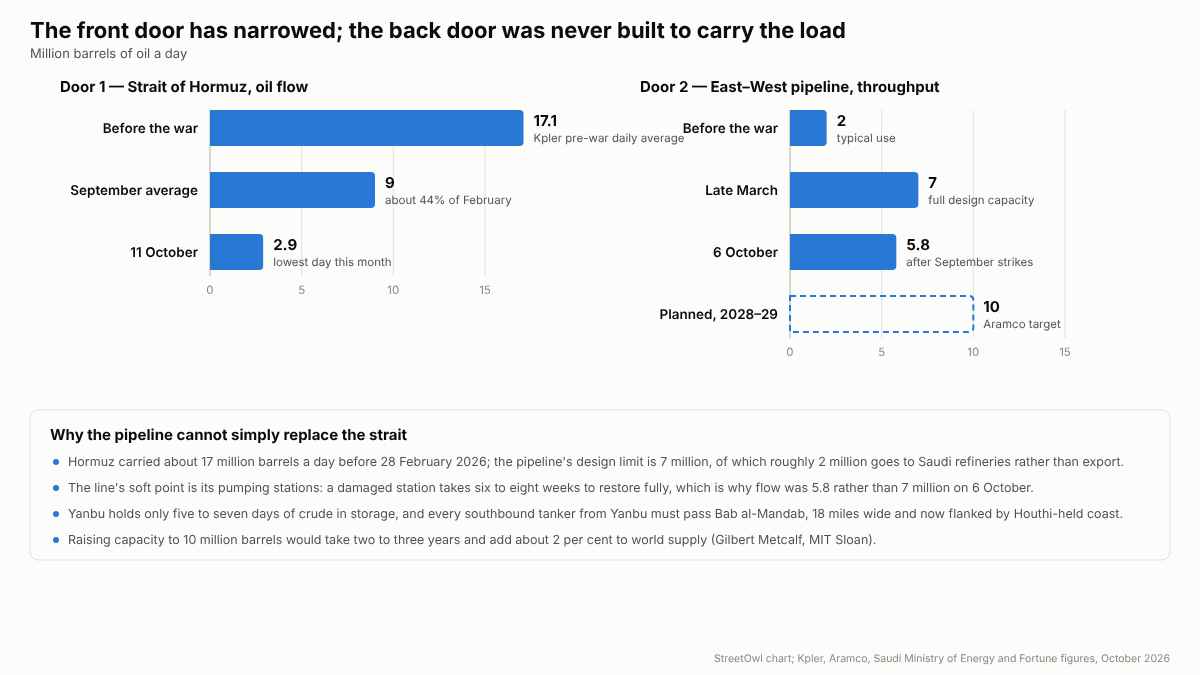
Saudi Arabia is, for practical purposes, a very large island. Its oil lies in the east, and almost all of it has to leave by sea through one of two doors. The front door is the Strait of Hormuz, which before this year carried about 17 million barrels a day, roughly a fifth of the world's seaborne oil. The back door is a 1,200-kilometre pipeline, the East–West Crude Oil Pipeline or Petroline, built in 1981 when the Iran–Iraq war first made the Gulf a dangerous place to load a tanker. Two parallel pipes run west from the Abqaiq processing hub to Yanbu on the Red Sea with a design capacity of 7 million barrels a day, and for forty years the line was the kingdom's insurance policy, normally carrying about 2 million barrels a day.
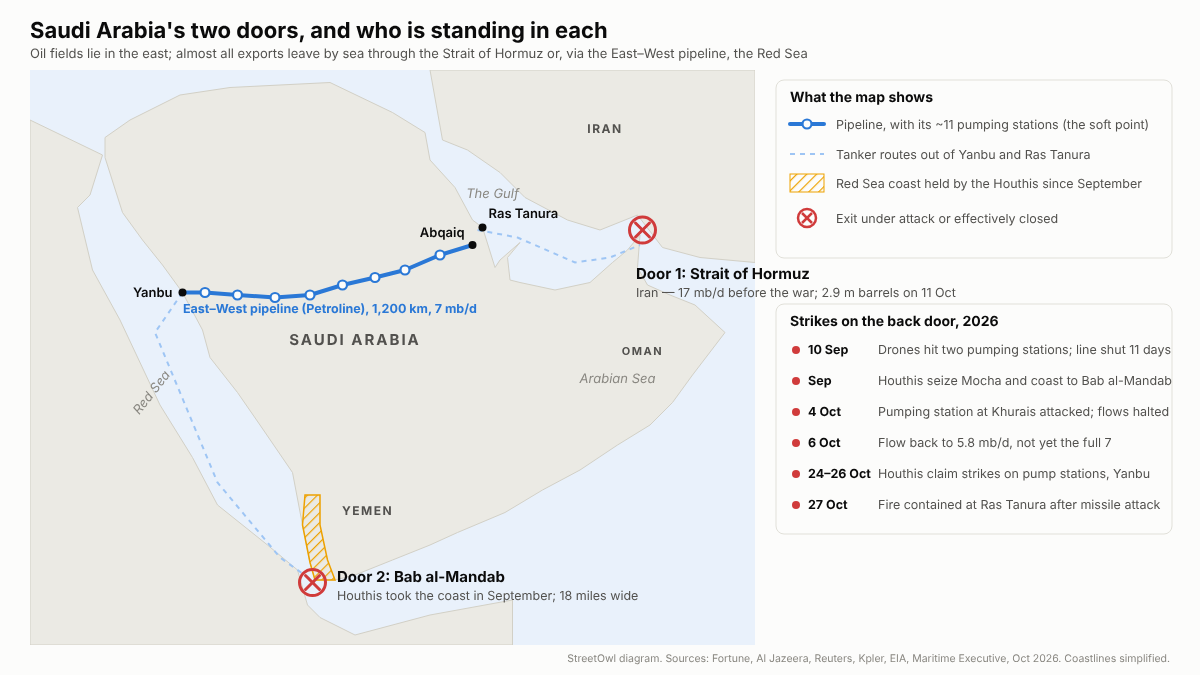
When the United States and Israel struck Iran on 28 February 2026 and the strait effectively closed, not because ships were sunk but because protection-and-indemnity insurers withdrew cover on 5 March, Aramco turned the insurance policy into the main road. By late March the Petroline was pumping its full 7 million barrels a day, about 2 million of which went to Saudi refineries rather than export. Saudi crude production nevertheless fell from more than 10 million barrels a day to below 7 million for much of the war's first six months, recovering to about 8 million in September. Kpler data put Hormuz oil exports at just under 9 million barrels a day in September, roughly 44 per cent of February's level, and on 11 October only 2.9 million barrels passed, against a pre-war daily average of 17.1 million.
What has changed this autumn is that the back door is under fire as well. The Houthis, Iran's allies in Yemen, declared a maritime blockade of Saudi Arabia in July, took the port of Mocha and the Red Sea coast down to the Bab al-Mandab strait in September, and began striking the pipeline itself. On 10 September drones hit infrastructure in the Riyadh and Medina regions; Reuters reported damage to two pumping stations, satellite analysis by the Payne Institute showed one station complex burning for at least 13 hours, and the line was shut from 11 to 22 September. A pumping station at Khurais was attacked on 4 October. On 6 October the energy minister, Prince Abdulaziz bin Salman, said flow was back to 5.8 million barrels a day, still short of the 7 million design figure. On 24 and 26 October the Houthis claimed fresh strikes on pumping stations and on Aramco facilities at Yanbu, and on 27 October a fire was contained at Ras Tanura, the kingdom's principal Gulf export terminal, after Saudi forces said they had intercepted three ballistic missiles and four drones.
Pumping stations are the soft point. Estimates of their number range from six to thirteen, with eleven the most common figure, and analysts at CSIS note that a damaged station takes longer to repair than a breached pipe because equipment has to be replaced and recertified; full restoration after the September strike was expected to take six to eight weeks. Yanbu itself holds only five to seven days of crude in storage, and every southbound tanker leaving it must pass Bab al-Mandab, about 18 miles wide at its narrowest and now flanked on the Yemeni side by Houthi-held coast. Aramco's chief executive, Amin Nasser, said on 23 October that the company aims to raise the pipeline to 10 million barrels a day, but the energy minister has said that would take two to three years, and Gilbert Metcalf of MIT Sloan estimates it would add only about 2 per cent to world supply.
The lesson is about geography rather than oil. A bypass is only a bypass if the other exit stays open. The Petroline was designed for a world in which Hormuz was dangerous and the Red Sea was safe. Iran and the Houthis have contrived to close both doors at once, and no pipeline can be engineered around that.
Sources
- Fortune, 23 October 2026
- Al Jazeera, 6 October 2026
- Al Jazeera, 14 October 2026
- The Maritime Executive, 27 October 2026
- OilPrice.com, 27 October 2026
- House of Saud (citing Reuters, CSIS and the Payne Institute), 26 October 2026
- BizPac Review (citing Reuters, EIA and Vortexa), 10 September 2026
- Wikipedia, 2026 Strait of Hormuz crisis (accessed 28 October 2026)
- Bloomberg, 27 October 2026
This piece was drafted by AI from the public sources named, then read and approved by Michael Rossi before it went up. It explains how something works; it is not advice of any kind.
← Back to StreetOwl