The password was the day's date: how 700 French supermarkets were cooked over the internet
Drop this at dinner: Someone cooked seven hundred French supermarkets over the internet last month, the fridges' password was the day's date, and France now says it was Iran's Revolutionary Guards.
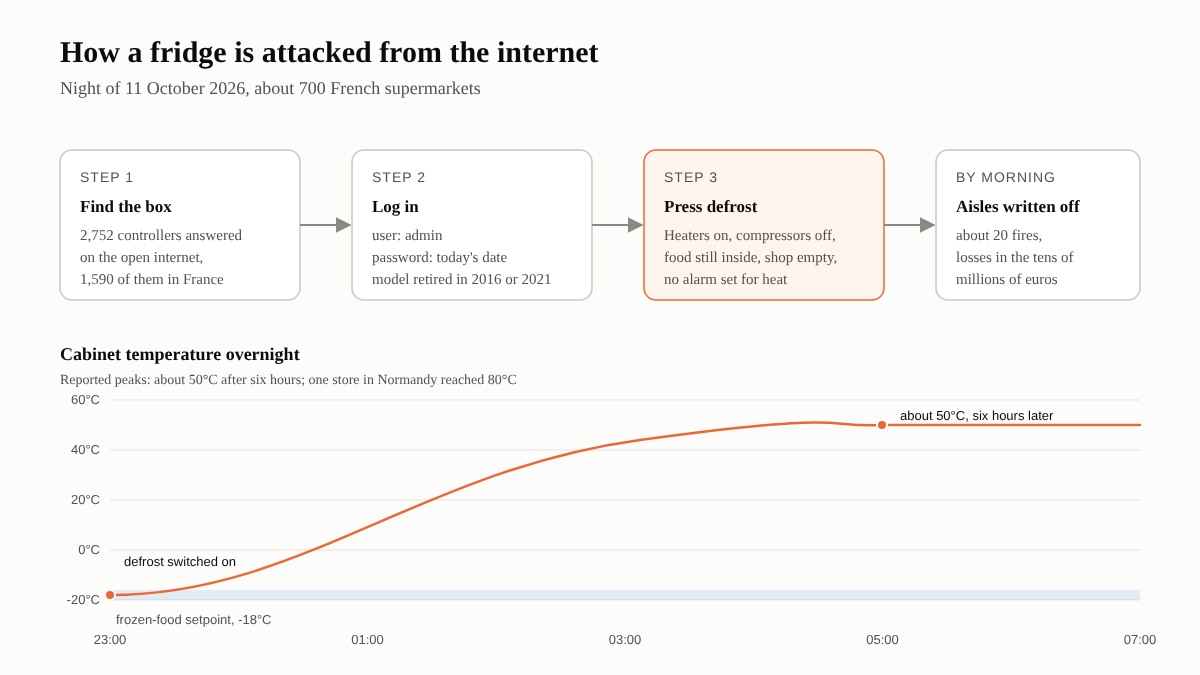
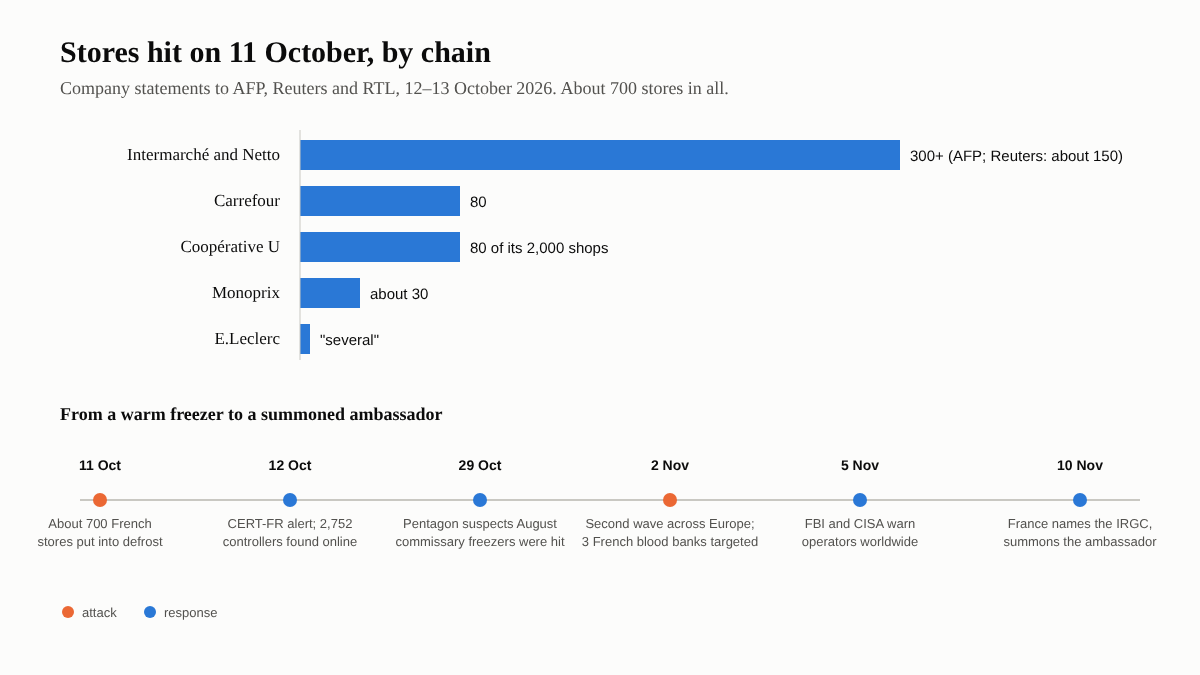
On 10 November Jean-Noël Barrot, the French foreign minister, named Iran's Revolutionary Guards as the authors of the strangest attack of the Iran war so far. On the night of 11 October somebody switched the fridges and freezers of about 700 French supermarkets into defrost with the food still inside: more than 300 Intermarché and Netto stores, 80 Carrefours, 80 Coopérative U shops, around 30 Monoprix and a handful of Leclercs. Cabinets sat at about 50°C for six hours, one in Normandy reached 80, about 20 caught fire, and Intermarché's parent, Les Mousquetaires, expects losses in the tens of millions of euros. Paris prosecutors have named three men from an IRGC cyber unit called Shahid Kaveh and asked for international arrest warrants; France has summoned Iran's ambassador and will seek EU sanctions. Iranian media dismissed the claims.
How it was done
A supermarket's cold aisles hang off one controller box, typically a Danfoss AK-SM 800 or AK-SC 355, models retired in 2021 and 2016, which the refrigeration contractor reaches over the web so that nobody has to drive out in the middle of the night. The day after the attack a researcher at Predicta Lab counted 2,752 of those boxes answering on the open internet, 1,590 of them in France, and many still accepted the login "admin" with the day's date as the password. Nothing clever was broken. The attackers logged in and pressed defrost, at night, when the shop floor was empty and no alarm was set to notice heat rather than cold.
On 2 November it happened again in Belgium, the Netherlands, Sweden, Estonia and Ireland, and someone tried to push the refrigerators of three French blood banks to 110°C; monitoring alerts caught that one and the plasma was saved. On 5 November the FBI, CISA and three other US agencies issued a joint warning to operators of industrial refrigeration and cold-chain systems worldwide, and the Pentagon now suspects that spoiled freezers at US military commissaries in August were an earlier case of the same thing.
Why it counts as war rather than crime
The point is cost. Since the Iran war began in February, Iranian pressure on Europe has moved to the cheap end of the spectrum: an alleged plot around RAF Fairford in September, an Iranian threat that led the US to move its tankers out of RAF Mildenhall on 9 November, and now fridges. Ruined yoghurt does not trigger NATO's Article 5, but it makes the war felt in Nantes.
It also stays deniable. Russia-linked hacktivist groups claimed the European attacks first, US intelligence rates the attribution to Iran only "low confidence", and France rests its case on Farsi-language traces, Iran-linked IP addresses and infrastructure previously tied to the Shahid Kaveh unit. That ambiguity is not a flaw of the method; it is the method.
Sources
- Just Security, Early Edition, 10 Nov 2026
- Cybernews, Iran or Russia? France challenges hackers' claims over fridge attacks, 10 Nov 2026
- Iran International, France warns Iran of retaliation over IRGC hack of supermarket freezers, 10 Nov 2026
- The Hacker News, Attackers heat French supermarket fridges up to 50°C by hijacking Danfoss controllers, Oct 2026
- Forbes, The French supermarket fridge hack that made cyberattacks physical, 20 Oct 2026
- Cyber Security News, CISA and FBI warn hackers are targeting industrial refrigeration systems, 9 Nov 2026
- Wikipedia, 2026 French supermarket refrigerator hack, Nov 2026
- MD Weekly Briefing, week of 9 Nov 2026
This piece was drafted by AI from the public sources named, then read and approved by Michael Rossi before it went up. It explains how something works; it is not advice of any kind.
← Back to StreetOwl