The neocloud money loop: how a Bitcoin miner nearly listed at A$44 billion
Drop this at dinner: An Australian company with fifty million dollars of revenue tried to list at forty-four billion this month, and it got that far because Nvidia is its investor, its supplier and its insurer all at once.
In early October an Australian company called Firmus attempted the largest float on the Australian stock exchange since Telstra. It wanted to sell about A$7 billion of shares at A$11 each, valuing the business at A$44 billion, enough for a seat in the ASX 20. The book opened on Tuesday 6 October; on Friday 9 October the board withdrew the offer, saying the terms did not reflect the strength of the business, and that it would raise private capital instead. On 28 October its audited accounts for the year to June were lodged with the regulator, ASIC, and they show what the money had been for.
Firmus is a neocloud. It began life in 2019 as a Bitcoin miner in Tasmania and now builds what it calls AI factories: halls of Nvidia chips rented out by the hour to OpenAI, which has signed for two sites in Malaysia, and Meta, which uses its Melbourne site. It has 46 megawatts running, 865 megawatts under development and some 3.2 gigawatts of planned capacity across Australia and South East Asia, against a total Australian data centre capacity of about 1.5 gigawatts.
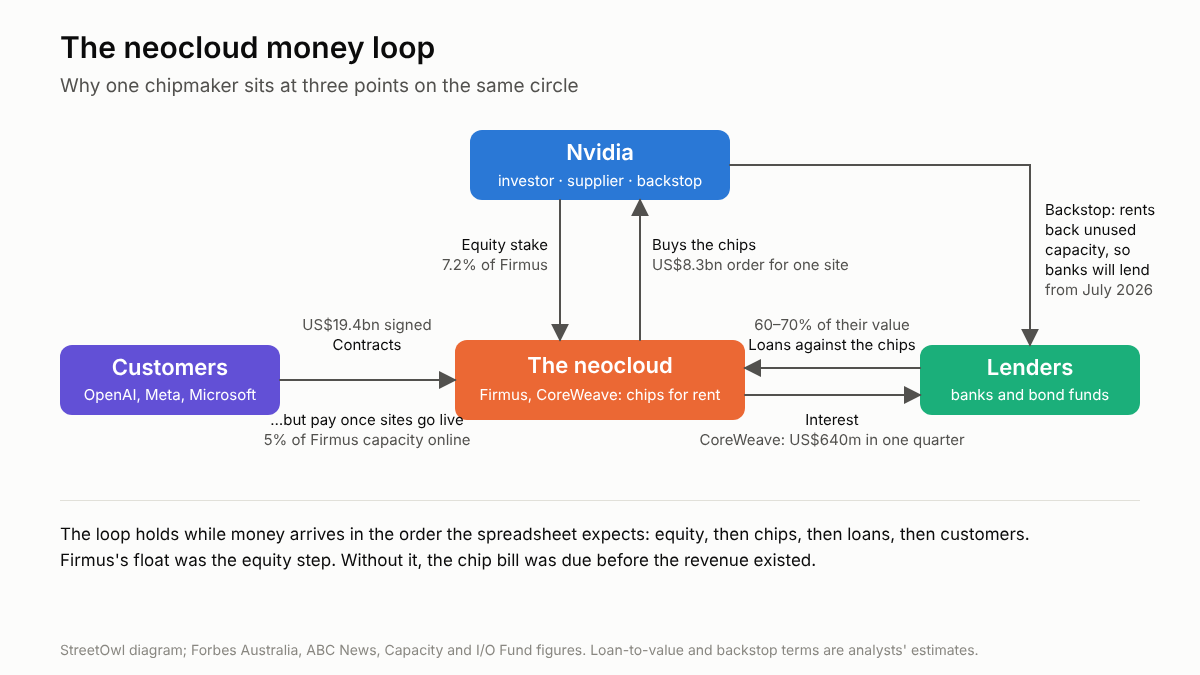
Why one chipmaker sits at three points on the circle
The neocloud model is a loop, and Nvidia sits at three points on it. It takes an equity stake, 7.2 per cent in the case of Firmus, after leading a A$330 million round in September 2025 and joining a US$2 billion round with Coatue, Blackstone and Jane Street in August 2026. The neocloud then spends that money, and a great deal more, on Nvidia's chips. Lenders advance roughly 60 to 70 per cent of the chips' value as loans secured on the hardware. And since 1 July 2026 Nvidia has offered to rent back any capacity that sits idle at a fixed rate, which is what persuades the banks to lend at all. Jensen Huang has called the charge of circular financing ridiculous, arguing that Nvidia's stakes are a small share of what these companies must raise.
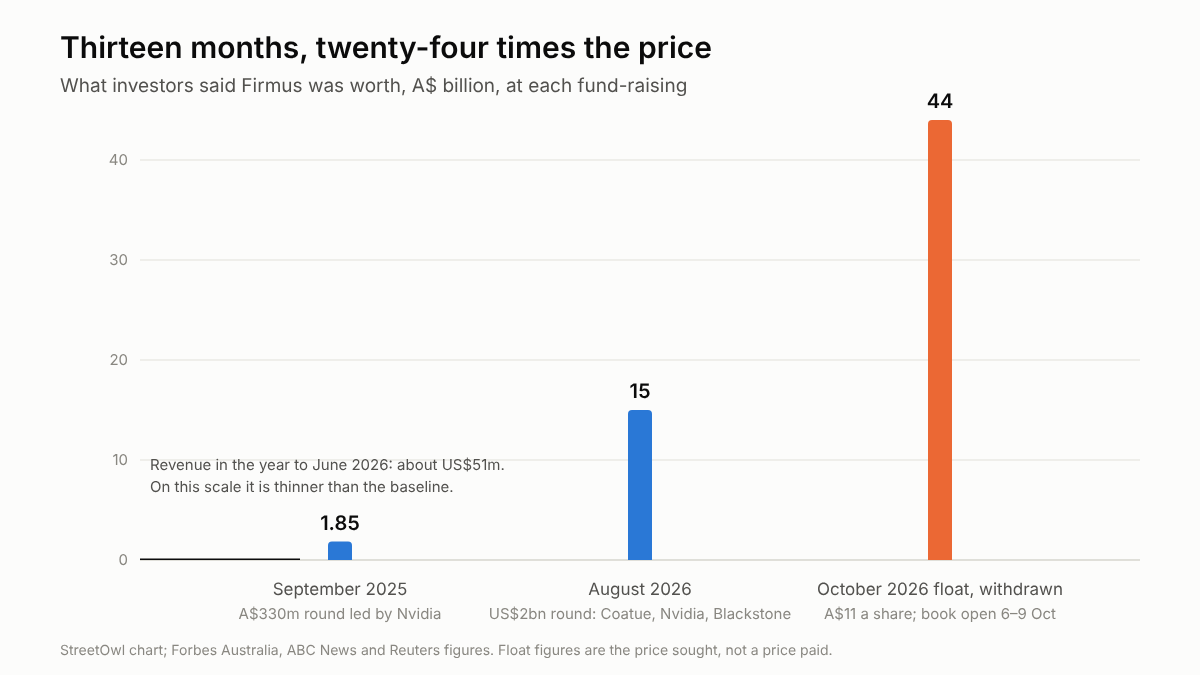
The numbers that broke the float
Firmus was valued at A$1.85 billion in September 2025, about A$15 billion in August 2026 and A$44 billion at the October float, a twenty-four-fold rise in thirteen months. Revenue in the year to June 2026 was about US$50.8 million, double the previous year, and only 5 per cent of the company's contracted capacity was switched on when it tried to list. The accounts disclose a US$8.3 billion chip commitment for a site at Batam in Indonesia, with about US$550 million of pre-payments due by December, which the directors' forecasts had assumed the float and new loans would fund. About half the shares on offer were being sold by early backers, and only about 42 per cent of the register was locked up, so large holders could have sold soon after trading began.
Demand from Australian superannuation funds and fund managers was thin. UniSuper declined, its chief investment officer saying the deal did not have a compelling valuation. On Wednesday 7 October the chief executive of CDC Data Centres said a plan to build 1.6 gigawatts of AI factories with Firmus was no longer under way, and orders began to be withdrawn. Shares in Maas Group, a 3.2 per cent holder with A$1.2 billion of fit-out contracts, fell 37 per cent in five days, and data centre operator NEXTDC has fallen sharply since.
The refinancing wall
A neocloud works only while capital arrives in the order the spreadsheet expects: equity, then chips, then loans, then customers who pay once the sites switch on. Firmus's float was the equity step; without it, the chip bill fell due before the revenue existed. The same arithmetic applies to the largest neocloud, CoreWeave, which carried US$35 billion of debt at 30 June 2026, paid US$640 million of net interest in a single quarter, and plans US$35 to 39 billion of capital spending this year against a revenue backlog of US$104 billion. Chip-backed loans across the sector mature between 2026 and 2028, a period lenders already call the neocloud refinancing wall, and Nvidia's rent-back guarantee shifts part of that risk onto its own balance sheet.
Sources
This piece was drafted by AI from the public sources named, then read and approved by Michael Rossi before it went up. It explains how something works; it is not advice of any kind.
← Back to StreetOwl