The grid's heartbeat, and the June evening it skipped
Drop this at dinner: Britain's entire grid shares a single pulse of fifty beats a second. In June it slipped to 49.66, which sounds like nothing until you know that at 48.8 the system starts switching people off automatically.
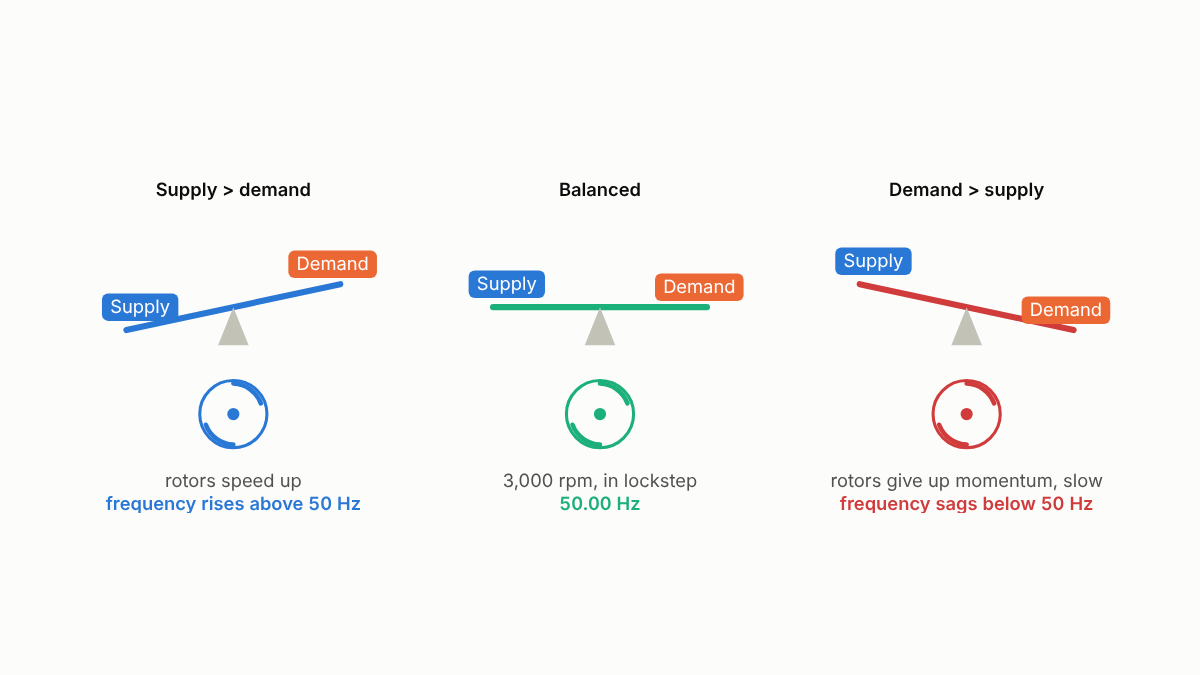
Every socket in Britain is plugged into one shared heartbeat. The grid runs at 50 hertz, and every large generator in the country, from the gas turbines at Pembroke to the reactor at Sizewell, spins in exact lockstep with that beat, which is what lets them pool their output into a single system. The same number is also the grid's only honest gauge of balance. Electricity cannot be stockpiled at scale, so supply and demand have to match every instant. When demand edges ahead of supply, nothing switches off; the missing energy is borrowed from the momentum of those spinning rotors, which slow by a whisker, and the whole country's frequency sags. Too much supply and it rises. The control room in Wokingham watches that figure the way a pilot watches altitude.
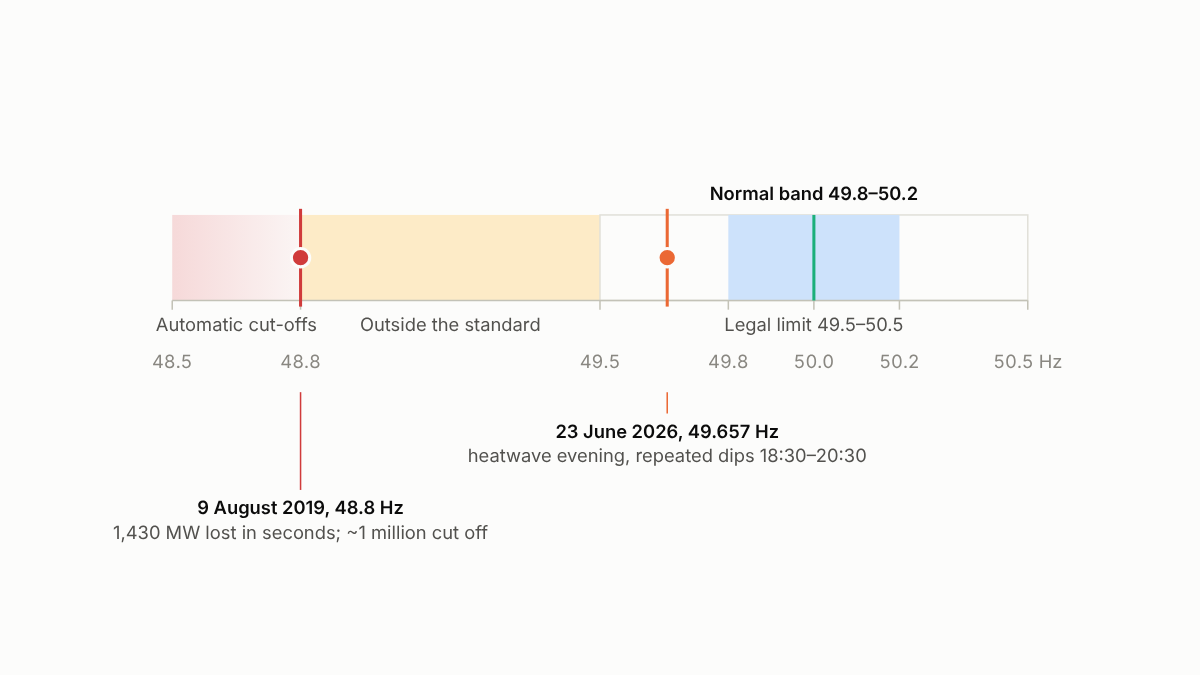
The National Energy System Operator's normal band is 49.8 to 50.2 Hz, the statutory limit is 49.5, and at 48.8 Hz relays across the network begin cutting customers off in five per cent blocks, automatically, to protect the rest. That is what happened on 9 August 2019, when a lightning strike knocked out an offshore wind farm and a gas plant within seconds, 1,430 megawatts vanished, frequency hit 48.8 and about a million people lost power.
That is why 23 June 2026 matters. During the heatwave, demand ran roughly 2 gigawatts above forecast, wind output was low, rooftop solar faded with the evening, and the French interconnector flipped from full import to export in under an hour because power was fetching about £1,200 a megawatt-hour in France against £600 in Britain, leaving the country some 5 GW short of what it had planned to buy. Frequency dipped below 49.8 Hz repeatedly between 18:30 and 20:30 and bottomed at 49.657. The control room ordered exports to the Netherlands cut to zero for two hours and asked France for emergency assistance. Nobody's lights went out, and NESO said at the time that the system was "not at risk", but reports published on 19 October 2026 showed five network constraint limits were breached that evening, and Ofgem will not publish its conclusion on whether the grid was secure until 31 January 2027.
The deeper shift is that solar panels, wind turbines and the cables from abroad feed the grid through electronics rather than spinning metal, so the national flywheel is shrinking year by year. The faster the frequency can fall after a shock, the less time anyone has to catch it.
Sources
This piece was drafted by AI from the public sources named, then read and approved by Michael Rossi before it went up. It explains how something works; it is not advice of any kind.
← Back to StreetOwl