The gas you can never burn
Drop this at dinner: Europe's gas stores hold more gas that can never be sold than gas that can, and the fuller they are the faster they pour, so 'three-quarters full' is less reassuring than it sounds.
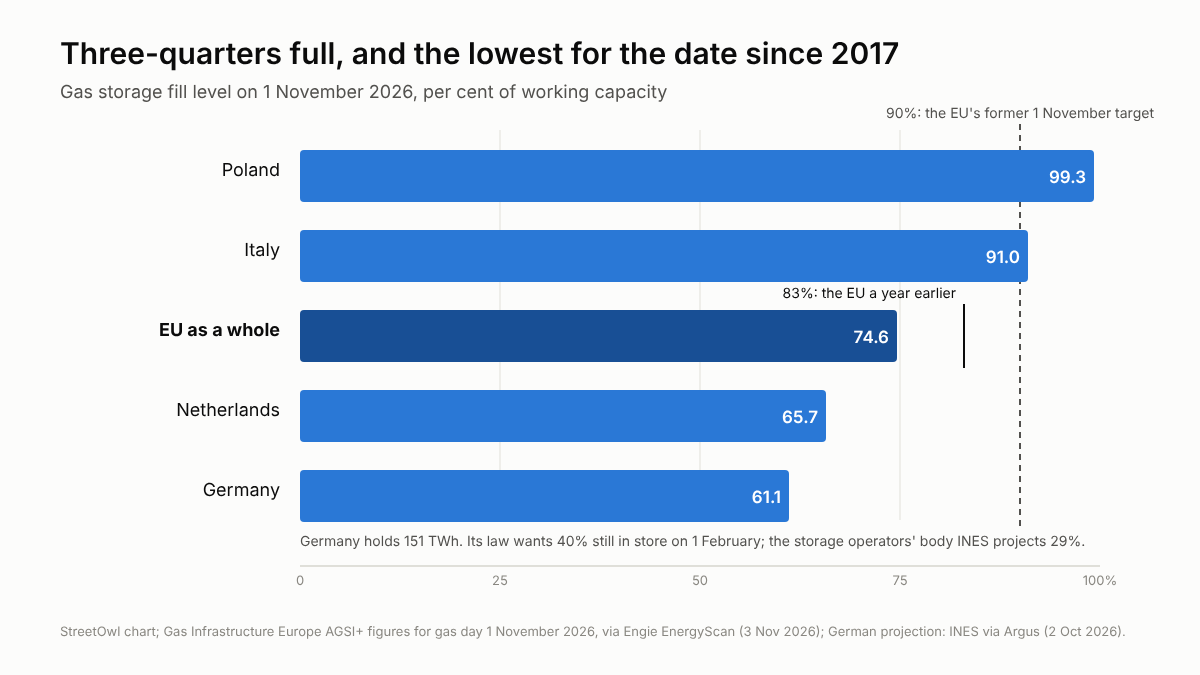
Europe went into winter on 1 November 2026 with its gas stores 74.6 per cent full, about 844 terawatt-hours, the lowest for that date in any year since 2017 and some fifteen points below the average. Germany stood at 61 per cent, and the Dutch TTF benchmark has been trading above €100 a megawatt-hour, a level last seen in 2022. Three-quarters full sounds like three-quarters of a winter in hand. The physics underground says otherwise, twice over.
The gas that has to stay
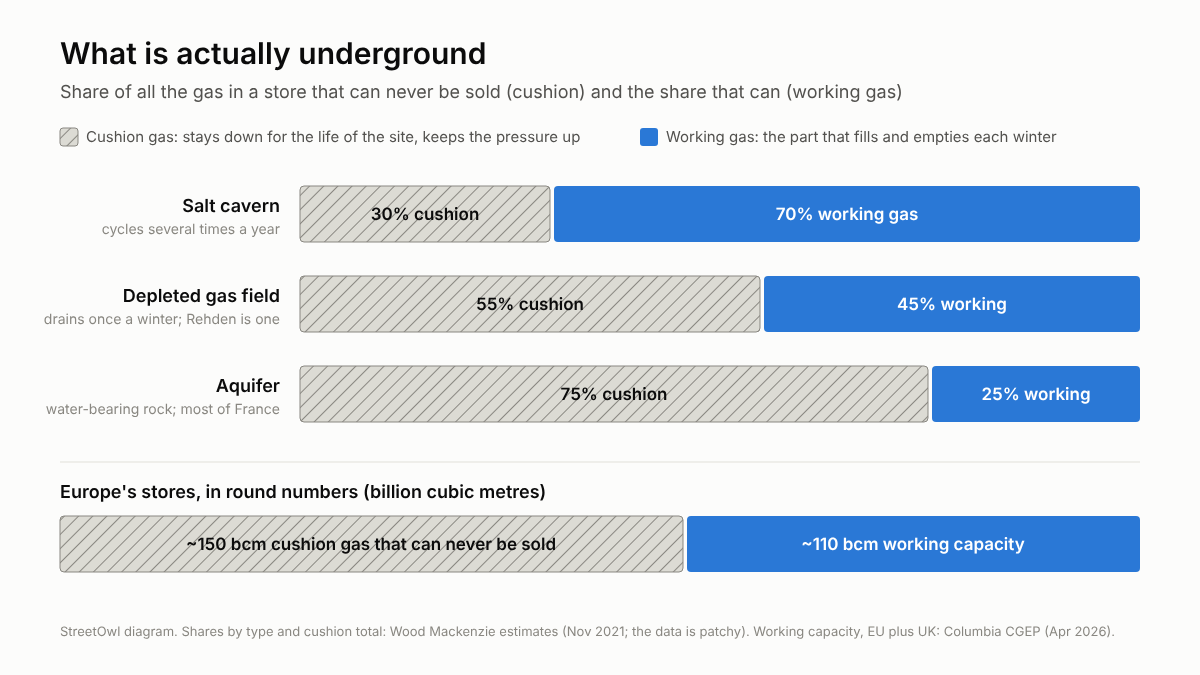
A store is never empty, and never can be. Most European storage sits in exhausted gas fields and in water-bearing rock, with a minority in caverns dissolved out of salt. To get gas out you need pressure, so a large permanent charge, the cushion gas, has to stay down for the life of the site. In a salt cavern it is about 30 per cent of everything in the ground; in a depleted field about 55 per cent; in an aquifer about 75 per cent, three units locked away for every one that can be sold.
Wood Mackenzie once put Europe's cushion at roughly 150 billion cubic metres against about 110 billion of saleable working capacity: more gas sits underground that can never be sold than gas that can. When Gazprom left Rehden, Germany's largest store at 4.1 bcm, effectively empty in 2022, that meant the working gas only. The cushion was still there, as it must be.
The fuller it is, the faster it pours
INES, the German storage operators' body, compares a store to a balloon: pressure is high when full and withdrawal is fast, and it falls as the gas comes out, even though plenty remains. Depleted fields and aquifers are built to drain once a winter; salt caverns can cycle several times a year, which is why they do the sprinting. The sprint matters on days like 7 January 2026, when German demand plus exports to neighbours hit 6.5 TWh, imports including LNG supplied about 3, and storage had to cover more than half.
A store at 30 per cent in February cannot do what the same store did at 75 per cent in November. That is why German law insists on 40 per cent still in the ground on 1 February, and why it matters that INES projects 29.
Sources
- Engie EnergyScan, Europe gas storage tracker (GIE AGSI+ data), 3 November 2026
- oEnergetice, 3 November 2026
- Argus Media, 2 October 2026
- S&P Global Energy, 7 July 2026
- Columbia Center on Global Energy Policy, 23 April 2026
- Wood Mackenzie, 4 November 2021
- S&P Global, 9 May 2022
- US Energy Information Administration, The Basics of Underground Natural Gas Storage
This piece was drafted by AI from the public sources named, then read and approved by Michael Rossi before it went up. It explains how something works; it is not advice of any kind.
← Back to StreetOwl