The first kilometre-high building, and the three problems that get worse as you go up
Drop this at dinner: The tower going up in Jeddah will be the first building over a kilometre tall, and the trickiest bit is not holding it up; it is that nobody has ever pumped wet concrete higher than 606 metres, and this one needs to go well past that.
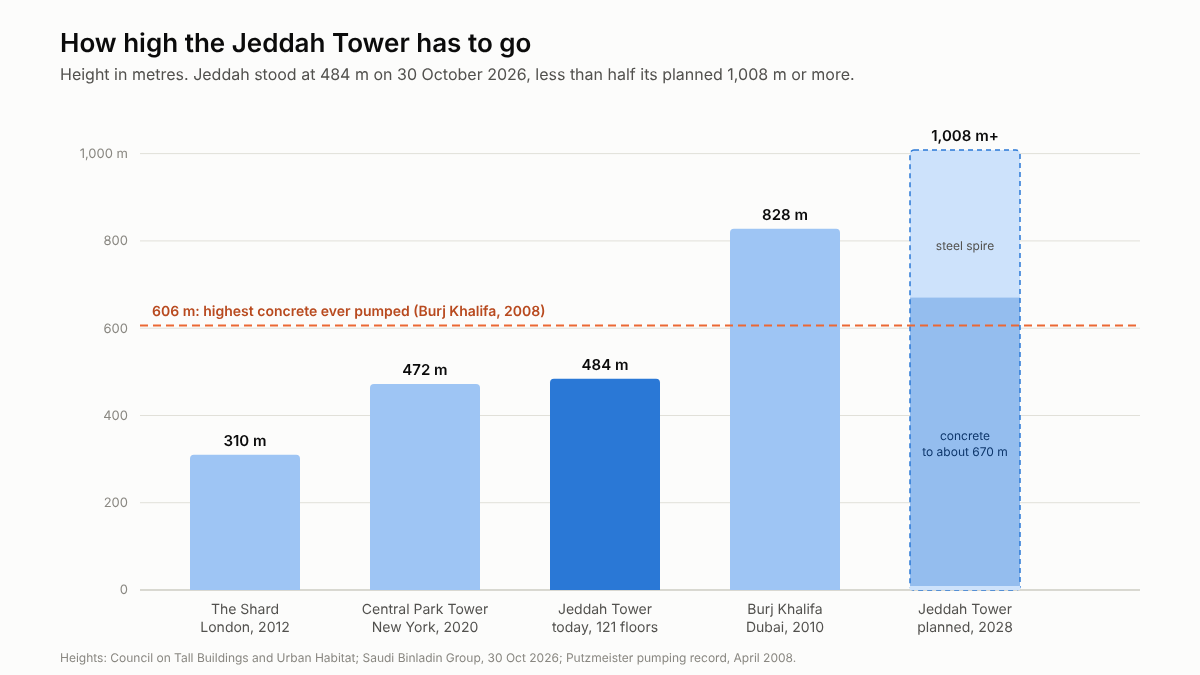
Somewhere above the Red Sea coast this month, a concrete core crept past the top of New York's Central Park Tower and became the fifteenth tallest building on earth, while still less than half finished. The Jeddah Tower stood at 484 metres and 121 floors on 30 October 2026; its builders expect to reach the halfway mark, about 500 metres, around the end of November, and the finished building will top 1,000 metres, the first ever to pass a kilometre. Construction began in 2013, stalled at the 63rd floor in 2018, and restarted only in January 2025. In the past year the team has added 49 floors in 52 weeks, and completion is pencilled in for August 2028.
Confusing the wind
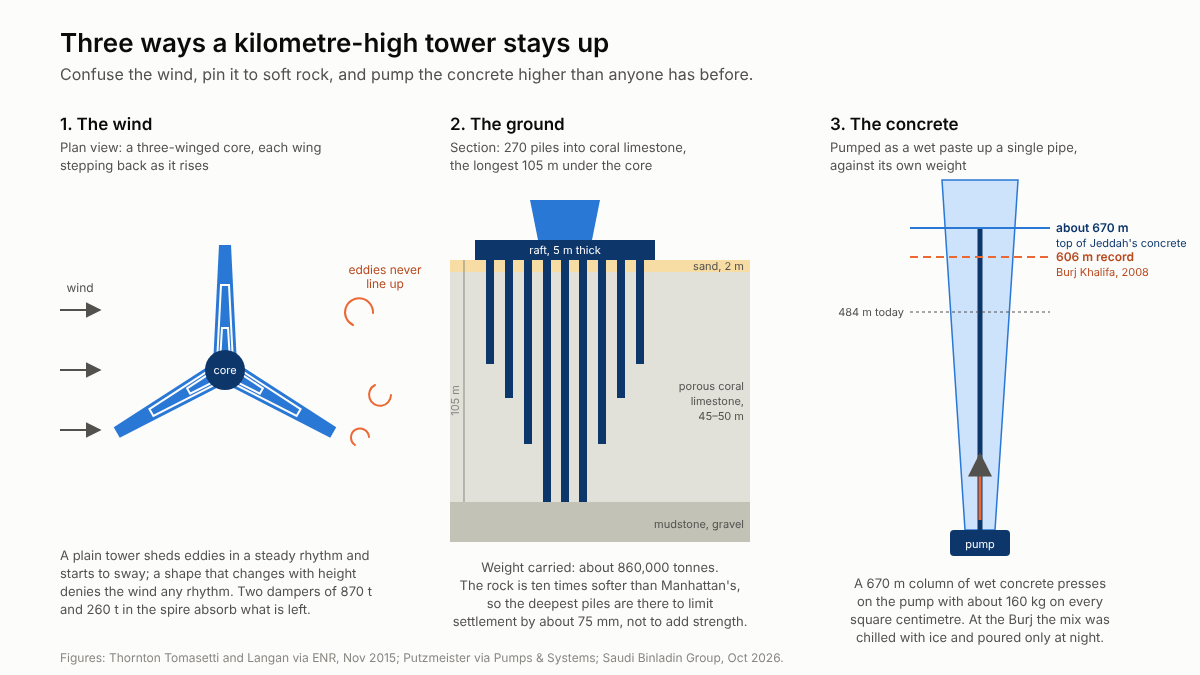
Three problems do not just get bigger with height, they change character. The first is wind. A tall, uniform tower in a steady breeze sheds spinning eddies alternately off each side, and those vortices give it a rhythmic shove that builds like a child being pushed on a swing. Adrian Smith, who also designed the Burj Khalifa, used the same answer here: a three-winged Y plan with each wing tapering and stepping back as it rises, so the wind never meets the same cross-section at any two heights and cannot settle into a rhythm. The engineers' phrase is that the shape "confuses the wind". Even so, two steel pendulums of 870 and 260 tonnes will hang inside the spire to soak up roughly 30 per cent of its sway.
Pinning it to soft rock
The second is the ground. Jeddah sits on porous coral limestone at least ten times softer than Manhattan's bedrock, so the tower rests on 270 piles up to 105 metres deep beneath a five-metre raft, carrying about 860,000 tonnes. The curious part is that the deepest piles under the core add almost no strength; they are there to shave about 75 millimetres off how far the building settles, so it settles evenly and stays level.
Pumping the concrete
The third is the one nobody has yet solved at this height. Concrete reaches the top as a wet paste pushed up a single pipe, and the record stands at 606 metres, set at the Burj Khalifa in 2008 with a mix chilled with ice and poured only at night. Jeddah's concrete structure runs to roughly 670 metres before the steel spire begins, so at some point in 2027 a pump in Saudi Arabia will have to push a column of concrete higher than anyone ever has.
Sources
This piece was drafted by AI from the public sources named, then read and approved by Michael Rossi before it went up. It explains how something works; it is not advice of any kind.
← Back to StreetOwl