The experience machine: would you plug into a perfect life?
Drop this at dinner: Ask people if they would plug into a machine that gives them a perfect life and most say no; tell them they are already in it and ask if they want out, and many say no again.
The American Psychological Association's 2026 trends report opens on a striking figure: between 2022 and mid-2025 the number of AI companion apps grew by 700 per cent, and Character.AI alone has around 20 million monthly users. The evidence on what they do to us points both ways. A Harvard Business School study found that talking to an AI companion eased loneliness about as much as talking to a person; an OpenAI and MIT Media Lab study found that heavy daily use went hand in hand with more loneliness. Underneath the argument sits a question posed fifty-two years ago by the Harvard philosopher Robert Nozick.
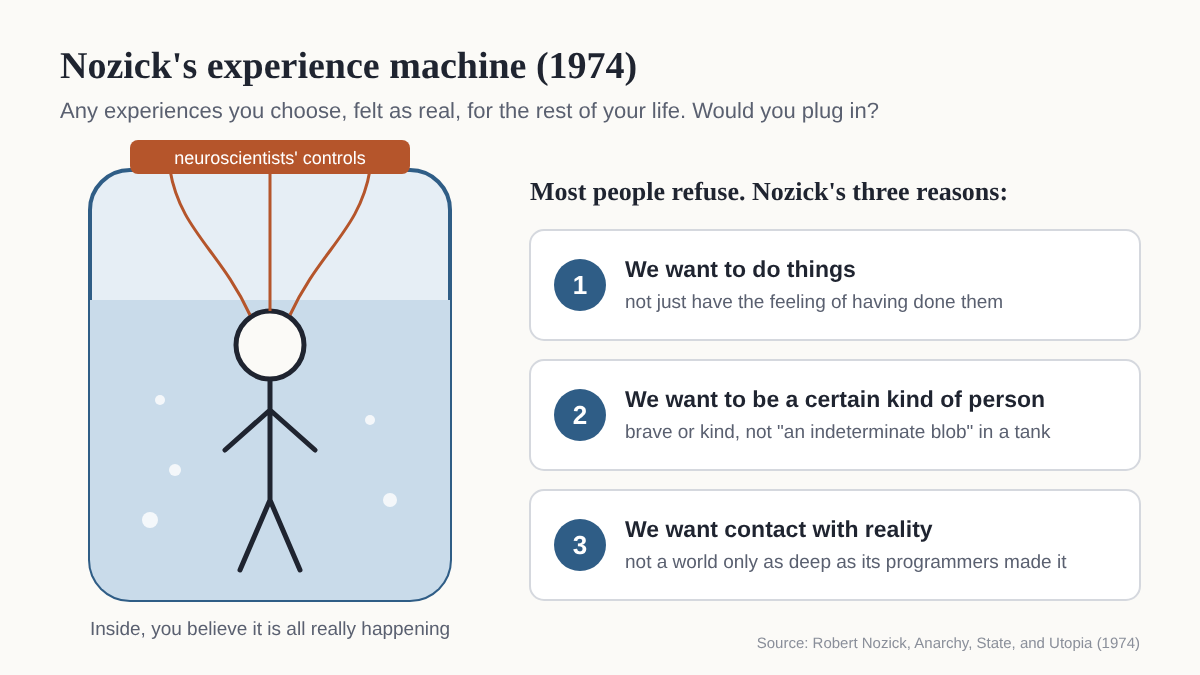
In Anarchy, State, and Utopia (1974), Nozick asked readers to imagine a machine, run by superb neuroscientists, that could give them any experiences they wanted: writing a great novel, making a friend, being loved. Floating in a tank with electrodes on the brain, they would believe it was all really happening. Would they plug in for life? Most people say no, and Nozick took that refusal as evidence against hedonism, the view that only pleasant experience matters. He gave three reasons for holding back: people want to actually do things, not just have the feeling of doing them; they want to be a certain kind of person, brave or kind, rather than “an indeterminate blob” in a tank; and they want contact with something real, not a world only as deep as its programmers made it.
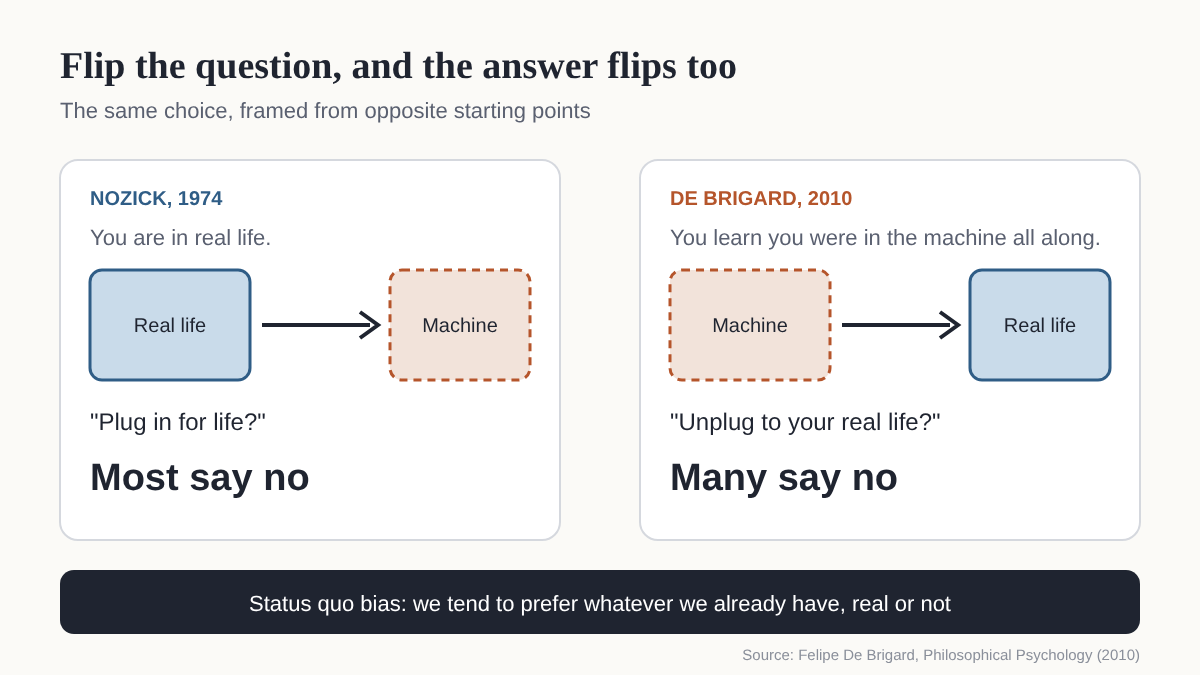
The comeback came in 2010, when the philosopher Felipe De Brigard turned the question around. Suppose people are told that their life so far has been lived inside the machine, and that they can unplug to their real life. Many people in his experiments chose to stay, which hints that the original “no” may owe as much to status quo bias, the preference for whatever we already have, as to a deep love of reality. That is why AI companions make the old puzzle live again: they are a small, voluntary piece of the machine, a friendship that feels real from the inside. The question is not whether the feelings are genuine, but whether a life should be judged only by how it feels.
Sources
- American Psychological Association, Monitor on Psychology, 1 Jan 2026
- Robert Nozick, Anarchy, State, and Utopia, Basic Books, 1974
- Felipe De Brigard, “If you like it, does it matter if it’s real?”, Philosophical Psychology, 2010
This piece was drafted by AI from the public sources named, then read and approved by Michael Rossi before it went up. It explains how something works; it is not advice of any kind.
← Back to StreetOwl