The candidate who beat everyone and lost: why no voting system can find the will of the people
Drop this at dinner: In 2022 most Alaskan voters preferred Nick Begich to either of his rivals and he was knocked out first; an economist proved in 1951 that every ranking system can misfire like that, so there is no will of the people, only the will of the counting method.
On Tuesday 3 November 2026 voters in Alaska were asked, for the second time in two years, whether to abolish the way they elect their politicians. Ballot Measure 2 would have ended the open primary and the ranked-choice general election that the state adopted by referendum in 2020, when the change passed by 174,032 votes to 170,251, or 50.55 per cent. On the early count the system survives: Alaska Public Media reported “no” to repeal on nearly 52 per cent with 98 per cent of precincts counted. The result is not final. Alaska accepts postal ballots for up to 15 days after polling day, and in 2024 a similar repeal led on election night before failing by 743 votes.
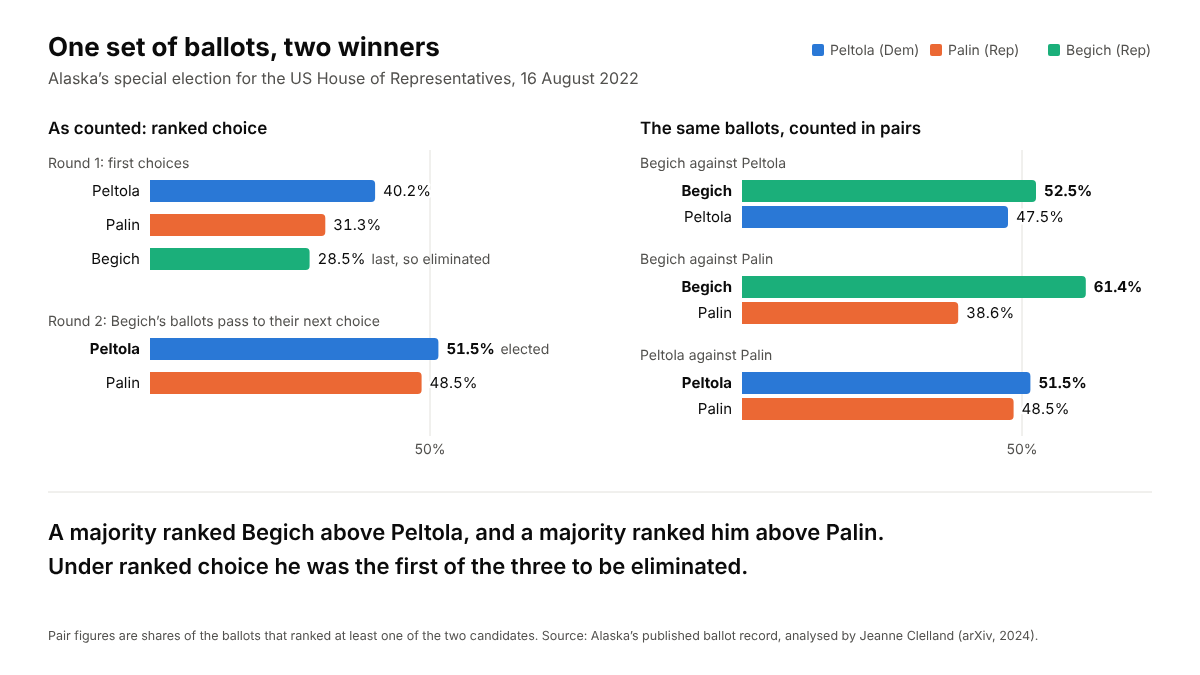
Much of the argument turns on one contest. In a special election for Alaska’s single seat in the US House of Representatives on 16 August 2022, three candidates were on the ballot. Mary Peltola, a Democrat, was the first choice of 75,799 voters (40.2 per cent); Sarah Palin, a Republican, of 58,973 (31.3 per cent); and Nick Begich, also a Republican, of 53,810 (28.5 per cent). Under ranked choice the candidate in last place is eliminated and those ballots pass to each voter’s next choice. Begich went out, and Peltola beat Palin by 91,266 to 86,026, or 51.5 per cent to 48.5.
Because every ballot records a ranking, the same votes can be counted another way: take the candidates two at a time and ask which of the pair more voters placed higher. The mathematician Jeanne Clelland did this from the state’s published record of the ballots. Begich beat Peltola by 87,859 to 79,451 (52.5 per cent) and beat Palin by 101,217 to 63,618 (61.4 per cent). A majority preferred him to each of his rivals, and he was the first to be eliminated. A candidate who beats every other in a straight contest is called the Condorcet winner. Had Palin not stood, Begich would have won; the result between two candidates turned on a third who could not win herself.
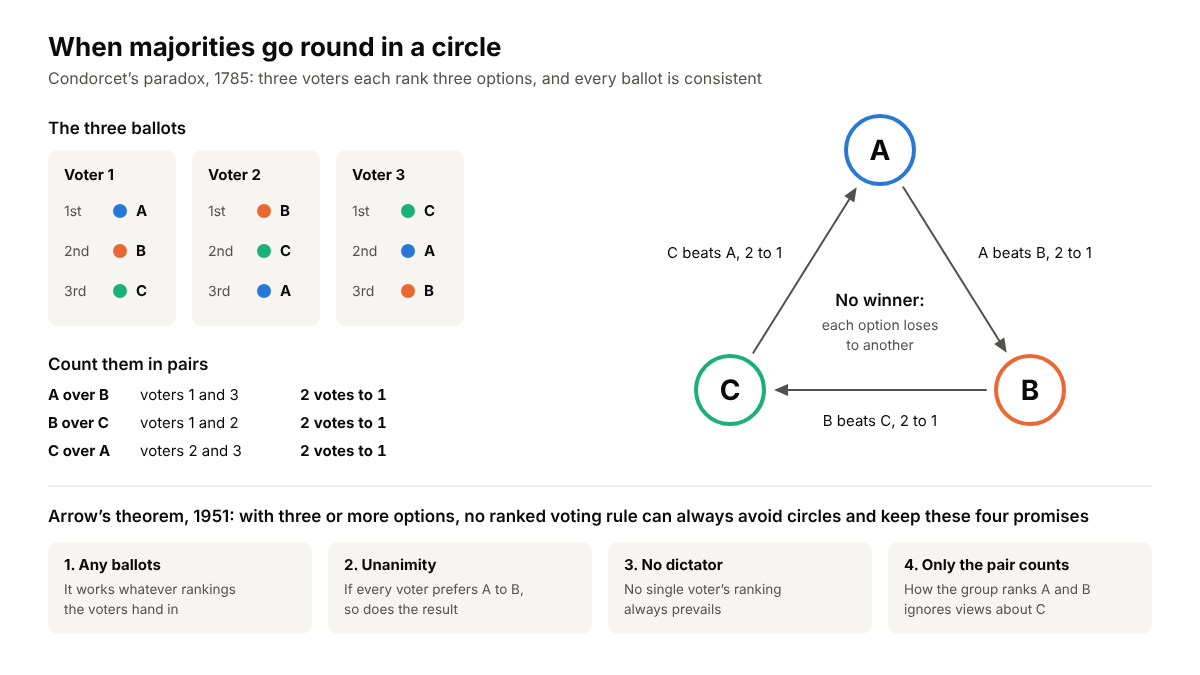
The name comes from the Marquis de Condorcet, who in 1785 published an essay on the mathematics of majority decisions. He noticed that there need not be such a winner at all. Take three voters and three options. The first ranks them A, B, C; the second B, C, A; the third C, A, B. Two of the three prefer A to B, two prefer B to C, and two prefer C to A. Each option loses to another by a majority, and the group’s preference runs in a circle. Asking what the majority wants has no answer, although every voter was perfectly consistent.
In a paper of 1950, “A Difficulty in the Concept of Social Welfare”, and in his book Social Choice and Individual Values the following year, the American economist Kenneth Arrow asked whether a cleverer method could escape the problem. He set out conditions that any reasonable way of turning individual rankings into a group ranking might be expected to meet. It should work whatever rankings the voters hand in. It should produce a consistent order with no circles. If every voter prefers A to B, the group should too. No single voter’s ranking should always prevail whatever everyone else thinks. And the group’s ranking of A against B should depend only on how voters rank A against B, not on where they place C. Arrow proved that when there are three or more options, no method satisfies all of them at once.
The theorem covers every system built on ranked preferences. First past the post reads only the top of each ranking, and it breaks the last condition whenever a third candidate splits the vote. Ranked choice was designed to reduce that, and in Alaska in 2022 it broke the same condition in a different way. Methods that always elect the Condorcet winner have no answer when the majority runs in a circle. Systems in which voters give each candidate a score rather than a place in an order fall outside the theorem, because a score carries more information than a rank, a point Arrow later accepted.
Philosophers have drawn opposite conclusions. The political scientist William Riker argued that the result makes “the will of the people” an incoherent idea: individuals have preferences, but a group has only the output of whichever procedure it uses, and a different procedure fed the same ballots can give a different answer. Others reply that the conditions need not all be insisted on, and that the theorem therefore puts no serious limit on democratic decisions.
Arrow, who shared the Nobel prize in economics in 1972, took a measured view of his own result. “Most systems are not going to work badly all of the time,” he said. “All I proved is that all can work badly at times.” The record bears him out. Across 182 American ranked-choice elections held between 2004 and 2022, researchers found only two in which a Condorcet winner existed and lost, Alaska in 2022 and the mayoral election in Burlington, Vermont, in 2009, and one with no Condorcet winner at all. Nick Begich won the Alaska seat in November 2024 under the same rules, and FairVote’s preliminary tally of Tuesday’s count had him ahead again with 50.3 per cent of first choices.
Sources
- Alaska Public Media via KTOO, 4 November 2026
- FairVote, 4 November 2026
- Jeanne Clelland, arXiv 2303.00108, 11 April 2024
- Stanford Encyclopedia of Philosophy, “Arrow’s Theorem”, revised 7 December 2025
- Wikipedia, “Arrow’s impossibility theorem”, read 6 November 2026
- Wikipedia, “Condorcet paradox”, read 6 November 2026
- Wikipedia, “2020 Alaska Measure 2”, read 6 November 2026
- Wikipedia, “2026 Alaska Measure 2”, read 6 November 2026
- Alaska Public Media, 20 November 2024
- Nobel Prize, economic sciences 1972
This piece was drafted by AI from the public sources named, then read and approved by Michael Rossi before it went up. It explains how something works; it is not advice of any kind.
← Back to StreetOwl