Paid by the hour: how Rolls-Royce really makes money from jet engines
Drop this at dinner: Rolls-Royce isn't really paid for jet engines any more; it's paid for every hour they fly, so the most profitable thing it can do is make sure they hardly ever need fixing.
Rolls-Royce publishes a trading update at seven this morning, and the figure most watched in the City will not be how many engines it sold but how many hours its engines spent in the air. That sounds backwards for an engine maker, yet it is the core of the business. In 1962 operators of the HS 125 business jet were offered a fixed fee for every hour its Viper engine flew, covering a complete replacement and repair service. The idea, now trademarked by Rolls-Royce as Power-by-the-Hour, has become the model for its large engines.
Today more than 90 per cent of Rolls-Royce's Trent engines are on long-term service agreements. The airline pays a rate per engine flying hour, set by how the engine is used, and Rolls-Royce takes on the maintenance, spare parts, health monitoring and breakdowns. Contracts on large engines run about eight years on average. The engine sale itself accounts for only around a third of revenue in the widebody and business-jet business; the hourly payments over the following decades provide the rest.
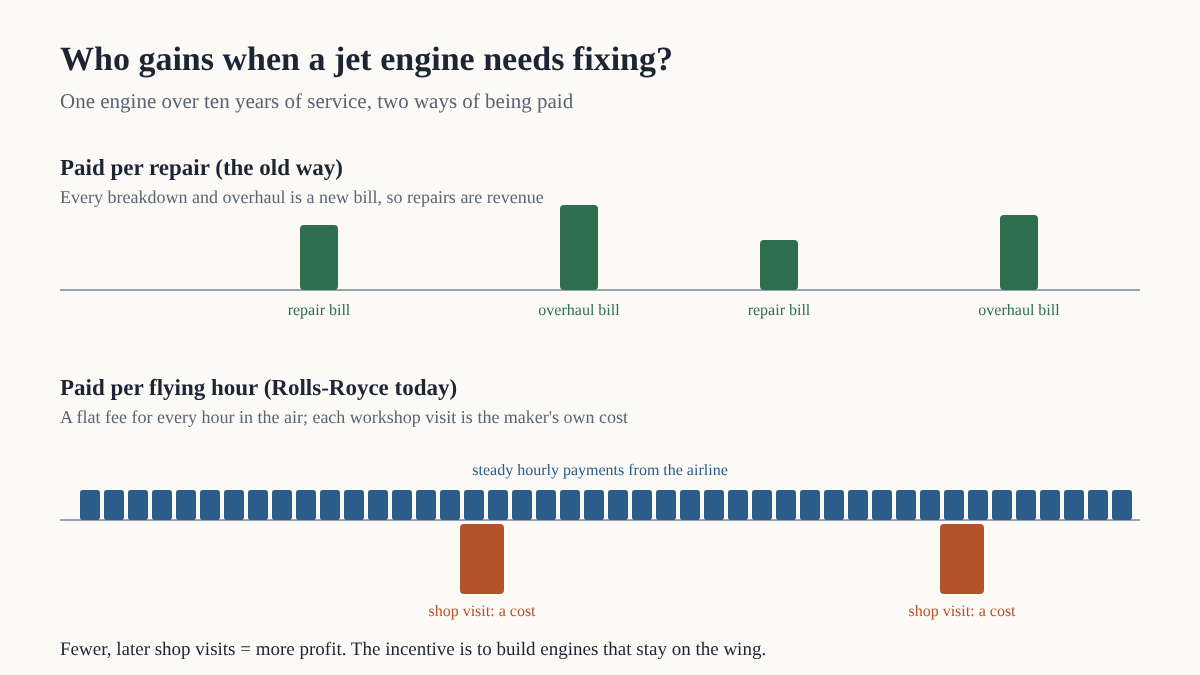
The arrangement turns the economics of repair upside down. A traditional repair shop earns more when an engine breaks. Under a flat hourly fee, every overhaul is paid for by the manufacturer, so the profit comes from keeping engines on the wing for longer between workshop visits. Rolls-Royce has redesigned the high-pressure turbine blades on its Trent 1000 and Trent 7000 engines, which it says more than doubles time on wing, and its civil aerospace operating margin reached 25.3 per cent in the first half of 2026. The airline pays the same hourly rate; the company has fewer costly shop visits to fund.
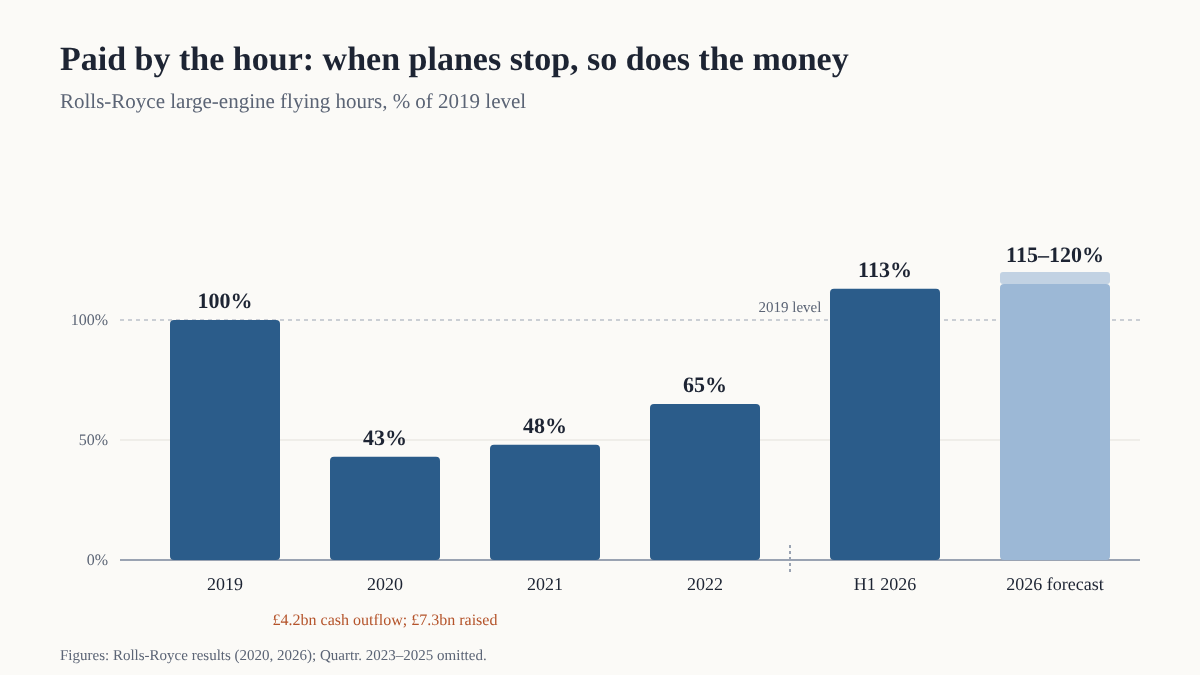
The model has a matching weakness: income stops when aircraft stop. In 2020 Rolls-Royce's large engines flew 43 per cent of their 2019 hours. Free cash outflow reached £4.2 billion, the company raised £7.3 billion of extra liquidity, including a £2 billion rights issue, and about 7,000 roles were cut. Flying hours were 48 per cent of the 2019 level in 2021 and 65 per cent in 2022.
The position has since reversed. Large-engine flying hours reached 113 per cent of pre-pandemic levels in the first half of 2026 and are forecast at 115 to 120 per cent for the year, and in July the company raised its full-year guidance for underlying operating profit to £4.7–4.9 billion and free cash flow to £3.8–4.0 billion. Because payment follows flying, the shares, down about 20 per cent from their August peak, are sensitive to anything that grounds aircraft, including higher jet fuel prices from the Iran war, which push up fares and can reduce the number of flights.
Sources
- Rolls-Royce, "Rolls-Royce celebrates 50th anniversary of Power-by-the-Hour", 30 Oct 2012
- Rolls-Royce, Long-term service agreements investor FAQ, 2024
- Rolls-Royce, 2020 full year results, 11 Mar 2021
- Leeham News, "Rolls-Royce raises earnings guidance as engine time-on-wing program accelerates", 30 Jul 2026
- Quartr Edge, "Rolls-Royce: Full Thrust Ahead", 30 Oct 2025
- The Twelfth Magpie, 9 Nov 2026
- ad-hoc-news, "Rolls-Royce stock heads toward November 12 trading update", 6 Nov 2026
This piece was drafted by AI from the public sources named, then read and approved by Michael Rossi before it went up. It explains how something works; it is not advice of any kind.
← Back to StreetOwl