Moral luck: why the same decision earns two years or life
Drop this at dinner: In English law the same reckless drive is worth two years or life depending on whether a child happened to step off the kerb, which is the whole problem of moral luck in one sentence.
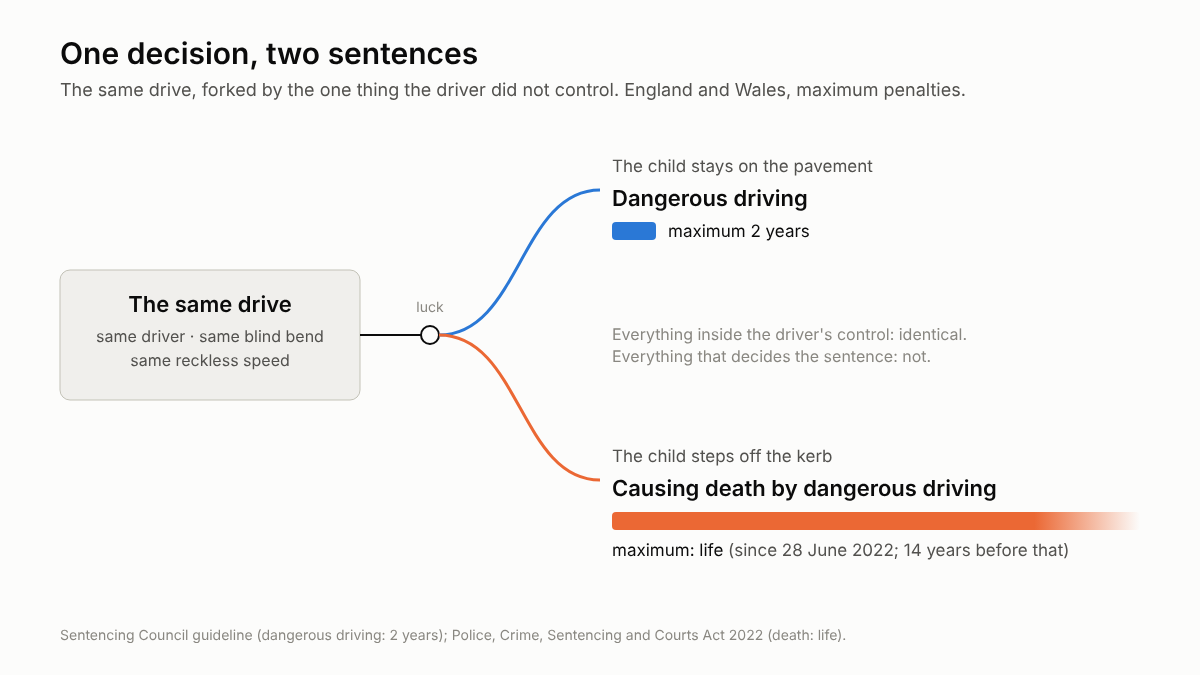
Here is a puzzle that fifty years of philosophy has not settled, and that English law quietly embodies. Two drivers take the same blind bend at the same reckless speed. One reaches home. For the other, a child steps off the kerb. The first, if caught, faces dangerous driving, which carries a maximum of two years in prison under the Sentencing Council's guideline. The second faces causing death by dangerous driving, which since 28 June 2022 carries a maximum of life, raised from 14 years by the Police, Crime, Sentencing and Courts Act 2022. Everything inside the two drivers' control was identical. The only difference was the child, and that difference is worth a lifetime.
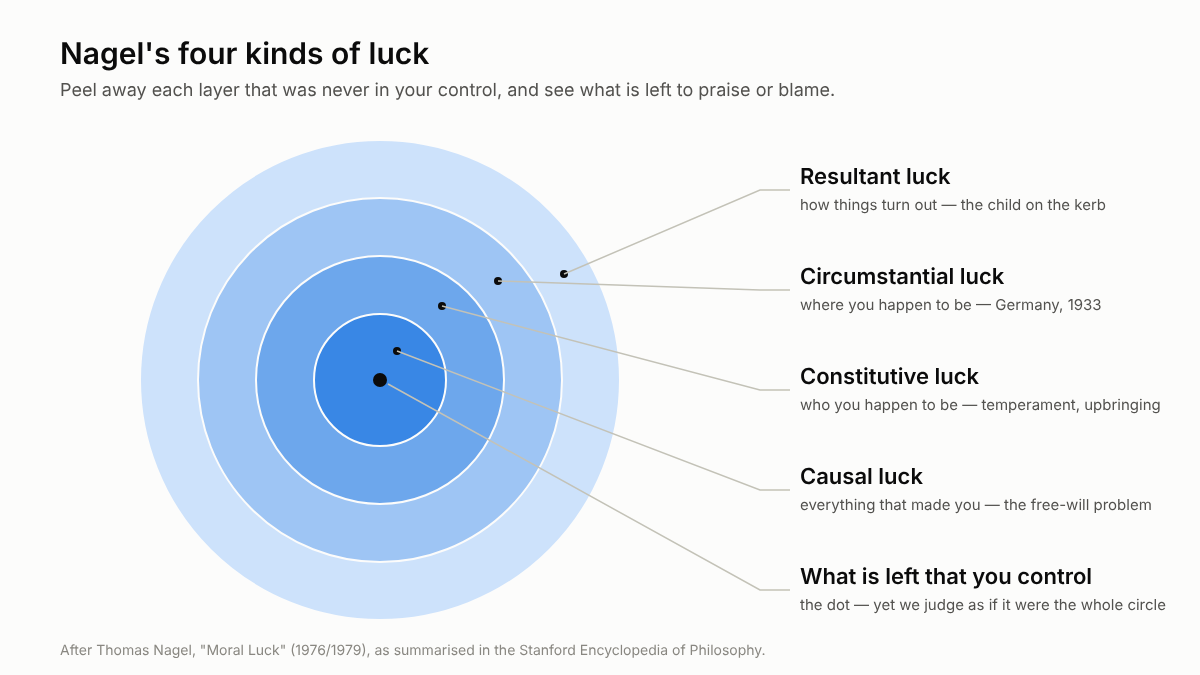
Bernard Williams and Thomas Nagel gave this its name in a pair of papers in 1976: moral luck. Kant had insisted that morality was the one thing luck could never touch; a good will, he wrote in the Groundwork, would still shine like a jewel even if it achieved nothing. Nagel pointed out that nobody actually judges that way. People are blamed for how things turn out (resultant luck), for the circumstances they happen to land in (circumstantial luck: the German who would have been a quiet clerk had he emigrated in 1930 instead became a collaborator), for the temperament they were born with (constitutive luck), and ultimately for everything that made them who they are (causal luck). Pull the thread far enough and almost nothing is left that anyone controls, yet praise and blame carry on as though everything were.
Williams' contribution was subtler. His lorry driver who blamelessly runs over a child feels something a bystander cannot, which Williams called agent-regret, and most people would think less of a driver who felt none. His fictional Gauguin abandons his family to paint: if the paintings turn out great the gamble looks justified, if mediocre it was mere desertion, and he cannot know which until it is too late to choose.
Where this bites in business and finance is that outcomes are the only thing a spreadsheet records. Poker players call it "resulting": judging a decision by how the cards fell. The board that pulled the Firmus float in October 2026 looks prudent; had the shares opened at a premium, the same directors would have been hailed as bold. The grid control room that kept the lights on through the 23 June 2026 heatwave is being investigated by Ofgem anyway. The philosophers' point is that a decision can only be fairly assessed on what was knowable at the moment it was made, and that the law, the markets and ordinary conversation all quietly refuse to do so.
Sources
- Stanford Encyclopedia of Philosophy, Moral Luck, summer 2026 edition
- Sentencing Council, dangerous driving guideline, in force 1 July 2023, updated 5 October 2026
- Ministry of Justice, Police, Crime, Sentencing and Courts Bill road traffic offences factsheet, 2022
- Wikipedia, Causing death by dangerous driving (sentence history), accessed 30 October 2026
This piece was drafted by AI from the public sources named, then read and approved by Michael Rossi before it went up. It explains how something works; it is not advice of any kind.
← Back to StreetOwl