How IPO shares are priced, and why hot listings are sold too cheaply
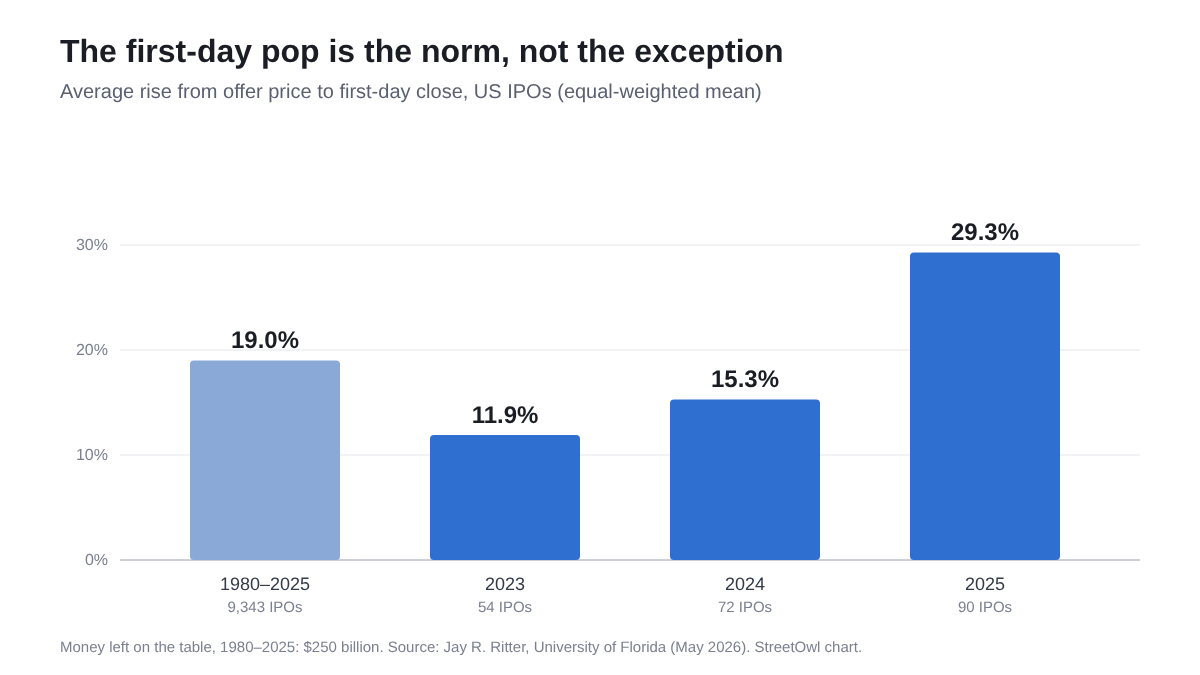
Drop this at dinner: Anthropic's flotation is around seven times oversubscribed and the banks will still price it below what buyers would pay, because a first-day pop is a feature, not a mistake: on average US listings have handed buyers 19 per cent on day one.
On Wednesday evening in New York, bankers led by Goldman Sachs and Morgan Stanley are due to set the price of Anthropic's shares, ahead of the AI company's debut on Nasdaq on Thursday 19 November under the ticker ANT. The range is $70 to $78 for 825 million shares, up to $64.4 billion, which would value the company at about $1.4 trillion and make it the largest stock-market listing ever. Reports say orders already cover the shares six to seven times over, which raises an obvious question: why not simply charge more?
Because a flotation is not an auction. It is a negotiation in which the seller is advised by banks that also look after the buyers. During the roadshow the banks collect orders from large funds, stating how many shares and at what price, into a “book”, then choose a price that leaves the book comfortably oversubscribed.
Something is deliberately left on the table. A first-day “pop” rewards the funds that took the risk, makes for a good headline and keeps those funds coming back for the next deal. Jay Ritter of the University of Florida has tracked 9,343 US listings from 1980 to 2025: on average they closed their first day 19 per cent above the offer price, about $250 billion that the companies could have raised but did not. In 2025 the average was 29 per cent. At Anthropic's size, every 10 per cent rise on the first day at the top of the range would be worth about $6.4 billion to the buyers.
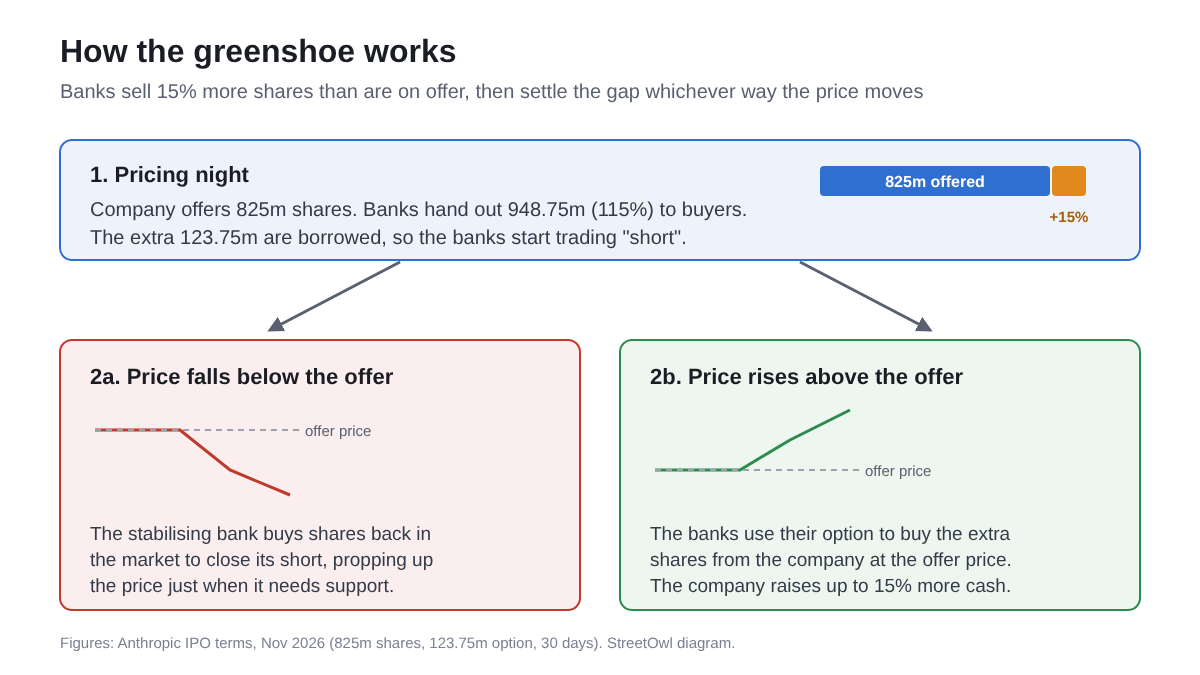
The cleverest part is the safety net, known as the greenshoe after the Green Shoe Manufacturing Company, the first to use it in 1963. The banks sell 15 per cent more shares than are on offer, in Anthropic's case an extra 123.75 million, so they begin trading with a short position.
If the price sinks below the offer, the stabilising bank, here Morgan Stanley, buys shares back in the market to close that short, supporting the price exactly when it needs it. If the price rises, the banks instead exercise an option, valid for 30 days, to buy the extra shares from the company at the offer price, and the company raises up to 15 per cent more money. Either way the banks' books balance: the greenshoe protects them whichever way the shares move.
Sources
- Renaissance Capital, 10 November 2026
- FourWeekMBA, How the Anthropic IPO works, 13 November 2026
- The Next Web, 16 November 2026
- Bloomberg, Anthropic's IPO is said to be about six times oversubscribed, 12 November 2026
- Jay R. Ritter, University of Florida, Initial Public Offerings: Underpricing, 18 May 2026
This piece was drafted by AI from the public sources named, then read and approved by Michael Rossi before it went up. It explains how something works; it is not advice of any kind.
← Back to StreetOwl