How does salt melt ice? Why the gritters go out before the frost
Drop this at dinner: Road salt doesn’t so much melt ice as stop it refreezing, and at −7°C a kilo does only a fifth of the work it does just below zero, which is why the gritters go out before the frost, not after.
On the night of Saturday 14 November the thermometer at South Newington, in north Oxfordshire, fell to −7.2°C, and the week ahead brings more frost and hill snow to northern Britain. National Highways has more than 530 gritters across 120 depots and, at its November peak, about 270,000 tonnes of salt to keep England's motorways and major A roads moving. Salt is often pictured as heating ice or burning through it. It does neither. It lowers the temperature at which water can freeze, and it does so by tipping a delicate balance.
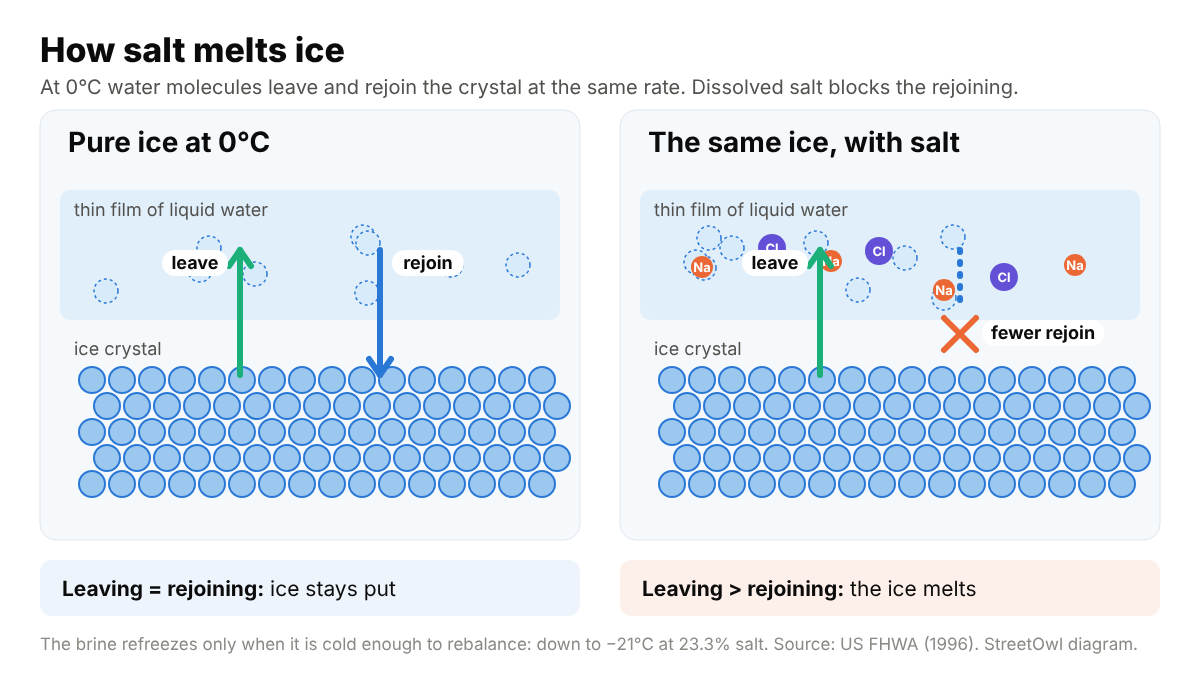
Ice at 0°C is not still. At its surface, water molecules are constantly breaking free into a thin film of liquid while others lock back into the crystal. At exactly 0°C the two rates match, which is why ice at that temperature neither melts nor grows. When salt is scattered on it, the salt dissolves into that film as sodium and chloride ions. These get in the way of molecules trying to rejoin the crystal but do nothing to stop molecules leaving, so the ice loses the tug of war and melts. The brine that forms dissolves more salt and eats outwards. Melting also draws heat from its surroundings, which is why salted ice feels colder and why salt and ice can freeze a home ice-cream maker.
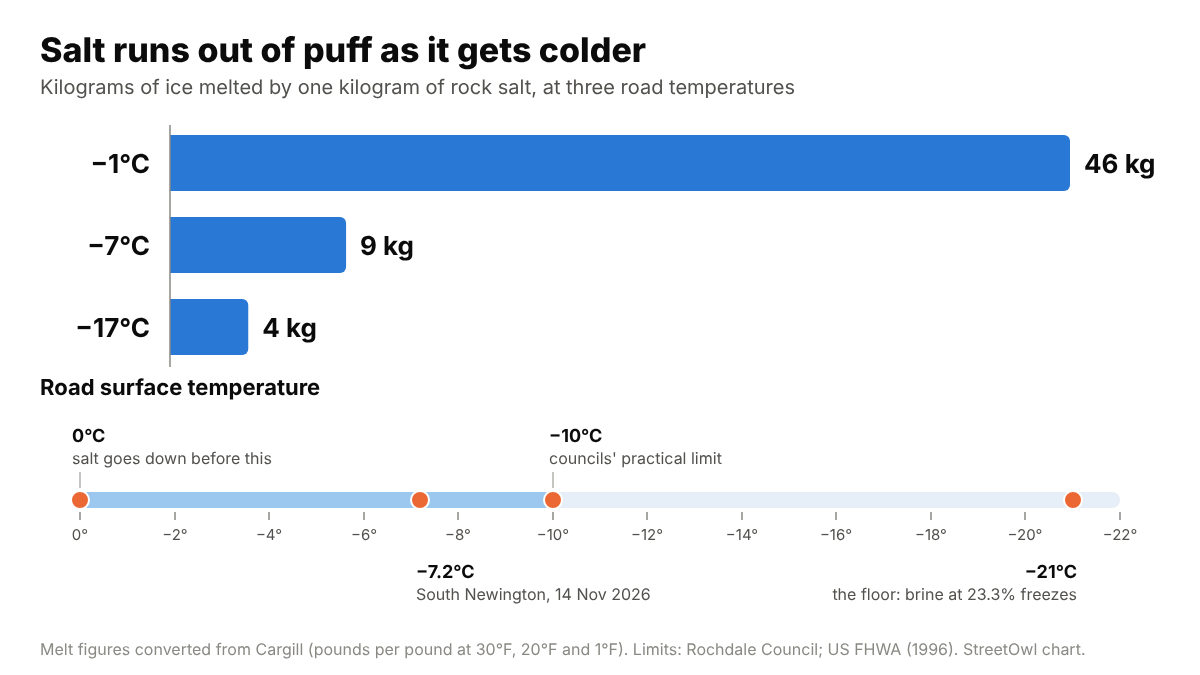
The catch is the cold. The colder it gets, the fewer molecules leave the ice and the slower salt works. Cargill, one of the largest salt suppliers, puts the melting power of a kilogram of rock salt at about 46 kilograms of ice at −1°C, about 9 at −7°C and only about 4 at −17°C. The theoretical floor is −21°C, where brine of 23.3 per cent salt itself freezes, but councils treat −10°C as the practical limit on roads.
That is why gritting is prevention rather than cure. Salt goes down before the road surface reaches zero, at just 10 to 40 grams a square metre depending on the forecast, and it is usually sprayed with brine as it leaves the lorry, a technique called pre-wetting, so that it sticks to the road and starts working at once instead of bouncing into the verge. Salt laid in advance also stops falling snow bonding to the tarmac, so ploughs can push it off. Traffic does the rest by churning the brine about, which is why a quiet lane can stay icy long after a busy main road has cleared.
Sources
- Observatory Analysis, UK weather and disruption watch, 15 November 2026
- National Highways, Winter driving: how we help you on our roads, 2026
- Rochdale Borough Council, Salt myths and facts, 2026
- Cargill, At what temperature does rock salt stop working?, 2026
- US Federal Highway Administration, FHWA-RD-95-202, June 1996
This piece was drafted by AI from the public sources named, then read and approved by Michael Rossi before it went up. It explains how something works; it is not advice of any kind.
← Back to StreetOwl