How does contactless payment work? The card has no battery
Drop this at dinner: A contactless card has no battery: the shop's terminal powers it through a magnetic field, and the card replies by flickering how much power it draws.
Since 19 March 2026, UK banks and payment providers with strong fraud controls have been allowed by the Financial Conduct Authority to set their own contactless limit, or to let customers choose one. Almost none have: Barclays, HSBC, Lloyds, Nationwide, NatWest, Santander and Monzo all kept the £100 single-payment cap. Contactless is now the default way to pay. In 2025 there were 19.2 billion contactless card payments in the UK worth £311 billion, an average of just under £18, and contactless made up 76 per cent of debit card and 67 per cent of credit card transactions. The card doing all this has no battery.
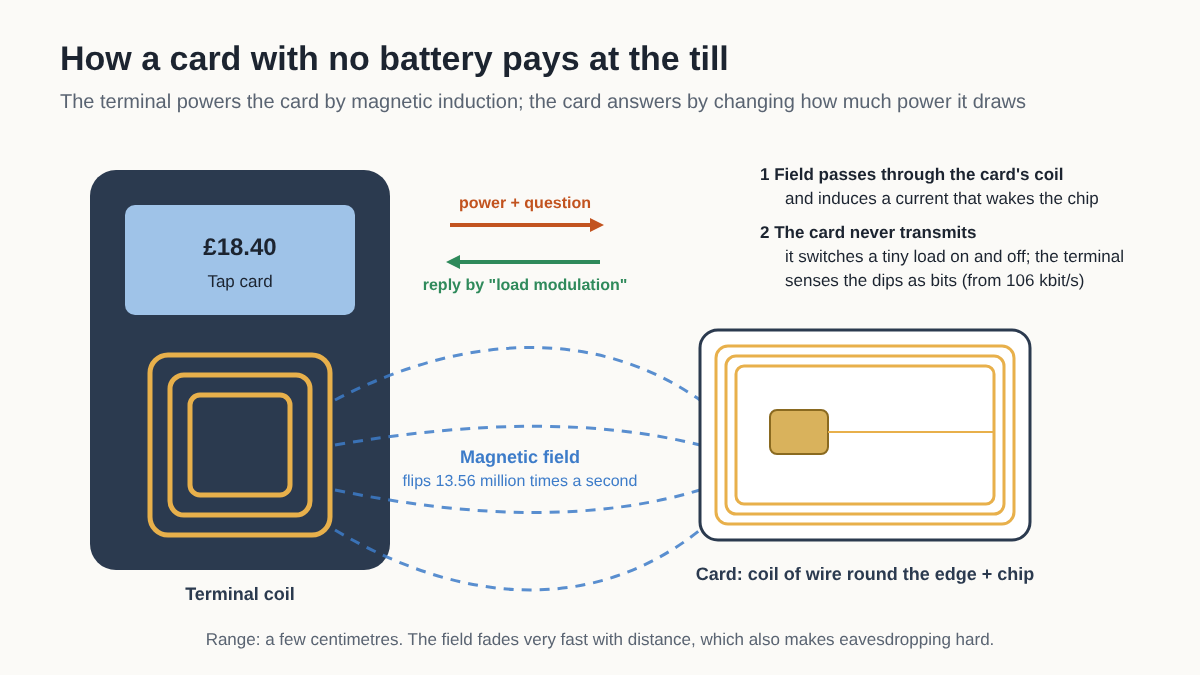
The terminal contains a coil of wire carrying a current that flips direction 13.56 million times a second, creating a rapidly changing magnetic field. Hidden inside the card, looped around its edge, is another coil. Held within a few centimetres and the changing field induces a current in the card's coil, the same principle that charges an electric toothbrush on its stand, and that is enough to power the chip. To answer, the card broadcasts nothing. It switches a tiny load on and off across its coil, which changes how much energy it draws from the field, and the terminal reads those small dips as ones and zeros, at a basic 106 kilobits a second. Because the field fades so fast with distance, the conversation only works at close range, which also makes it hard to eavesdrop on.
A new code every tap
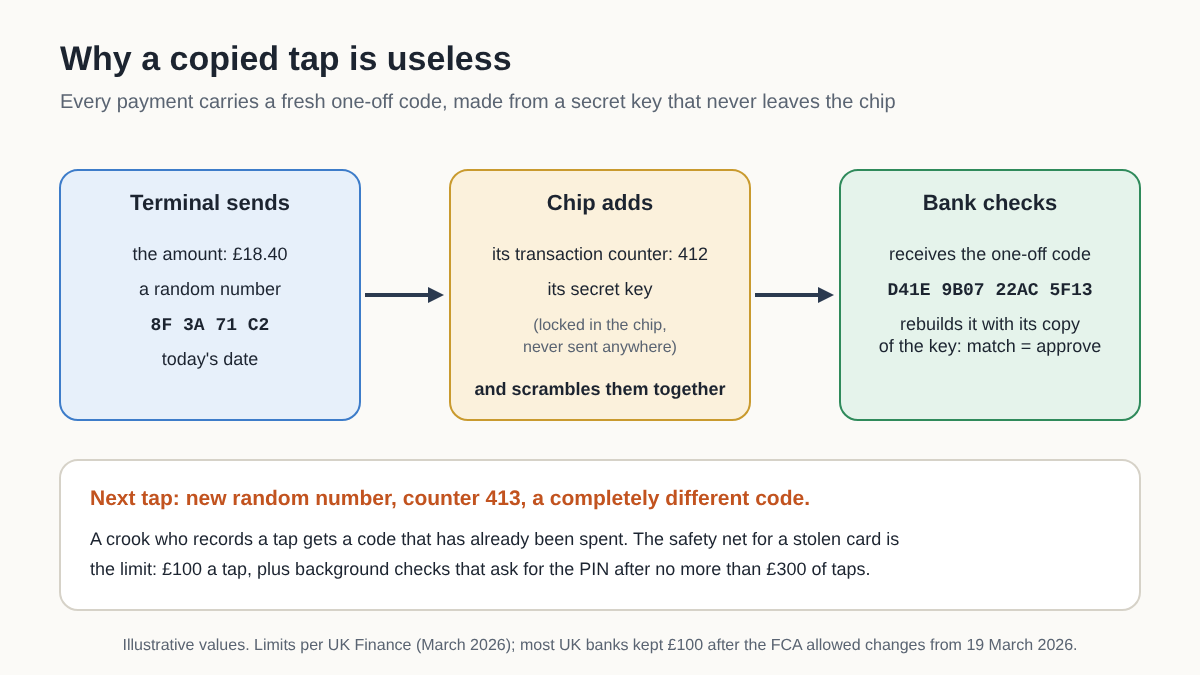
The security rests on the card never sending anything worth stealing twice. The terminal passes it the amount and a random number; the chip mixes those with a transaction counter and a secret key that is locked inside it and never leaves, producing a one-off code that the card issuer checks with its own copy of the key. A recorded tap yields a code that has already been spent. What protects a lost or stolen card is the limit: £100 a payment, with background checks that ask for the PIN once taps add up to no more than £300. Phone wallets such as Apple Pay and Google Pay have no fixed £100 cap because the phone's fingerprint, face or passcode check does the PIN's job.
Sources
This piece was drafted by AI from the public sources named, then read and approved by Michael Rossi before it went up. It explains how something works; it is not advice of any kind.
← Back to StreetOwl