How do you dig a tunnel under the Panama Canal?
Drop this at dinner: There is now a railway tunnel 65 metres under the Panama Canal, and while it was being dug the only thing stopping the Pacific pouring in was a wall of clay slurry held up by a bubble of compressed air.
On 26 October a tunnel boring machine called Panamá, 13.46 metres across, broke through a concrete wall beside Albrook station in Panama City. It finished a 4.5-kilometre railway tunnel under the Panama Canal, bored about 65 metres below sea level beneath the Pacific entrance while ships kept passing overhead. The tunnel will carry Metro Line 3, a $2.84 billion line that was 82 per cent complete at the breakthrough and is due to open to passengers in 2028, giving commuters an alternative to the crawl over the Bridge of the Americas.
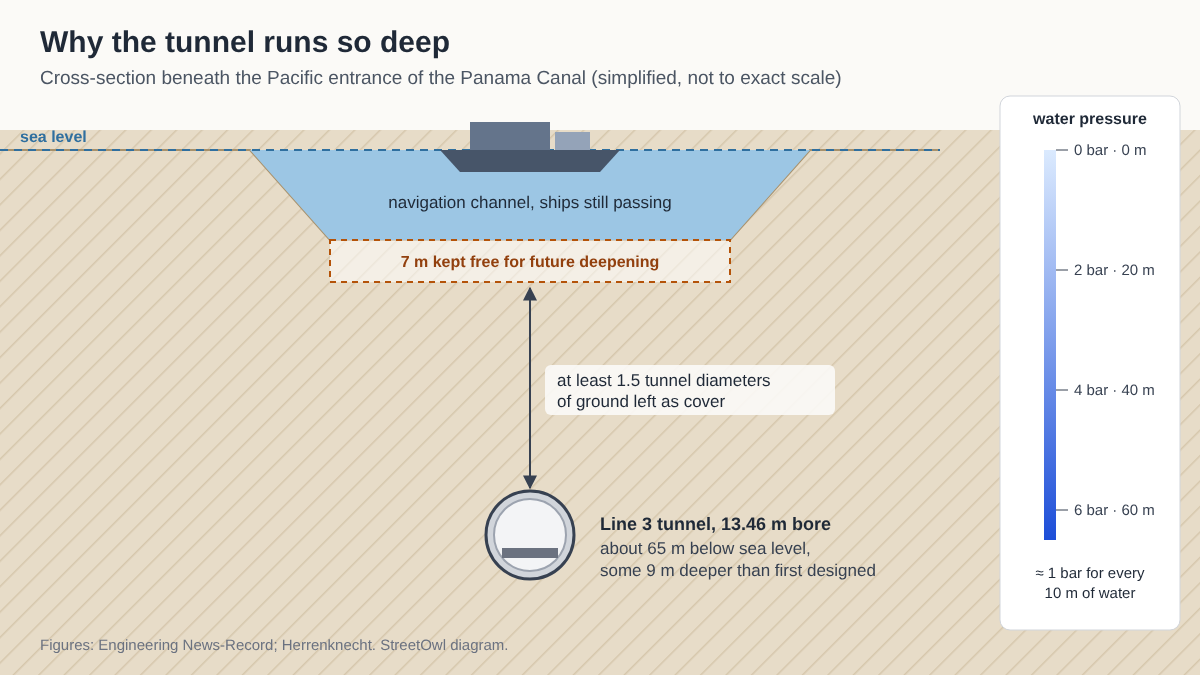
The depth was set by the canal. The Panama Canal Authority required 7 metres to be kept clear beneath the navigation channel for possible future deepening, and at least one and a half tunnel diameters of ground above the tunnel. Together those pushed the bore about 9 metres lower than first designed. At that depth the main problem is water pressure. Every 10 metres of water adds roughly one bar, so at the face the ground and groundwater pressed in at 6 to 6.5 bar: about 65 tonnes on every square metre, and more than 9,000 tonnes across the whole face. Ground cut away without support at that pressure lets water flood in.
Pushing back with clay and air
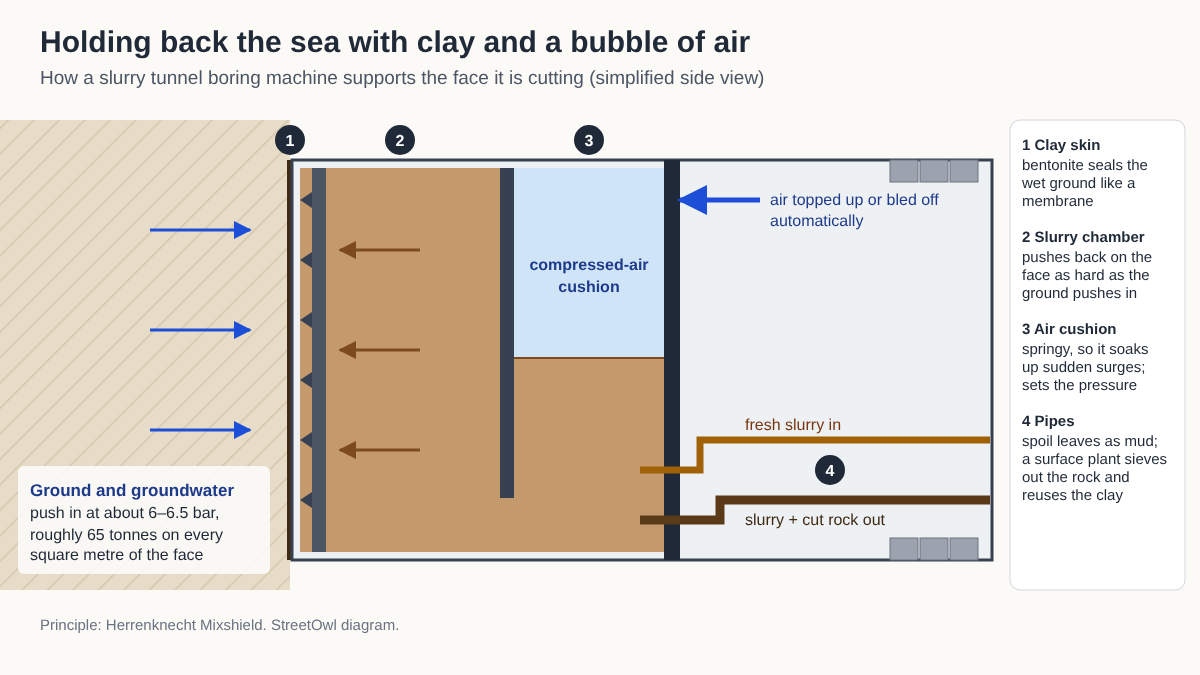
The machine, a Herrenknecht Mixshield, answers by pushing back exactly as hard. The chamber behind the rotating cutterhead is filled with bentonite slurry, a fine clay suspension. Pressed against wet ground it forms a thin, nearly watertight skin, so the slurry's pressure bears on the face like a hand holding a door shut.
The pressure itself is set by air. Behind a partition called the submerged wall sits a pocket of compressed air resting on the slurry. Air is springy, so when the machine passes from sandstone into basalt and the pressure surges, the bubble absorbs the jolt while the control system tops it up or bleeds it off. Pumps pushing liquid alone would react far more abruptly.
The spoil leaves the way it is held back: mixed into the slurry and piped to a plant on the surface that sieves out the rock and recycles the clay. Nearly 700,000 cubic metres came out over about two years, and the tunnel is lined with 2,295 concrete rings of nine segments each. Maintenance was designed around the pressure too. At 6 bar, work at the face would mean diving conditions, so the cutting tools could be changed from inside the hollow arms of the cutterhead at ordinary air pressure.
Sources
- Engineering News-Record, Panama Metro Line 3 tunnels beneath Panama Canal, 2026
- Herrenknecht, Mixshield product page, 2026
- Tunnels & Tunnelling International, tunnelling beneath Panama Canal, 2026
- Tunnelling Journal via Geomechanics.io, 12 February 2026
- Tunnelbuilder, TBM completes historic breakthrough beneath the Panama Canal, 2026
This piece was drafted by AI from the public sources named, then read and approved by Michael Rossi before it went up. It explains how something works; it is not advice of any kind.
← Back to StreetOwl