How do jet engine blades not melt? The air and the single crystal that keep them alive
Drop this at dinner: The blades in a jet engine spin in gas hundreds of degrees hotter than the melting point of the metal they are made of, and each one is grown as a single crystal.
On 28 October 2026 the UK Government and Rolls-Royce agreed a ten-year, £2.5 billion research and technology programme aimed at putting a British engine on the next generation of single-aisle airliners, expected to enter service in the mid-to-late 2030s. Rolls-Royce says it would create 3,300 UK jobs at the company and its suppliers by the end of 2029; an UltraFan demonstrator is planned for ground testing in 2028. The agreement is a framework: no grant has yet been awarded.
Among the parts the programme singles out are high-pressure turbine blades, which Rolls-Royce calls the heart of a jet engine. They work in gas hotter than the metal they are made of can survive.
Hotter than the metal
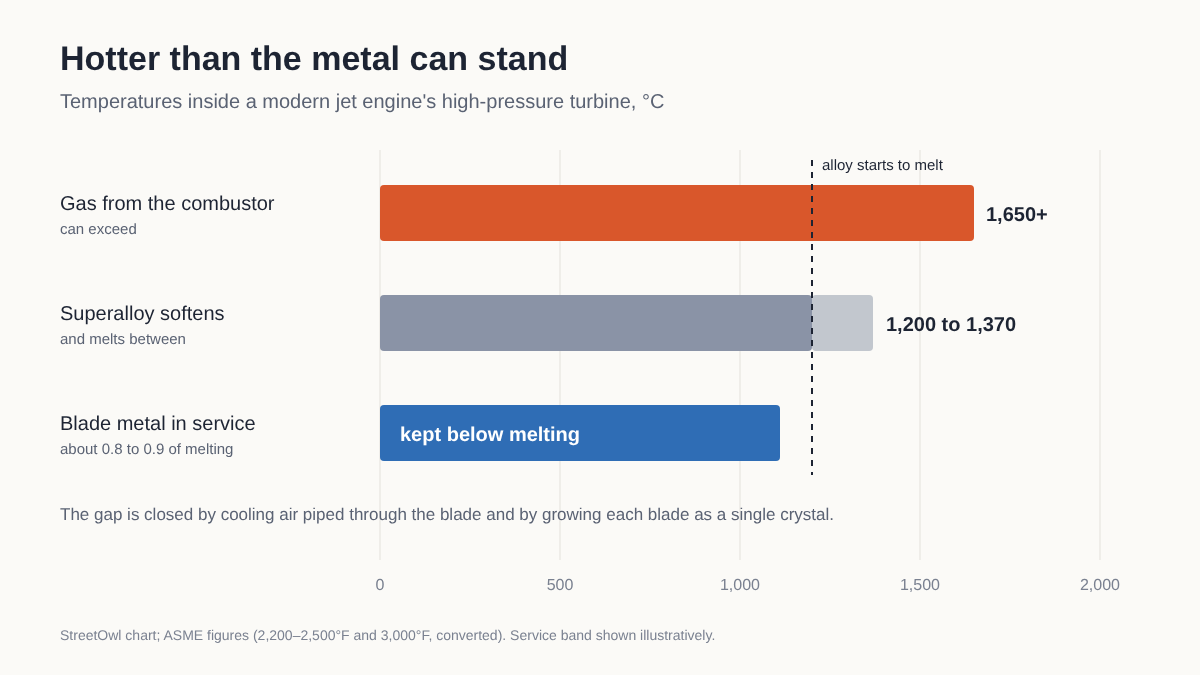
Gas leaving the combustor of a modern high-performance jet engine can exceed 3,000°F, about 1,650°C. The nickel superalloys from which turbine blades are cast soften and melt between about 2,200°F and 2,500°F, roughly 1,200°C to 1,370°C.
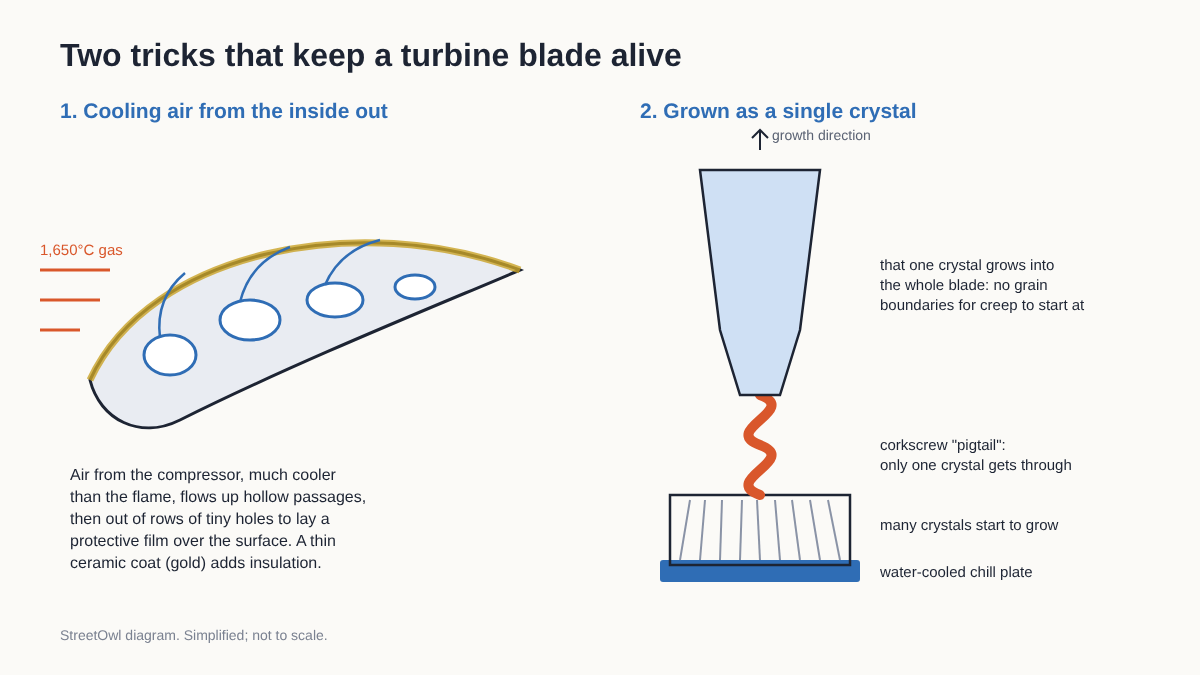
The first part of the answer is air. Some of the air from the compressor, far cooler than the flame, bypasses the combustor and is piped up through passages inside the hollow blade, then bleeds out through rows of tiny holes in its surface, laying a thin film of cooler air over the metal. A ceramic coating adds a layer of insulation. The blade metal ends up running at around eight- to nine-tenths of its melting temperature.
Grown, not forged
The second part is the metal itself. Ordinary cast metal is a jumble of tiny crystals, or grains, and the boundaries between them are where, under heat and the pull of spinning, the metal slowly stretches and fails, a process called creep.
In the late 1960s Pratt & Whitney engineers led by Maurice "Bud" Shank set out to remove those boundaries altogether by casting each blade as a single crystal. The alloy is cast in a vacuum and cools upwards from a water-chilled plate. Many crystals start to grow, but they must pass through a corkscrew passage in the mould, known as a pigtail or grain selector, which only one survives. That crystal then grows into the whole blade.
The idea went from concept to production within ten years. Single-crystal blades show as much as nine times the life in creep strength and thermal fatigue of conventional castings, and they can be cast with thinner walls, leaving more room for cooling passages.
Sources
This piece was drafted by AI from the public sources named, then read and approved by Michael Rossi before it went up. It explains how something works; it is not advice of any kind.
← Back to StreetOwl