How are tunnels dug without a tunnel boring machine?
Drop this at dinner: The trickiest bits of London's newest railway tunnels weren't dug by giant boring machines but by excavators, a metre at a time, with concrete sprayed straight onto the clay so the tunnel holds itself up like an eggshell.
Earlier this month HS2 announced that all of its deep-bore tunnelling between London and Birmingham is finished. The last stretch was unusual. The final 360 metres of twin tunnel into the new Old Oak Common station in west London were not dug by one of the giant boring machines used elsewhere on the line, but by excavators working through London clay, with concrete sprayed straight onto the raw ground as they went. The spot is a cavern where trains cross from one track to another to reach six platforms, and that shape is the clue.
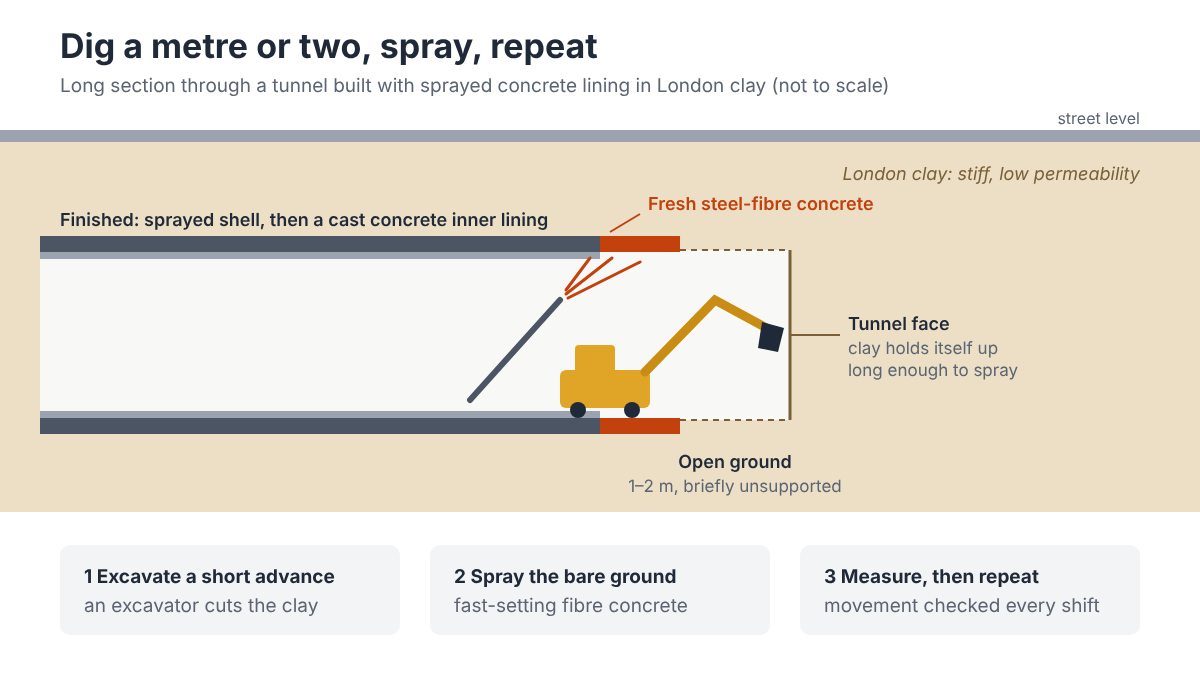
Dig, spray, repeat
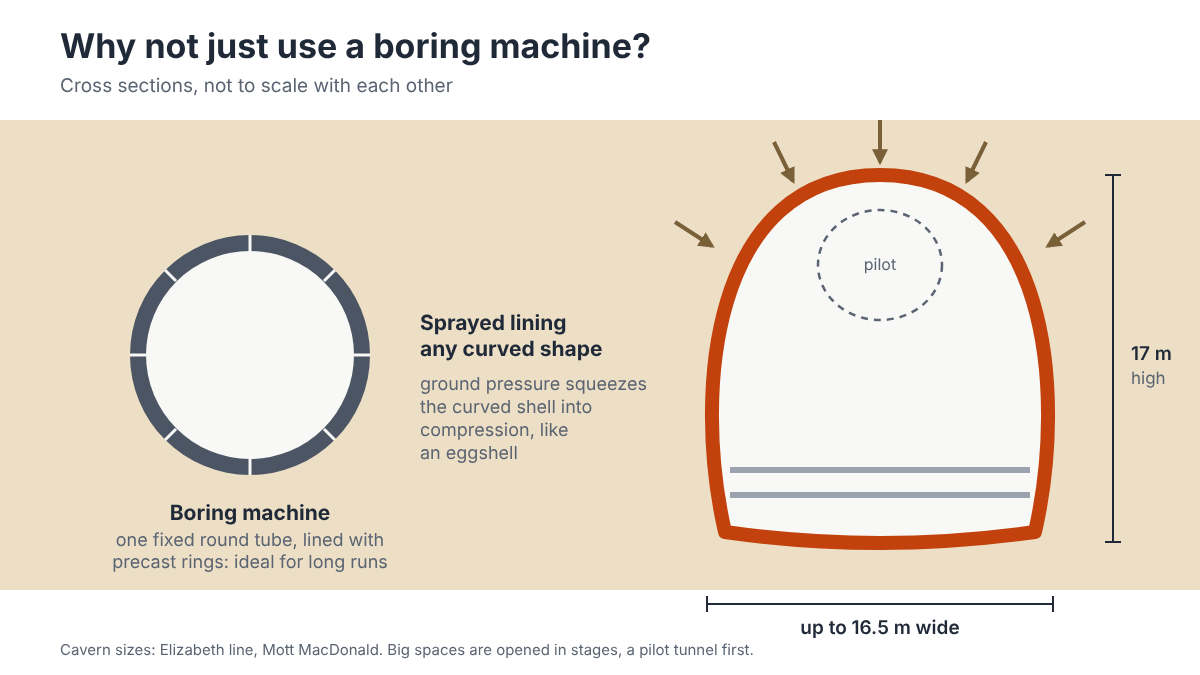
A tunnel boring machine is superb at one job: a long, round tube of fixed size. It cannot easily make a junction, a widening or a chamber big enough for a crossover. For those, engineers use sprayed concrete lining. They dig a short advance, typically a metre or two at a time on the Elizabeth line, then at once spray steel-fibre concrete, mixed with an accelerator so it sets fast, onto the bare clay, and repeat. Big spaces are opened in stages: a small pilot tunnel first, then enlarged. The clever part is that the lining is not a prop holding the ground up. Shaped as a smooth curve, it is squeezed into compression "like an eggshell", in Mott MacDonald's phrase, so the ground and the shell carry the load together.
Why the shell holds
London clay helps, because it is stiff and lets little water through, so a freshly opened metre stays put long enough to be sprayed. Every movement is measured, and if the ground shifts past set trigger levels the crew changes its approach.
On the Elizabeth line the first lining was 300 to 350 mm thick, caverns reached 17 metres high and 16.5 metres wide, and progress was often only one to four metres a day. Slow, but for a short tunnel with an awkward shape it saves time and money. HS2 even finished its last breakthrough "Jenga-style", cutting the dividing wall into blocks and pushing them out into the completed tunnel.
Sources
This piece was drafted by AI from the public sources named, then read and approved by Michael Rossi before it went up. It explains how something works; it is not advice of any kind.
← Back to StreetOwl