A fridge bulb, heard from one light-day away
Drop this at dinner: Voyager 1 runs its radio on about the power of a fridge bulb, and all the energy Earth has ever received from it in 49 years wouldn't lift a grain of sand; on 18 November it will be a full light-day away.
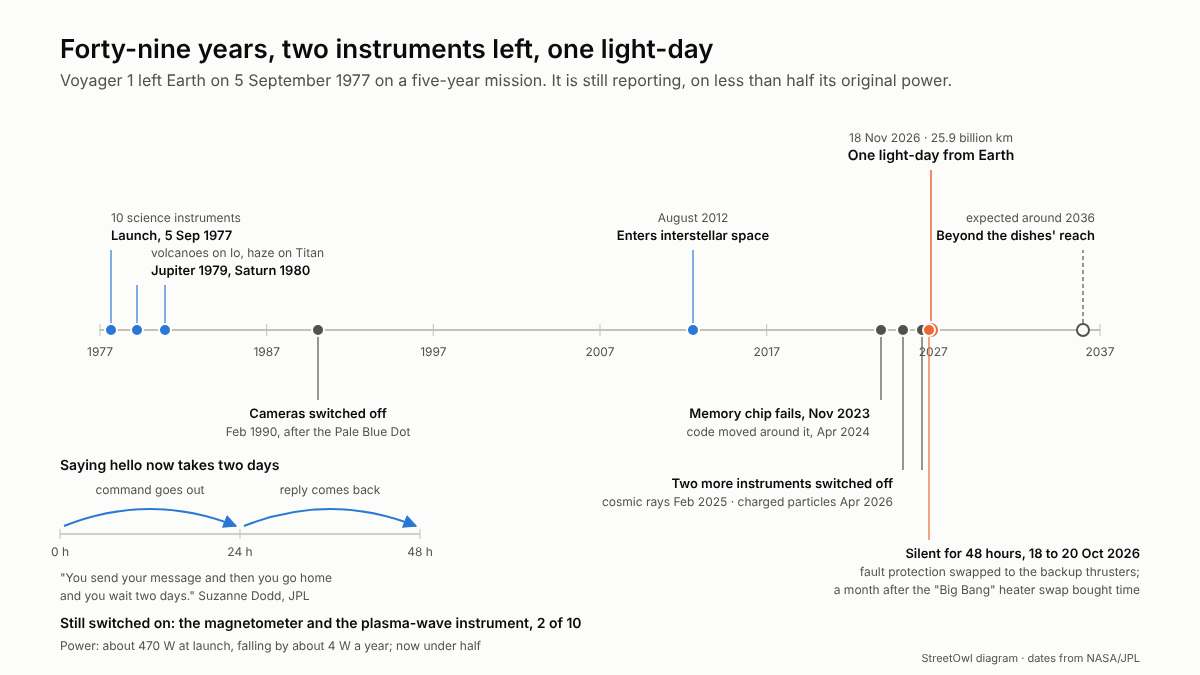
On 18 November, a little after six in the morning UK time, Voyager 1 will become the first thing humans have ever built to be one light-day from Earth: 25.9 billion kilometres, far enough that a radio message takes 24 hours to arrive and the answer takes 24 hours to come back. Suzanne Dodd, who runs the mission at NASA's Jet Propulsion Laboratory, puts it simply: you send your hello, you go home, and you wait two days. The milestone very nearly arrived in silence. On 18 and 19 October the Deep Space Network's dishes listened at the appointed hours and heard nothing. The signal returned on the 20th, and the diagnosis is that the spacecraft's own fault protection had switched to its backup thrusters, which pauses everything else, something it had never done in 49 years.
A billionth of a billionth of a watt
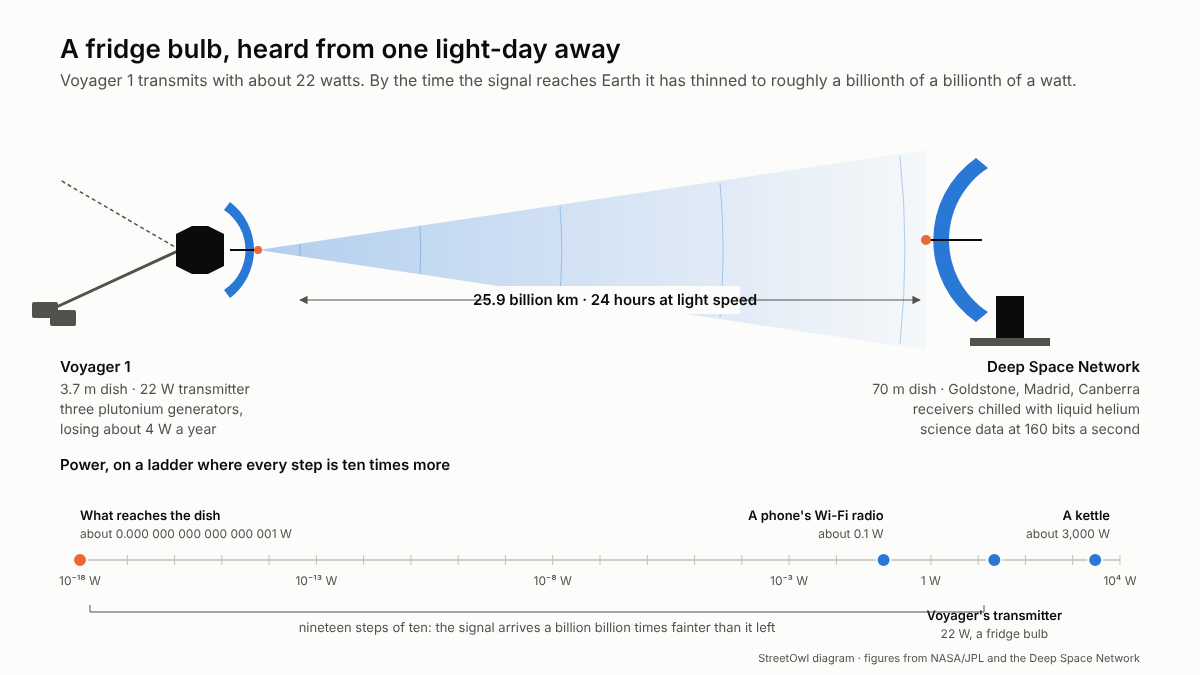
The engineering marvel is not that Voyager still flies but that anyone can hear it. Its transmitter puts out about 22 watts, less than the bulb in a fridge, through a 3.7-metre dish. By the time that signal has spread across 26 billion kilometres, the share landing on a 70-metre antenna in California, Spain or Australia is about a billionth of a billionth of a watt. Add up every scrap of energy those dishes have collected from Voyager 1 since 1977 and it would not lift a grain of sand off the table.
Three tricks make it audible. The receivers are chilled with liquid helium so the electronics make less hiss than the whisper they are listening for. The spacecraft talks slowly, about 160 bits a second for science data, because radio noise grows with how fast you talk, and a bit that lasts longer stands clear of it. And Earth knows precisely which sliver of the spectrum to watch, so the dish can ignore almost everything else.
The other clock is power
The other clock is power. Three plutonium generators gave 470 watts at launch and lose about four a year; the budget is now under half. In September engineers swapped three heating devices for lower-power ones, a manoeuvre they called the Big Bang, which otherwise would have cost another instrument by summer 2027. Two science instruments remain, a magnetometer and a plasma-wave detector, and by the mid-2030s the dishes expect to lose it for good.
Sources
This piece was drafted by AI from the public sources named, then read and approved by Michael Rossi before it went up. It explains how something works; it is not advice of any kind.
← Back to StreetOwl