Why the yen keeps sliding back to ¥160, and why Tokyo buys it back there
Japan pays far less interest than America and imports almost all its fuel, so money leaves the yen for months at a time; at about ¥160 to the dollar the Finance Ministry sells dollars and buys yen, the currency jumps, and then the drift begins again.
Four visits to the same line
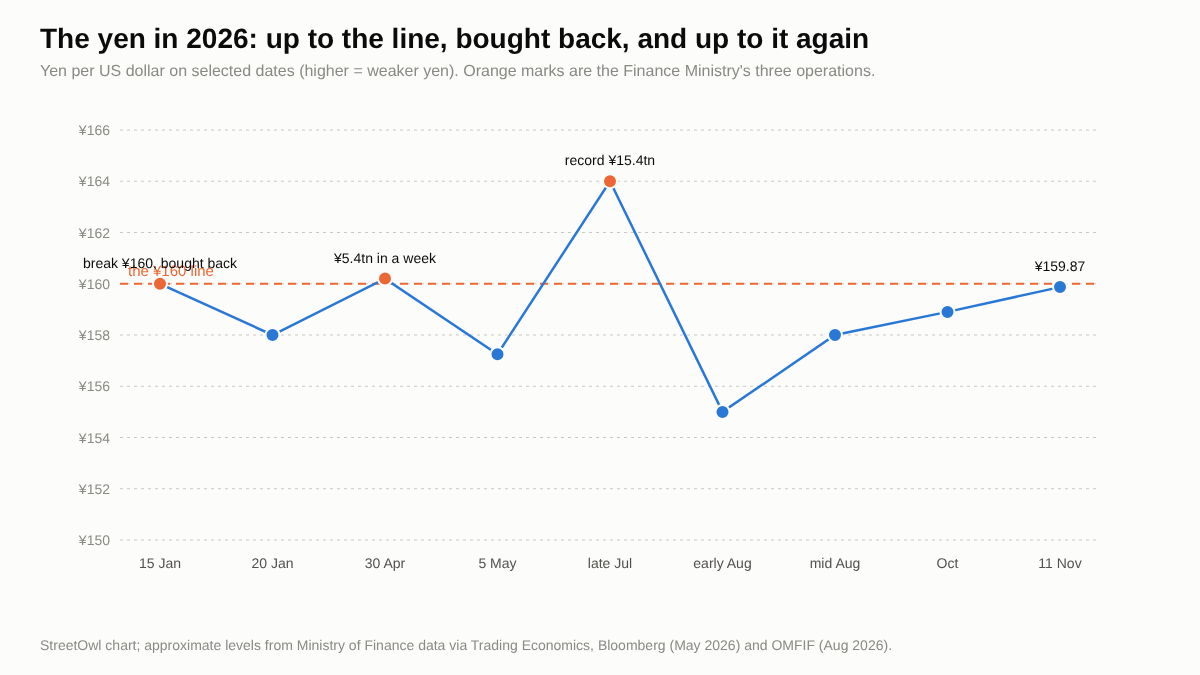
The yen closed at ¥159.87 to the dollar on Wednesday 11 November, a four-week low, and Japanese newspapers were once again writing about intervention risk. It is the fourth time this year the currency has walked up to the same door. In January it weakened past ¥160 and the Finance Ministry bought it back to about ¥158. At the end of April it happened again and the ministry spent about ¥5.4 trillion ($34 billion) in a week. In late July it reached about ¥164 and Tokyo bought a record ¥15.4 trillion of yen over three days, with the US Treasury joining in, unusually, and paying in euros; the dollar fell to about ¥155. Each time, the yen then drifted back.
That pattern has two halves. One pushes the yen down slowly; the other pulls it back suddenly.
The slow push: interest rates and the fuel bill
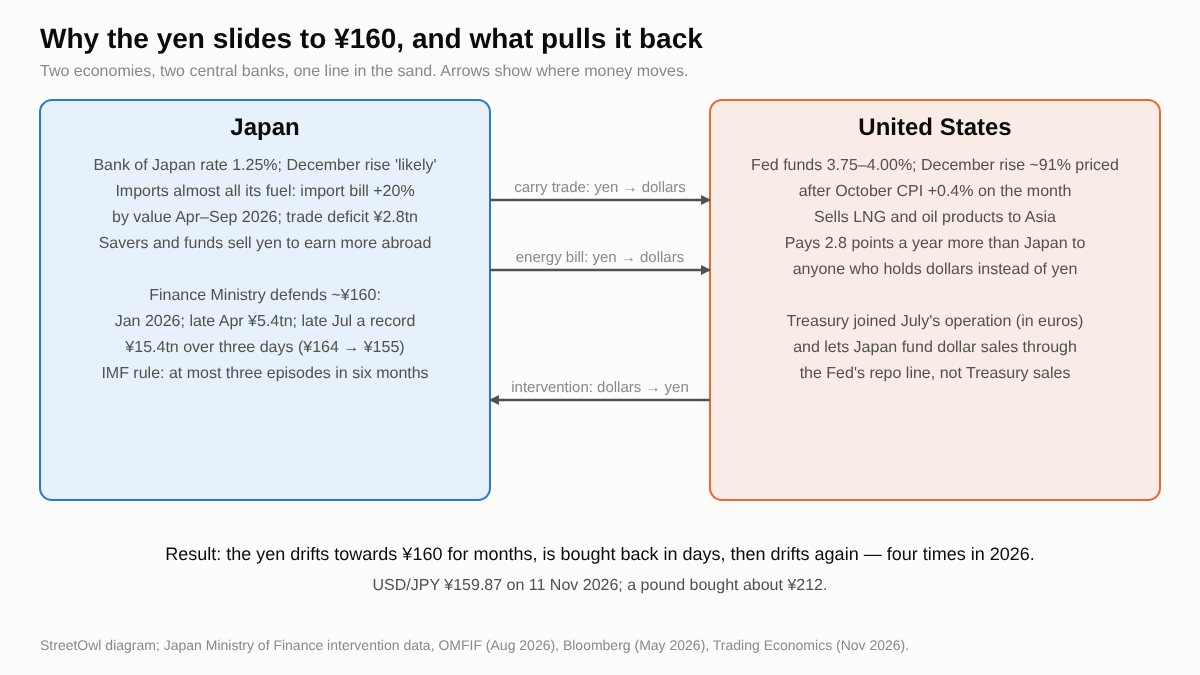
Japan's central bank lends at 1.25 per cent and America's at 3.75 to 4.00 per cent, and after the hot US inflation figure on 10 November the market put the chance of a further American rise in December at about 91 per cent. A Japanese saver, pension fund or hedge fund that sells yen and buys dollars is paid roughly 2.8 percentage points a year to wait. On top of that sits energy. Japan imports almost all its fuel, and in the six months to September its import bill rose 20 per cent by value while volumes fell, leaving a trade deficit of about ¥2.8 trillion, nearly double a year earlier. Every tanker that docks at Yokohama is a sale of yen. Cheaper oil has helped since October, but not enough to beat the interest-rate gap.
The Bank of Japan is the slow lever. Its chief economist said this week that a December rise is likely, and the meeting on 18–19 December could take the rate to 1.50 per cent; even then the gap with America would be two and a half points.
The sudden pull: a ministry with $1.2 trillion
A weak yen raises Japanese import prices, cuts real incomes and is unpopular, so the ministry treats ¥160 as a line. It holds about $1.2 trillion of foreign reserves, and this year it agreed to fund its dollar sales through the Federal Reserve's repo facility rather than by selling US Treasury bonds, which is why Washington stopped objecting and even joined in. The constraint is the International Monetary Fund: more than three intervention episodes in six months and Japan risks losing its 'free floating' label, which is why the operations are rare, large and timed for shock. Intervention does not change the direction of the yen; it changes the price, and the drift resumes within a few months because nothing underneath has changed.
Three things could keep the yen weak past ¥160 regardless: an American central bank that raises rates in December and again in January, a Japanese one that pauses, and an oil price back above $100 if the Gulf talks fail. One thing could lift it without the ministry: a surprise from the Bank of Japan on 19 December with a signal of more to come. The dated events are Japan's October trade figures around 19 November, the US rate decision on 10 December and the Bank of Japan's on 19 December.
What it means for a British household
A pound bought about ¥212 on 11 November, against ¥211 at the end of October, so £100 is roughly ¥21,200, as much yen as it has bought all year; StreetOwl's Holiday money board on the Travel tab shows what £100 buys. If Tokyo intervenes, that rate would fall by several per cent in a day, so a traveller changing money for a trip to Japan is better off doing it before the ministry acts than after. The things Britain imports from Japan, chiefly cars and machinery, are priced in sterling by the dealers, so a weak yen reaches British shop prices slowly, if at all.
Sources
- Trading Economics, Japanese yen news, 10–11 Nov 2026
- OMFIF, Japan's yen intervention and unusual US support, Aug 2026
- Bloomberg via Yahoo Finance, Japan has two more key windows for yen intervention by IMF rules, 4 May 2026
- The Japan Times, Yen nears key ¥160 level after US inflation data, 12 Nov 2026
- Trading Economics, Brent crude news, 9–11 Nov 2026
- Japan Ministry of Finance, Trade statistics, first half of fiscal 2026 (Apr–Sep), Oct 2026
This piece was drafted by AI from the public sources named, then read and approved by Michael Rossi before it went up. It explains why a currency moves; it is not advice to buy or sell any currency and is not financial advice.
← Back to StreetOwl