Why the yen falls while Hormuz is shut, and why it would rise fastest when it opens
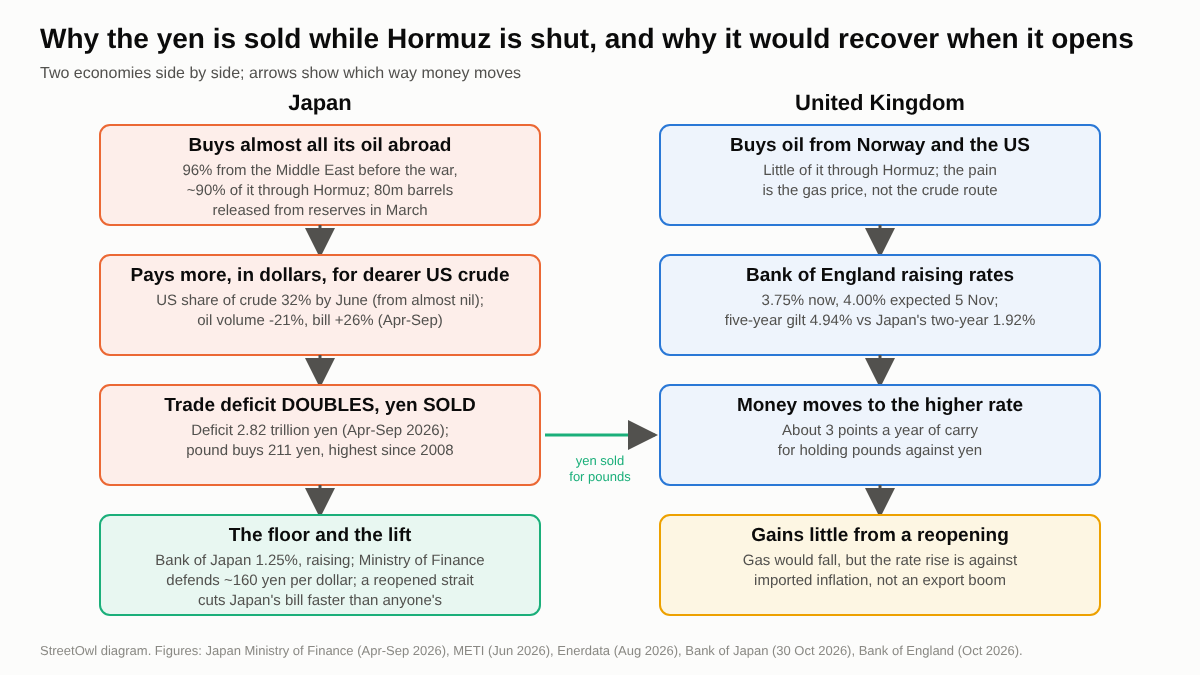
Japan buys almost all its oil from the Gulf, so a closed strait makes it pay more dollars for every barrel, so its trade deficit has doubled and the yen is sold every day the strait stays shut, which is also why a reopening would lift it faster than any other currency.
The country that needs the strait most
Nobody is more exposed to the Strait of Hormuz than Japan. Before the war, 96% of its oil came from the Middle East and roughly 90% of it sailed through the strait, from the United Arab Emirates (44%) and Saudi Arabia (40%). Japan has almost no oil of its own, so when the strait shut it released 80 million barrels, 45 days' worth, from its reserves in March and rebuilt its supply chain in a hurry. By June the Arab share of its crude had fallen to 62% and the United States was supplying 32%, from almost nothing a year earlier. Every one of those American barrels is dearer, further away and paid for in dollars.
The customs data show what that does to a currency. In the fiscal half-year to September, Japan's trade deficit nearly doubled to ¥2.82 trillion. It imported 21% less crude by volume and paid 26% more for it; 8% less LNG and paid 13.5% more. A country that sells fewer yen for oil but far more yen for each barrel is a country whose currency is being sold every day the strait stays shut.
What the pound buys
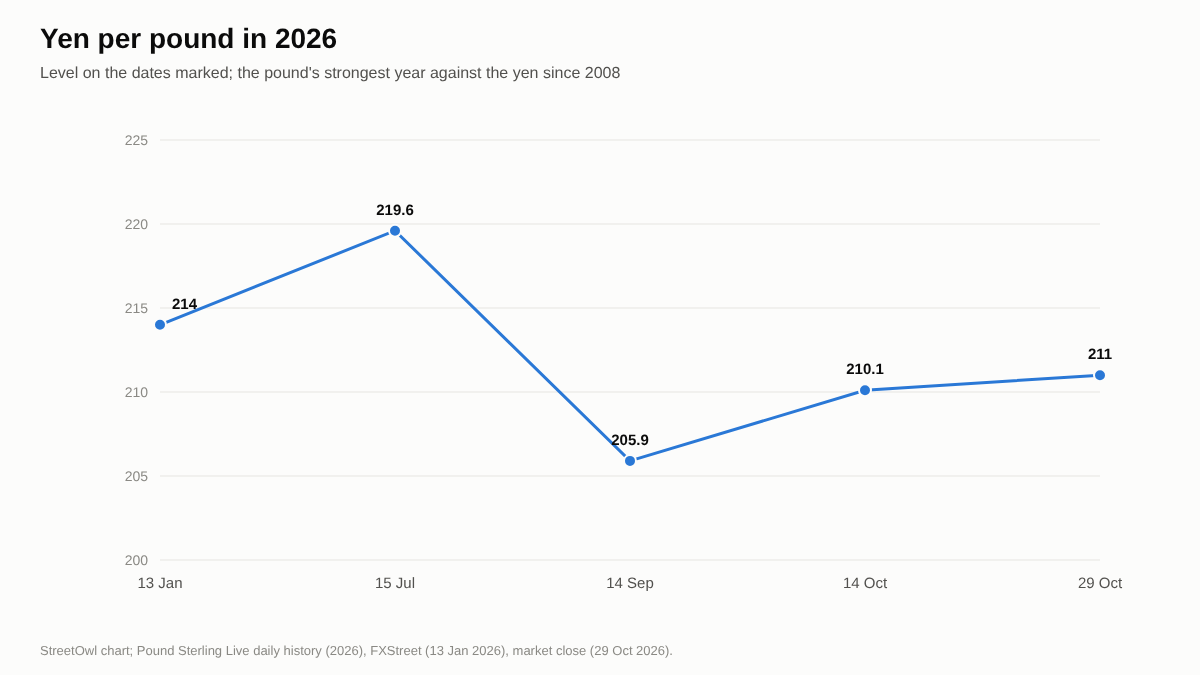
The yen has spent the year between ¥157 and ¥161 to the dollar, and a pound bought ¥211 on Thursday, in a 2026 range of ¥206 (14 September) to ¥220 (15 July): the pound's strongest year against the yen since 2008. Interest rates explain the rest. Britain's five-year gilt pays 4.94%, Japan's two-year bond 1.92%, so the world is paid about three points a year to hold pounds rather than yen, and it has.
Two central banks, pulling in opposite directions
The Bank of Japan held its policy rate at 1.25% on Friday 30 October, by eight votes to one, with Hajime Takata voting for 1.50%. It raised its inflation forecast for the year to March 2028 to 2.6%, said underlying inflation was now consistent with its 2% target and that the risks to prices were on the upside; markets put the chance of a rise in December at about 80%. Its forecasts assume Dubai crude falls from about $105 a barrel to $70 over the next two years. If the oil shock fades, the bank raises rates into a shrinking deficit; if it does not, the inflation Japan imports forces it to raise rates anyway. Either way the gap with Britain narrows.
The Ministry of Finance, meanwhile, defends the ¥160 line. It is suspected of having intervened when the dollar rose above ¥161 in May, and finance minister Satsuki Katayama repeated on 27 October that the government 'stands ready to take decisive action' in the currency market. So the yen's room to fall from here is a policy line about 2% away, and its room to rise is whatever happens when Hormuz reopens, when Japan's energy bill falls faster than anyone's. The Bank of England, by contrast, is expected to raise Bank Rate from 3.75% to 4.00% on 5 November against imported inflation, not an export boom; Britain buys its crude mainly from Norway and the United States and gains little from a reopening.
The dates that could change it
The Bank of England's decision on 5 November; Japan's monthly trade figures around the 20th of each month, which show whether the oil bill is still rising; the Bank of Japan's next meeting on 18 and 19 December; and any sustained rise in tanker transits through Hormuz, which would cut Japan's import bill before anyone else's.
What it means for a British household
Holiday money has rarely been better for a trip to Japan: £100 buys about ¥21,100, and the Holiday money board on StreetOwl's Travel tab shows what £100 buys around the world and how it has moved this year. The flip side is that a reopened strait would make the yen dearer again, so a Japan trip booked for next spring is cheaper to pay for now than later. Japanese imports, cars and cameras above all, are also cheaper in sterling than they were a year ago, though car makers set their British prices only a few times a year, so the saving arrives slowly.
Sources
- Reuters via Yahoo Finance, Yen gains after BOJ, AI jitters drive Treasury rally, 30 October 2026
- investingLive, BoJ declares underlying inflation at 2% target, lifts FY2027 price forecast as rates held, 30 October 2026
- OilPrice.com, Japan's trade deficit doubles as Hormuz crisis hikes energy import costs, 21 October 2026
- Enerdata, Japan unveils energy resilience plan as 96% of oil imports come from the Middle East, 31 August 2026
- Arab News Japan, Japan's Arab oil imports drop to 62% in June as US oil surges to 32%, 31 July 2026
- investingLive, Japan finance minister Katayama warns of decisive action as yen intervention risks linger, 27 October 2026
- Pound Sterling Live, British pound to Japanese yen history 2026
- FXStreet, pound-yen rate advances to 214, highest since August 2008, 13 January 2026
This piece was researched with AI from the public sources named and written up and checked by Michael Rossi before it went up. It explains why a currency moves; it is not advice to buy or sell any currency and is not financial advice.
← Back to StreetOwl