Why the vet bill keeps rising: the pandemic puppies are turning six
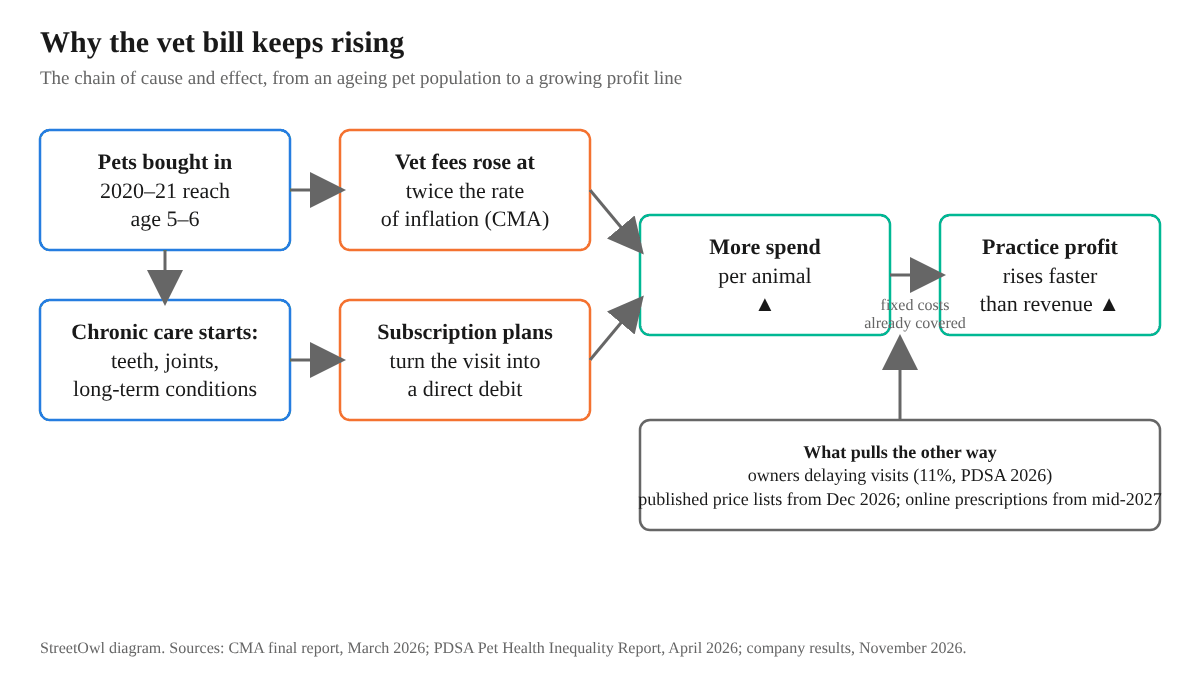
Pets bought in the lockdown years are reaching the age when chronic care starts, vet fees have risen at twice the rate of inflation, and subscription plans turn the visit into a direct debit, so the money spent per animal keeps climbing even as owners feel the squeeze.
The one bill you cannot shop around for
A vet practice sells the one service a customer cannot delay, compare or decline on the day. The animal is ill, the owner is at the counter, and the price is whatever the practice says it is. The Competition and Markets Authority's final report on the veterinary market, published in March 2026 after a two-and-a-half-year investigation, found that vet fees had risen at twice the rate of inflation.
That pricing power is the first part of the machine. The second is who is paying: PDSA's April 2026 survey of 4,440 adults found that two in three pet owners could not cover an unexpected operation, one in five found pet ownership dearer than expected, 9% had gone into debt for their pet, and 11% had delayed a vet visit in the past year, which the charity puts at around three million animals.
The lockdown bulge is getting older
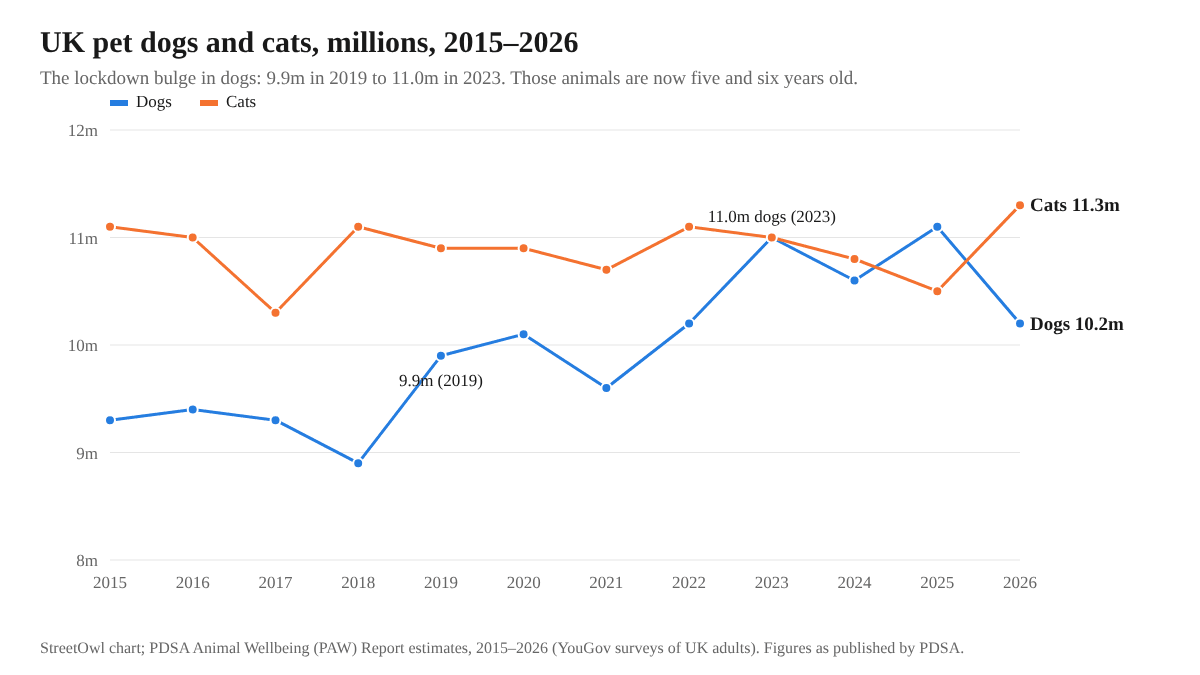
PDSA's annual estimates put the UK dog population at 9.9 million in 2019, 11.0 million in 2023 and 10.2 million in 2026, with cats at 11.3 million this year. The dogs and cats acquired in 2020 and 2021 are now five and six years old, which is the age when dental work, joint problems and long-term conditions start to appear. Spend per animal rises with age even when the number of animals does not, so the bulge that filled the parks in 2021 is now filling the waiting rooms.
The large practice groups have added a third element: the subscription. Monthly pet-health plans that bundle vaccinations, check-ups and flea treatment now cover well over a million animals across the two biggest listed groups. A plan takes the decision of whether to visit away from the owner at the moment the household budget is tightest, and smooths the practice's income into a direct debit.
Why the practice's profit grows faster than its takings
Results published on 25 November 2026 by one of the big groups show how the arithmetic works. Takings across its vet practices rose only 2.3% in the half-year to October, down from 6.7% a year earlier, yet the profit from those practices rose 8.6%. The practices are joint ventures that pay the group a fee, and once a practice has covered its fixed costs of rent, equipment and salaried staff, most of each extra pound of fees is profit. The group raised its full-year profit guidance to the top of its range. Its larger rival reported like-for-like sales growth of 2.4% in the four months to October 2026, after 2.1% for the year to June.
The weak line in both reports is the number of visits, not the price of each one. One group blamed weak consumer confidence for lower visitor numbers in July; the other's vet growth has halved in a year. The machine is pricing power meeting a customer who is cutting back.
What the regulator did, and did not, change
The CMA's remedies are about transparency rather than price. Practices must publish a full price list for standard services between December 2026 and March 2027; give written estimates for treatment expected to cost more than £500 and itemised bills; cap the fee for a written prescription at £21 for the first medicine and £13 for each additional one, and tell owners they can ask for one, from June to September 2027; and state whether they are independent or part of a group. A 'Find a Vet' service run by the Royal College of Veterinary Surgeons, showing prices and ownership, is due in September 2027.
Nothing in the package caps the consultation, the operation or the overnight stay, which is where most of the bill sits. What it does do is make it easier for owners to buy medicines online once they hold a written prescription, and to compare a practice's prices with the one down the road. For households, the first practical change is the published price list this winter; for the practices, the test is whether visit numbers recover as the lockdown pets age.
Sources
- Alliance News via Shareprices, CMA forces vets to publish prices, caps fees, 24 March 2026
- PDSA, UK pet populations of dogs, cats and rabbits, 2011-2026
- PDSA, Pet Health Inequality Report ('petflation'), April 2026
- Home of Direct Commerce, Pets at Home half-year results, 25 November 2026
- Press Association via LBC, Pets at Home bounds back to growth, 25 November 2026
- Hargreaves Lansdown, CVS Group FY update, 23 July 2026
- SquawkNews, CVS Group like-for-like sales rise 2.4% in four months, 25 November 2026
This piece was drafted by AI from the public sources named, then read and approved by Michael Rossi before it went up. It describes how one thing moves another; it names no investment and is not financial advice.
← Back to StreetOwl