Why the Swiss franc, the world's safest currency, is quietly losing ground to the pound
Switzerland pays nothing to borrow its own money while Britain pays almost five per cent, the safe-haven rush of the spring has faded and the Swiss trade surplus has shrunk, so the franc has drifted lower and a pound now buys more francs than at any time in six months.
The world's cheapest money
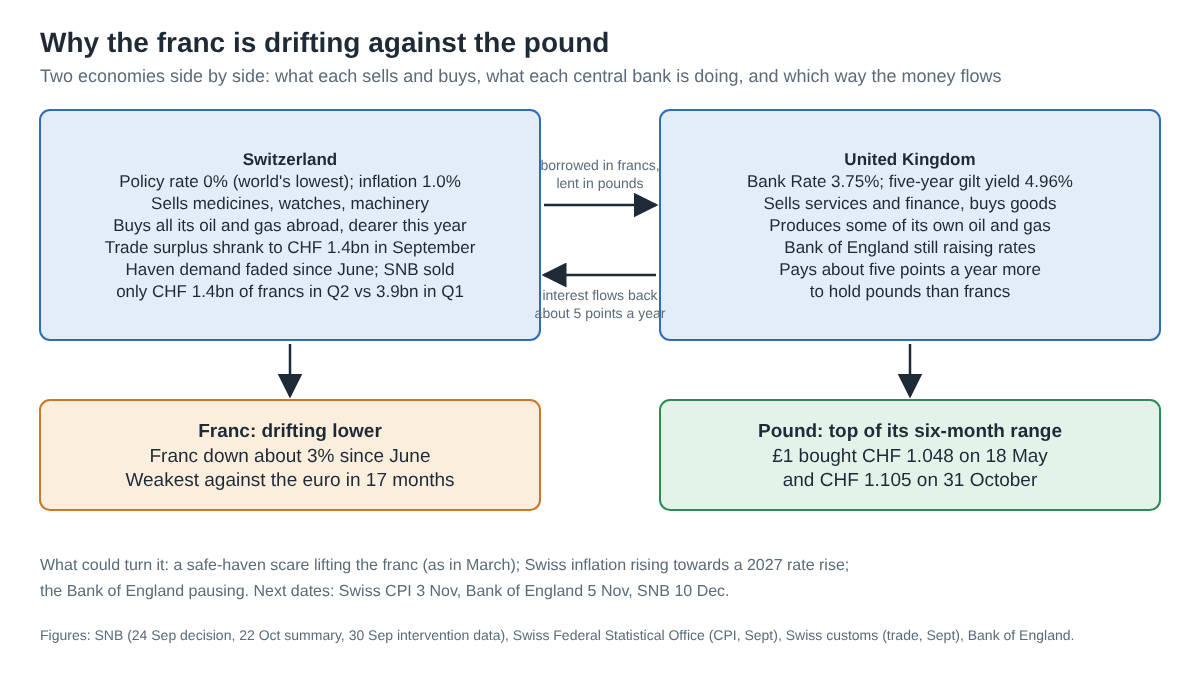
The Swiss National Bank's policy rate is 0%, the lowest of any major economy, and it expects inflation of just 0.7% this year and 0.8% in 2027 and 2028, so almost nobody expects Swiss rates to rise before late 2027. Britain's Bank Rate is 3.75% and a five-year government bond pays about 4.96%. That gap of roughly five percentage points a year is what a bank or fund earns by borrowing francs and holding pounds.
The SNB said as much in the summary of its September discussion, published on 22 October: wide interest-rate gaps and low franc volatility have made the franc more attractive as a funding currency for such trades. When a central bank describes its own money in those terms, the flow is already under way.
Two props that used to hold the franc up
The first was the safe-haven bid. When the Strait of Hormuz closed in March, money rushed into francs and the SNB sold CHF 3.9bn of its own currency in the first quarter to lean against the rise. That bid has faded: the SNB sold only CHF 1.4bn in the second quarter, said in September that there had been little safe-haven demand since June, and dropped its earlier warning of an increased willingness to intervene.
The second was trade. Switzerland sells medicines, watches and machinery to the world and usually runs a large surplus. In September the surplus shrank to CHF 1.4bn, the smallest since November 2022, as imports jumped 24.9% while exports of chemicals and pharmaceuticals rose just 0.5%. Switzerland imports all of its oil and gas, and its transport prices are rising 3.6% a year, so dearer energy eats into the surplus that normally earns francs.
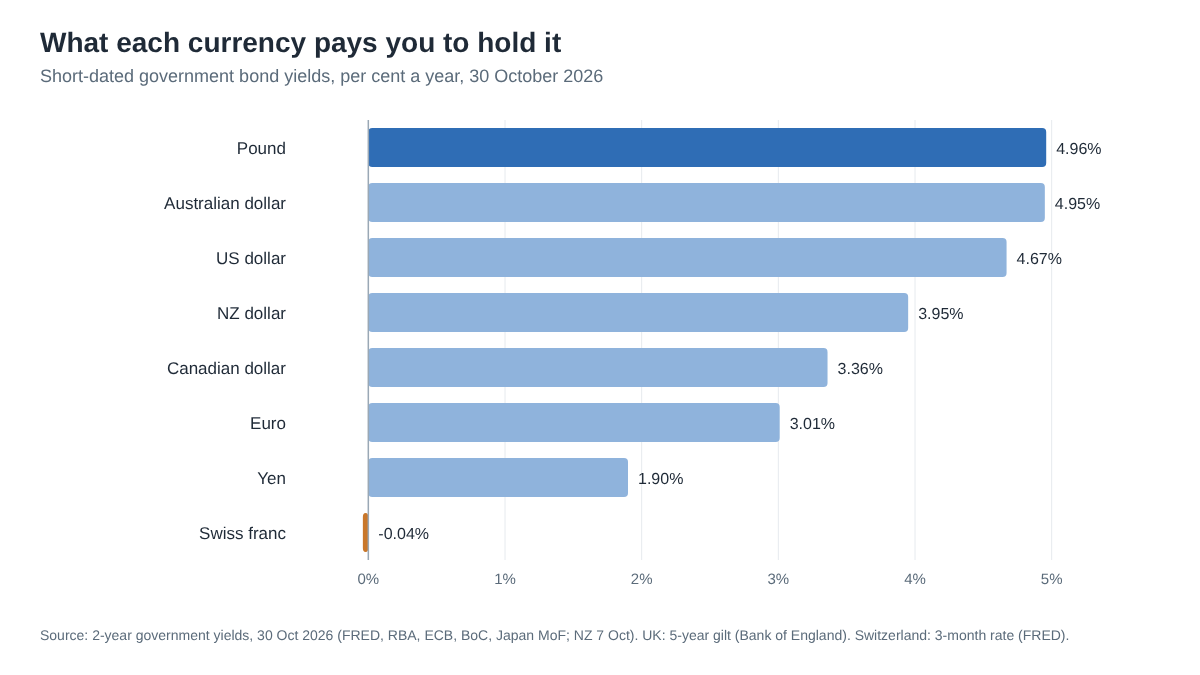
What the exchange rate has done
The franc has fallen about 3% against a basket of currencies since June and in September touched its weakest level against the euro in 17 months. A pound bought CHF 1.048 on 18 May 2026, the low point of the year, and CHF 1.105 on 31 October, close to the six-month high of CHF 1.109 set on 1 October. Swiss inflation is creeping up, to 1.0% in September, the highest since 2024, which is the one Swiss number that could bring a rate rise forward.
The dates that could change the picture are close together: Swiss inflation for October on 3 November, the Bank of England's rate decision on 5 November, and the SNB's next assessment on 10 December. A fresh scare in the Gulf would also matter, because the franc tends to jump when the world is frightened, as it did in March.
What it means for a British household
Holiday money first: £100 bought about CHF 105 in May and buys about CHF 110 now, which takes a little of the sting out of a famously expensive country for anyone heading to the Alps this winter. StreetOwl's Holiday money board on the Travel tab shows what £100 buys in francs each day. On the shopping side, Britain imports Swiss medicines, watches, coffee machines and chocolate; a weaker franc makes those a few per cent cheaper to bring in, though retailers pass such savings on slowly if at all.
Sources
- Swiss National Bank, monetary policy assessment of September 2026: summary of discussion, 22 October 2026
- SWI swissinfo.ch, SNB holds rate at zero and eases intervention threat, 24 September 2026
- SWI swissinfo.ch, SNB continued franc sales in second quarter, 30 September 2026
- Trading Economics, Swiss trade surplus smallest since 2022 (September data), 20 October 2026
- Trading Economics, Swiss inflation September 2026, 1 October 2026
- Wise, GBP to CHF exchange rate history, 31 October 2026
- Finance Calendar, SNB rate decision 10 December 2026
- Bloomberg, SNB judged franc threat no longer needed as haven flows ebbed, 22 October 2026
This piece was researched with AI from the public sources named and written up and checked by Michael Rossi before it went up. It explains why a currency moves; it is not advice to buy or sell any currency and is not financial advice.
← Back to StreetOwl