Why the Swiss franc, the world's safe harbour, has had its worst year against the dollar since 2015, and why Swiss inflation may be about to end it
The franc pays almost no interest and the dollar pays about 4.6%, so money has been borrowed in francs and parked in dollars all year and the franc fell 9%; Swiss inflation has now jumped to 1.5%, the Swiss central bank has stopped wanting a weak franc, and the interest-rate gap that paid for the whole arrangement has started to close.
A safe currency that lost a year to the dollar
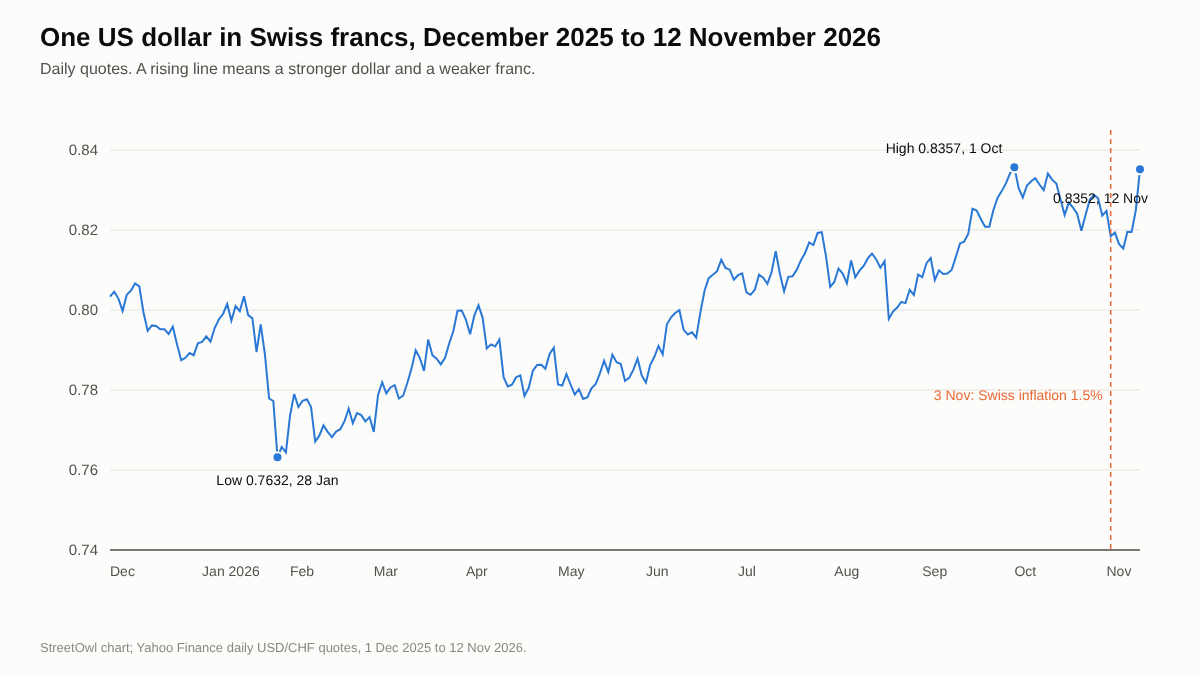
A dollar bought CHF 0.8352 at the close on 12 November 2026. That is a hair below the year's high of 0.8357, set on 1 October, and 9% above the low of 0.7632 on 28 January. The franc, the currency people buy when they are frightened, has spent 2026 losing to the dollar in a year with a Gulf war, an oil shock and a 6% fall in the Nasdaq in a single day.
The reason is the plainest mechanism in foreign exchange, and it has just started to run backwards.
The machine: borrow cheap, lend dear
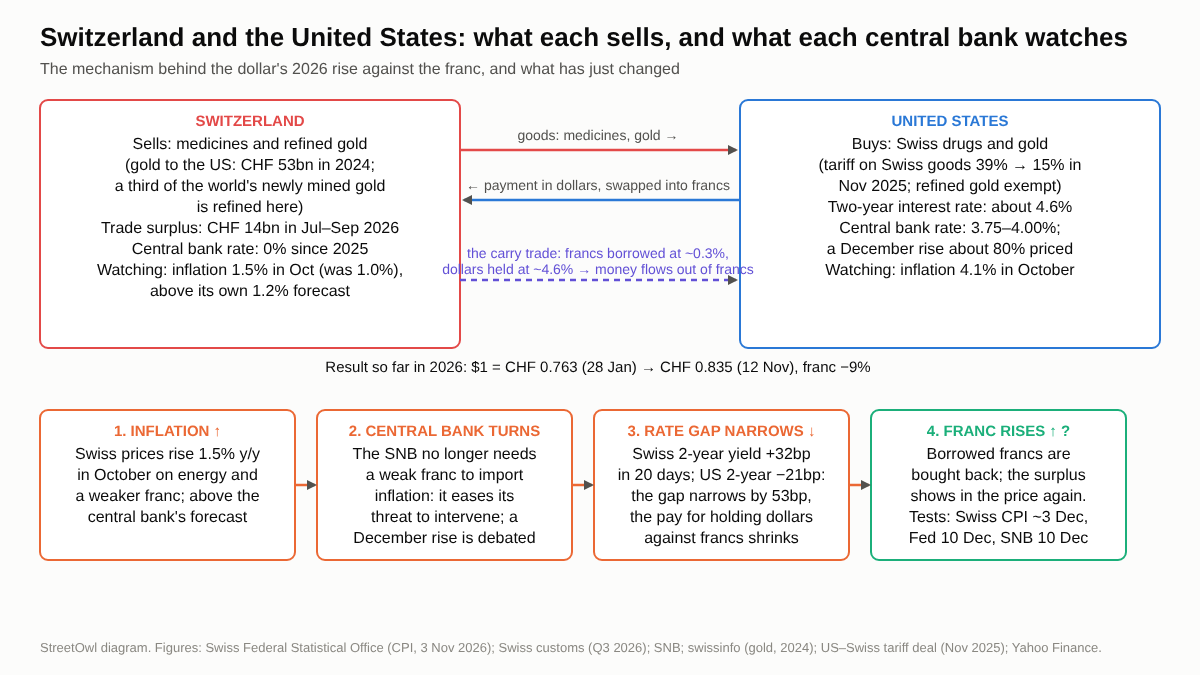
Switzerland's two-year interest rate is about 0.3%; America's is about 4.6%. Borrow francs, hold dollars, and you are paid roughly 4.3 percentage points a year for doing nothing, as long as the exchange rate does not move against you. With the Swiss National Bank's rate at zero since 2025 and Swiss inflation close to nothing, the franc became the currency the world borrowed in, and the SNB was content: a softer franc was the cheapest way to import a little inflation into a country that had too little of it.
Underneath sits a persistent Swiss trade surplus, CHF 14bn in the third quarter of 2026. Switzerland sells America medicines and refined gold: its refineries handle about a third of the world's newly mined gold, and sent roughly CHF 53bn of it to the United States in 2024, which is why Washington's 39% tariff of August 2025 was cut to 15% in November with refined gold left out. A surplus means foreigners must keep buying francs to pay for Swiss goods. The only reason that did not show in the price this year is that the borrowing flow ran the other way, with the central bank's blessing.
What changed on 3 November
Swiss consumer prices rose 1.5% in the year to October, up from 1.0% in September, higher than every forecast in the Bloomberg survey and above the SNB's own 1.2% projection for the fourth quarter. The cause is energy (heating oil, petrol and diesel) plus the weaker franc itself, which makes imports dearer; core inflation, without energy, is still 0.5%.
Two things followed. The franc jumped to a five-month high against the euro, and the SNB, which had been threatening to lean against franc strength, stopped threatening: a currency that was importing inflation is now welcome to rise. Markets began to price a possible rate rise at the SNB's meeting on 10 December, though Bloomberg Economics still expects no move until late 2027. In the twenty days to 12 November the Swiss two-year yield rose by about 0.32 percentage points while the American one fell by about 0.21: a narrowing of more than half a point in the gap that pays for holding dollars against francs. When that pay shrinks, borrowed francs get bought back.
The dollar's side of the ledger
The dollar's strength this autumn is a Federal Reserve story. After a hot American inflation reading for October (4.1%), markets put the chance of a Fed rate rise on 10 December at about 80%, and the dollar index touched its 2026 high on 11 November. American producer prices for October are published on 13 November, the last big release before the Fed meets.
The dates that decide the next leg are therefore close together: Swiss consumer prices for November around 3 December, the Fed on 9–10 December and the SNB on 10 December. If the SNB raises rates or drops the word "temporary" from its description of the inflation rise, the premise of borrowing in francs is gone for 2027; if Swiss inflation falls back below 1.2% and the Fed raises with a promise of more, the old arrangement runs on.
What it means for a British household
A pound bought CHF 1.106 on 12 November 2026, up from 1.053 a year earlier and near the top of its 2026 range of 1.032 (2 March) to 1.108 (1 October). A ski week in Switzerland costs about 5% less in francs than last season, and StreetOwl's Holiday money board on the Travel tab shows what £100 buys. The mechanism above says this is close to as good as it gets: a Swiss rate rise in December would take two or three per cent off it. Swiss imports, from watches and medicines to coffee capsules, are priced the same way.
Sources
- swissinfo.ch / Bloomberg, 3 November 2026 — Swiss inflation accelerates to highest in almost three years
- investinglive, November 2026 — SNB watches for second-round Swiss inflation effects as December rate hike bets build
- Tradingpedia, 4 November 2026 — Stronger inflation spurs hawkish SNB, firmer franc
- FXStreet, 11 November 2026 — Swiss franc slides nearly 1% as US dollar hits fresh yearly high
- Trading Economics, November 2026 — Switzerland balance of trade (Swiss customs figures)
- swissinfo.ch, 17 November 2025 — US tariff negotiations reaffirm Switzerland's role as a gold hub
- CPA, 12 November 2026 — UK business news today (markets, Fed pricing)
- Yahoo Finance, daily USD/CHF and GBP/USD quotes to 12 November 2026
This piece was drafted by AI from the public sources named, then read and approved by Michael Rossi before it went up. It explains why a currency moves; it is not advice to buy or sell any currency and is not financial advice.
← Back to StreetOwl